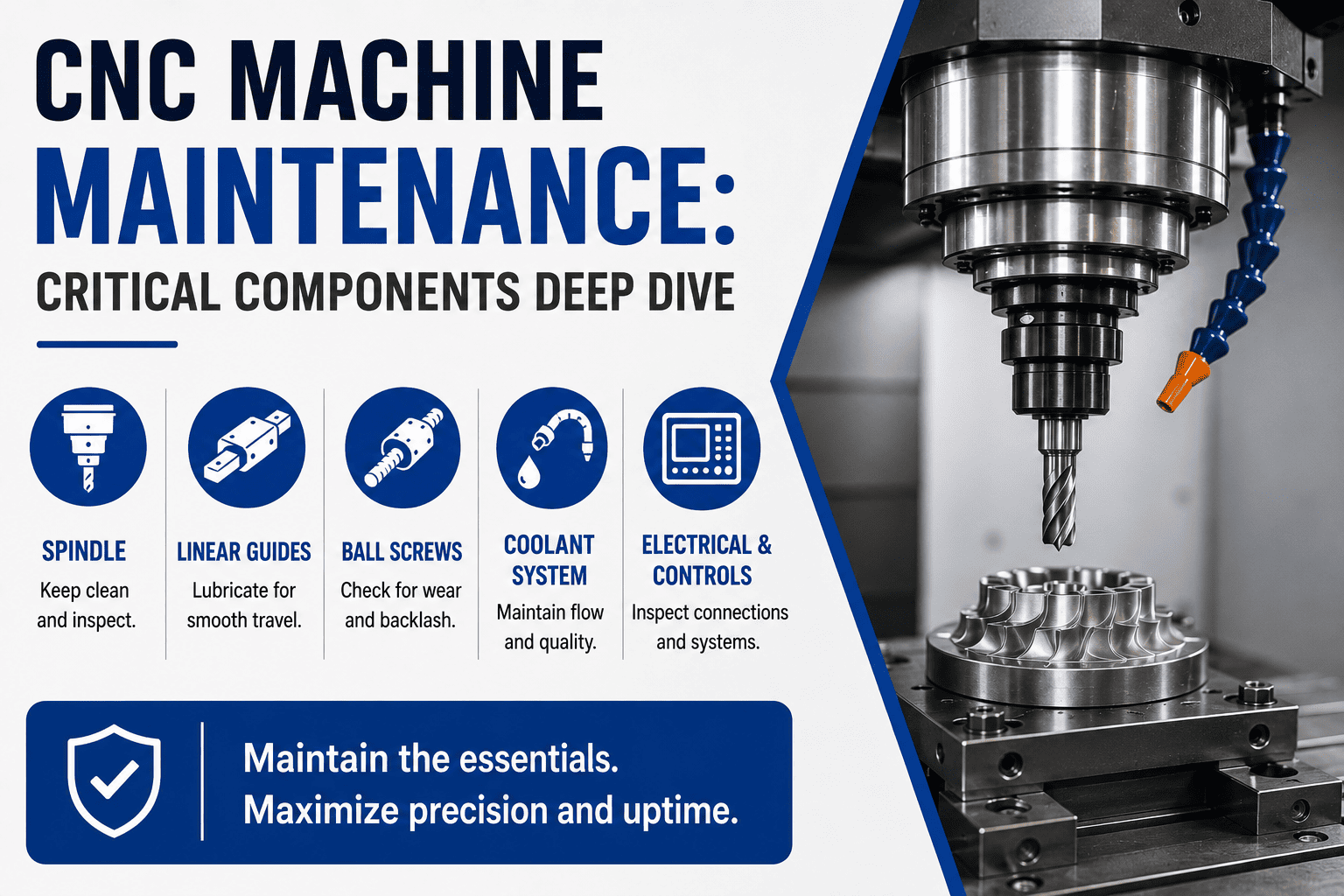
A modern CNC machining center has more than 20 distinct maintenance touchpoints — miss even a handful, and the machine ages prematurely, loses positioning accuracy, and eventually crashes. This CNC machine maintenance deep dive goes beyond the basic checklist, giving technicians and reliability engineers a component-by-component guide to ballscrews, linear ways, coolant systems, way lube, and control systems. Standardizing these critical maintenance routes inside an AI-powered CMMS like OxMaint turns reactive firefighting into predictable, data-driven uptime — you can Start Free Trial today or read on to see how each component impacts your bottom line.
CNC MAINTENANCE DEEP DIVE
What if you could cut unplanned CNC downtime by 40% with precision component care?
Over 70% of CNC machine failures trace back to just five subsystems: way lubrication, ballscrews, coolant, chip evacuation, and tool changers. Master the maintenance on these critical components, and you keep your machining centers in spec and out of the crash log.
COMPONENT BREAKDOWN
CNC Critical Components: What Fails and Why It Matters
A machining center is only as reliable as its weakest subsystem. Here is a deep dive into the five CNC maintenance components that drive the majority of precision loss, unplanned downtime, and repair costs.
Linear Ways and Guideways
Linear guides carry extreme dynamic loads. When way lube flow drops or chips contaminate the way covers, friction spikes and guideway surfaces score. Proper CNC ways maintenance requires checking lube flow rates weekly, inspecting wipers for tears, and verifying rail straightness annually with a laser interferometer. A single scored linear guide can cost $4,000–$8,000 to replace — plus 24 hours of lost production.
Ballscrews and Thrust Bearings
Ballscrew backlash is the silent killer of CNC precision. CNC ballscrew maintenance involves measuring backlash every 500 hours, lubricating the ball nut via the auto-lube circuit, and checking for thermal growth on the thrust bearings. If backlash exceeds 0.015mm, you risk scrapped parts and poor surface finish. Ignoring it leads to a $6,000–$15,000 ballscrew replacement.
Coolant Systems
CNC coolant maintenance goes far beyond topping off the tank. Improper concentration (outside the 8–10% range) causes rust, bacterial growth, and tool wear. You must check refractometer readings daily, clean the paper filters weekly, and dump-and-refill the sump every 90 days. Neglected coolant ruins spindle bearings and voids machine warranties.
Chip Evacuation & Conveyors
Chip conveyors are out of sight, but when they fail, coolant floods the shop floor. Inspect conveyor chain tension monthly, clear metal packing from the drive sprockets, and flush the fines tank quarterly. A jammed auger can back up chips into the way covers, accelerating linear guide wear by up to 300%.
Tool Changers & Magazine
Tool changer crashes account for nearly 15% of major CNC collisions. Cam followers, gripper arms, and turret indexing mechanisms need greasing every 1,000 hours. Furthermore, tool pocket alignment should be verified using a dial indicator every six months to ensure the ATC seats tools within 0.002mm runout.
Control Systems & Encoders
Modern CNC control systems rely on clean, stable power and precise feedback loops. Dust buildup on encoder scales causes false positioning errors. Blow out electrical cabinets monthly with dry, filtered air, verify battery backup voltages, and check the HVAC unit on the cabinet to ensure internal temperatures stay below 40°C (104°F) to prevent thermal drift.
PM SCHEDULE
CNC Preventive Maintenance Schedule by Interval
CNC reliability hinges on hitting the right maintenance task at the right hour. Use this interval-based CNC maintenance guide to structure your preventive maintenance (PM) routes.
| Interval | Critical Component | Maintenance Task | Expected Outcome |
|---|---|---|---|
| Daily | Way Lube & Coolant | Check lube reservoir levels, verify coolant concentration via refractometer, drain air from the lube lines. | Prevent dry starts; maintain tool life and surface finish. |
| Weekly | Chip Evacuation & Spindle | Clean way covers and wipers, inspect chip conveyor for metal packing, grease spindle taper. | Prevent contaminant ingress into linear guides; maintain taper accuracy. |
| Monthly | Coolant & Tool Changer | Clean coolant filters, verify ATC arm positioning, check way lube metering output (cc/min). | Sustain coolant chemistry; prevent dropped tools and ATC crashes. |
| Quarterly | Ballscrews & Geometry | Measure ballscrew backlash, test geometric alignment (ball bar test), inspect electrical cabinet filters. | Catch precision drift early; maintain part tolerance compliance. |
| Bi-Annually | Hydraulics & Control | Change hydraulic fluid, replace way wipers, verify encoder scale cleanliness, test UPS batteries. | Prevent catastrophic seal failures and data loss in the CNC control. |
MAINTENANCE WORKFLOW
From Reactive to Predictive: The 4-Step CNC Maintenance Guide
Transitioning a 180-asset plant from reactive firefighting to predictive CNC machine care requires a structured workflow. Here is how high-performing reliability teams standardize their approach.
Digitize PM Checklists
Replace paper logs with digital CNC preventive maintenance checklists mapped to each component. A 180-asset plant spending $42K/yr on paperwork and lost data can eliminate manual entry errors instantly. Track completion rates and force photo verification on critical tasks like way wiper inspections.
Trigger Work Orders Automatically
Configure maintenance triggers based on spindle hours, cycle counts, or calendar intervals. When a CNC machine hits 500 hours of spindle-on time, the CMMS should automatically generate a ballscrew backlash measurement work order and assign it to the right technician with the required spare parts attached.
Track Spare Parts Inventory
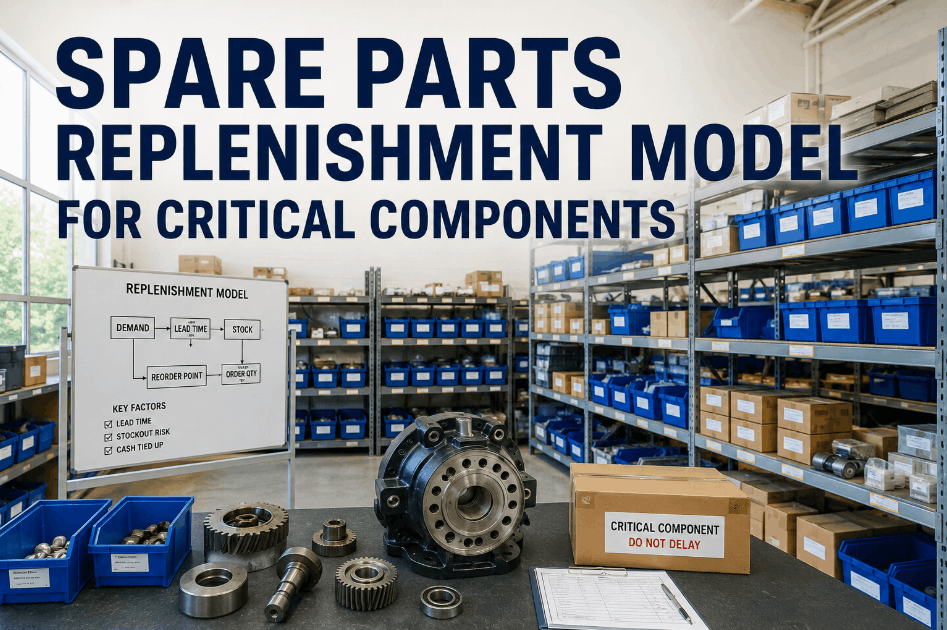
Link critical components to spare parts minimums. When a way lube pump fails, the system should instantly show if you have a replacement in stock, its bin location, and automatically reorder if below the safety stock. Downtime waiting on parts drops from days to hours.
Analyze Failure Patterns (PdM)
Feed historical work order data and vibration/temperature sensor readings into analytics dashboards. Predictive algorithms can flag a ballscrew thrust bearing that is trending toward failure weeks before it affects part quality, allowing you to schedule repairs during planned changeovers rather than mid-shift breakdowns.
STOP REACTING TO CRASHES
See OxMaint on your CNC assets — book a 30-min demo
Discover how AI-powered PM routes, automated work orders, and spare-parts tracking eliminate the spreadsheet chaos that costs your plant thousands in CNC downtime.
SOLUTION FIT
How OxMaint Powers Your CNC Machine Care Strategy
OxMaint is an AI-powered CMMS and Enterprise Asset Management (EAM) platform built to execute the exact component-level maintenance strategies detailed above. Here is how it maps to your CNC reliability goals.
Automated PM Work Orders
Generate spindle-hour and cycle-count based work orders for ballscrew and way lube maintenance automatically. Eliminate missed intervals and cut unplanned downtime by 30–50%.
Predictive Analytics
Leverage AI to analyze vibration and temperature data from linear guides and spindles. Predict failures before they hit the crash log, saving an average of $50K per avoided catastrophic event.
Spare Parts Tracking
Attach BOMs and min/max stock levels to every CNC asset. Auto-reorder wipers, seals, and bearings so your maintenance team never waits 3 days for a $15 part while the machine sits idle.
Digital Audit Trails
Replace paper logs with ISO 55000-compliant digital records. Every component inspection, torque value, and refractometer reading is time-stamped and technician-attributed for instant audit readiness.
REAL-WORLD IMPACT
The ROI of Structured CNC Maintenance
"By moving our CNC way lube and ballscrew PMs into OxMaint, we caught a thrust bearing failure 3 weeks before it would have crashed the spindle. That single alert paid for the software for the next two years."
FAQ
CNC Machine Maintenance FAQs
What are the most critical components in CNC machine maintenance?
The most critical components are linear ways and guideways, ballscrews and thrust bearings, coolant systems, chip conveyors, and tool changers. These five subsystems account for over 70% of unplanned CNC downtime. Prioritizing them in your preventive maintenance schedule drastically improves machining center reliability. You can map these to digital PM routes when you Start Free Trial.
How often should CNC way lube and coolant be checked?
CNC way lube reservoir levels and coolant concentration should be checked daily via visual inspection and a refractometer. Way lube metering valves should be verified monthly to ensure the correct cc/min output, while coolant should be dumped and refilled every 90 days to prevent bacterial growth and poor surface finishes.
What is the cost of ignoring CNC ballscrew maintenance?
Ignoring ballscrew maintenance leads to backlash exceeding 0.015mm, resulting in scrapped parts, poor surface finishes, and eventual bearing seizure. A replacement ballscrew assembly costs between $6,000 and $15,000, plus 24–48 hours of lost production. Regular backlash measurement every 500 spindle hours prevents this.
How does a CMMS improve CNC preventive maintenance?
A CMMS improves CNC maintenance by automatically triggering work orders based on spindle run-hours or calendar intervals, tracking spare parts inventory, and digitizing inspection checklists. This eliminates missed PMs and paper errors. To see how it works on your machines, Book a Demo with our team.
Can predictive maintenance work on older CNC machines?
Yes, predictive maintenance works on older CNC machines by retrofitting IoT sensors (vibration, temperature) onto critical components like spindle bearings and ballscrews. The data is fed into a CMMS like OxMaint, which uses AI to establish baseline behavior and alert technicians to anomalies before a catastrophic failure occurs.
READY TO UPGRADE?
Transform Your CNC Maintenance Strategy Today
Join the reliability teams using OxMaint to automate work orders, predict failures, and keep their machining centers in spec. Get up and running in days, not months.
Free 14-day trial · No credit card