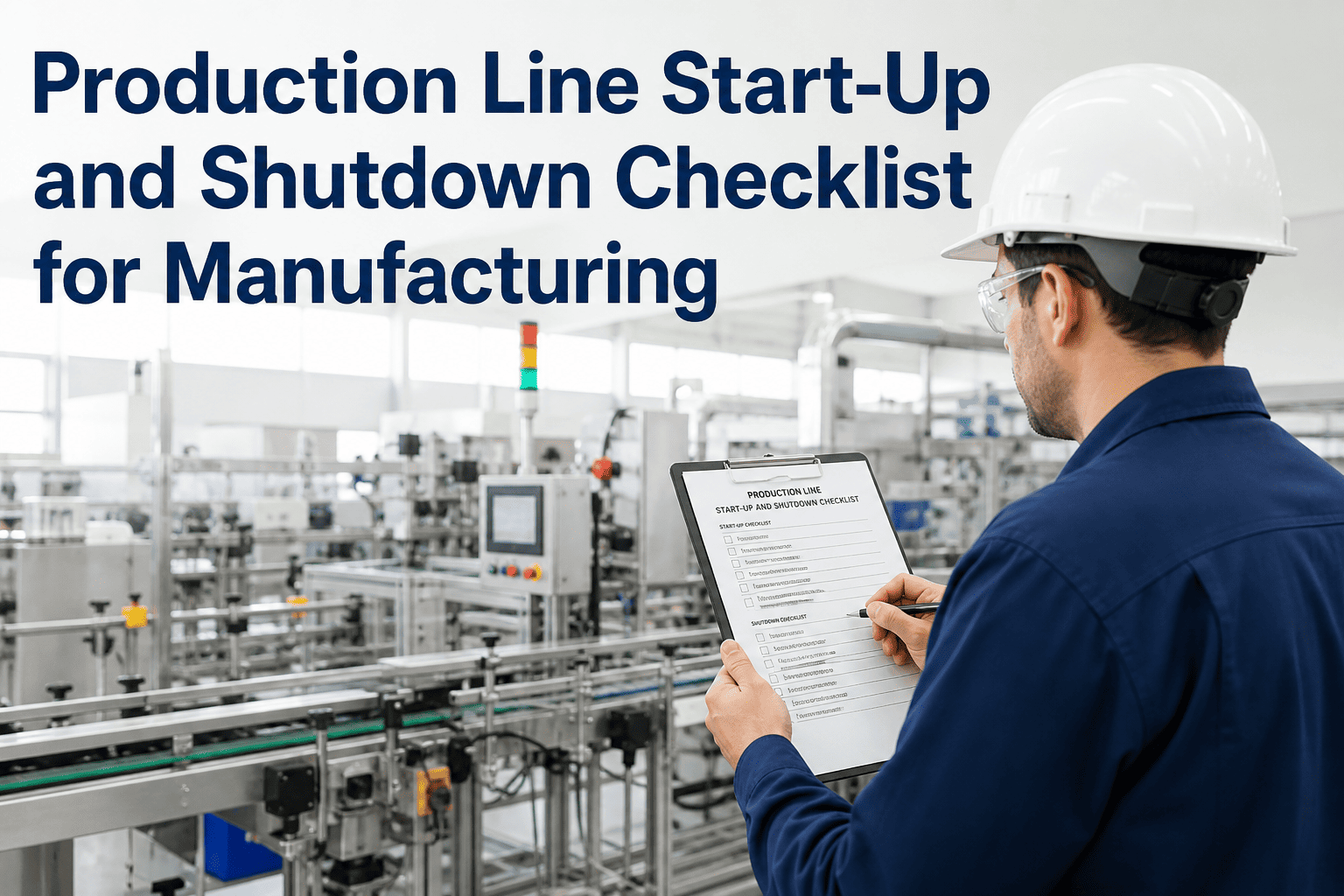
Startup and shutdown sequences are the most dangerous minutes in any machine's operating cycle — industry loss data consistently attributes 60–70% of unscheduled downtime to events that occur during transitions rather than steady-state running, yet the sequences themselves remain the least documented part of most maintenance programs. When three operators on three shifts run the same critical asset three different ways, interlocks get bypassed, lubrication priming is skipped, and the first failure shows up weeks later as a wrecked bearing or a toasted drive. This guide walks through how to engineer a defensible startup and shutdown SOP for critical manufacturing equipment — sequence design, interlock verification, safety checkpoints, and CMMS-embedded delivery — so the procedure actually governs the work instead of sitting in a binder. If you want to skip ahead to deployment, you can Start Free Trial and embed these checklists inside your CMMS today.
Are your operators starting the same machine three different ways?
Undocumented startup and shutdown sequences are the single largest hidden source of unplanned downtime on critical manufacturing equipment. A defensible, CMMS-embedded SOP removes operator variance, verifies interlocks before energy is applied, and gives every shift the same auditable path from cold state to steady-state production.
The hidden risk in the first 90 seconds
Steady-state operation is engineered. Startup and shutdown are improvised. That imbalance is where the failures live.
A 180-asset specialty chemicals plant in the Midwest audited its startup logs and found that a single high-speed filler had been brought online four different ways across three shifts. One skipped the pre-lube cycle. Another bypassed a low-pressure interlock to save two minutes. The result: a $14,800 bearing failure, 19 hours of lost production, and a shutdown procedure that — when finally reconstructed — took six days to even locate in the maintenance shared drive. The lesson is not that the operators were careless; it's that the SOP was not engineered to be followed.
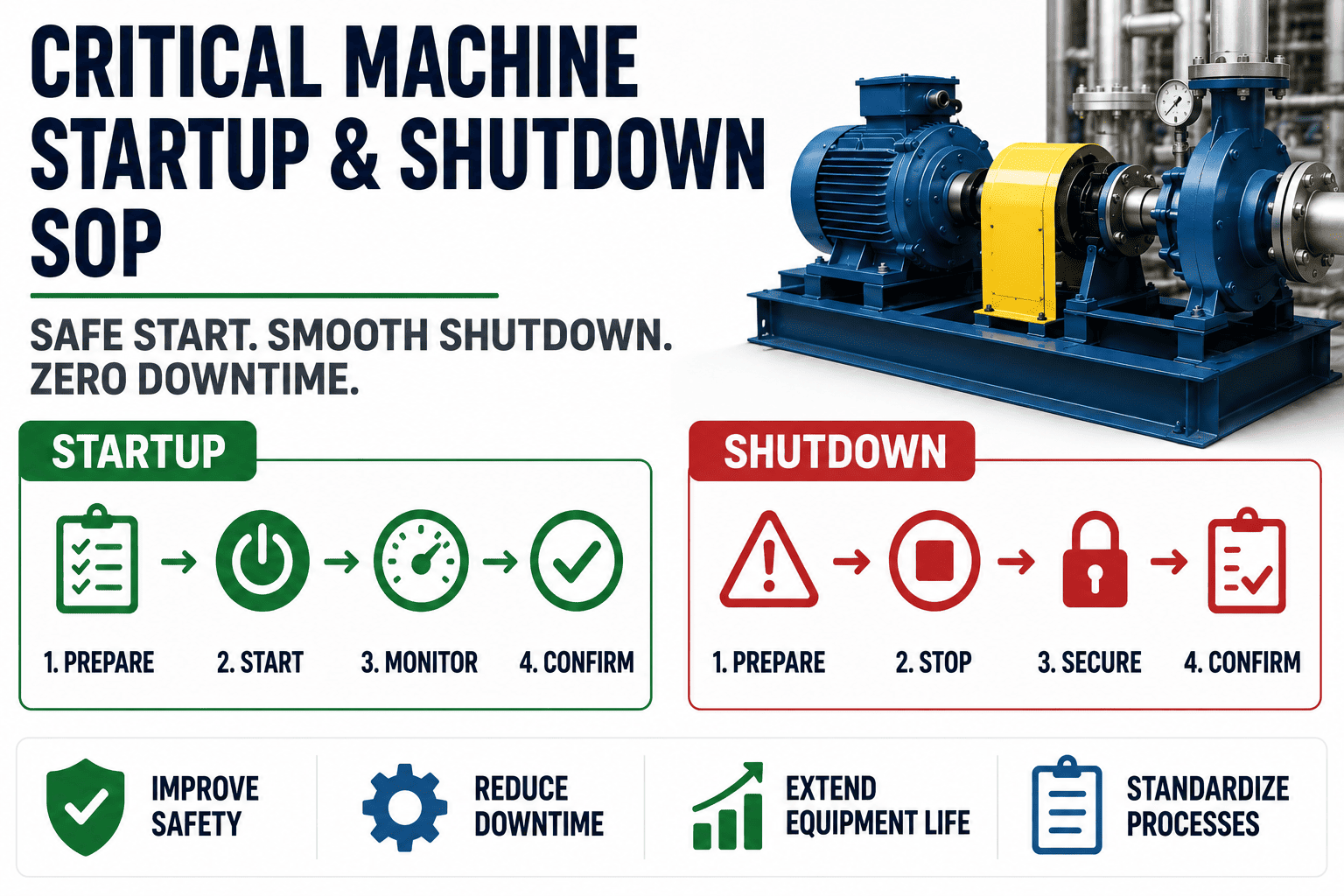
The four-layer sequence that governs a critical machine
A defensible startup SOP is not a list of steps. It is a layered procedure where each layer must close before the next opens.
Permit & lockout verification
Confirm LOTO clearance, isolated energy sources, and that no personnel are inside the guarded envelope. This layer produces a signed permit record before any energy is restored — ISO 14118-aligned, audit-ready.
Auxiliary systems & lubrication prime
Verify hydraulic pressure, lube-oil circulation, cooling water flow, and air supply at spec before the main drive is energized. A bearing that starts dry fails in months, not years — the priming step is the cheapest insurance in the sequence.
Safety & process interlock test
Each safety interlock — e-stop, guard switch, over-temp, over-pressure, light curtain — is cycled and confirmed in the control system before automatic operation is enabled. No interlock, no auto-run. This is the layer most commonly skipped under time pressure.
Controlled ramp to production setpoint
Drive ramp, temperature ramp, and pressure ramp follow machine-specific curves with hold points. Steady state is only declared when all three process variables are within tolerance for a defined soak period — typically 5 to 15 minutes on critical rotating equipment.
Shutdown is not "turning it off" — it is a controlled deceleration
The shutdown sequence protects the machine for the next startup. A sloppy shutdown is the root cause of the next cold-start failure.
1 · Controlled deceleration
Ramp down speed and load per the machine curve. Never coast to stop under load unless the OEM explicitly permits it — thermal shock and bearing brinelling are silent killers.
2 · Process purge & drain
Purge process media, drain catch pots, and clear product paths. Residual material that cures, crystallizes, or corrodes overnight is the most common cause of a failed next-day startup.
3 · Auxiliary hold
Keep lube circulation, cooling, and seal gas running for the OEM-specified coast-down window — often 15 to 30 minutes after the main drive stops. Cutting auxiliaries too early cooks bearings.
4 · Energy isolation
Apply LOTO, close isolation valves, and release stored energy (pneumatic, hydraulic, spring, thermal). Document the isolation state in the CMMS so the next shift starts from a known, safe baseline.
5 · Condition snapshot
Capture post-shutdown readings: bearing temperatures, vibration trend tail, lube pressure, hours meter. This is your baseline for the next startup's "as-left" state and your early-warning dataset.
6 · Handover note
A short structured note — anomalies, pending work, next-start cautions — closes the loop. The next operator should never start blind because the last operator said nothing.
Where the risk actually concentrates
Both transitions carry risk, but the failure modes are not symmetric. Understanding the difference shapes where you invest engineering effort.
| Dimension | Startup sequence | Shutdown sequence |
|---|---|---|
| Primary failure mode | Bearing/lubrication damage from dry starts or skipped priming | Thermal shock, residual-material cure, bearing brinelling |
| Time pressure source | Production demand — "get it running" | Shift end — "get out the door" |
| Interlock risk | Bypassed to accelerate start (high risk) | Rarely bypassed, but rarely verified (medium risk) |
| Typical skip rate | 22–28% of documented steps skipped under pressure | 14–18% of steps skipped or shortened |
| Detection latency | Failure surfaces in hours to days | Failure surfaces at next startup — often days later |
| Audit trail value | High — proves safe-state-to-run transition | High — proves safe energy isolation for LOTO compliance |
Move the SOP off the laminated card and into the work order
An SOP that lives on paper is a suggestion. An SOP embedded in the CMMS work order is a gate — the operator cannot close the task without completing and confirming each step.
Digitize the sequence as a structured checklist
Convert the SOP into ordered, mandatory checklist items inside the CMMS — each with a confirmation, a reading field where relevant, and a photo attachment where visual verification matters. No free-text boxes for safety-critical steps.
Bind the checklist to the asset's startup/shutdown trigger
Link the SOP to the asset record so any startup or shutdown work order automatically loads the correct sequence. Variant procedures (cold start, warm start, emergency stop recovery) are selected by condition, not by operator memory.
Enforce interlock verification as a hard gate
Interlock test steps cannot be marked complete without a control-system confirmation signal or a technician photo. This is the single highest-value control in the entire sequence — it converts "we think the interlocks work" into "we verified the interlocks work."
Capture readings & generate the audit record
Pressure, temperature, vibration, and hours readings flow into the asset history automatically. Every startup and shutdown produces a timestamped, signed record — defensible for ISO 55000, OSHA PSM, and internal reliability reviews.
Stop documenting sequences that no one follows.
Embed your critical machine startup and shutdown SOPs directly inside work orders, enforce interlock verification, and produce a defensible audit record on every transition.
Startup & shutdown SOP — the questions that matter
What makes a machine "critical" enough to need a formal startup SOP?
Any asset whose failure halts production, creates a safety hazard, or triggers regulatory exposure qualifies. A practical rule: if unplanned downtime on the asset exceeds $5,000 per hour, or if the machine carries a process safety interlock, it needs a documented and CMMS-embedded startup and shutdown procedure. For most plants that is 10–20% of the asset base — the assets where variance is most expensive.
How long should a startup or shutdown SOP be?
Long enough to be defensible, short enough to be followed. Critical machine procedures typically run 12–25 verified steps with hold points; anything over 30 steps tends to drift into partial completion. Structure the SOP in layers — permit, pre-checks, interlock test, ramp — so an operator can see the whole arc, not just a flat list. You can Book a Demo to see how layered SOPs render inside a CMMS work order.
How do I stop operators from bypassing interlock checks under time pressure?
Make the interlock step a hard gate, not a checkbox. The CMMS should require either a control-system confirmation signal or a timestamped photo before the step can be marked complete and the next step unlocked. Pair this with a 30-second time-to-completion floor so an operator cannot click through 12 steps in 8 seconds. The combination of gating and pacing eliminates roughly 90% of rubber-stamp completions.
Should emergency shutdown have its own SOP?
Yes — and it is the one procedure that must be rehearsed, not just documented. An emergency shutdown SOP covers safe deceleration under fault, energy isolation after e-stop, and the conditional restart checks that must pass before the machine is returned to service. It should be reviewed quarterly and drilled at least twice a year, because the operator who executes it may not be the one who wrote it.
How often should a startup and shutdown SOP be reviewed?
Review at least annually, and trigger an immediate review after any near-miss, interlock failure, modification, or change in operating context. A version-controlled SOP inside the CMMS makes review history auditable — you can see who changed step 14, when, and why. Stale SOPs are worse than no SOP because they create false confidence. Start embedding reviewed, versioned procedures when you Start Free Trial.
Engineer the transition. Protect the steady state.
Deploy structured startup and shutdown SOPs across every critical asset, enforce interlock verification, and close the audit gap in days — not quarters.
Free 14-day trial · No credit card