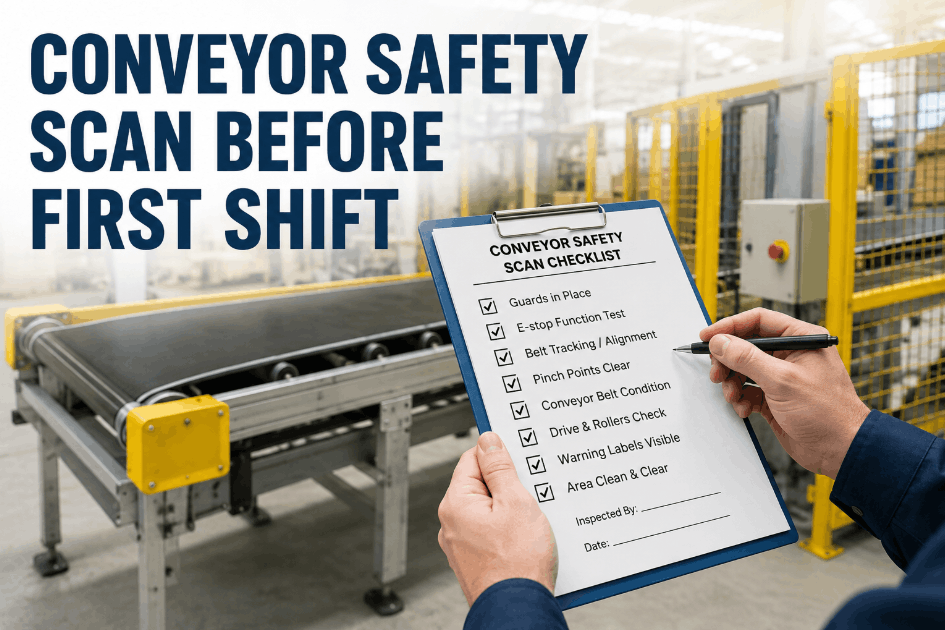
Conveyor safety failures at shift startup are among the most preventable causes of operator injury and unplanned line downtime in manufacturing — not because maintenance teams ignore conveyors, but because pre-shift checks are performed informally, undocumented, and inconsistently across operators and shifts. When belt misalignment, missing guards, or non-functional E-stops go undetected at startup, the line runs until a hazard becomes an incident. The structural gap is predictable: no standardized first-shift scan, no documented sign-off before production begins, no visibility into which conveyor sections were checked and by whom. This checklist helps maintenance teams, line supervisors, and safety leads confirm that every conveyor zone is verified before operators are exposed to moving equipment. Sign Up Free on Oxmaint to digitize conveyor pre-shift inspections, capture guard and E-stop verification with timestamped sign-offs, and give supervisors real-time startup readiness visibility across every production line. From belt tracking to pinch point clearance, an unstructured startup check is one of the most correctable gaps in line safety. Book a Demo to see how Oxmaint connects pre-shift inspection results to work order generation, safety audit logs, and operator accountability records — so every shift starts with a verified, documented safety baseline rather than an assumed one. Use this checklist before first shift to confirm that conveyor guards, E-stops, belt alignment, and pinch point clearances are checked, recorded, and cleared for production start.
1. Machine Guarding Verification
Guards are the first line of defense against conveyor contact injuries. Before startup, confirm that every guard is in position, undamaged, and secured — not assumed to be in place because it was present at the end of the previous shift.
2. Emergency Stop Function Testing
E-stops that are present but non-functional provide no protection. First-shift startup must include an active function test of every E-stop along the conveyor run — not a visual check that the button exists.
3. Belt Tracking and Alignment Checks
Belt misalignment at startup causes edge wear, spillage, and structural damage within a single shift. Confirm that belt tracking is within tolerance before production load is applied — not after the first jam or spillage event stops the line.
4. Pinch Point and Clearance Verification
Pinch point hazards on conveyors are often created by maintenance activity, product buildup, or equipment shifts that occur between shifts. Confirm that all identified pinch zones are clear and that no new hazard conditions have developed since the previous production run.
5. Operator Readiness and Startup Authorization
A completed safety scan only prevents incidents if the authorization process ensures the line cannot start until all checks are cleared. Confirm that startup authorization is a formal, documented step — not an assumed clearance once the inspection is done.