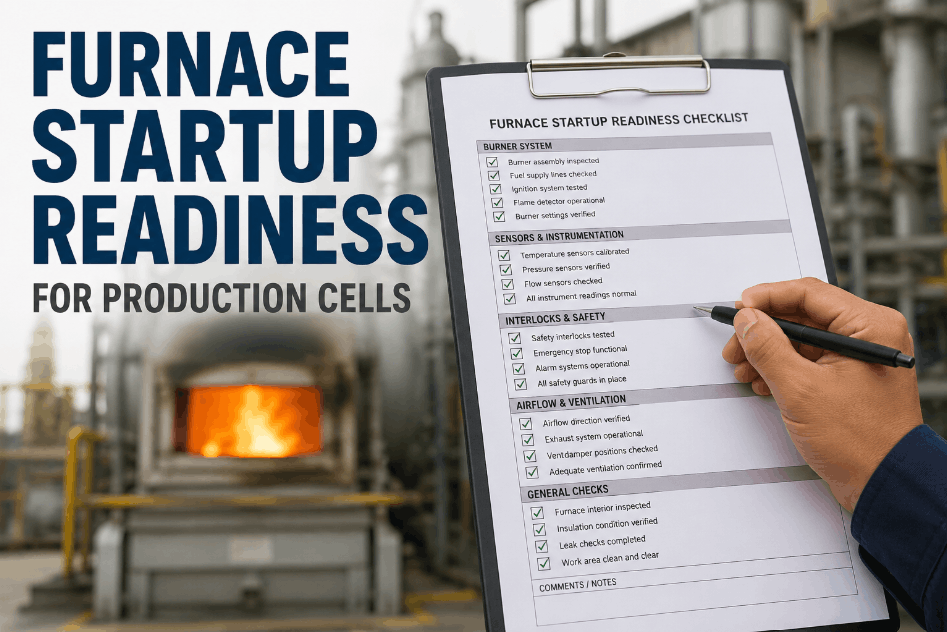
Furnace startup failures in production environments rarely happen without warning — they happen when warning signs are not checked before the burner is lit. Unverified interlock states, uncalibrated sensors, or blocked airflow paths at startup create thermal process deviations that damage product, trip safety systems mid-cycle, and in the worst cases create combustion hazards that production teams are not positioned to respond to without prior preparation. The gap is structural: furnace startup sequences are often performed from memory by experienced operators, with no documented pre-start checklist, no formal verification that interlocks are functional, and no record that the startup was completed correctly before the first production cycle began. This checklist helps process engineers, maintenance leads, and plant supervisors confirm that burner settings, temperature sensors, safety interlocks, and combustion airflow are verified before every production cell startup. Sign Up Free on Oxmaint to digitize furnace pre-start inspections, capture interlock and sensor verification with operator sign-offs, and give process supervisors startup readiness visibility across all thermal assets on a single platform. From burner pressure settings to atmosphere control verification, an undocumented furnace startup is one of the most correctable thermal process risks in industrial operations. Book a Demo to see how Oxmaint connects furnace startup checklist completion to production authorization, work order generation for failed checks, and compliance record keeping for thermal process equipment — so every furnace startup is controlled, repeatable, and defensibly documented. Use this checklist before every production cell startup to confirm that all furnace systems are verified and the thermal cycle begins from a known, safe baseline.
1. Burner System and Combustion Setting Verification
Burner settings that drift between shutdowns create thermal deviation from the first ignition cycle. Confirm that fuel pressure, air-to-fuel ratio, and pilot flame condition are verified against target parameters before the main burner is energized.
2. Temperature Sensor and Control System Verification
A furnace running on a failed or drifted temperature sensor produces thermal profiles that are invisible to the control system and the operator. Confirm that all zone sensors are reading correctly and that the control system is responding to setpoint commands before production parts enter the furnace.
3. Safety Interlock and Limit Switch Confirmation
Furnace interlocks that are present but not verified at startup create the appearance of protection without the substance. Confirm that every safety interlock and limit switch is functional before the heating cycle begins — not after a process exceedance demonstrates that the protection did not activate.
4. Combustion Airflow and Atmosphere Control Checks
Airflow imbalance and atmosphere deviations at startup create thermal non-uniformity that affects product quality from the first cycle. Confirm that combustion air delivery and, where applicable, controlled atmosphere gas flows are verified before the furnace is loaded.
5. Pre-Production Authorization and Soak Confirmation
A furnace at setpoint temperature is not always a furnace ready for production. Confirm that the thermal soak period is complete, temperature uniformity across all zones is within tolerance, and production authorization is formally documented before the first part enters the load zone.
-inspection-checklist-for-industrial-facilities.png)