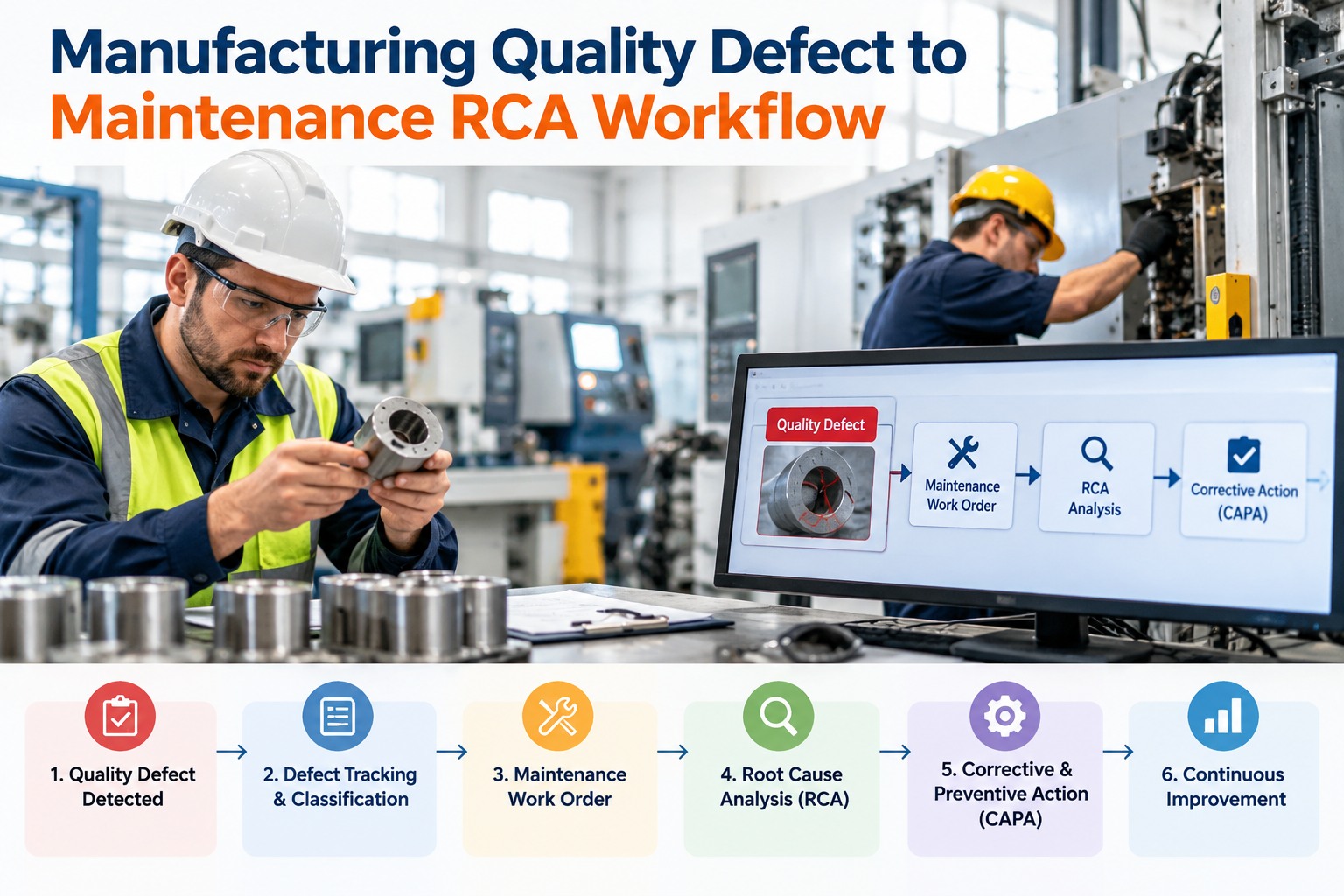
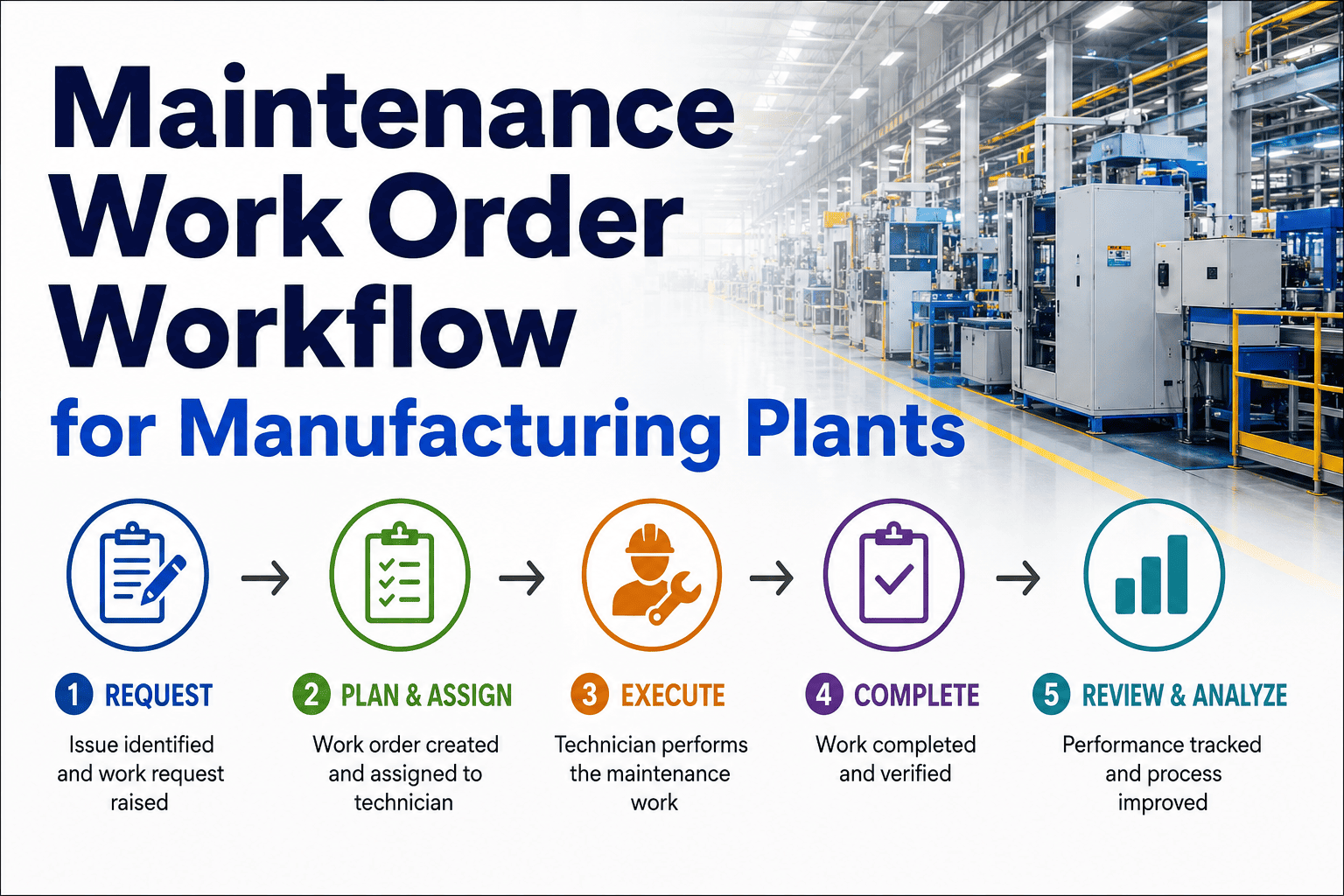
A defect found at 9 a.m. should not have to wait until the next shift to be fixed yet on paper, that is exactly what happens. The inspection catches the problem, the note sits in a binder, and no one escalates it until it fails for real. OXMAINT AI is the AI-powered maintenance management software that turns every failed inspection into a tracked, escalated and verified work order — automatically.
Digital Inspection · Defect Tracking · Escalation · 2026
Digital Inspection Software That Tracks, Escalates and Closes Every Defect
A clipboard catches the defect — then loses it. OXMAINT AI, the AI-powered CMMS and digital inspection software, runs the whole loop on one platform: a failed checklist item becomes a logged defect, the defect gets an owner and a clock, severity rules escalate it on their own, and a corrective work order opens the instant it is flagged. A problem turns into a verified fix in minutes, not shifts.
1Flag
→
2Track
→
3Escalate
→
4Verify
DEFECT #4821CRITICAL
Asset · Pump P-204 · Line 3
Seal leak flagged on shift inspection · photo attached
Flagged09:04
Escalated to supervisor09:05
Work order assignednow
Corrective action verified—
~60%
of failed manufacturing audits trace to missing or incomplete records
25–40%
higher error rate for manual inspections vs digital workflows
10–20%
of sales revenue lost to poor quality — scrap, rework, returns, warranty
~$28B
projected inspection-management software market by 2033
Where Defects Quietly Disappear
Most teams do not have an inspection problem — they have a follow-through problem. The defect gets spotted. What breaks is everything that is supposed to happen after. Here is where a finding slips through the cracks on a manual process, and why "we inspect regularly" is not the same as "nothing falls through."
Logged, never escalated
A defect gets written down, then waits for someone to notice. No owner, no due date, no clock — so nothing forces it to move.
Escalation by shoulder-tap
Whether a critical defect jumps the queue depends on who the inspector happens to run into on the way back to the office.
No proof it was verified
The repair happens, probably. But nothing records whether the fix actually held — so the same fault returns, and no one sees the pattern.
Two shifts from action
On paper, a flagged defect has to physically travel from the floor to the office before anyone can act — giving a small fault days to grow.
Fixing this is not about inspecting more. It is about what the software does the moment a defect is flagged. Sign up free and give every defect an owner and a clock in OxMaint.
The Defect Lifecycle: From Flag to Verified Fix
A defect is only "handled" when the loop is closed — found, routed, fixed, and confirmed. OxMaint runs all six stages on one connected record, so nothing has to be re-typed and nothing gets lost between the clipboard and the work order.
01
Failed Inspection
A checklist item fails. The inspector marks it a defect at the point of inspection, with a photo — not a note for later.
→
02
Defect Captured
Asset ID, location, severity and image attach to one record automatically — no end-of-shift transcription.
→
03
Tracked
The defect gets a status, an owner and a due date. It is now visible on a live list, not buried in a binder.
→
04
Escalated by Priority
Severity and time rules route it — critical defects jump the queue, and overdue ones climb to a supervisor on their own.
→
05
Work Order Raised
A corrective work order opens automatically, pre-filled with the defect's asset, photo, history and priority.
→
06
Verified & Closed
The technician closes it with evidence, an effectiveness check confirms the fix held, and the trail is kept for audit.
Every stage writes to the same record, so an auditor can trace a finding from the flagged item all the way to its verified repair in one view. Book a demo to see the full defect loop running live in OxMaint.
Escalation: Severity Sets the Clock
A fixed queue answers "what gets fixed first?" by timestamp. That is the wrong question. OxMaint answers it by consequence — every defect carries a severity, and severity sets both the first action and how fast an unactioned defect climbs to the next level. Here is how the four tiers behave.
CRITICAL
Missing guard · gas or steam leak · brake past limit
First actionInstant work order + supervisor alert
ResponseImmediate
If overdueClimbs to plant manager
HIGH
Bearing temp rising · recurring minor fault · worn part near limit
First actionSame-shift corrective work order
ResponseHours
If overdueClimbs to maintenance lead
MEDIUM
Minor leak · belt wear within tolerance · noise change
First actionScheduled corrective work order
ResponseDays
If overdueFlagged to the planner
LOW
Cosmetic wear · non-functional blemish · housekeeping
First actionLogged and batched
ResponseRoutine cadence
If overdueReviewed at next PM
You set these rules once, per asset class, and the software enforces them on every defect without anyone chasing a list. Start free and set escalation rules for your own assets in OxMaint.
A Defect You Logged but Never Closed Is Just a Breakdown With a Head Start.
The point of digital inspection is not more findings — it is fewer surprises. OxMaint turns each flagged defect into a tracked, escalated, verified work order, so your team spends its hours fixing what matters instead of hunting a paper trail.
Paper Tracking vs Connected Digital Tracking
The gap is not in the inspection itself — it is in what the defect can do after it is written down. Here is the same defect, handled two ways.
The paper trail usually exists — it is the corrective loop that is broken. Book a demo to compare your current defect flow side by side in OxMaint.
How OxMaint Runs the Whole Loop
Inspection, tracking, escalation and corrective action are not four tools — they are one workflow. OxMaint is built so a defect never leaves that workflow until it is verified and closed.
Mobile Inspection Management
Run checklists on a phone; a failed item becomes a defect at the point of inspection, with the photo attached.
Automatic Defect-to-Work-Order
Every flagged defect raises a corrective work order with asset, location and severity already filled in.
Severity-Based Escalation Rules
Set the clock per priority. Critical and overdue defects climb to the right person on their own.
Technician Assignment & Mobile
Work orders route to the right crew with the defect context attached, and move forward right from the floor.
Corrective-Action Verification
Close-out needs evidence, and a scheduled effectiveness check confirms the fix actually held.
Audit-Ready Traceability
Every defect links back to its inspection and forward to its fix — one chain of custody, pulled in seconds.
You add the action layer on top of the inspections you already run — not a second system to maintain. Sign up free and connect your first inspections to work orders in OxMaint.
Reviewed by OxMaint Maintenance Operations
This page was reviewed for accuracy against current CMMS practice for inspection management, defect escalation and corrective-action verification. Figures reflect published 2024–2026 industry research on digital inspection, audit performance and quality cost.
Frequently Asked Questions
What is digital inspection software for defect tracking?
It replaces paper checklists with mobile inspections where a failed item becomes a tracked defect — with a photo, a severity and an owner — instead of a note that waits in a binder.
How does defect escalation actually work?
You set rules by severity and time. A critical defect raises a work order and alerts a supervisor at once; a defect left past its due date climbs to the next level on its own — no shoulder-tap required.
Does a flagged defect really become a work order on its own?
How does it prove a corrective action worked?
Close-out requires evidence, and an effectiveness check can be scheduled 30, 60 or 90 days later — so a fix is verified against recurrence, not just assumed complete.
Which teams and industries is it for?
Any team that inspects assets — manufacturing, facilities, power, food, fleet and healthcare — anywhere a defect needs to be caught, routed and verified.
Stop Losing Defects Between the Clipboard and the Fix.
Put every inspection, defect and corrective action on one connected platform with OXMAINT AI — point-of-inspection defect capture, severity-ranked escalation that routes itself, work orders that open the instant a defect is flagged, and a verified trail ready for any audit. Catch the failures before your line does.