Manufacturing plant shutdowns are among the most expensive and high-stakes events a facility faces each year. Industry research consistently shows that over 80% of turnarounds exceed their budget by more than 10%, and nearly half result in significant schedule delays — not because the work is too complex, but because planning started too late or scope was not controlled. An unplanned production outage costs three to five times more than a structured shutdown. The difference between a turnaround that drains capital and one that delivers real reliability gains comes down entirely to what happens in the 8 to 12 weeks before the shutdown window opens. This checklist covers all five phases of a manufacturing plant shutdown — scope definition, pre-shutdown preparation, execution, safety management, and restart verification — with every task structured for the turnaround manager who needs a single source of accountability. Start your free Oxmaint trial to manage your shutdown scope, work orders, contractor coordination, and restart sign-off in one platform.
Turnaround Management · Scope Control · LOTO & Confined Space · Restart Verification
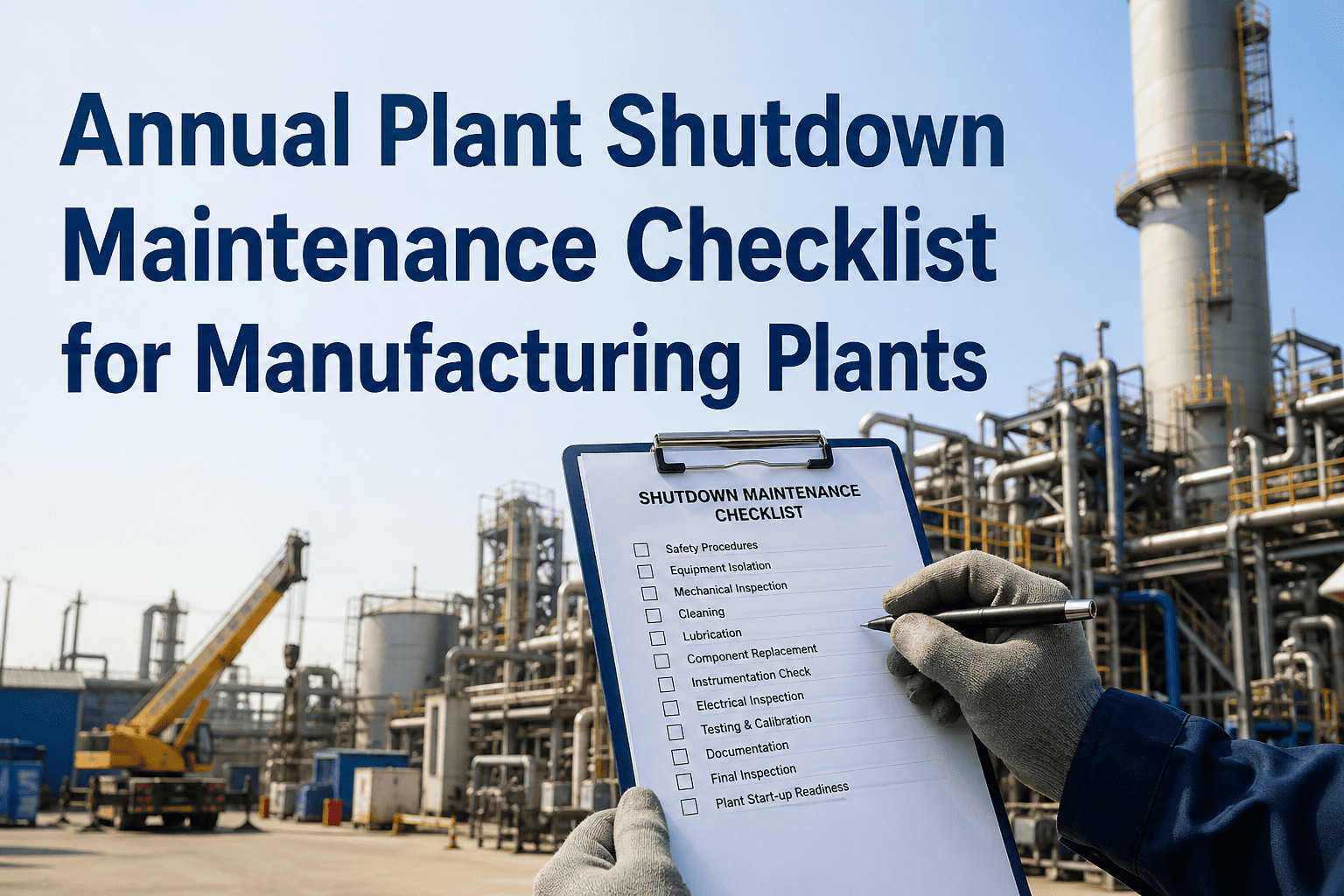
Annual Plant Shutdown Maintenance Checklist
Five-phase shutdown framework — from scope definition and contractor mobilisation to execution control and restart verification — for manufacturing turnarounds that finish on time and within budget.
80%
Of turnarounds exceed budget by 10%+ (industry average)
3–5×
More expensive — unplanned outage vs. structured shutdown
8–12 wks
Minimum planning lead time for a structured plant turnaround
30%
Less execution time — top performers vs. industry average (planning quality, not team size)
Shutdown Phases
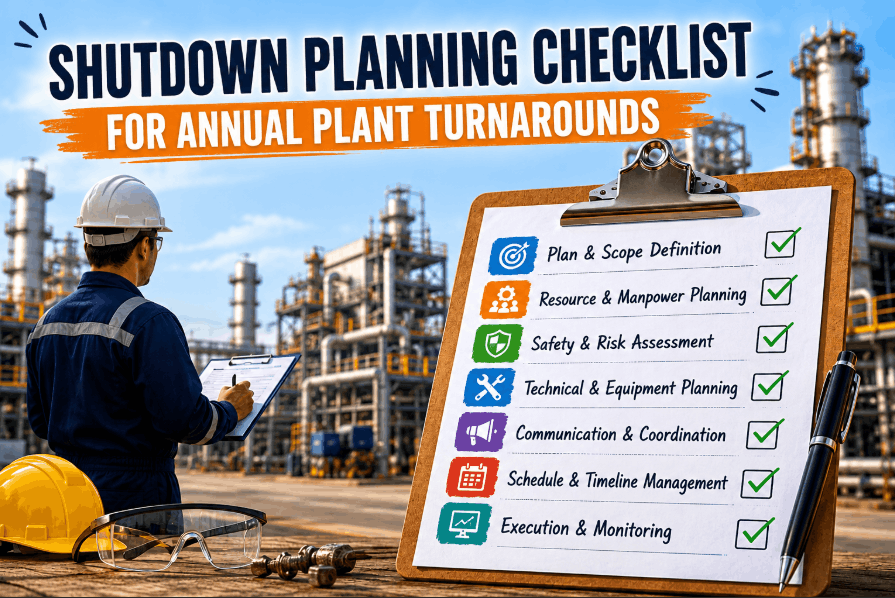
The Five Phases of a Structured Plant Turnaround
1
Scope & Planning
8–12 weeks before
2
Pre-Shutdown Prep
2–4 weeks before
3
Safety & LOTO
Day 1 execution
4
Execution & Control
During shutdown window
5
Restart & Handover
Final 24–48 hours
Oxmaint's Shutdown Planning module centralises your scope register, work packages, contractor assignments, and restart sign-off — so every task has a named owner, a deadline, and a completion record before the shutdown window closes.
This phase is where turnarounds are won or lost. Plants that begin planning fewer than 8 weeks out consistently overrun because there is insufficient time to procure long-lead parts, confirm contractors, and build work packages with enough detail to control execution.
Team & Governance
Turnaround Manager appointed with full decision authority and single-point accountability for scope, schedule, budget, and safety outcomes
Owner: Plant Manager · Deadline: Week -12
Core team formed with documented roles — planning lead, scheduling coordinator, safety officer, procurement lead, and operations liaison with named individuals
Owner: Turnaround Manager · Deadline: Week -12
SMART shutdown objectives defined — specific KPIs for on-time restart, budget adherence, and reliability targets for the next 12 to 36 months post-startup
Owner: Turnaround Manager + Plant Management · Deadline: Week -11
Scope Development & Freeze
All proposed work items collected from maintenance, operations, engineering, regulatory, and capital projects — every item captured in a central scope register
Owner: Planning Lead · Deadline: Week -10
Risk-based work selection applied — every task challenged: Does this require a shutdown? Can it be deferred? Can it be done during normal operations without a process stop?
Owner: Planning Lead + Operations · Deadline: Week -9
Scope frozen at defined cutoff date with formal change control procedure — any scope addition after freeze requires a written request with cost and schedule impact sign-off
Owner: Turnaround Manager · Deadline: Week -8 (non-negotiable)
Long-lead spare parts identified and purchase orders placed — specialty valves, motors, custom fabrications, and OEM parts with lead times exceeding 4 weeks ordered immediately after scope freeze
Owner: Procurement Lead · Deadline: Week -8 immediately after scope freeze
Work Package Development
Complete work packages built for every scope item — including job steps, labour estimates, materials list, tools required, PPE requirements, and associated safety permits
Owner: Planning Lead · Deadline: Week -6
Critical path schedule built and shared with all team leads — identify the single sequence of tasks that determines overall shutdown duration; protect critical path tasks from scope addition
Owner: Scheduling Coordinator · Deadline: Week -6
Contractors pre-qualified, contracted, and briefed — contractors arriving without facility-specific LOTO procedures and confined space protocols are the leading cause of Day 1 delays
Owner: Turnaround Manager + Safety Officer · Deadline: Week -6
Materials, Parts & Staging
All parts received and verified against work package bills of materials — zero missing items accepted; outstanding items escalated to procurement for expedited delivery before shutdown start
Owner: Procurement Lead + Stores · Deadline: 5 days before shutdown
Materials kitted by work package and staged at designated laydown areas — technicians must not lose execution time searching for parts during the shutdown window
Owner: Stores / Warehouse Lead · Deadline: 3 days before shutdown
Special tools and lifting equipment confirmed available — crane permits, rigging inspection certificates, and calibration records for test equipment all verified before Day 1
Owner: Planning Lead · Deadline: 5 days before shutdown
Safety Pre-Shutdown Preparation
Confined space entry permits prepared — vessel entry permits require atmosphere testing for oxygen, flammable gases, and toxins before and during every entry; trained attendants and rescue equipment positioned
Owner: Safety Officer · Deadline: Before each entry event
LOTO isolation point registers prepared for all equipment in scope — each equipment entry in the register must include energy type, isolation device location, and verification method
Owner: Safety Officer + Maintenance Lead · Deadline: 1 week before shutdown
Pre-shutdown safety briefing scheduled for all crews — all personnel briefed on hazards, emergency procedures, LOTO requirements, and communication protocols before any work begins
Owner: Safety Officer · Deadline: Day before shutdown start
No work begins until isolation is verified. The most common source of serious injury during shutdowns is premature work commencement before energy isolation is confirmed. Every energy type — electrical, hydraulic, pneumatic, thermal, and chemical — requires documented isolation with physical verification.
Electrical
- Breakers opened and locked in off position with individual padlocks
- Zero energy verified with calibrated voltage tester at point of work
- Lock and tag applied by each authorised worker on multi-energy equipment
Pneumatic / Hydraulic
- Supply valves closed, locked, and residual pressure bled to zero
- Pressure gauges at zero confirmed before any line break or fitting removal
- Hydraulic accumulators depressurised and locked out per OEM procedure
Thermal / Process
- Steam lines isolated with double-block-and-bleed or spectacle blind
- Equipment cooled to safe working temperature before entry or pipe break
- Chemical flush and neutral wash completed before confined space entry
Documentation
- Every isolation point signed off on the LOTO register before crew mobilisation
- Permit to Work issued for each work package — countersigned by Safety Officer
- Isolation register retained on site and available for inspection throughout shutdown
Daily Execution Rhythm
Daily critical path review conducted each morning — compare actual progress to plan; any task running behind on the critical path triggers same-day corrective action, not next-day escalation
Owner: Turnaround Manager + Scheduling Coordinator · Cadence: Daily 07:00
Work order completion status updated in real time — every completed task signed off with technician name, date, and as-found / as-left condition documented in the work order record
Owner: All Technicians and Leads · Cadence: Continuous during shift
Scope change register reviewed daily — any new work discovered during execution evaluated for criticality, cost impact, and schedule impact before approval; approved changes added to work order system immediately
Owner: Turnaround Manager · Cadence: Daily end-of-shift review
Quality & Inspection Gates
Inspection hold points observed — all statutory inspections (pressure vessel re-certification, safety valve testing, NDT of weld repairs) completed before equipment is closed up or reinstated
Owner: Inspection Lead + Safety Officer · At each defined hold point
As-found conditions documented for all opened equipment — deviations from expected condition (wear measurements, corrosion thickness, clearance readings) captured for reliability analysis and future shutdown scope planning
Owner: Maintenance Technicians · At equipment opening
Contractor work quality verified before sign-off — all contractor work packages require a plant engineer or maintenance lead witness signature before the work order is closed and the area released
Owner: Maintenance Lead / Plant Engineer · At task completion
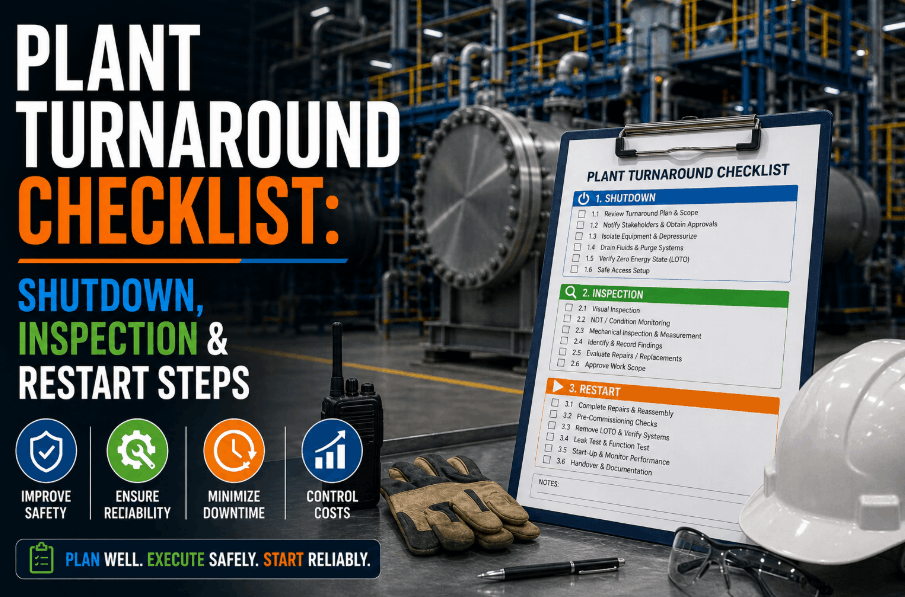
Restart is where a well-executed shutdown can still fail. A rushed re-energisation with open work orders, unreinstated isolations, or untested safety systems creates exactly the incident the shutdown was meant to prevent. Every item below must be completed and signed before first energy is reintroduced.
LOTO Removal Verification
- All workers confirmed out of area before any isolation is removed
- LOTO removal authorised in reverse order of application — last lock applied is first removed
- Isolation register signed off as fully reinstated by Safety Officer before first energy introduction
- Confined space entry permits formally closed and countersigned
Equipment Reinstatement Checks
- All guards, covers, and access panels reinstated and fastened — foreign object detection walkthrough completed before energisation
- All instrumentation reconnected and calibrated — sensor readings verified against reference instruments at first startup
- Lubrication completed on all equipment opened during shutdown — correct lubricant grade confirmed per PM specification
- Safety relief valves reinstated, tagged, and function-tested before pressure is reintroduced
Sequential Restart & Sign-Off
- Sequential startup procedure followed — utilities first, then process equipment, then production; no step skipped under schedule pressure
- First-start parameters logged and compared to pre-shutdown baseline — unexpected readings trigger hold before full production load is applied
- Plant handover sign-off completed by Turnaround Manager and Operations Manager — production does not start without dual signature
- Post-shutdown debrief scheduled within 5 days — lessons captured feed directly into the next shutdown scope and planning process
Quick Reference
Shutdown Phase Timeline & Key Milestones
| Phase |
Key Milestone |
Timing |
Owner |
| Scope & Planning |
Turnaround Manager appointed; scope register open |
Week -12 |
Plant Management |
| Scope & Planning |
Scope frozen; change control procedure active |
Week -8 |
Turnaround Manager |
| Scope & Planning |
Long-lead parts ordered; contractors pre-qualified |
Week -8 |
Procurement Lead |
| Scope & Planning |
All work packages complete with job steps and materials |
Week -6 |
Planning Lead |
| Pre-Shutdown Prep |
All parts received and kitted at staging areas |
5 days before |
Procurement + Stores |
| Pre-Shutdown Prep |
LOTO registers and confined space permits prepared |
1 week before |
Safety Officer |
| Pre-Shutdown Prep |
Pre-shutdown safety briefing completed |
Day before |
Safety Officer |
| Safety / LOTO |
All isolations verified and LOTO register signed off |
Day 1 before work starts |
Safety Officer |
| Execution |
Daily critical path review and scope change control |
Each day of shutdown |
Turnaround Manager |
| Restart |
LOTO removed, reinstatement verified, sequential startup |
Final 24–48 hrs |
Safety Officer + Ops Manager |
| Handover |
Plant handover dual signature and debrief scheduled |
Restart day |
Turnaround Manager + Ops |
FAQs
Frequently Asked Questions
How far in advance should annual shutdown planning begin?
A minimum of 8 weeks is required for a structured turnaround — 12 weeks for complex multi-contractor shutdowns. Plants that start planning fewer than 8 weeks out consistently overrun because there is insufficient time to source long-lead parts, qualify contractors, and build work packages with the level of detail that prevents execution delays.
What is scope freeze and why is it the most important milestone in shutdown planning?
Scope freeze is the cutoff date after which no new work can be added without a formal change order. Scope creep — adding work after planning is complete — is the single largest driver of schedule overrun and budget excess in plant shutdowns. After scope freeze, any addition must show a cost estimate and schedule impact before the Turnaround Manager approves it.
What records must be retained from a plant shutdown for compliance purposes?
LOTO permits, confined space entry forms, work order completion records, contractor quality sign-offs, statutory inspection certificates, and safety meeting attendance records must all be retained. These records demonstrate compliance during regulatory audits and provide the institutional knowledge that reduces planning time on future shutdowns.
How does Oxmaint support turnaround management and scope control?
Oxmaint centralises the shutdown scope register, work order assignment, contractor briefing documentation, progress tracking, and restart sign-off in one platform. Real-time visibility into execution progress enables same-day decisions that prevent small delays from becoming multi-day overruns — without paper-based handoffs between departments.
What is the most common cause of restart delays after a plant shutdown?
Incomplete reinstatement — safety guards not replaced, instrumentation not reconnected, or LOTO removal not formally completed — causes the majority of restart delays. A structured reinstatement sign-off process with a named individual responsible for each zone eliminates this. The sequential startup procedure must also be followed in full, not compressed under schedule pressure.
Plan Your Next Shutdown to Finish On Time, On Budget, Zero Incidents.
Oxmaint's Shutdown Planning module gives your turnaround team a single platform — scope register, work packages, contractor coordination, real-time progress tracking, and restart sign-off — all with the audit trail your safety and compliance programme requires.