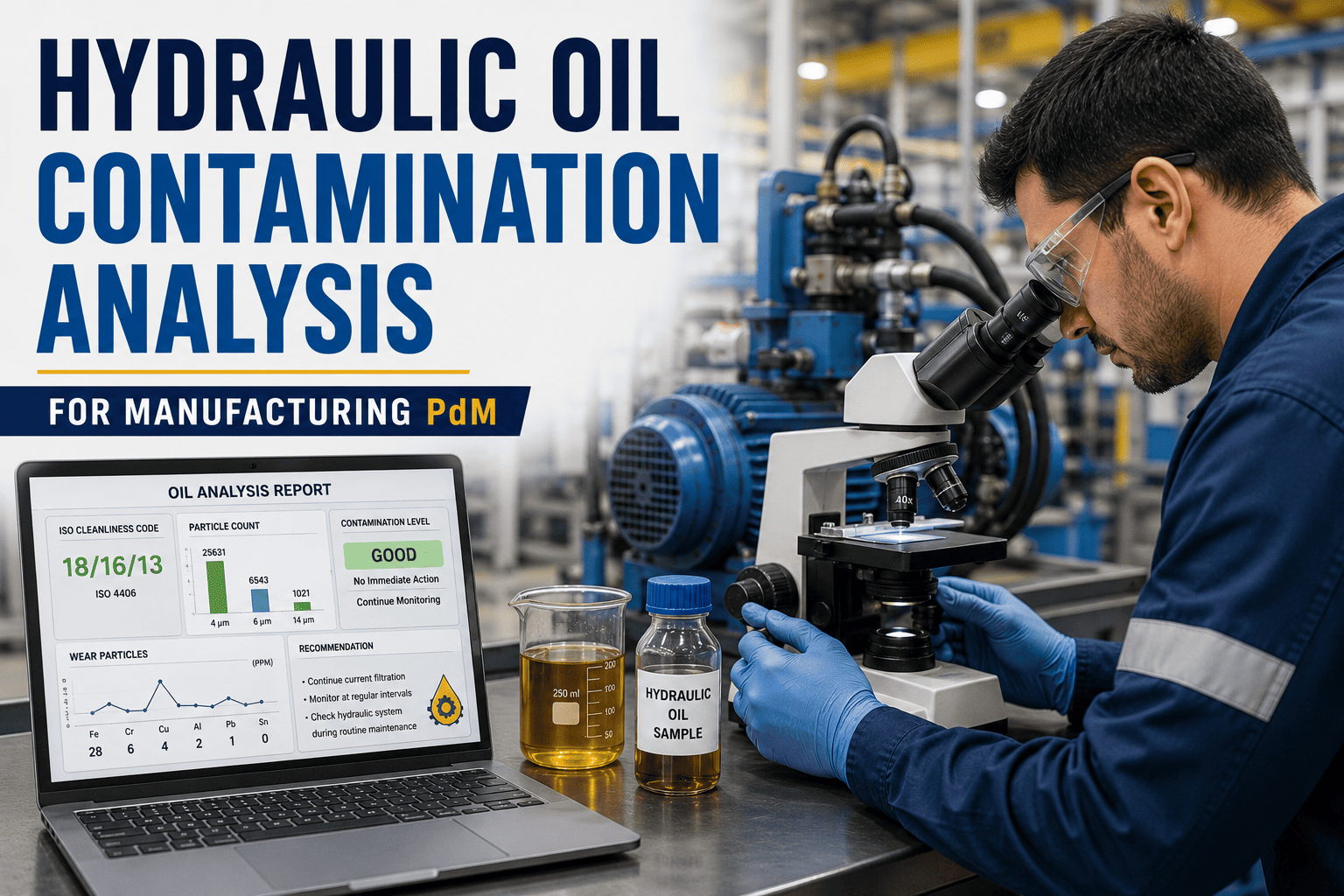
Hydraulic oil contamination drives 70–80% of hydraulic system failures in manufacturing plants, and the cost of ignoring it shows up as blown seals, scored cylinder rods, and stalled production lines long before a CMMS work order is ever generated. ISO 4406 cleanliness codes give maintenance teams a common language for sizing and counting the particles that quietly destroy pumps, valves, and actuators — but only if you sample correctly, test consistently, and route the results into a predictive maintenance workflow. This guide breaks down particle counting, patch testing, target cleanliness by application, and how to schedule oil sample tracking inside your CMMS so a $25 lab report prevents a $25,000 rebuild. Ready to operationalize it? Start Free Trial and build your first oil-analysis route this week.
Is your hydraulic oil quietly destroying your most expensive assets?
Three out of four hydraulic failures trace back to contamination — and most plants only find out after a pump grenades mid-cycle. ISO 4406 analysis turns invisible wear debris into a number you can trend, alarm, and act on.
What a dirty system actually costs you
A single ISO code above target can slash component life by 50% or more. Here is what that looks like in real dollars on a typical manufacturing floor.
A 180-asset plant spending $42K/yr on hydraulic rebuilds
A Midwestern stamping plant running 180 hydraulic assets tracked $42,000 in annual pump and valve rebuilds — mostly cyclic press hydraulics and molders. After implementing quarterly ISO 4406 sampling with patch-test confirmation and CMMS-alarmed thresholds, they flagged two press power units running at ISO 21/19/16 against a 18/16/13 target. A targeted kidney-loop filtration intervention and a seal-breach repair on one unit dropped both systems to target within six weeks. Rebuild spend fell to $18,400 the following year — a 56% reduction on a roughly $3,100 testing and filtration investment.
Reading a three-number cleanliness code
ISO 4406 reports particle counts at three micron sizes. Each number is a scale code, not a raw count — and moving one code up roughly doubles your contamination load.
| ISO Code | Particle Count (per mL) | What it means on the floor |
|---|---|---|
| 14 | 80 – 160 | Target for servo hydraulics and high-precision CNC systems |
| 16 | 320 – 640 | Target for most industrial hydraulic systems under moderate load |
| 18 | 1,300 – 2,500 | Acceptable ceiling for general mobile and industrial hydraulics |
| 20 | 5,000 – 10,000 | Above target — pump life cut roughly in half; investigate source |
| 22 | 20,000 – 40,000 | Active failure zone — expect catastrophic component damage within weeks |
Match the ISO target to the asset, not the catalog
Over-specifying cleanliness burns filter budget. Under-specifying burns component budget. Use these industry-established targets as your starting baseline, then refine with your own trend data.
Servo & Proportional Valves
ISO 15/13/10- Sample every 500 operating hours or monthly, whichever comes first
- Kidney-loop polish to 3 µm absolute; monitor beta ratio continuously
- Desiccant breathers mandatory — humidity spikes will fool particle counters
- Trend the ≥4 µm code weekly during commissioning and after any repair
Industrial Hydraulic Presses
ISO 18/16/13- Sample every 1,000 hours or quarterly from a live, pressurized line
- Return-line filtration at 10 µm with a dedicated 3 µm polishing loop
- Patch test monthly to catch ferrous wear debris before particle counts move
- Replace desiccant breathers at 30% humidity saturation, not on a fixed calendar
Mobile & Heavy Equipment
ISO 20/18/15- Sample every 500 hours or at every oil change, whichever comes first
- High-flow return filters rated 10 µm beta-200; pre-charge new oil to target
- Test for water ingress every cycle — Karl Fischer if visible haze is present
- Trend the ≥14 µm code aggressively; one spike usually means a cylinder seal breach
Gear & Bearing Lube Circuits
ISO 19/17/14- Sample monthly from a mid-line tap while the system is at operating temperature
- Pair ISO 4406 with elemental analysis — look for rising copper, lead, and iron trends
- Patch test quarterly; magnetic plug inspection at every scheduled PM
- Alarm at two consecutive codes above target before scheduling a flush or change
From oil tap to CMMS work order — in six stops
A defensible oil-analysis program is a closed loop: sample, test, trend, alarm, act, verify. Skip any step and you are paying for lab reports nobody reads.
Draw a live sample from a pressurized line
Pull 100 mL from a dedicated sampling valve while the system is at operating temperature and running — never from a drained sump or a cold idle machine. Dead-oil samples under-report particle counts by 40% or more and will not catch active wear.
Run particle count and patch test in parallel
Send one bottle to an accredited lab for automatic particle counter (APC) results at 4/6/14 µm(c) and run a patch test on-site or at the lab to visually characterize the debris. Patch testing catches ferrous and non-ferrous chips that APCs can miss when water or air interferes.
Log the three ISO codes into the CMMS asset record
Every sample result lands against the asset ID it came from, not in a spreadsheet. Trend the 6 µm(c) code on a rolling 12-month chart so a one-point jump is visible the moment it posts — not at the next quarterly review.
Trigger a CMMS work order at the alarm threshold
Set a hard alarm at one ISO code above target and a critical alarm at two codes above. A single exceedance generates an inspection work order; two consecutive exceedances auto-generate a root-cause investigation with patch-test photos attached.
Intervene with filtration, flush, or component repair
Choose the cheapest intervention that returns the system to target — kidney-loop polishing for silt, a targeted flush for water or varnish, a seal or filter-housing repair for ingression. Document the root cause and the corrective action on the work order before it closes.
Re-sample within 7 days to confirm the fix held
Never close a contamination work order without a verification sample. If the code did not return to target, the root cause was wrong and the cycle restarts at Step 1. This single discipline separates programs that save money from programs that burn it.
Turn every oil sample into a CMMS-tracked work order
Build ISO 4406 alarm thresholds, sampling routes, and verification workflows in OxMaint — and stop reading lab reports in a vacuum.
When to trust the number — and when to look at the patch
Automatic particle counters are fast and repeatable, but they have blind spots. Patch testing fills them. Run both and you will catch what either method alone will miss.
| Method | What it measures | Strengths | Limitations | Best used for |
|---|---|---|---|---|
| Automatic Particle Counter (APC) | Particle count by size channel, reported as ISO 4406 codes | Fast, repeatable, objective, trendable numerically | Falsely low in the presence of water, air, or dark oil; cannot identify material | Routine trending and alarm-threshold monitoring |
| Patch Test | Visual debris characterization on a 0.8 µm membrane | Catches ferrous and non-ferrous chips; shows shape, color, and composition | Subjective; semi-quantitative; slower turnaround | Root-cause investigation and post-alarm verification |
| Elemental Analysis (ICP / RDE) | PPM of wear metals, contaminants, and additives | Identifies the source alloy of wear particles | Misses particles larger than ~10 µm; does not give a cleanliness code | Pinpointing which component is wearing and how fast |
Hydraulic oil contamination analysis, answered
How often should I sample hydraulic oil for ISO 4406 analysis?
Sample critical servo and proportional systems every 500 operating hours or monthly, general industrial hydraulics every 1,000 hours or quarterly, and mobile equipment every 500 hours or at every oil change. Always sample from a live, pressurized line at operating temperature — dead-oil samples from a cold sump under-report particle counts by up to 40% and will hide active wear.
What ISO 4406 cleanliness target should I set for my hydraulic press?
Most industrial hydraulic presses should target ISO 18/16/13, with high-pressure servo systems targeting 15/13/10 and heavy mobile equipment running at 20/18/15. Start with the OEM specification, then tighten one code if you see recurring valve or pump failures. Track the 6 µm(c) code as your primary alarm — it correlates most strongly with component wear.
Can I rely on particle counting alone, or do I need patch testing too?
Run both. Automatic particle counters are fast and trendable but can read falsely low when water, air bubbles, or dark oil interfere with the laser. Patch testing on a 0.8 µm membrane catches the ferrous and non-ferrous chips that an APC misses and lets you visually characterize the wear mode. The strongest programs trend APC numbers and trigger a patch test on every alarm.
How do I build an oil-sample tracking route inside my CMMS?
Create a PM triggered by operating hours or calendar interval for each hydraulic asset, attach the sampling procedure and target ISO codes to the work order, and require the lab result to be logged against the asset record before the PM can close. Set hard alarms at one ISO code above target and critical alarms at two codes above, each auto-generating a follow-up work order. You can stand this up in minutes — Start Free Trial and build your first route today.
What does it cost to run an oil-analysis program, and what is the payback?
A typical lab panel runs $25–$60 per sample, and a 180-asset plant sampling quarterly spends roughly $18,000–$25,000 per year on testing. Against a $42,000 annual hydraulic rebuild spend — common for plants without a program — the payback is usually under 12 months, with rebuild costs dropping 40–60% once alarm thresholds and verification sampling are enforced. Want a structured walkthrough? Book a Demo and we will model it on your asset list.
Stop replacing pumps you could have saved
Build ISO 4406 sampling routes, alarm thresholds, and verification workflows in OxMaint — and turn oil analysis into predictive maintenance that actually pays for itself.
Free 14-day trial · No credit card