Hydraulic System Preventive Maintenance Checklist (Fluid Analysis, Inspection & Reliability Guide)

By Johnson on March 26, 2026

hydraulic-system-preventive-maintenance-checklist-fluid-analysis-inspection

Fluid contamination is responsible for more than 80% of hydraulic system failures — yet most maintenance programmes catch it only after a pump has already failed, a seal has already been destroyed, or a cylinder rod has already started leaking. The difference between a hydraulic system that runs 15,000 hours between overhauls and one that fails at 3,000 hours is almost always the fluid maintenance programme, not the equipment specification. Particle contamination measured at ISO 4406 cleanliness level 22/20/17 in an unmanaged system carries 64 times more particles than the same fluid maintained at 16/14/11 — and every particle above 6 microns is a potential scoring event on a pump barrel or valve spool. This checklist structures hydraulic preventive maintenance across four frequency tiers — Daily, Weekly, Monthly, and Annual — covering fluid analysis, contamination control, filter inspection, seal and hose integrity, pressure verification, and reservoir condition. Sign up for Oxmaint to schedule all four tiers as recurring PM work orders linked to your hydraulic asset records, with fluid analysis results attached to the same asset history.

Preventive Maintenance Scheduling

Hydraulic System Preventive Maintenance Checklist

Fluid Analysis · Contamination Control · Seal Integrity · Pressure Testing · Leak Detection

Daily
6
Checks
Fluid level, temperature, leaks, noise, pressure gauges, filter indicators
Weekly
5
Checks
Hose condition, seal inspection, breather, cooler, valve temperatures
Monthly
5
Checks
Fluid sampling, pressure relief testing, cylinder rod, pump case drain, filter change
Annual
4
Checks
Full fluid change, reservoir clean, pump performance, system pressure audit
Hydraulic Fluid Cleanliness — ISO 4406 Contamination Scale
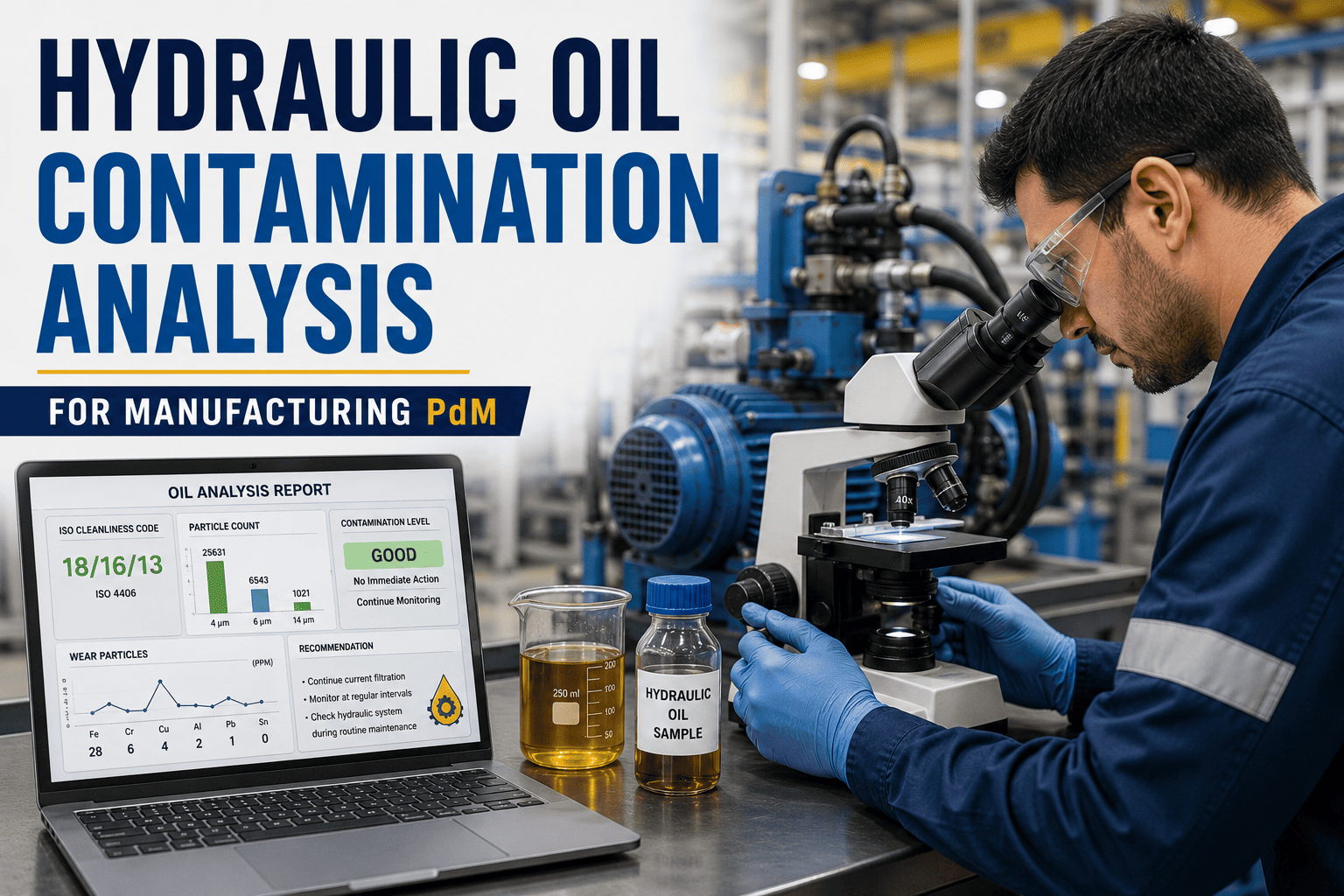
The ISO code reports particle counts at 4μm, 6μm, and 14μm. Each code increment doubles the particle count. This is why fluid cleanliness management is an exponential — not linear — problem.
22/20/17 Unmanaged System

High failure risk — pump wear accelerated
19/17/14 Minimum Acceptable

Acceptable for low-pressure systems only
17/15/12 General Hydraulics Target

Target for most industrial systems above 200 bar
16/14/11 Best Practice Target

Servo valve systems — sustained PM programme required

Source: ISO 4406:2021 and Eaton Vickers contamination control guidelines. Cleanliness level is determined by particle count analysis from a representative fluid sample.

Daily Checks

Daily Inspection — Fluid Level, Temperature, Leaks & Pressure

Daily hydraulic checks take less than ten minutes and catch the conditions that will become a failure within a shift if left unaddressed. A reservoir at 60% level, an operating temperature 15°C above yesterday's reading, or a filter bypass indicator that has tripped are all serious events that a paper log book will record but an Oxmaint PM work order will escalate. Sign up for Oxmaint to configure daily hydraulic checks as mobile-first PM tasks with photo capture for any flagged condition.

DAY Daily Startup & Running Checks — Every Shift Every shift start + mid-shift running check
Reservoir fluid level — sight glass or dipstick reading
Check fluid level at the reservoir sight glass or dipstick before startup. Hydraulic fluid level below the low mark exposes the pump suction inlet to air entrainment — a condition that generates cavitation, which destroys pump internals within hours of onset. A fluid level drop between shifts that is not attributable to a known drain or fill operation indicates an active leak that must be located before the shift continues. Log the level reading in Oxmaint against the hydraulic unit asset.
Normal: between low and high marks. Below low mark: locate source before starting. Log any level change >5% since last shift.
Fluid temperature — reservoir and return line thermometer
Record operating temperature from the thermometer on the reservoir or the thermocouple in the return line at normal operating load. Hydraulic fluid operating consistently above 60°C accelerates fluid oxidation, degrades viscosity, and attacks seal elastomers — compressing what would be a 4,000-hour seal life to under 1,000 hours at 80°C. An operating temperature that has risen 10°C compared to the last recorded reading at the same ambient conditions signals a degraded heat exchanger or a blocked cooler that must be investigated.
Normal operating temperature: 40–60°C. Caution: 60–70°C. Action: above 70°C — stop and investigate cooler and load.
Visual leak check — all external connections, fittings and cylinder rods
Walk the hydraulic circuit and visually inspect all hose connections, manifold faces, cylinder rod seals, and reservoir fittings for weeping or active leakage. A drip that generates one drop every 10 seconds wastes approximately 4 litres of hydraulic fluid per day — and the fluid on a hot surface or near an ignition source is a fire risk. Photograph any new leak point with the Oxmaint mobile app and raise a corrective work order before the shift ends. Mark any new leak point with a felt pen to track progression between shifts.
Zero active drips acceptable. Weeping at static seals: log and monitor. Any new active drip: corrective work order before shift end.
System pressure gauges — operating pressure vs. relief valve setting
Read the system pressure gauge during normal loaded operation and compare to the documented normal operating pressure range. A system pressure consistently running 20 bar below normal indicates either a worn pump unable to generate rated flow, a partially open relief valve, or an internal bypass condition. Pressure 20 bar above normal setpoint suggests a relief valve that has drifted high — placing excessive stress on hoses, fittings, and cylinder seals. Record the reading in Oxmaint to detect drift over time.
Operating pressure: within ±10% of normal range. Below −20 bar: check pump and relief valve. Above +20 bar: check relief valve setting.
Filter bypass / clogging indicator — check at maximum flow
Inspect the filter clogging indicator (differential pressure pop-out button or electrical indicator light) during peak system demand — the point at which flow through the filter is highest. An indicator that shows bypass has been reached means the filter element is at full capacity and all fluid is bypassing the filter element unfiltered — delivering uncontrolled contamination to every component downstream. Replace the element before the next shift begins.
Indicator: green or below threshold. Yellow/red indicator tripped at peak flow: replace element before next shift.
Noise and vibration — pump, motor and actuator sound check
Listen to the pump, motor, and any actuators during startup and running for any unusual noise — high-pitched whine (cavitation), knocking (aeration or mechanical wear), rattling (loose components or pressure surges), or sudden changes in the normal operating sound signature. Cavitation noise in a hydraulic pump is a damage-acceleration signal that will destroy the pump within 50–200 operating hours if the root cause (low fluid level, blocked suction strainer, or high fluid viscosity at cold start) is not eliminated.
Normal operating sound signature: no whine, knock, or rattle. Any new unusual noise: investigate before continuing operation.
Detects
Fluid level drop indicating active leak before pump cavitation damage begins
Temperature rise indicating cooler degradation before seal and fluid life is shortened
Filter bypass condition before uncontrolled contamination reaches critical components
Weekly Checks

Weekly Inspection — Hoses, Seals, Breathers & Valve Temperatures

Weekly checks add the physical inspection layer that daily walkdowns cannot cover at shift-start pace. Hose condition, breather filter integrity, and heat exchanger performance are the three weekly items most commonly deferred — and the three most commonly cited as contributing factors in hydraulic reliability investigations. Book a demo to see how Oxmaint schedules weekly hydraulic checks independently from daily checks, with a different assigned technician and escalation path.

WK-A Hoses, Seals & Fittings Every week
Hydraulic hose condition — all high-pressure and return lines
Inspect the full length of every hydraulic hose for: external abrasion to the outer sheath exposing the reinforcement braid, blistering or bubbling indicating inner tube failure, kinking or tight radius bends exceeding the hose minimum bend radius, and swelling at crimped fittings indicating fitting separation under pressure. A blistered hose is a pre-burst condition — remove from service immediately. Log the hose identification number and condition in Oxmaint against the hose register. Replace any hose flagged as damaged without exception.
No blistering, no abrasion to reinforcement, no swelling at ferrules. Blistered or abraded: replace before next operation.
Cylinder rod condition — chrome surface and rod seal weeping
Inspect cylinder rod chrome surfaces for pitting, scoring, corrosion, and surface damage. A scored chrome rod surface will destroy the rod seal on every stroke — the seal lip cannot maintain contact with a damaged surface. Inspect each rod seal for weeping — a thin film of fluid on the rod beyond the wiper seal indicates the rod seal is beginning to pass fluid and should be replaced at the next scheduled maintenance window before it becomes an active leak.
Rod surface: no pitting, scoring, or corrosion visible. Seal: no fluid film beyond wiper. Weeping: schedule seal replacement within 2 weeks.
Static seal and manifold face inspection — torque check on bolted joints
Inspect all static O-ring face seal connections and manifold mounting bolts for evidence of weeping. Thermal cycling in hydraulic systems causes bolted joints to relax over time — a manifold that was correctly torqued at installation may have relaxed 15–20% after 500 heat cycles. Check bolt torque on all manifold mounting bolts with a calibrated torque wrench and re-torque to specification. Log any bolts found below specification in Oxmaint for trend tracking.
All static joints: no weeping. Manifold bolts: at specification torque. Any below spec: re-torque and log.
WK-B Breather, Cooler & Valves Every week
Reservoir breather filter — condition and indicator status
Inspect the reservoir breather filter for physical damage, contamination indicator status, and evidence of moisture ingress. The breather is the primary atmospheric ingress point for particle and moisture contamination — a blocked or failed breather allows the reservoir to draw in unfiltered air during the thermal contraction of fluid cooling after shutdown. Spring-type breathers should be replaced annually regardless of condition — spring tension loss allows ingress even without visible blockage.
Breather: indicator green, no physical damage. Spring types: replace annually. Blocked: replace immediately.
Heat exchanger — fin cleanliness and cooling performance
Inspect air-cooled heat exchanger fins for blockage by debris, dust, or oil aerosol contamination. A heat exchanger fin area blocked by 30% reduces cooling capacity by more than 30% — because the blocked area also disrupts airflow across the clean sections. Clean fins with compressed air or low-pressure water wash as required. For water-cooled systems, verify cooling water inlet and outlet temperatures are within the design differential — a reduced differential at constant flow indicates fouled tubes or reduced coolant quality.
Air-cooled: fins clear, no blockage visible. Water-cooled: dT within design range. Blocked fins: clean before next operating shift.
Servo and proportional valve temperatures — infrared spot check
Use an infrared thermometer to spot-check the body temperature of servo and proportional valves during loaded operation. A valve body temperature above 65°C indicates either excessive internal leakage (cross-port bypass) or a solenoid coil that is drawing excessive current due to partial short circuit. Both conditions indicate imminent valve failure. Compare readings between valves of the same type — a valve 20°C above its neighbours at the same operating point is a replacement candidate.
Valve body temperature: <65°C. Above 65°C: check solenoid current and internal leakage. Log infrared reading to Oxmaint.
Hydraulic PM on a schedule that actually runs.
Oxmaint triggers daily, weekly, monthly, and annual hydraulic checks automatically — linked to the asset, timestamped, and escalated if missed. No spreadsheet. No paper log. No forgotten filter change.
Monthly Checks

Monthly Inspection — Fluid Sampling, Pressure Relief & Pump Performance

Monthly checks require a higher skill level and more time than daily or weekly tasks — they involve quantitative measurement, fluid sampling, and pressure testing that generate data which must be trended over time to be useful. A single fluid sample result tells you the current state. Twelve consecutive monthly samples tell you whether the system is improving, stable, or degrading — and that trend is the predictive maintenance signal that prevents the unplanned failure. Sign up for Oxmaint to store fluid sample results against the asset record and automatically flag any result that deviates from the trend baseline.

MTH Monthly PM — Fluid Analysis, Pressure & Pump Checks Every month — calendar or operating hours trigger
Monthly Fluid Sample Analysis — What to Test and Why
Particle Count (ISO 4406)
Measures contamination level at 4μm, 6μm, and 14μm. Primary predictor of component wear rate and filter effectiveness. Compare to previous sample — a rising trend indicates a contamination ingress point or a failing filter.
Viscosity at 40°C
Viscosity outside the specified grade range (typically ±10% of ISO VG grade midpoint) indicates either fluid degradation by shear, thermal breakdown, or contamination by a different oil grade. Low viscosity increases leakage and wear; high viscosity increases heat and reduces pump efficiency.
Water Content (Karl Fischer)
Water above 0.1% in hydraulic fluid promotes microbiological growth, accelerates additive depletion, and causes hydrogen embrittlement of high-strength steel components. Above 0.2%, the fluid should be replaced regardless of other condition indicators. Water in hydraulic oil is not negotiable.
Wear Metals (ICP)
Spectrometric analysis for iron (pump wear), chromium (cylinder rod wear), copper (bearing cage wear), and aluminium (pump housing wear) identifies which component is generating wear particles before it fails. A rising iron trend in a system with stable particle count indicates fine pump wear below 5μm — predictive of pump failure within 500–1,000 hours.
Total Acid Number (TAN)
TAN measures fluid oxidation and additive depletion. A rising TAN indicates the fluid's antioxidant package is being consumed — typically due to thermal overload or extended service beyond the change interval. When TAN reaches twice the new oil value, schedule fluid replacement at the next maintenance window.
Neutralisation Value (NV)
Measures the acidity or alkalinity reserve in the fluid. A high acid neutralisation value combined with rising TAN indicates the fluid has passed its useful life and is generating acid attack on component surfaces, particularly copper-based alloy bearing cages and spool valve materials.
Fluid sample collection — representative sample from return line
Collect a fluid sample from the return line sampling valve (or inline sampling point if fitted) while the system is at normal operating temperature and load. Never sample from the reservoir drain or from a stagnant section — these samples do not represent the fluid condition in the active circuit. Use a pre-cleaned sample bottle, flush the sampling point before collecting, and label the sample with the asset ID, date, operating hours, and last oil change date. Submit to a hydraulic fluid analysis laboratory within 48 hours of collection for accurate results.
Sample: return line at operating temperature. Bottle: pre-cleaned. Submitted: within 48 hours. Log to Oxmaint with analysis results on receipt.
Pressure relief valve — function test and setting verification
Test the pressure relief valve function by operating the system to the relief valve cracking pressure using a calibrated pressure gauge on the test port. The relief valve should crack at the documented setpoint (±5 bar) and should return cleanly to seat when the load is removed without pressure spike or hunting. A relief valve that cracks above setpoint is over-pressurising the system; one that cracks below setpoint is limiting available system force. Both conditions indicate the valve requires resetting or replacement. Log the test pressure and result in Oxmaint.
Relief valve: cracks within ±5 bar of setpoint. Returns cleanly to seat. Hunting after relief: valve maintenance required.
Pump case drain flow — volumetric efficiency check
Measure pump case drain flow rate by timing the fill of a measured container from the case drain line (with the case drain temporarily directed to a graduated bucket) under consistent load conditions. Compare against the previously recorded baseline for this pump at this load condition. A case drain flow that has increased by 25% or more compared to the baseline indicates internal pump wear — the pump is losing volumetric efficiency as internal clearances open due to wear. Log the measurement against the pump asset record in Oxmaint.
Case drain flow: within 25% of baseline at same load. 25–50% above baseline: monitor closely. Above 50%: plan pump replacement.
Filter element change — differential pressure triggered or scheduled
Replace the return line filter element if the bypass indicator has tripped during the month, or at the scheduled interval (typically every 500–2,000 hours depending on system cleanliness and filter rating). When replacing the element, cut open the used element using a filter cutting tool and inspect the debris for metal particles, rubber fragments, or coloured deposits — each tells a story about what is failing upstream. Document and photograph significant filter debris findings in Oxmaint and raise a corrective investigation.
Replace: at bypass indicator trigger or scheduled interval. Inspect debris: photo and document in Oxmaint. Metal particles: investigate upstream components.
Detects
Fluid degradation trend before it reaches the replacement threshold
Pump wear progression via case drain measurement before catastrophic failure
Relief valve drift before it over-pressurises seals and hoses across the system
Annual Overhaul

Annual Checks — Full Fluid Change, Reservoir Clean & System Pressure Audit

The annual hydraulic overhaul is the reset point for the entire system's contamination baseline. A full fluid change without a concurrent reservoir clean simply refills a dirty reservoir — the new fluid reaches the previous contamination level within hours of startup. Done correctly, the annual overhaul resets the ISO cleanliness level and gives every monthly fluid sample for the next 12 months a meaningful clean-slate reference. Book a demo to see how Oxmaint schedules annual hydraulic overhauls as multi-task work orders with parts reservation and labour planning linked to the asset record.

ANN Annual Overhaul — Full System Reset Annually or per OEM operating hours threshold
Reservoir drain and internal clean — before new fluid charge
Drain the reservoir completely and inspect the interior for sludge, varnish deposits, water accumulation in the bottom (water is denser than most hydraulic oils and settles in the lowest point of the reservoir), and metallic sediment that indicates component debris. Wipe the interior with lint-free cloths — never use rags that shed fibres into the hydraulic system. A reservoir with visible varnish or sludge deposits must be cleaned with a compatible solvent and then flushed with a small charge of fresh hydraulic fluid before the main fill. Log the reservoir condition with photographs in Oxmaint before closing.
Reservoir interior: clean, no sludge or varnish. Water in bottom: drain and investigate ingress source. Solvent flush: confirm solvent fully evacuated before fill.
New fluid charge — filter during fill, not from drum
Fill the reservoir with new hydraulic fluid passed through a kidney loop filtration unit rated at 3–6 micron absolute — never fill direct from the drum. New hydraulic fluid from sealed drums typically arrives at ISO 20/18/15 cleanliness — far dirtier than the target operating cleanliness of 17/15/12 or better. Filling unfiltered introduces the same particle burden that the entire year's PM programme was designed to control. Confirm the filled system reaches the target ISO cleanliness level by taking a sample 24 hours after startup and before any major load cycles.
Fill method: kidney loop filter at ≤6 micron absolute. Post-fill sample at 24 hours: confirm target ISO level reached before production load.
Full system pressure test — all circuits and safety device verification
Conduct a full system pressure test after the annual service using calibrated test gauges on all circuit test points. Verify that all relief valves, sequence valves, and counterbalance valves are set to documented values. Check accumulator pre-charge pressure (gas side) against specification — a nitrogen-charged accumulator that has lost pre-charge provides no energy storage and can allow the piston to bottom-out, generating pressure spikes at each actuation cycle. Document all pressure readings in Oxmaint as the annual baseline.
All circuits: at documented setpoints ±5 bar. Accumulator pre-charge: within 5 bar of specification. All safety device settings: verified and documented.
Hose register review — age-based replacement of life-expired hoses
Review the hydraulic hose register and replace any hose that has reached its maximum service life regardless of visual condition — the standard industry guideline is six years from manufacture date (not installation date) for high-pressure hoses. The manufacture date is stamped on the hose outer sheath. A hose manufactured in 2019 that looks externally perfect is operating on borrowed time in 2026 if the inner tube and reinforcement braid have reached their fatigue limit. Log all hose replacements with new manufacture dates and installation dates in Oxmaint.
Any hose at or beyond 6 years from manufacture date: replace regardless of external condition. Log new manufacture and installation dates.
Annual Check Acceptance Criterion If Failed Log in Oxmaint
Reservoir internal condition No sludge, varnish, or water Solvent clean and flush before fill Photo + condition note
New fluid ISO cleanliness (24hr) Target ISO level confirmed Continue kidney loop until level achieved Sample result + ISO code
All circuit pressure settings Within ±5 bar of documented setpoint Adjust and re-test, document new setting Pressure readings per circuit
Accumulator pre-charge Within 5 bar of spec Recharge with dry nitrogen Pre-charge reading + date
Hose age (manufacture date) Less than 6 years Replace before returning to service New hose tag + manufacture date
Resets
System ISO cleanliness baseline after full fluid and reservoir clean cycle
All pressure circuit setpoints against the documented specification before 12 months of drift
Hose life-cycle register before age-expired hoses reach burst pressure in service
Field Outcome

What Structured Hydraulic PM Delivers — A Plant Operations Account

"

Before we structured our hydraulic PM programme in Oxmaint, we were replacing two to three pump units per year on our press hydraulics — each at around £4,200 for the pump plus 16 hours downtime. The failures looked random. When we started monthly fluid sampling and logging the results in Oxmaint against each press asset, we could see that every pump that failed had shown a rising iron trend in the two samples before failure. We were giving the pumps an early warning 8–12 weeks before they failed — we just had no system to act on it. After 18 months on the Oxmaint programme, we have replaced one pump — planned, during a scheduled shutdown, with zero production impact. The fluid sampling pays for itself in the first avoided pump failure.

— Maintenance Manager, Precision Stamping Facility, West Midlands, UK, 2025
FAQ

Hydraulic Preventive Maintenance — Common Questions

How often should hydraulic fluid be sampled for analysis?

Monthly sampling is the minimum standard for industrial hydraulic systems operating in continuous production environments. The value of fluid analysis is not in any single sample result — it is in the trend across 6 to 12 consecutive monthly samples. A rising wear metal trend spotted over three months allows you to plan a pump replacement during a scheduled shutdown. Without trend data, the same failure appears without warning. Sign up for Oxmaint to store monthly fluid analysis results against your hydraulic asset records and view trend charts across the asset's service history.

What ISO 4406 cleanliness level should I target for my hydraulic system?

The target ISO 4406 cleanliness level depends on the most sensitive component in your circuit. For servo valve systems operating above 200 bar, the target is ISO 16/14/11 or better. For general industrial hydraulics with proportional valves, target ISO 17/15/12. For low-pressure systems with directional control valves only, ISO 19/17/14 is acceptable. The practical starting point for most unaudited industrial systems is to establish the current baseline with a fluid sample, then implement a programme to reduce the ISO code by two increments over 90 days through filter optimisation and contamination control. Book a demo to see how Oxmaint tracks ISO cleanliness trends per hydraulic asset.

When should hydraulic hoses be replaced — on condition or on age?

Both criteria apply and both are mandatory — whichever is reached first triggers replacement. High-pressure hydraulic hoses should be replaced at six years from the manufacture date stamped on the outer sheath, regardless of visual condition. Any hose showing blistering, abrasion to the reinforcement braid, or swelling at the ferrule should be replaced immediately regardless of age. The six-year rule exists because inner tube fatigue and reinforcement wire fatigue are not visible externally. Oxmaint's hose register tracks manufacture dates and sends advance replacement notifications 60 days before any hose reaches the six-year threshold.

What causes hydraulic pump cavitation and how does the daily check catch it?

Hydraulic pump cavitation occurs when the inlet pressure at the pump suction drops below the fluid's vapour pressure, causing vapour bubbles to form and then collapse violently on the high-pressure side — generating localised pressure spikes that erode pump barrel and piston surfaces. The most common causes are low fluid level, a blocked suction strainer, fluid viscosity too high for the ambient temperature, or a suction line restriction. The daily noise check — listening for a high-pitched whine during startup — catches cavitation at its earliest onset, typically 50–200 hours before it causes irreversible pump damage. Sign up for Oxmaint to log noise observations from daily checks against the pump asset record for trend tracking.

How does Oxmaint manage four different frequency tiers of hydraulic PM checks?

Oxmaint creates four separate recurring work order series per hydraulic asset — daily, weekly, monthly, and annual — each with its own task list, assigned technician grade, estimated duration, and required parts. The daily check triggers every shift start; the weekly check triggers every Monday morning; the monthly check triggers on the 1st of each calendar month or at the operating hours interval, whichever comes first. If any check is missed or overdue, Oxmaint escalates the outstanding PM to the maintenance supervisor automatically. Book a demo to see the full hydraulic PM scheduling configuration in Oxmaint.

Four Tiers. One Asset Record. Zero Missed PM.

Build a Hydraulic PM Programme That Actually Runs

Every check in this four-tier framework exists because a hydraulic failure — a burst hose, a seized pump, a contaminated valve — has been traced to a PM task that was scheduled but not executed, or executed but not recorded. Oxmaint puts every hydraulic check on a schedule that triggers automatically, assigns it to the right technician, and escalates it if it is not completed. Your fluid analysis results, your filter change records, and your pressure test data are all in one place — linked to the asset from the first daily check to the annual overhaul.

Share This Story, Choose Your Platform!