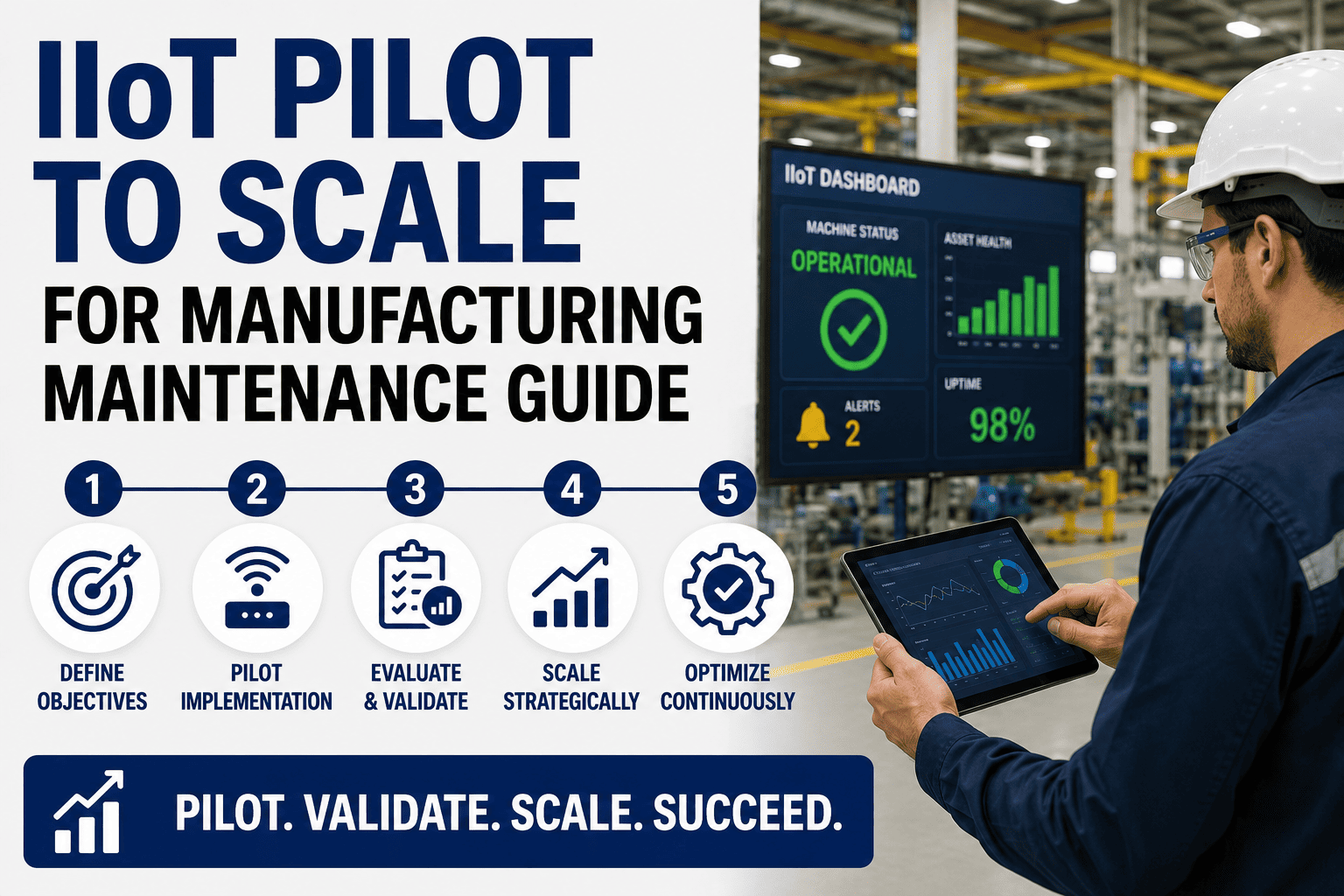
Scaling IIoT from pilot to full plant in manufacturing maintenance is where most programs stall — nearly 70% of industrial IoT pilots never reach plant-wide deployment, and the reasons are rarely about the sensors themselves. An IIoT pilot to scale for manufacturing requires a different playbook: standardized data models, automated sensor onboarding, CMMS integration templates, and a governance framework that can absorb 500 monitored assets without collapsing into alert noise and orphaned dashboards. This guide walks maintenance and reliability leaders through the architecture, change management, and platform decisions that turn a successful 20-asset proof of concept into a production-grade predictive maintenance program. Ready to skip the pilot purgatory? Start Free Trial and see how OxMaint handles the scale layer from day one.
IIoT Scaling Guide for Manufacturing
Your pilot worked. Now what happens at 500 assets?
70% of manufacturing IIoT pilots never scale beyond the initial line. The failure isn't the technology — it's the missing architecture for data model reuse, sensor onboarding automation, CMMS integration, and governance. Here's the proven path from a 20-asset pilot to a full-plant predictive maintenance program.
The Scale Gap
Why IIoT pilots succeed but scaling fails in manufacturing
A 20-asset pilot is a controlled experiment with hand-picked equipment, bespoke dashboards, and an engineering team watching every alert. At 500 assets, the same approach becomes unsustainable — and that's exactly where the IIoT pilot to scale manufacturing journey breaks down.
Without triage rules, alert fatigue causes teams to mute the system entirely within 90 days.
Orphaned IIoT devices that stop reporting data silently leave assets unprotected.
Fragmented visibility forces managers to manually reconcile data across platforms.
Real-world scenario
A 180-asset food processing plant spent $85K on a vibration pilot across 12 critical motors. The pilot cut unplanned downtime 22% on those assets. But when they tried to expand to all 180 assets, manual sensor provisioning, spreadsheet-based threshold tuning, and no CMMS link meant the rollout took 14 months — during which the pilot's original gains eroded to 8% because the team couldn't sustain the alert workload. The fix wasn't more sensors; it was a scalable platform architecture.
Scaling Architecture
How to scale IIoT in a manufacturing plant: the 5-layer framework
Moving from IIoT pilot to full plant requires rethinking each layer of the stack — not just adding sensors. Here's the framework reliability teams use to go from 20 to 500+ monitored assets without rebuilding the architecture each time.
Sensor onboarding automation
Manual sensor commissioning takes 45–60 minutes per device at pilot scale — tolerable for 20 sensors, impossible for 500. Auto-provisioning templates cut that to under 5 minutes: pre-configured asset type mappings, default sampling rates, and tag-naming conventions that follow ISA-95 hierarchy. Every new vibration sensor on a pump inherits the correct data model without an engineer touching it.
Standardized data model reuse
Your pilot proved that a motor-pump-coupling chain needs 11 vibration tags, 4 temperature tags, and 2 current tags. Encode that as a reusable asset template. When you onboard the next 50 pump skids, the data model deploys automatically — thresholds, FFT analysis bands, and fault frequency calculations all inherit from the template. No per-asset engineering.
CMMS integration templates
The biggest scale failure is IIoT data that doesn't reach the maintenance team's workflow. Pre-built CMMS integration templates push anomaly detections directly into work order generation — mapped to the right asset, with the right priority, attached with diagnostic context. No swivel-chair between your condition monitoring dashboard and your work order system.
Data capacity and retention planning
500 assets streaming 4 kHz vibration data generates roughly 2.1 TB per month. Without tiered storage — hot data for 30 days, warm for 12 months, cold for long-term trend analysis — query performance degrades and cloud costs explode. Plan for 3x headroom: what works at 500 assets must survive the next expansion to 1,500 without a re-architecture.
Governance and alert triage model
At pilot scale, every alert is reviewed by a reliability engineer. At plant scale, that's 300+ alerts per day. A governance model with severity-based routing, automated suppression of known-noise patterns, and escalation rules ensures only actionable detections reach the team. The goal: fewer than 15 review-worthy alerts per day per plant.
Implementation Timeline
IIoT scale manufacturing roadmap: month-by-month rollout plan
A phased 12-month rollout balances early wins with foundational architecture. Trying to do everything at once is why IIoT scaling manufacturing initiatives lose budget mid-deployment. Here's the timeline that keeps executive sponsorship intact.
Foundation & standardization
Codify pilot learnings into 3–5 reusable asset templates. Define tag-naming conventions per ISA-95. Stand up tiered storage. Deploy CMMS integration template with OxMaint. Target: 1 template onboarded, integration live.
Critical asset expansion — Wave 1
Onboard the next 80–100 critical assets using auto-provisioning. Validate that templates deploy correctly at volume. Tune alert thresholds based on first 30 days of baseline data. Target: 100+ assets monitored, alert noise under 25/day.
CMMS workflow integration & change management
Enable automated work order generation from anomaly detections. Train maintenance technicians on IIoT-driven work order context. Shift from reactive to predictive PMs on monitored assets. Target: 40% of PMs adjusted based on condition data.
Full plant rollout — Wave 2
Expand to remaining 300–400 assets. Apply governance model with severity routing and automated noise suppression. Begin cross-asset analytics and fleet benchmarking. Target: 500+ assets live, alert review load under 15/day.
Optimization & predictive model refinement
Retrain anomaly models on 9 months of fleet data. Implement RUL (remaining useful life) predictions on top 20% criticality assets. Document ROI for next budget cycle. Target: 25–40% downtime reduction sustained plant-wide.
Change Management
The governance model that prevents IIoT scale chaos
Technology is 30% of the IIoT scale challenge; governance is 70%. Without clear ownership, alert triage rules, and feedback loops, even the best architecture drowns in noise. Here's the governance framework that lets one pilot become 500 monitored assets without losing signal.
| Dimension | Pilot approach (20 assets) | Scaled approach (500+ assets) |
|---|---|---|
| Alert handling | Engineer reviews every alert manually | Severity-based auto-routing; only P1/P2 reach humans |
| Threshold tuning | Per-asset manual baseline (4 hrs each) | Template-based with fleet statistical baselines |
| Sensor health | Checked ad hoc when data looks wrong | Automated heartbeat monitoring; stale-data alerts at 2 hrs |
| Work order link | Manual entry from dashboard screenshot | Auto-generated WO with diagnostic context in CMMS |
| Ownership | Project engineer owns everything | Reliability lead owns models; maintenance lead owns actions |
| Feedback loop | Quarterly review meeting | Closed-loop: post-repair validation updates model accuracy |
"The moment we crossed 200 monitored assets, manual processes that worked fine in the pilot became the bottleneck. Auto-provisioning and CMMS-linked work orders weren't optional — they were the difference between scaling and stalling."
— Reliability Manager, tier-1 automotive components manufacturer
How OxMaint Helps
Scale IIoT maintenance with OxMaint: from pilot to 500+ assets without the chaos
OxMaint is built for the scale layer — not just the pilot. Its AI-powered CMMS and EAM platform handles the integration, automation, and governance work that turns condition monitoring data into maintenance action across a full plant. Here's how specific capabilities map to the IIoT scaling challenge.
Automated work order generation from IIoT anomalies
OxMaint's CMMS integration templates detect anomaly signals and auto-create work orders — mapped to the correct asset, prioritized by criticality, and loaded with diagnostic context. Technicians arrive knowing what the sensor found, not just that something broke. Outcome: cut mean-time-to-repair 25–40% on monitored assets.
Reusable asset templates for fast onboarding
Define an asset type once — pump, motor, gearbox, fan — and OxMaint applies the full data model, PM schedule, spare-parts list, and inspection checklist to every instance. Onboarding the next 50 pump skids takes hours, not weeks. Outcome: 90% reduction in per-asset setup time at scale.
Predictive analytics with closed-loop model refinement
OxMaint's AI doesn't just detect anomalies — it learns from repair outcomes. When a technician closes a work order with root-cause data, the model updates. Over 6–9 months, prediction accuracy climbs from 60% to 85%+ on critical assets. Outcome: 30–50% reduction in unplanned downtime sustained at plant scale.
Unified dashboard replacing fragmented pilot tools
OxMaint consolidates condition monitoring, work orders, asset history, and spare-parts inventory into one platform — eliminating the 3.2-dashboards-per-plant problem. Plant managers get a single view of asset health, maintenance backlog, and KPI trends. Outcome: audit-ready compliance reporting and 15+ hours/month saved on manual data reconciliation.
See OxMaint on your assets — book a 30-min demo
Walk through a live IIoT-to-work-order flow on equipment like yours. See how auto-provisioning, template-based onboarding, and predictive analytics scale from 20 to 500+ assets without the usual chaos.
FAQ
IIoT pilot to scale manufacturing: frequently asked questions
Why do IIoT pilots fail to scale in manufacturing plants?
IIoT pilots fail to scale because the pilot approach — manual sensor provisioning, per-asset threshold tuning, and standalone dashboards — doesn't survive at 500+ assets. The root causes are lack of data model reuse, no CMMS integration (so insights never reach maintenance workflow), and absent alert governance that drowns teams in noise. Scaling requires platform standardization and automation, not just more sensors.
How long does it take to scale IIoT from pilot to full plant?
A properly architected IIoT scale-up takes 10–12 months for a 500-asset plant: 2 months for foundation and template standardization, 5 months for phased asset onboarding in two waves, 3 months for CMMS workflow integration and change management, and 2 months for optimization. Trying to compress below 8 months typically sacrifices governance and causes alert fatigue within 90 days of go-live. You can see how OxMaint accelerates this timeline — book a demo to review your rollout plan.
What is the ROI of scaling IIoT for manufacturing maintenance?
Plants that successfully scale IIoT maintenance typically see 25–40% reduction in unplanned downtime, 15–25% reduction in maintenance costs (via condition-based PMs replacing time-based ones), and 20–30% extension in asset useful life. For a 500-asset plant with $4M annual maintenance spend, that translates to $600K–$1.2M in annual savings, with payback in 14–18 months on the IIoT platform investment.
How does CMMS integration change when scaling IIoT?
At pilot scale, CMMS integration is often manual — someone reads a dashboard and creates a work order. At full-plant scale, this must be automated: anomaly detections flow directly into the CMMS as pre-populated work orders with asset ID, diagnostic context, recommended action, and priority. This requires pre-built integration templates, standardized asset hierarchies (ISA-95), and closed-loop feedback when repairs are completed. OxMaint handles this end-to-end — start a free trial to test the integration on your assets.
What data capacity planning is needed for 500+ IIoT assets?
A 500-asset plant streaming 4 kHz vibration, temperature, and current data generates roughly 2.1 TB per month. You need tiered storage: hot data (30 days, fast query) for real-time monitoring, warm data (12 months) for trend analysis, and cold storage for long-term model training. Plan 3x headroom for future expansion. Without tiering, cloud storage costs exceed $50K/year and query latency makes dashboards unusable within 6 months.
Stop managing IIoT pilots. Start scaling maintenance outcomes.
OxMaint gives you the CMMS, predictive analytics, and governance framework to turn sensor data into action across every asset in your plant — without the alert noise, manual workarounds, or dashboard sprawl.
Free 14-day trial · No credit card