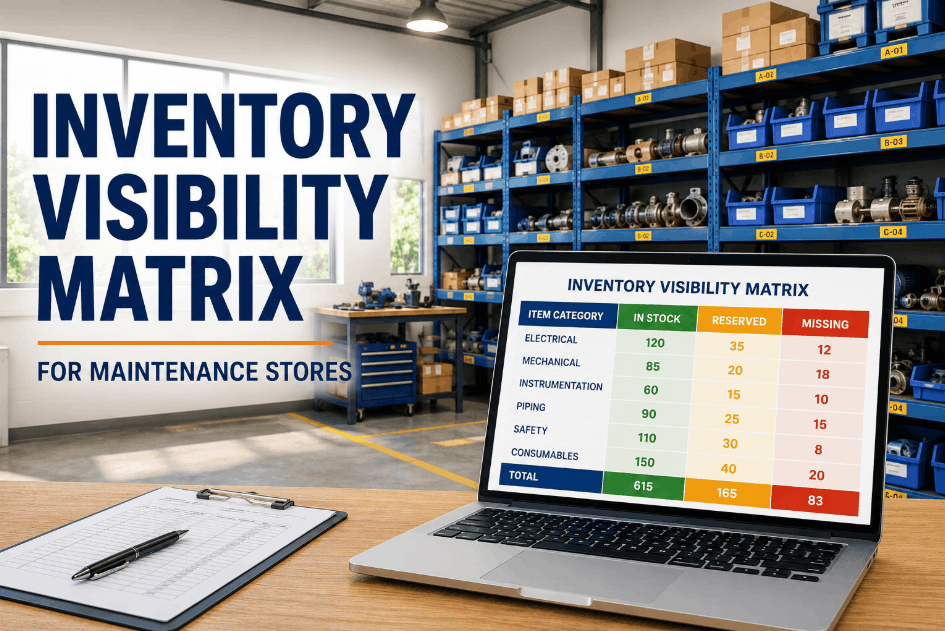
Inventory visibility in maintenance stores is not just a stockroom problem — it is a production risk. When parts availability is unclear, planners guess, technicians wait, and unplanned downtime costs compound silently. An inventory visibility matrix gives maintenance teams a structured view of what is on hand, what is reserved for open work orders, what is on order, and what is critically low. Maintenance teams using Sign Up Free on OxMaint gain real-time parts visibility tied directly to work orders and asset records — eliminating the gap between what the warehouse reports and what the shop floor actually needs. A well-designed inventory visibility matrix turns reactive parts scrambles into planned, predictable maintenance execution.
Why Inventory Visibility Gaps Break Maintenance Planning
Most plant warehouses carry parts data in disconnected systems — spreadsheets, ERP modules, or paper bin cards — none of which reflect real-time demand from active work orders. The result is planners scheduling jobs without confirmed parts, and technicians discovering stockouts at the point of execution. Book a Demo to see how OxMaint links parts inventory directly to open and planned work orders so availability gaps surface during planning, not during execution.
Six Dimensions of an Inventory Visibility Matrix
An effective inventory visibility matrix covers more than bin quantities. It maps parts status across demand, reservation, procurement, and risk dimensions. Sign Up Free to connect your parts records to maintenance work orders in OxMaint and build the visibility your planning team requires.
On-Hand Quantity vs. Reserved Stock
Gross bin quantity without reservation data is misleading. A visibility matrix separates available stock from quantities already reserved for open or scheduled work orders — giving planners a true net-available figure when scheduling future jobs.
Stockout Risk Scoring by Part Criticality
Not all stockouts carry equal risk. Scoring parts by asset criticality, lead time, and demand frequency identifies which shortages will halt production and which represent minor inconveniences — enabling targeted reorder action on the parts that matter most.
Demand Variance and Consumption Patterns
Irregular consumption patterns — driven by seasonal demand, shutdown cycles, or reactive maintenance surges — cause reorder models based on average demand to fail. Mapping demand variance in the visibility matrix enables more resilient safety stock calculations.
Purchase Timing and Open PO Status
Parts on order but not yet received create a false sense of coverage. A visibility matrix that surfaces open PO status, expected receipt dates, and vendor lead time variance ensures planners know whether incoming stock will arrive before a scheduled job requires it.
Part Substitution Availability
When a primary part is unavailable, approved substitutions can prevent job delays. The visibility matrix should surface qualified alternates with their own stock status — enabling technicians and planners to execute without waiting for primary part replenishment.
Warehouse Accuracy and Inventory Health Score
Visibility matrix data is only as reliable as the physical count accuracy behind it. Tracking cycle count completion rates, discrepancy rates, and inventory health scores ensures the matrix reflects reality — not just system records from months-old transactions.
Inventory Visibility Matrix: Parts Status by Category
Different parts categories carry different visibility priorities and risk profiles. Mapping your inventory against this matrix framework highlights where planning exposure is highest. Book a Demo to see how OxMaint tracks parts availability, reservations, and reorder triggers alongside work order schedules in one platform.
| Parts Category | Primary Visibility Risk | Reorder Model | Stockout Impact | OxMaint Visibility Lever |
|---|---|---|---|---|
| Critical Spare Components | Long lead time, low demand frequency | Min-max with safety stock | Production halt | Asset-linked reorder alerts + PO tracking |
| Consumable Materials | High velocity, poor replenishment tracking | Continuous review | Job delay | Work order consumption logging + auto-reorder |
| Repairable Spares | Repair cycle visibility gaps | Exchange pool model | Extended downtime | Repair status tracking tied to asset records |
| Shutdown-Specific Parts | Demand spikes during planned outages | Project-based pre-staging | Shutdown delay | Shutdown kit reservation in work order system |
| Slow-Moving Stock | Obsolescence and capital tie-up | Periodic review | Capital waste | Demand history analysis + obsolescence flagging |
How Inventory Blind Spots Compound Maintenance Costs
Parts visibility gaps rarely appear as a single failure. They cascade across emergency procurement, overtime labor, missed PM windows, and extended asset downtime — each generating costs that obscure the original inventory management failure. Sign Up Free to connect your inventory records to OxMaint's work order and asset management system and eliminate the visibility gaps driving these cost cascades.
Building an Inventory Visibility Matrix with OxMaint
Catalog Parts with Criticality and Lead Time Data
Register each part in OxMaint with asset linkage, criticality classification, vendor lead time, and substitution mapping. This foundation drives accurate stockout risk scoring and prioritizes which parts the visibility matrix monitors most closely.
Connect Parts to Work Orders and PM Schedules
Link required parts to every corrective and preventive work order in OxMaint. This creates a real-time reservation layer that separates available stock from committed quantities — the core of a reliable visibility matrix.
Configure Reorder Triggers and Stockout Alerts
Set minimum stock thresholds, safety stock levels, and automatic reorder alerts in OxMaint. Alerts tied to work order demand — not just bin quantities — ensure procurement action happens before scheduled jobs are at risk.
Track Purchase Orders Against Job Timelines
Log open POs and expected receipt dates in OxMaint and compare them against upcoming work order schedules. Planners can see at a glance whether incoming stock will arrive in time — or whether job rescheduling is needed.
Report Inventory Health Across Equipment Classes
Use OxMaint's reporting dashboards to monitor inventory health scores, stockout frequency, and demand variance trends by equipment category, production line, and shutdown cycle — turning visibility data into actionable procurement strategy.
Frequently Asked Questions: Inventory Visibility Matrix for Maintenance Stores
What is an inventory visibility matrix in maintenance?
An inventory visibility matrix maps parts status across on-hand quantity, reservations, open POs, stockout risk, and demand patterns — giving maintenance planners a complete picture of parts availability before scheduling work orders.
How does OxMaint support inventory visibility for maintenance stores?
OxMaint links parts records to work orders and PM schedules, tracks open PO status against job timelines, and surfaces stockout risks during planning — connecting inventory visibility directly to maintenance execution.
What is the difference between on-hand quantity and available quantity?
On-hand quantity is the total bin count. Available quantity subtracts stock reserved for open or planned work orders. Planning against available quantity prevents double-allocation and false coverage assumptions.
How does stockout risk scoring work in a visibility matrix?
Stockout risk scoring combines part criticality, current stock level, lead time, and upcoming demand from scheduled work orders. High-risk parts trigger procurement action before jobs are scheduled to start.
How often should a maintenance inventory visibility matrix be reviewed?
High-criticality parts benefit from daily visibility checks tied to work order scheduling. Full matrix reviews aligned with weekly planning cycles and monthly procurement meetings ensure broader inventory health is maintained.