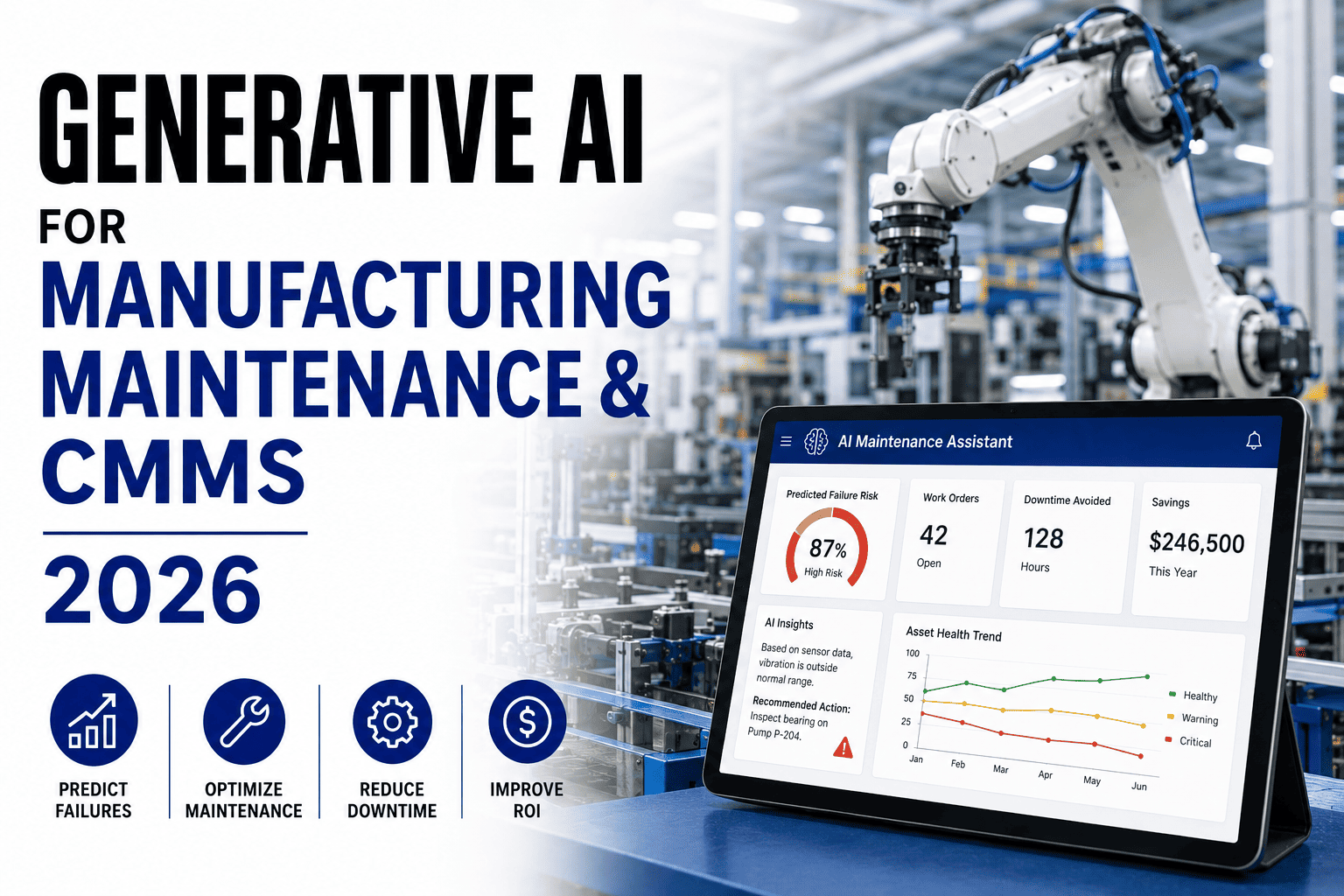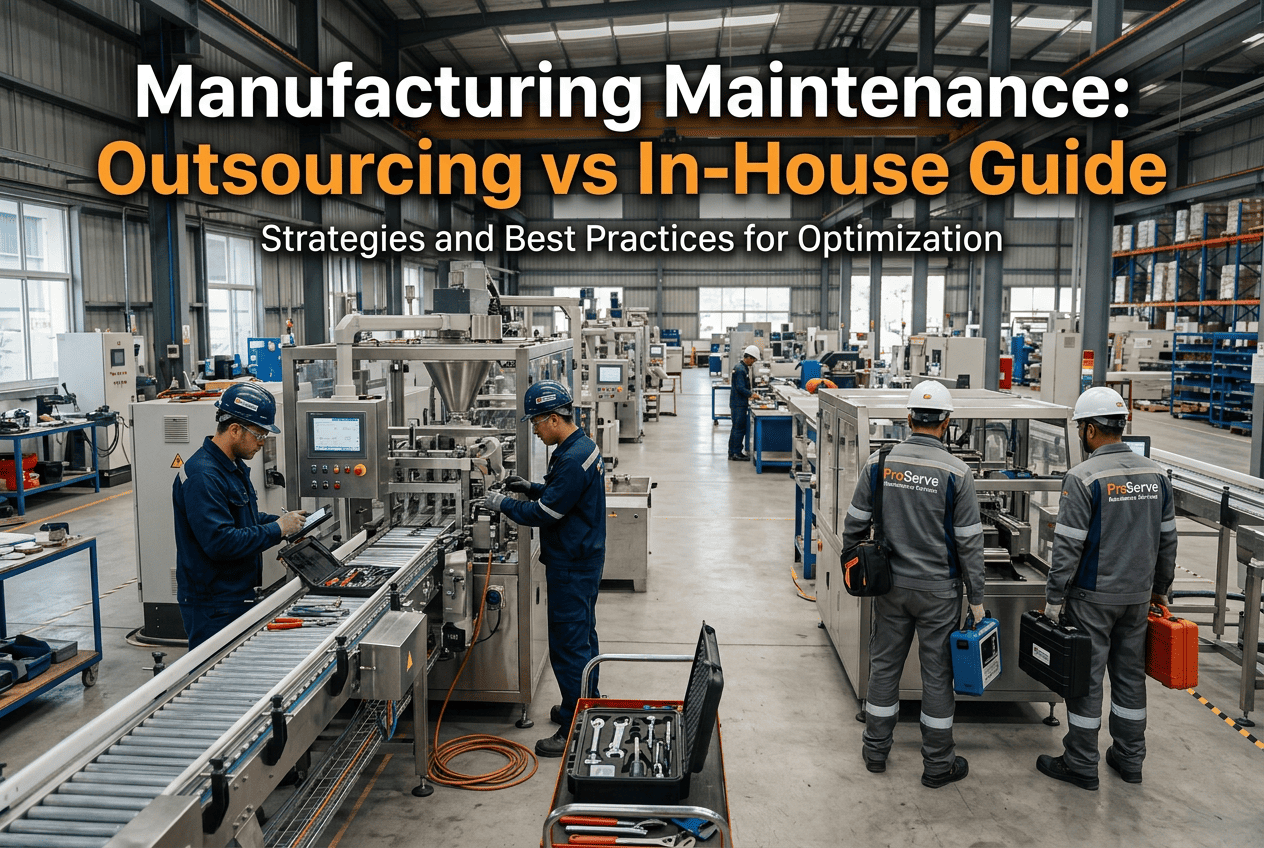
Manufacturing maintenance is going through the same structural shift that IT went through fifteen years ago. Where plants once employed every maintenance planner, every technician, every reliability engineer directly and bought every IIoT sensor and every analytics platform outright, a growing share of manufacturers are now buying the entire maintenance function as a service — with the service provider bringing the technicians, the IoT hardware, the analytics platform, and the reliability expertise, and charging on a subscription, per-unit, or outcome-based model instead of a capital purchase. The manufacturing sector is moving fast: over 45% of manufacturers report adopting some form of as-a-service model with reported capital expenditure reductions of up to 30% on maintenance-related tooling, software, and workforce infrastructure. The driver is not fashion — it is the intersection of aging maintenance workforces, prohibitive IIoT and AI investment costs at single-plant scale, and increasing pressure to unlock capital tied up in non-differentiating support functions. But MaaS is not a universal answer. It fits certain plants and certain contract structures beautifully, and it fails specific ones badly. This guide is the manufacturing executive's working framework for evaluating Maintenance-as-a-Service — the four service tiers, the six contract components, the risks that break the model, and the critical role a shared CMMS platform plays as the single non-negotiable in any MaaS engagement. Oxmaint is the CMMS built for both sides of a MaaS relationship — customer retains data ownership, service provider gets full operational access, and the audit trail sits on neutral ground. Start a free Oxmaint trial to run MaaS-ready maintenance on a shared platform, or book a demo to see how the CMMS structures a customer-provider MaaS engagement.
Manufacturing · MaaS · Outsourced Reliability Program
Maintenance-as-a-Service for Manufacturing — The 2026 Executive Guide
Service tiers, contract structures, data ownership, and the role of the CMMS in outsourced reliability programs — plus the fit test that tells you whether MaaS is right for your plant.
-
45%+
of manufacturers report adopting some form of as-a-service delivery model for maintenance and reliability
-
Up to 30%
reported CapEx reduction on maintenance tooling, IIoT hardware, software, and workforce infrastructure
-
14.5%
projected CAGR for the manufacturing-as-a-service segment through 2030
-
Availability
the KPI most commonly used as the performance metric in outcome-based MaaS contracts
What Maintenance-as-a-Service Actually Is
Four Defining Characteristics of the MaaS Model
Maintenance-as-a-Service is not a rebrand of maintenance outsourcing. It is a structurally different commercial relationship built on four defining characteristics — each of which distinguishes a real MaaS engagement from a labor-hire contract or a break-fix service agreement.
-
01
Bundled Service Delivery
Technicians, planners, reliability engineers, IIoT sensors, analytics platform, spare parts, and CMMS access — bundled into one commercial arrangement, not procured piecemeal.
-
02
Subscription or Outcome Pricing
Recurring monthly or quarterly fees, per-unit-produced charges, or availability-linked payments — not one-time equipment sales or hourly technician billing.
-
03
Performance Accountability
Service Level Agreements against availability, MTBF, MTTR, and schedule compliance — with commercial consequences for missing SLA targets.
-
04
Shared Data Platform
CMMS access for both customer and provider on the same platform, with customer retaining data ownership even as the provider executes the maintenance work.
The Four-Tier MaaS Service Model
MaaS Comes in Four Escalating Tiers — Choose Deliberately
Not every MaaS engagement outsources everything. The market has evolved into four discrete service tiers ranging from PM execution outsourced up through full function replacement with outcome-based pricing. Understanding which tier fits which plant is the first strategic decision.
-
Tier 1
Basic PM Execution
Scope: PM tasks executed by service provider technicians on-site. Customer retains planning, engineering, and management functions.
Pricing: Fixed monthly fee per asset or per PM cycle
Best Fit: Plants with technician shortages but strong reliability engineering
-
Tier 2
Full Maintenance Function
Scope: Provider takes over the entire maintenance department — planners, technicians, supervisors, materials, tools. Customer keeps only strategic oversight.
Pricing: Fixed annual fee or per-unit-produced charge
Best Fit: Non-core plants, remote locations, capital efficiency mandates
-
Tier 3
Outcome-Based Contract
Scope: Provider guarantees availability, MTBF, or throughput targets. Payment linked to delivered outcome, not tasks executed. Provider bears the risk of downtime.
Pricing: Base fee plus availability bonuses or downtime penalties
Best Fit: High-value continuous-production assets with measurable output
-
Tier 4
Hybrid Gain-Share
Scope: Provider co-operates with in-house team. Both parties share cost savings and productivity gains against baseline. Strategic partnership model.
Pricing: Cost baseline plus shared savings above target performance
Best Fit: Mature reliability organizations wanting to accelerate transformation
The Six Components of a MaaS Contract
What Actually Sits Inside a MaaS Bundle
A real MaaS engagement bundles six discrete service components into one commercial arrangement. Any contract missing one or more of these has moved out of MaaS and back into a traditional outsourcing arrangement — a distinction that matters for procurement, legal, and operational reasons.
-
C1
Remote Condition Monitoring
IIoT sensors deployed on critical assets. Vibration, temperature, pressure, current. Data streams to provider's central monitoring center for continuous surveillance.
-
C2
Predictive Analytics
Machine learning models trained on failure signatures. Anomaly detection alerts before breakdown. Provider analytics team interprets and prioritizes.
-
C3
Shared CMMS Platform
Single platform accessible to both customer and provider. Work orders, PM schedules, asset records, spare parts, KPIs. Customer retains data ownership.
-
C4
On-Site Technicians
Provider employees stationed at the plant. Skilled trades, planners, supervisors. Customer manages the interface but not day-to-day HR.
-
C5
Spare Parts Management
Provider owns or manages critical spares inventory. Consignment stocking, vendor-managed inventory, or full ownership depending on contract tier.
-
C6
Reliability Engineering
Root cause analysis, PM optimization, criticality assessment, spare parts review. Provider brings cross-industry reliability expertise the plant cannot cost-justify alone.
Contract Structure Comparison
Four Contract Structures — Each Shifting Risk Differently
The commercial structure of a MaaS contract determines who bears which risk. Below is the working comparison every procurement team should have on the table when structuring a MaaS engagement.
| Structure | How It Works | Risk on Customer | Risk on Provider |
|---|---|---|---|
| Fixed Fee | Flat monthly or annual charge for defined scope | Scope creep, quality drift | Cost overruns absorbed by provider |
| Time & Materials | Billed against hours worked plus materials used | Runaway cost, no incentive for efficiency | Minimal — margin protected on every hour |
| Outcome-Based | Payment linked to availability, MTBF, or throughput | Provider game-the-metric risk | Full performance risk — downtime = revenue loss |
| Gain-Share | Baseline plus shared savings against target | Baseline manipulation, ceiling on upside | Effort without guaranteed return above baseline |
The Data Ownership Non-Negotiable
No MaaS Contract Should Cede Ownership of Maintenance Data to the Service Provider
Every MaaS engagement generates years of asset history, failure patterns, spare parts usage, and reliability insights. That data is the plant's institutional memory. When the contract ends — and every contract eventually ends — the data must stay with the plant, not walk out with the departing provider. A shared CMMS platform where the customer owns the account and the provider is a permissioned user is the only structural answer. Anything else is a lock-in trap dressed as a partnership.
The Fit Test
Five Conditions That Tell You Whether MaaS Fits Your Plant
MaaS is not a universal answer. Five plant-level conditions predict whether the model will deliver value or destroy it. Every executive team should score each condition honestly before committing to a MaaS structure.
-
01
Skills Access Is the Binding Constraint
If the plant cannot hire or retain skilled maintenance trades — vibration analysts, PLC technicians, reliability engineers — a MaaS provider pooling talent across sites solves a problem in-house cannot.
-
02
Maintenance Is Non-Core to Strategy
If maintenance excellence is not a differentiator for the plant's competitive position — the plant is not competing on uptime — outsourcing the function frees management attention for what actually differentiates.
-
03
Assets Are Standard Enough to Pool
If the assets are common industrial machinery — pumps, motors, compressors, standard packaging lines — a provider with cross-site pattern data adds value. Highly bespoke assets lose that leverage.
-
04
Capital Efficiency Is a Priority
If the plant faces pressure to reduce capital tied up in tooling, IIoT hardware, and analytics platforms, MaaS shifts CapEx to OpEx and frees the balance sheet. Some businesses value that heavily.
-
05
Outcomes Are Measurable
Outcome-based MaaS requires clean, agreed measurement of availability, throughput, or MTBF. Plants without a mature measurement baseline cannot structure the outcome contract in the first place.
The Five Risks and How to Mitigate
Every MaaS Engagement Carries Five Risks — Mitigation Baked Into the Contract
MaaS carries structural risks that in-house teams do not face. All five are manageable — but only if the contract addresses each explicitly. A MaaS engagement without mitigation on any of the five risks below will underperform expectations or fail outright.
R1
Data Ownership Loss
Provider owns the CMMS. Customer loses access at contract end.
Mitigate: Customer owns CMMS account; provider is a permissioned user.
R2
Vendor Lock-In
Proprietary sensors, custom integrations make switching prohibitively costly.
Mitigate: Open-standard sensors, transferable licenses, data export rights.
R3
Institutional Knowledge Erosion
In-house maintenance expertise disappears within 2–3 years.
Mitigate: Retain reliability engineering role internally; document everything in the CMMS.
R4
Change Management Failure
Operations staff resist provider technicians; friction damages performance.
Mitigate: Structured integration plan, joint operations meetings, phased transition.
R5
Cost Escalation
Scope creep or annual index adjustments push contract cost above in-house benchmark.
Mitigate: Defined scope with change-control process; capped annual escalation.
The Role of the CMMS
Why the CMMS Platform Is the Foundation Every MaaS Engagement Runs On
Every MaaS relationship — regardless of tier or contract structure — runs on a CMMS platform. It is the shared workspace where customer and provider both operate, and its ownership structure determines the entire relationship's power balance. Three functions the CMMS uniquely serves inside a MaaS engagement:
-
Function 1
Neutral Ground for Both Parties
Customer sees every task, every KPI, every spare consumed. Provider executes without controlling visibility. Neither side operates in the dark. Transparency is structural, not negotiated.
-
Function 2
The Data Asset That Outlasts the Contract
Years of failure records, PM history, and reliability insights build up inside the platform. When the contract ends, the data stays. The next provider — or the reinstated in-house team — starts with full history.
-
Function 3
SLA Measurement Engine
Availability, MTBF, MTTR, schedule compliance — every SLA calculated from CMMS work order data. The platform is the invoice basis in outcome-based contracts. Ownership of the measurement engine matters.
Built for MaaS Delivery
How Oxmaint Structures a Customer–Provider MaaS Engagement
-
Multi-Tenant Access
Customer Owns the Account, Provider Is a User
Customer creates the Oxmaint tenant. Provider technicians, planners, and analysts invited as permissioned users. Contract ends — provider access revoked, data stays.
-
Role-Based Permissions
Every User Sees What Their Role Requires
Provider technician sees assigned work orders. Provider planner sees the schedule. Customer executive sees KPIs and SLA compliance. Fine-grained control across the workflow.
-
SLA Dashboards
Availability, MTBF, MTTR Live for Both Sides
Outcome-based contracts need continuous KPI visibility. Availability rollups, MTBF trends, MTTR by asset class — the same numbers on both parties' screens.
-
IIoT Sensor Integration
Provider Sensors Feed Customer-Owned Data
Provider deploys IIoT sensors on-site. Data flows into the customer-owned Oxmaint tenant. Provider analytics run on the customer's data — but the customer retains ownership.
-
Audit Trail
Every Task, Every Change Time-Stamped
Complete audit history against every work order, every asset. Contract disputes, outcome verification, and continuous improvement all trace to the same source of truth.
-
Data Portability
Full Export at Any Time
Contract ending, provider switching, or bringing maintenance back in-house — full data export available at any time. No lock-in. No hostage negotiation.
Measured Outcomes
What Manufacturers Gain When MaaS Is Structured Correctly
-
CapEx
Shifted to OpEx
IIoT hardware, analytics platforms, and specialist headcount all shift from capital budget to operating expense — freeing balance sheet capacity for core investments.
-
Access
To Cross-Industry Expertise
Provider brings failure patterns and best practices from across dozens of client sites — insight a single plant cannot generate from its own operation alone.
-
SLA
Backed Availability
Outcome-based contracts convert availability from a hope into a contractual obligation with commercial consequences — aligning provider incentives with plant performance.
-
Retained
Data Ownership
Customer-owned CMMS platform means the maintenance data asset stays with the plant even as service providers rotate — no lock-in, no institutional amnesia at contract end.
Frequently Asked
Maintenance-as-a-Service & CMMS Questions
How is MaaS different from traditional maintenance outsourcing?
Traditional outsourcing typically involves labor hire — the customer directs, the contractor supplies bodies, billed hourly. MaaS bundles technicians with IIoT sensors, predictive analytics, a CMMS platform, spare parts management, and reliability engineering into one commercial arrangement, usually with subscription or outcome-based pricing rather than hourly billing. MaaS providers carry more risk and deliver more integrated capability than a typical maintenance contractor. Sign up for Oxmaint to run MaaS on a shared CMMS platform.
Who should own the CMMS in a MaaS engagement?
The customer, without exception. Years of failure records, PM history, spare parts consumption, and asset lifecycle data build up during the engagement and represent the plant's institutional memory. If the CMMS is provider-owned, ending the contract means losing the data — a lock-in trap that turns providers into effective incumbents regardless of performance. A shared CMMS where the customer owns the account and grants the provider permissioned access is the only structurally safe arrangement.
What KPI is most commonly used in outcome-based MaaS contracts?
Equipment availability is the most common performance metric in outcome-based MaaS contracts. Some contracts also use MTBF, throughput per unit time, or composite reliability scores. All require a clean measurement baseline before contract signing — plants without a mature CMMS-driven measurement capability cannot structure outcome contracts because the outcome cannot be objectively verified. Book a demo to see availability and reliability KPIs live in Oxmaint.
Is MaaS appropriate for every manufacturing plant?
No. MaaS fits plants facing skills-access constraints, plants where maintenance is not a strategic differentiator, plants with common industrial assets that pool well, plants under capital efficiency pressure, and plants with mature measurement infrastructure. Plants with highly bespoke equipment, plants where uptime is the core competitive advantage, or plants without measurement discipline should keep maintenance in-house or evaluate a light-touch Tier 1 model rather than a full-scope MaaS engagement. Sign up for Oxmaint to build the measurement foundation MaaS requires.
Structure · Deliver · Retain
MaaS Done Right Is a Partnership; MaaS Done Wrong Is a Lock-In Trap
The difference sits in the contract structure and the platform. Pick the right service tier for the plant's constraints. Choose the contract structure that puts the right risk on the right party. Bake data ownership, vendor lock-in mitigation, and knowledge retention into the terms. And run the whole engagement on a shared CMMS platform the customer owns — where the provider is a permissioned partner, not a data gatekeeper. Oxmaint is the CMMS built for exactly that structure — customer-owned, provider-accessible, SLA-measurable, and fully portable at contract end.