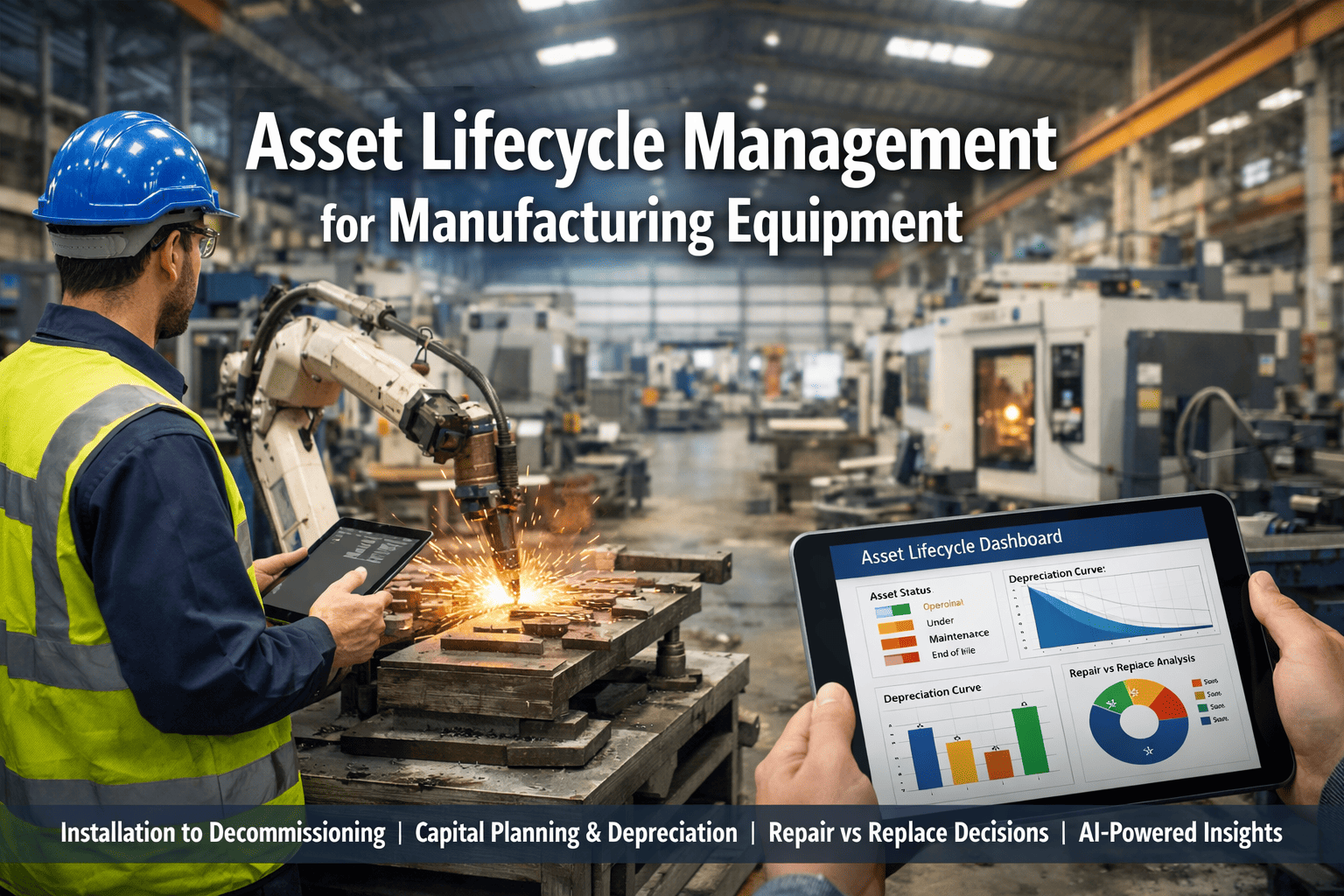
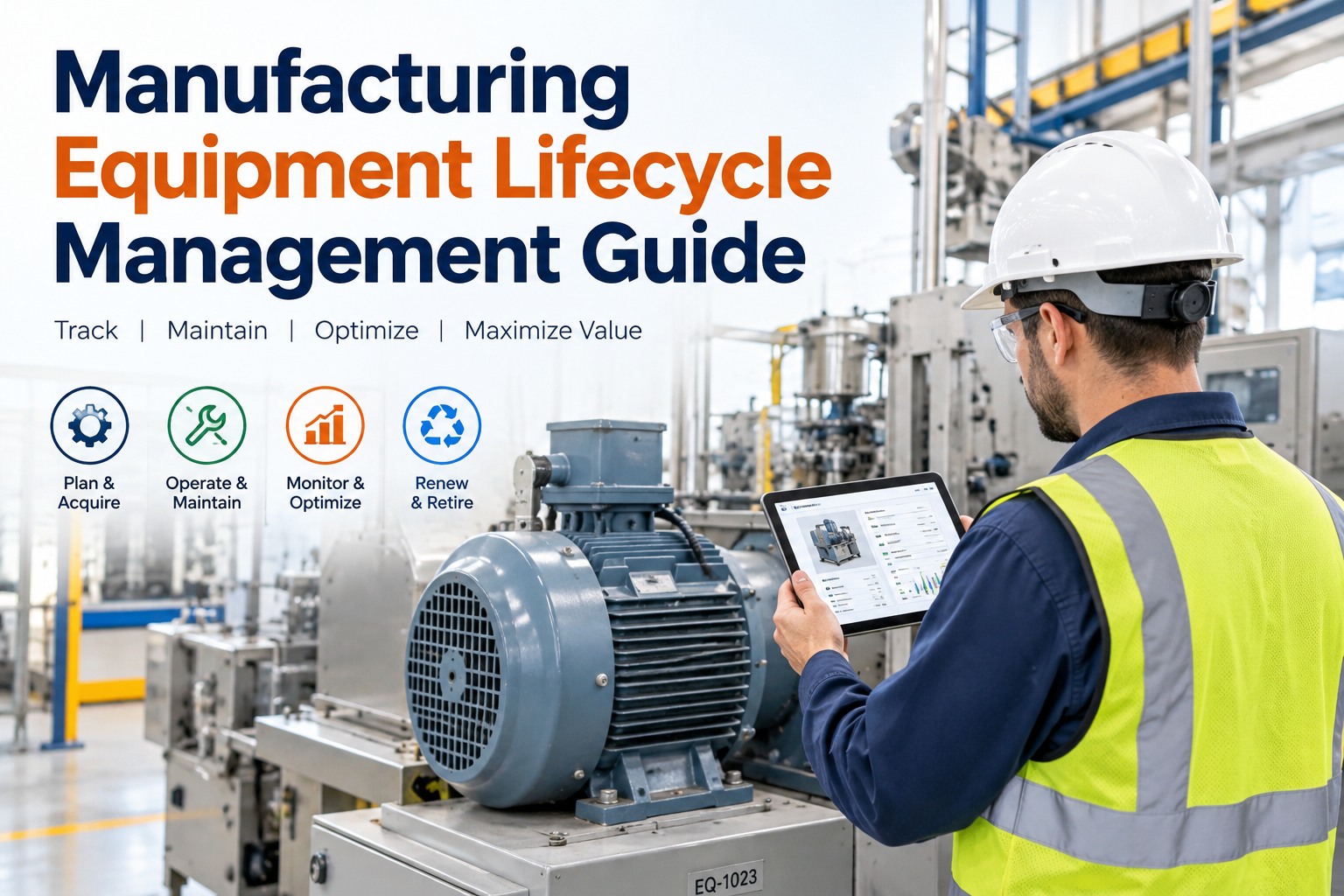
Every piece of manufacturing equipment has a story — when it was installed, what's been done to it, what broke and when, who fixed it, and how critical it actually is if it goes down. Most plants have fragments of that story scattered across a spreadsheet, a filing cabinet of service records, and whatever a technician happens to remember. Equipment lifecycle management is the discipline of keeping that story in one place, structured the same way for every asset, from commissioning to decommission — so a repair-vs-replace decision is based on an actual record, not a guess about how old something feels. This guide covers what belongs in that record, how to structure it, and how to rank criticality so the record tells you where to look first.
Manufacturing Equipment · Asset Register · Lifecycle Tracking · 2026
Give Every Machine a Record That Follows It for Life
A repair-vs-replace call made from memory and a hunch is a coin flip — the same call made from a full maintenance history, criticality score and failure trend is a decision. OXMAINT AI keeps every asset's register entry, work order history, inspection findings and criticality ranking on one record, from the day it's commissioned to the day it's decommissioned, so the next question about a machine has an actual answer.
3 phases
infant mortality, useful life, wear-out — the classic bathtub failure curve
5 levels
site, area, system, asset, component — a standard equipment hierarchy depth
4 factors
safety, production impact, repair cost and redundancy typically drive a criticality score
1 record
per asset, following it from commissioning through to decommission
The Bathtub Curve: Why One Maintenance Plan Doesn't Fit a Machine's Whole Life
Equipment failure risk isn't constant over time — it follows a well-documented pattern in reliability engineering known as the bathtub curve. A maintenance plan that's right for a machine in year three is often wrong for the same machine in year fifteen. Start free and track where each asset actually sits on this curve.
1
Infant Mortality
Early-life defects and commissioning issues. Failure rate starts high, then falls quickly.
2
Useful Life
Low, largely random failure rate. Standard PM intervals and condition monitoring fit well here.
3
Wear-Out
Rising failure rate as components age. The zone where fixed-interval plans stop being enough.
A Hierarchy That Matches How the Plant Actually Works
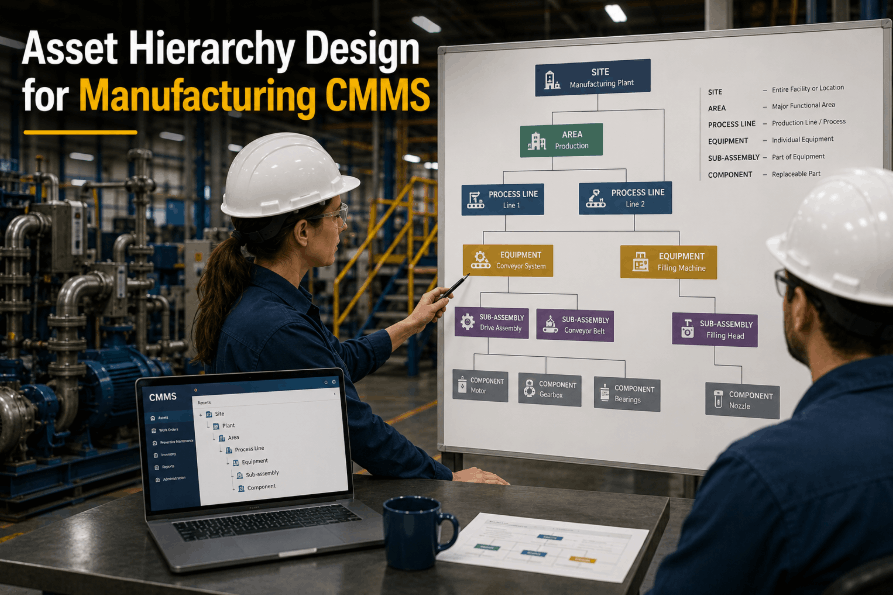
An asset register only stays useful if it's structured consistently — the same levels, applied the same way, across every line and every machine. Book a demo to see this hierarchy applied to your plant floor.
Site
The physical plant or facility.
→
Area
A production line, department or process zone.
→
System
A functional group — e.g. compressed air, a packaging cell.
→
Asset
The individual machine — the pump, the press, the conveyor.
→
Component
The part level — motor, bearing, gearbox — where wear is tracked.
What Actually Belongs in the Equipment Register
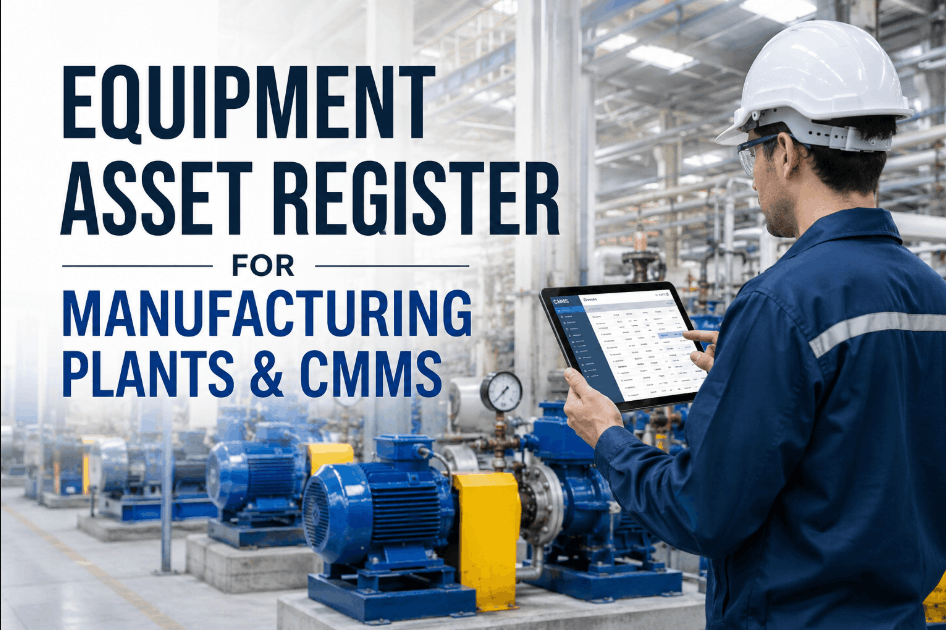
An asset register that's just a name and a location isn't much use when a repair-vs-replace decision comes up. This is the field set that makes it a working record. Sign up free and start filling in these fields on your existing equipment list.
✓
Identity — asset ID, make, model, serial number, install date.
✓
Hierarchy position — where it sits in site → area → system → asset → component.
✓
Criticality score — a defined, repeatable ranking, not a gut feeling.
✓
Full maintenance history — every work order, PM and defect, not just the last one.
✓
Spare parts & BOM — what it takes to keep it running, and current stock status.
✓
Warranty & documentation — manuals, warranty terms, and any compliance records attached.
Every Asset. Every Work Order. One History.
OXMAINT AI keeps the full register entry, criticality ranking, maintenance history and spare-parts data together per asset — so the next repair-vs-replace conversation starts from a record, not a memory.
Ranking Criticality Without Guessing
Not every asset deserves the same attention. A consistent criticality score is what lets a small team focus effort where it actually matters. Book a demo to see criticality scoring applied to your asset list.
⚠️
Safety Impact
Could a failure injure someone or create a regulatory exposure?
🏭
Production Impact
Does a failure stop the line, or just one of several redundant units?
💰
Repair Cost & Time
How expensive and how slow is the fix once it's needed?
🔁
Redundancy
Is there a backup asset, or does this one carry the whole load alone?
From Commissioning to Decommission — What the Record Should Capture
01
Commission
Asset entered into the register with full identity, hierarchy position and baseline documentation.
02
Operate & Maintain
Every PM, work order, inspection and defect logged against the asset as it happens.
03
Reassess
Criticality and condition reviewed periodically, especially as an asset moves toward wear-out.
04
Decommission
Asset retired with its full history preserved — useful reference for whatever replaces it.
Frequently Asked Questions
What's the difference between an asset register and equipment lifecycle management?
An asset register is the structured record of what equipment exists and its key attributes. Lifecycle management is the ongoing practice of updating and using that record — maintenance history, criticality reviews, condition tracking — from commissioning through decommission, rather than a static list.
How many hierarchy levels should an asset register actually have?
A common structure runs site → area → system → asset → component, but the right depth depends on plant size and how granular maintenance planning needs to be. Smaller operations sometimes collapse area and system into one level; larger multi-site operations may need an additional site-group level above.
How often should criticality rankings be reviewed?
Criticality isn't fixed — a change in production process, a new redundant unit, or an asset moving from useful life into wear-out can all change its ranking. Reviewing rankings annually, or whenever a major process or equipment change happens, keeps the score meaningful.
Do older assets need a different maintenance strategy than newer ones?
Often yes, per the bathtub curve — an asset in its wear-out phase has a rising failure rate that a fixed-interval PM plan designed for its useful-life phase doesn't account for. Condition assessment and more frequent review generally make more sense once an asset shows wear-out signs.
Can OXMAINT AI import our existing spreadsheet-based equipment list?
Yes — existing equipment lists typically import as a starting register, which can then be structured into a formal hierarchy and enriched with criticality scores and maintenance history as that data becomes available.
Stop Reconstructing a Machine's History From Memory.
Build one register entry per asset — identity, hierarchy, criticality and full maintenance history — that follows the machine from commissioning through decommission.

![equipment-asset-register-template-for-manufacturing-plants-[free-excel]](./manage-post-2k26/uploads/equipment-asset-register-template-for-manufacturing-plants-[free-excel].png)