Manufacturing plants running 24/7 operations cannot afford technicians who are guessing. A structured maintenance training program is the difference between a plant that reacts to breakdowns and one that prevents them — and the gap between those two states is measured in thousands of dollars per hour of unplanned downtime. Whether you are building a program from scratch or overhauling one that has not kept pace with new equipment, Oxmaint helps maintenance teams document procedures, track technician competencies, and close skill gaps faster — or book a 30-minute walkthrough to see how your plant can build a training system inside a live CMMS.
Maintenance Training Guide
Build a Maintenance Training Program That Actually Reduces Downtime
A step-by-step framework for manufacturing plants: skills assessment, competency mapping, on-the-job training, and certifications — built around your equipment, your team, and your production targets.
43%
of unplanned downtime traces to technician skill gaps
2.4×
faster fault resolution with structured training vs. on-the-fly learning
68%
of manufacturers say technician competency is their top maintenance challenge
Why This Matters
A maintenance training program in manufacturing is not a one-time induction course. It is a continuous system that maps every technician's skills against every asset's requirements, identifies the gaps, and closes them through structured on-the-job training, classroom instruction, and third-party certification — updated whenever equipment or processes change.
The 5-Phase Framework for a Maintenance Training Program
Most plants that struggle with training do not lack motivation — they lack structure. The following five-phase framework gives you a repeatable system that works at any plant size, from a 50-person facility to a 5,000-person operation.
01
Asset Inventory & Criticality Ranking
Before writing a single training objective, list every asset and rank it by criticality. Training resources are finite — invest them where a failure hurts most. A Tier 1 asset (production-stopping) requires deeper technician competency than a Tier 3 utility.
Output: Criticality-ranked asset register
02
Skills Gap Assessment
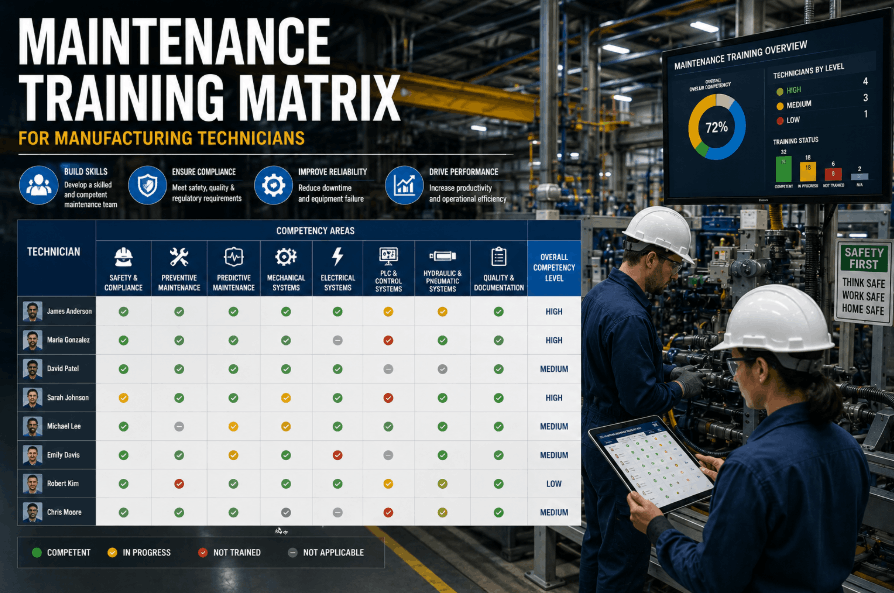
Map current technician skills against asset requirements. A skills matrix with three levels — Aware, Competent, Expert — shows exactly where the gaps are. Gaps on critical assets become high-priority training actions immediately.
Output: Skills gap heatmap by technician and asset
03
Training Content Development
Write standard operating procedures (SOPs), maintenance task instructions, and assessment checkpoints. The best training content is built from your own equipment manuals, failure histories, and experienced technician knowledge — not generic textbooks.
Output: Asset-specific SOPs and task instruction library
04
Delivery & On-the-Job Training
Classroom instruction sets the foundation. On-the-job training with a qualified mentor completes it. The ratio matters: research consistently shows that 70% of maintenance skill development happens on the job, 20% through peer coaching, and 10% through formal training.
Output: Signed-off competency records per technician
05
Certification & Continuous Assessment
Formal certification — internal sign-offs and external credentials like CMRP or SMRP — closes the loop and gives technicians recognition for competency. Refresher schedules prevent skill decay on assets that are rarely touched.
Output: Certification matrix with renewal dates
Skills gap to training plan in one platform
Your Technicians Know Some Assets. Do You Know Which Ones They Don't?
Oxmaint's competency tracking module maps technician skills against asset requirements, flags the gaps, and links training records directly to work orders — so you always know who is qualified to work on what.
Skills Matrix: The Core Tool of Any Training Program
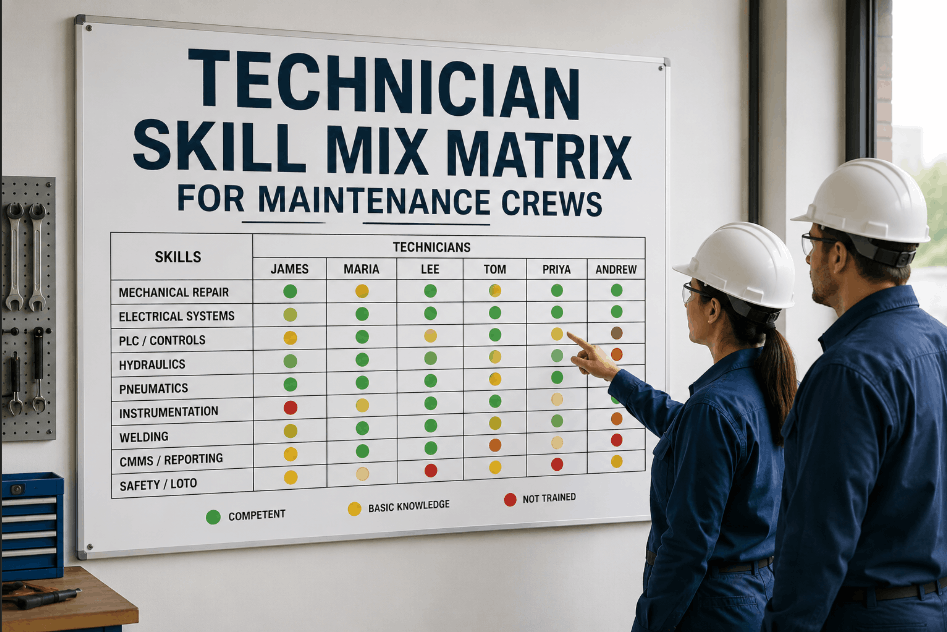
A skills matrix is a grid that cross-references every technician against every critical asset or skill area. It turns a subjective conversation about "who knows what" into a measurable, actionable document that drives training investment decisions.
Technician Skills Matrix — Sample Format
Expert — can train others
Competent — works independently
Aware — needs supervision
None — not trained
On-the-Job Training: Where Competency Is Actually Built
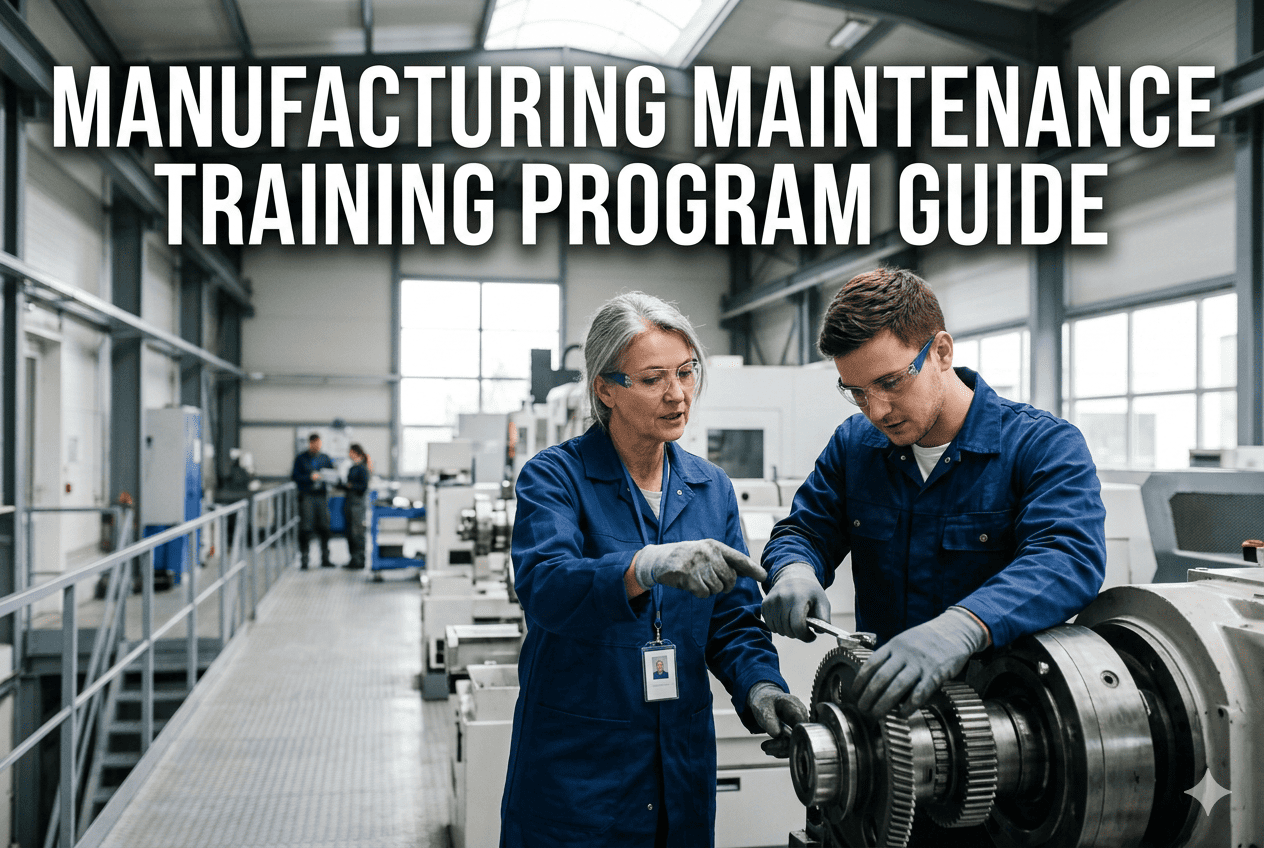
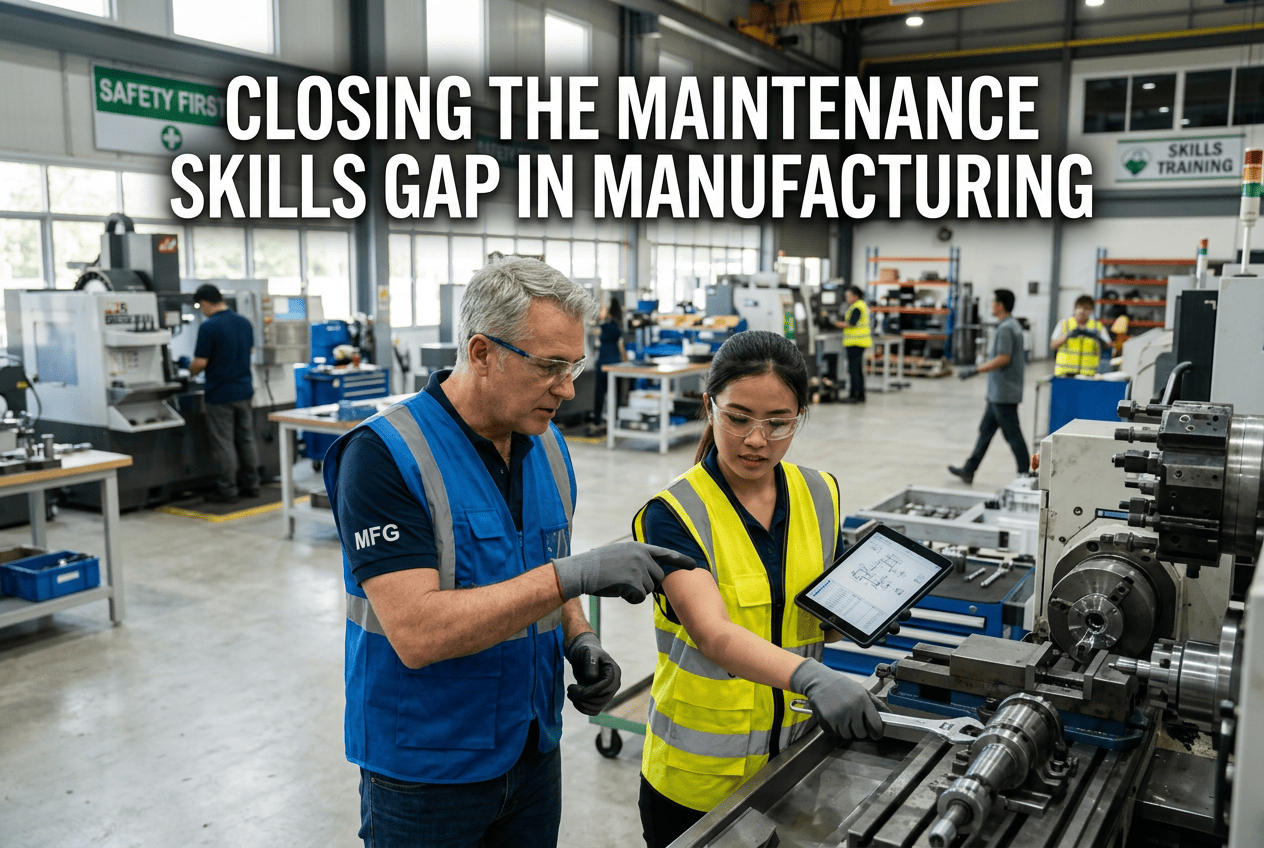
No classroom course can replicate what happens when a technician stands in front of a failing conveyor at 2 AM. Structured on-the-job training bridges the gap between knowledge and action — and it is the most cost-effective training investment a plant can make.
Step 1
Demonstrate
The qualified mentor performs the full task while the trainee observes. Every step is narrated — the why, not just the what. First pass is always slow and deliberate.
Step 2
Explain
The trainee narrates what they saw. The mentor corrects gaps in understanding before hands-on work begins. This step catches conceptual errors before they become physical mistakes.
Step 3
Practice
The trainee performs the task with the mentor watching. The mentor does not intervene unless safety is at risk — allowing the trainee to develop real confidence through doing.
Step 4
Assess
The mentor evaluates against a written checklist tied to the SOP. Pass or fail is documented. Partial competency is flagged for repeat training on specific sub-tasks only.
Maintenance Certifications That Carry Weight in Manufacturing
Internal sign-offs confirm that a technician can perform a specific task on a specific asset. External certifications confirm that a technician understands maintenance principles at a professional level. Both matter — and the best training programs build a path to both.
Measuring Training Program Effectiveness
A training program without measurement is just an expense. These four metrics tell you whether your program is working — and where to adjust it.
MTTR
Mean Time to Repair
The most direct indicator of technician competency. Trained technicians diagnose faster and complete repairs correctly the first time. Track MTTR by asset category, not just plant-wide.
Target: 15–20% reduction within 6 months of training
REWORK
Rework Rate
Repeat failures on the same asset after a maintenance task signal incomplete training or SOP gaps. A rework rate above 8% on critical assets demands immediate training review.
Target: Below 5% on Tier 1 assets
COMP%
Competency Coverage
Percentage of critical assets with at least two technicians at Competent or Expert level. Single-point-of-knowledge is a plant risk, not just a training metric.
Target: 100% of Tier 1 assets have 2+ competent technicians
CERT%
Certification Currency
Percentage of required certifications that are current and not expired. Lapsed certifications on safety-critical assets are a compliance risk as well as a competency risk.
Target: 100% current at all times
Training records inside your CMMS
Every Work Order Should Know If the Assigned Technician Is Qualified for That Asset
Oxmaint links technician competency records to asset profiles and work orders — so supervisors assign the right person every time, and compliance audits take minutes, not days.
Common Training Program Mistakes That Cost Plants Time and Money
Most training programs fail not because of a lack of effort, but because of structural mistakes that look harmless at the start. These are the five most common ones.
01
Training to the Equipment Manual, Not the Failure History
Manufacturer manuals describe how equipment works when it is new. Your failure history describes how it actually fails in your environment. The best training content merges both — and is updated every time a new failure mode appears.
02
No Refresher Schedule for Rarely-Touched Assets
A technician trained on a centrifugal pump three years ago who has not touched one since is not a competent technician — they are an audit risk. Skills decay without use. High-criticality, low-frequency assets need annual simulation or refresher training.
03
Competency Confirmation That Is Verbal, Not Documented
A supervisor saying "Rajesh is good on hydraulics" is not a competency record. When a hydraulic failure results in an injury or a regulatory audit, verbal confirmation protects no one. Every sign-off needs a date, an assessor name, and a specific task list.
04
Treating New Hire Induction as the Full Training Program
Induction gives a technician enough knowledge to work safely. It does not give them the depth to diagnose and repair complex failures. The training program that starts at onboarding and stops at week two is not a training program — it is a liability release form.
05
Measuring Training Hours Instead of Training Outcomes
Forty hours of training that does not reduce MTTR or rework is forty hours of cost with no return. Measure competency levels before and after, and track whether maintenance performance on trained assets improves. Hours are inputs — outcomes are what the business needs.
Frequently Asked Questions
How long does it take to build a maintenance training program from scratch?
A basic program with a skills matrix, SOPs for Tier 1 assets, and OJT sign-off records can be operational in 8–12 weeks. A comprehensive program covering all assets, external certifications, and refresher schedules typically takes 6–12 months to fully mature.
Oxmaint's templates accelerate the first phase significantly by giving you pre-built competency frameworks you adapt to your equipment.
What is the most cost-effective training investment for a small maintenance team?
For teams under 15 technicians, structured OJT with documented sign-offs delivers the highest ROI. Pair it with one or two CMRP certifications for senior technicians to anchor the program with professional-level knowledge. External courses for every technician are rarely affordable — internal mentoring with documented outcomes is.
How do you train technicians on assets that are rarely available for hands-on practice?
Planned shutdowns are the best opportunity — schedule OJT assessments during every planned maintenance window on critical assets. For assets that are almost never offline, simulation-based training or tabletop walkthroughs with actual spare parts are the practical alternative. Document the training regardless of format.
Should training records be inside the CMMS or in a separate HR system?
How often should the skills matrix be updated?
At minimum, review it annually and update it whenever new equipment is installed, a technician changes role, a new failure mode is identified, or a certification expires. Plants that treat the skills matrix as a living document — reviewed quarterly — consistently outperform those that update it once a year at audit time.
From skills gap to competent team
Stop Running Your Plant on Tribal Knowledge. Build a Training System That Outlasts Any One Technician.
Oxmaint gives you skills matrices, SOP libraries, competency sign-off workflows, and training records — all connected to your work orders and asset register. Your plant's knowledge stays in the system, not in someone's head.