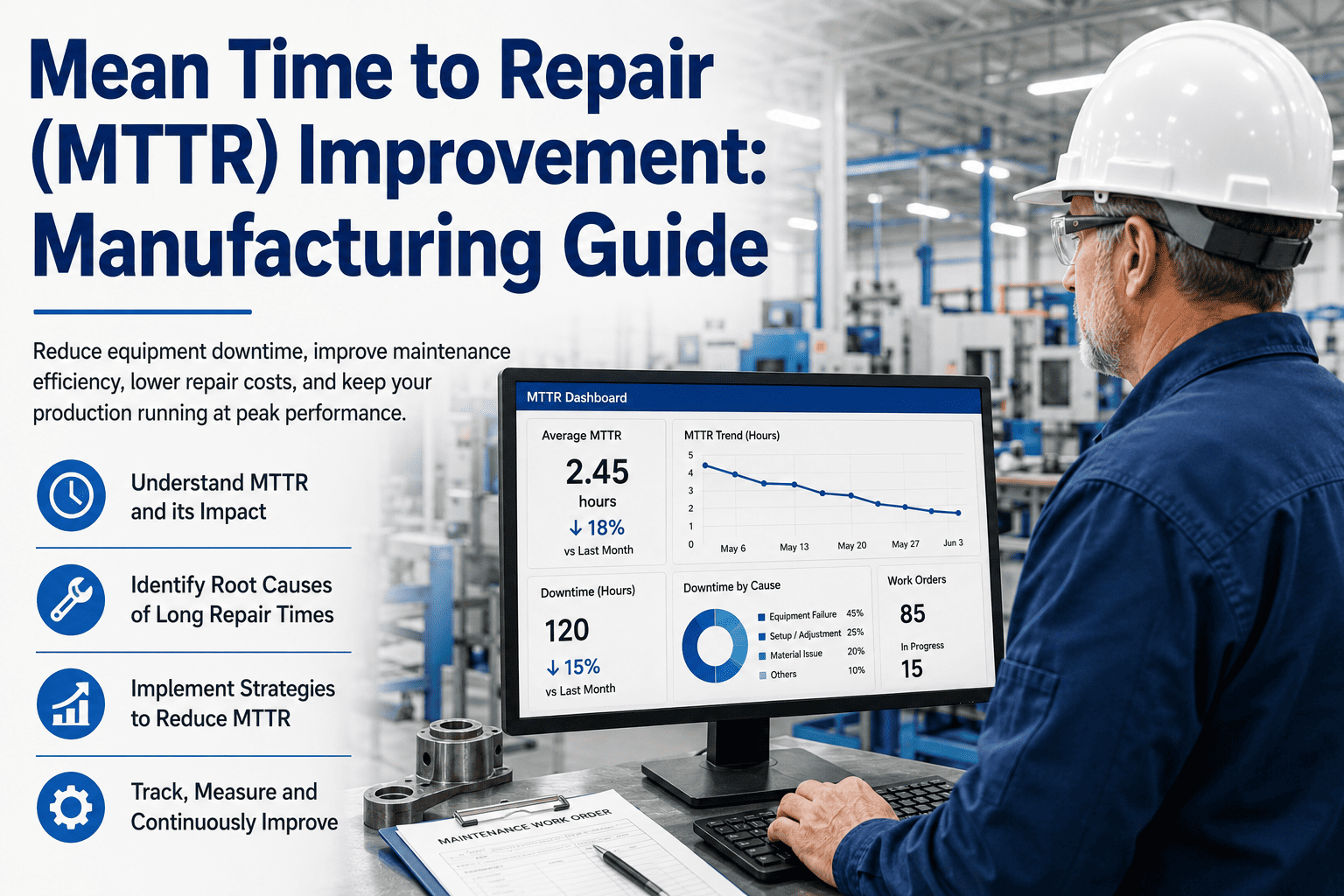
Mean Time to Repair is the single most reliable indicator of how fast your plant bounces back from an unplanned failure — and for most discrete manufacturers it sits between four and six hours, roughly double what top-quartile performers achieve. The good news is that MTTR is not a function of luck or technician heroics; it breaks down cleanly into diagnosis time, parts-wait time, and hands-on repair time, each of which can be compressed with the right workflow. Plants that deploy mobile CMMS dispatch, pre-kitted critical spares, and digital SOPs routinely cut MTTR by 30–50% within two quarters. If you want to see the platform that drives those gains in production, Start Free Trial and run a 14-day pilot on your worst-offending line.
Is a four-hour repair window really costing your plant $11,400 per event?
Every hour a critical asset sits down, throughput evaporates, overtime accrues, and the maintenance backlog compounds. Cutting MTTR from 4.5 hours to under 2 is not theoretical — it's a documented outcome when dispatch, parts, and procedures are engineered to remove wait time.
MTTR is a formula — and three levers move it
Most plants track MTTR as a single number and treat it like weather. It is actually a sum of three discrete, measurable phases, and the phase your team is weakest in dictates where the next hour of improvement work goes.
Diagnose Time
Fault-isolation minutes from the first CMMS alert to a confirmed root cause. Digitized SOPs and fault-code libraries collapse this from ~90 minutes to under 25.
Wait Time
Stalled minutes waiting for parts, permits, or a second tech. Pre-kitted critical spares and mobile dispatch cut this from ~95 minutes to under 20.
Repair Time
Actual wrench-time. Limited by skill and tooling — improved by standard work, cross-training matrices, and torque/spec sheets on the technician's tablet.
“Wait time is the silent killer. Most plants don't realize 34% of their MTTR is spent watching a forklift carry a bearing across the building.”
— Reliability engineering field study, 12 mid-size discrete manufacturersA 180-asset plant that cut MTTR from 4.6 to 1.9 hours
A Tier-2 automotive supplier running 180 critical assets was spending $42,000 a year on emergency repair overhead alone, with MTTR stuck at 4.6 hours. Here is the phase-by-phase shift after a 90-day CMMS + kitting rollout.
| MTTR Phase | Before (min) | After (min) | Lever Applied | Saved |
|---|---|---|---|---|
| Diagnose | 104 | 23 | Fault-code library + mobile SOPs | −81 min |
| Wait (parts) | 96 | 18 | Pre-kitted top-20 critical spares | −78 min |
| Wait (dispatch) | 42 | 9 | Mobile CMMS push notifications | −33 min |
| Repair | 34 | 28 | Tablet spec sheets + torque presets | −6 min |
| Total MTTR | 276 min (4.6 hr) | 78 min (1.3 hr) | Combined workflow overhaul | −198 min |
The $42K question: what does a 30–50% MTTR cut pay back?
Take a 180-asset plant averaging 1.8 critical failures per asset per year at $11,400 per event. The math is uncomfortable — and then it gets comfortable fast once the CMMS rollout lands.
324 failures × $11,400
MTTR of 4.6 hr, 324 critical events annually, average event cost blending lost throughput, emergency labor premium, and customer penalty exposure.
30% MTTR cut
Conservative 30% reduction shaves 1.4 hr per event, recovering 453 production hours per year and eliminating most emergency overtime premium on the top two lines.
50% MTTR cut
Top-quartile 50% reduction unlocks $1.85M annually, funds the entire CMMS + kitting program 16 times over, and lifts OEE on the bottleneck line by 6.2 points.
The plant didn't buy more technicians. It bought fewer minutes per failure — and the minutes were cheaper than the people.
— Plant manager, post-implementation reviewStop accepting 4-hour repairs as normal.
Deploy a mobile CMMS workflow that dispatches the right tech with the right kit in under 90 seconds — and watch MTTR fall below 2 hours inside one quarter.
What plants see in the first 90 days
“We went from 5.2 hours to 2.1 hours MTTR on our packaging line in 11 weeks. The single biggest move was kitting the top 20 failure parts — that alone killed 70 minutes of wait per event.”
“Mobile dispatch meant technicians got the work order with fault codes, SOP, and parts location before they left the breakroom. Our diagnose phase dropped from 95 to 21 minutes.”
“The payback was undeniable. $42K a year in emergency overhead became $12K, and the CMMS subscription paid for itself in under three months on one line alone.”
MTTR improvement, answered straight
What is a realistic MTTR benchmark for a discrete manufacturing plant?
Industry-average MTTR sits between 4 and 6 hours for discrete manufacturers, while top-quartile plants operate at under 2 hours. World-class facilities with mature TPM programs and mobile CMMS workflows push toward 60–90 minutes on critical assets. If your MTTR exceeds 4 hours, you are leaving roughly 220 production hours per line on the table every year — that is the first number to attack.
How do we measure MTTR correctly without skewing the data?
Start the clock at failure detection (not when the work order is finally opened) and stop it when the asset returns to production-ready state, not when the technician leaves. Count only unplanned corrective events — exclude PMs and planned downtime. Track MTTR by asset class, not plant-wide averages, because a 90-minute stamping press repair and a 6-hour conveyor motor swap should never share a denominator.
Which phase of MTTR should we attack first — diagnose, wait, or repair?
In most plants, wait time is the lowest-hanging fruit because it is almost entirely a process problem, not a skill problem. Pre-kitting the top 20 critical spares by failure mode typically removes 60–80 minutes per event with zero technician training required. Diagnose time is the next target via fault-code libraries and digital SOPs. To see both addressed in a live workflow, Book a Demo and we'll walk your top three failure modes on the call.
How long does a realistic MTTR reduction take to show results?
Plants that deploy mobile CMMS dispatch and pre-kitted spares typically see 30–50% MTTR reduction within 8–12 weeks. The fastest gains come in the first 30 days from dispatch speed and parts availability; diagnose-time improvements follow as fault-code libraries mature. Full 50%+ reductions that include repair-time gains require 4–6 months as standard work and cross-training take hold.
Is reducing MTTR worth the investment in CMMS and kitting infrastructure?
For a 180-asset plant averaging 324 critical failures a year at $11,400 per event, a 30% MTTR cut recovers over $1.1M annually; a 50% cut recovers $1.85M. Most CMMS + kitting programs pay back in 8–14 weeks on a single high-frequency line. The cost of not acting compounds — every quarter at 4.5-hour MTTR is roughly $275K in avoidable downtime on a plant that size. You can Start Free Trial and measure the gap on your own assets before committing.
Your next repair event doesn't have to be a four-hour fire drill.
Deploy the CMMS workflow that 180-asset plants use to cut MTTR by 30–50% in a single quarter. Dispatch in 90 seconds. Kit the right parts. Land repairs under 2 hours.
Free 14-day trial · No credit card