Predictive Maintenance for Manufacturing Equipment: Preventing Downtime
By oxmaint on February 27, 2026
Unplanned equipment breakdowns cost industrial manufacturers close to $50 billion every year — and the per-hour cost of a production line sitting idle has roughly doubled since 2019. For most manufacturing plants, the question is no longer whether to invest in predictive maintenance but how quickly they can get it running. By pairing IoT sensors with AI-driven analytics, predictive maintenance detects the early warning signs of equipment failure 30 to 60 days before a breakdown actually happens — giving your team the time to plan repairs, order parts, and schedule work during convenient windows instead of scrambling through costly emergency shutdowns. Want to see how this works for your equipment? Book a free demo to get a predictive maintenance plan customized for your plant.
Why Manufacturing Equipment Fails Without Warning
Most unplanned downtime is not caused by sudden catastrophic events — it is the result of slow, invisible degradation that goes undetected until it crosses a critical threshold. Aging components, lubrication breakdown, thermal stress, and vibration-induced wear accumulate quietly over weeks and months. Without continuous monitoring, maintenance teams have no way to see these problems developing until the machine stops.
42%of facilities say aging equipment is the leading cause of unplanned downtime
21%blame mechanical failure as the second most common trigger for unexpected stoppages
11%attribute unplanned stops to operator error — often caused by lack of equipment condition visibility
67%of manufacturers run preventive maintenance yet still experience unexpected failures regularly
Stop guessing which machine will fail next. Oxmaint connects your equipment data with intelligent alerting so your team catches problems weeks before they cause shutdowns.
Predictive vs Preventive Maintenance: What Actually Works
Preventive maintenance follows a calendar. Predictive maintenance follows the data. While time-based servicing reduces some failures, it also leads to over-maintenance on healthy equipment and misses problems that develop between scheduled intervals. Condition-based prediction solves both issues — servicing only when the data says it is needed and catching failures that fixed schedules miss entirely.
Time-Based Servicing
Services equipment on fixed intervals regardless of actual condition
Wastes 30-40% of component useful life through premature replacement
Zero visibility between scheduled service windows
Still results in 8-15% of failures occurring unexpectedly
Reactive gaps persist despite planned schedules
VS
Condition-Based Prediction
Triggers maintenance only when sensor data indicates developing issues
Runs components to full useful life — replacement timed precisely by data
Continuous 24/7 monitoring catches problems as they develop
Reduces unplanned downtime by 70-90% in mature programs
Data-driven precision eliminates guesswork
How AI and IoT Sensors Detect Equipment Problems Before Breakdown
Predictive maintenance is not a single technology — it is a layered system where physical sensors, edge processing, machine learning, and maintenance software each play a distinct role. Together, they transform raw machine vibrations and temperatures into clear, actionable alerts that tell your team exactly what is failing, how urgent it is, and what to do about it.
01
IoT Sensor Networks on the Factory Floor
Vibration accelerometers, temperature probes, current transducers, acoustic sensors, and pressure transmitters are mounted on critical rotating and process equipment. Modern industrial sensors capture data at sub-second intervals — building a continuous, high-resolution picture of each machine's operating health that forms the raw material for every prediction.
Edge Computing for Real-Time Response
Edge devices installed near equipment pre-process raw sensor streams locally — filtering noise, validating readings, and running initial anomaly detection. This architecture delivers sub-second alert capability even during network disruptions and reduces the bandwidth required to transmit data to central analytics systems.
02
03
Machine Learning Pattern Recognition
AI models trained on historical failure patterns and manufacturer specifications analyze incoming sensor data to detect subtle degradation signatures — bearing wear, shaft misalignment, thermal drift, motor imbalance. Modern ML pipelines achieve 85-95% accuracy in predicting mechanical failures and improve continuously as they process more data from your specific equipment.
CMMS Integration and Automated Work Orders
When AI identifies a developing issue, it generates a prioritized alert that flows directly into your maintenance management system — creating a work order with the failure type, urgency level, recommended corrective action, and required spare parts. Sign up for Oxmaint to automate work orders from predictive alerts — so nothing falls through the cracks between detection and repair.
04
Watch sensor alerts turn into resolved work orders — automatically. Book a live demo and our engineers will walk through the complete predictive workflow for your equipment types.
5 Monitoring Methods That Predict Machine Failures
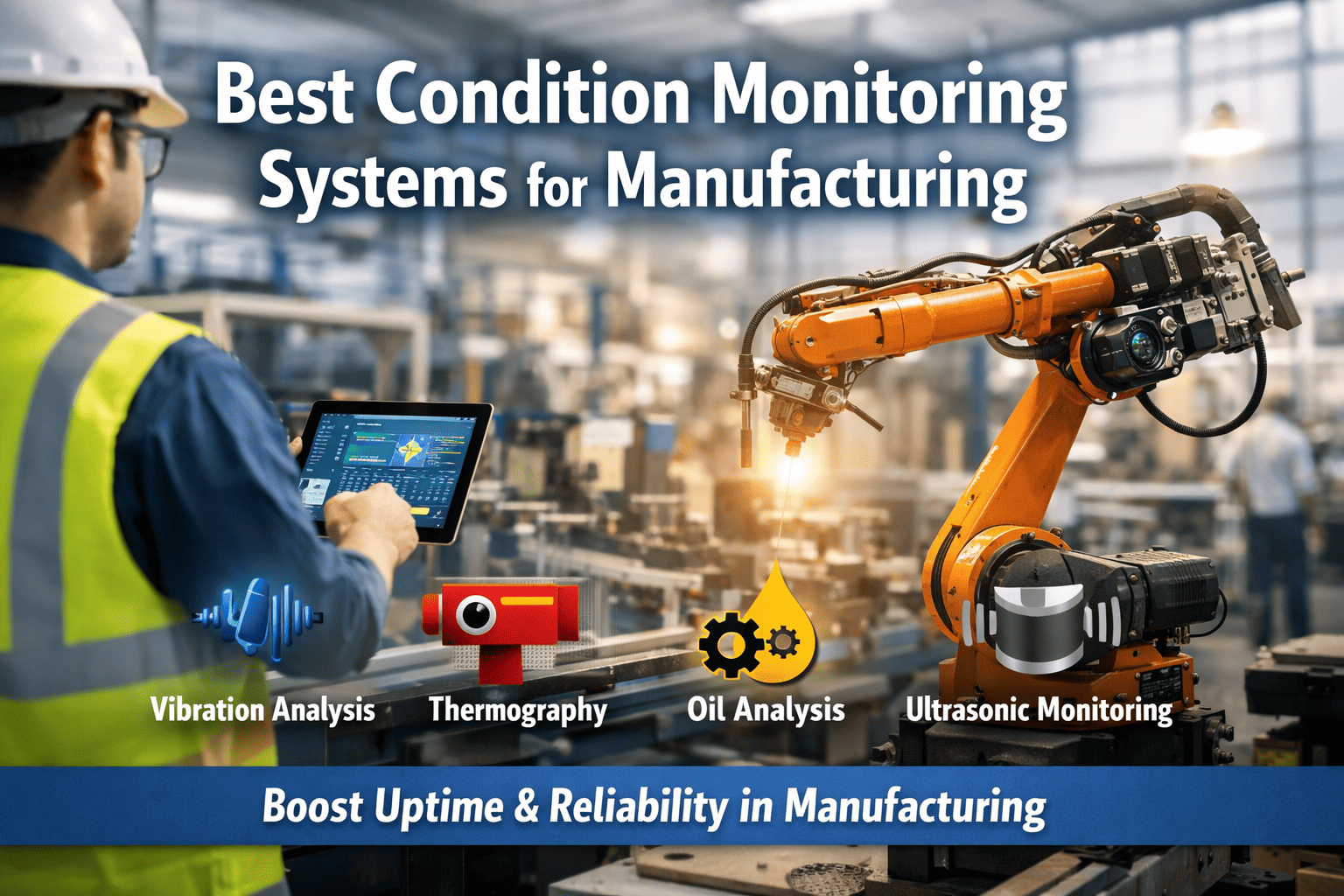
No single sensor catches every failure mode. The strongest predictive programs layer multiple condition-monitoring techniques together — vibration catches mechanical wear, thermography catches electrical and thermal faults, oil analysis reveals internal degradation, and acoustic monitoring finds leaks and arcing. Choosing the right combination for your equipment is what separates a good program from a great one.
Vibration Analysis
Best for: Motors, pumps, fans, compressors, gearboxes
Accelerometers and velocity sensors detect imbalance, misalignment, bearing defects, looseness, and gear mesh problems in rotating equipment. The most widely deployed predictive technique in manufacturing — covering roughly 27% of all condition monitoring applications — because rotating machinery is the backbone of most production lines.
Infrared Thermography
Best for: Electrical panels, switchgear, bearings, steam systems
Non-contact thermal cameras identify hot spots caused by loose connections, overloaded circuits, bearing friction, insulation breakdown, and blocked cooling. Scans are performed on energized, running equipment with zero production interruption — making thermography one of the fastest and least disruptive predictive techniques available.
Oil and Lubricant Analysis
Best for: Gearboxes, hydraulic systems, engines, turbines
Laboratory testing of oil samples reveals metal wear particles, contamination levels, viscosity changes, and chemical degradation. Provides a window into the internal condition of enclosed components that cannot be inspected visually — detecting gear tooth wear, piston ring degradation, and seal failures months before external symptoms appear.
Ultrasonic Detection
Best for: Pneumatic systems, slow-speed bearings, electrical systems
Airborne and structure-borne ultrasonic sensors detect high-frequency sound emissions from compressed air leaks, electrical arcing, corona discharge, and early bearing deterioration. Particularly valuable for slow-speed equipment where vibration analysis has limited sensitivity, and for finding energy waste in pneumatic distribution networks.
Motor Current Signature Analysis
Best for: Electric motors of all sizes across the plant
Analyzes electrical current patterns to identify rotor bar cracks, stator winding faults, eccentricity, and load anomalies — without installing any additional physical sensors. Uses existing power monitoring infrastructure, making it one of the lowest-cost predictive methods to deploy across large motor populations in any manufacturing facility.
Industries Saving Millions with Predictive Equipment Monitoring
Every manufacturing sector has different critical equipment, failure modes, and downtime cost profiles. But the pattern is consistent: plants that deploy predictive monitoring on their highest-impact assets see measurable cost reductions and uptime improvements within the first 6-12 months. Book a demo to identify which assets in your plant will deliver the fastest ROI.
Real Numbers: Predictive Maintenance ROI in Manufacturing
The business case for predictive maintenance is not theoretical — it is backed by deployment data from thousands of manufacturing facilities worldwide. The global market for predictive maintenance solutions is projected to grow from roughly $14 billion in 2025 to over $63 billion by 2030, driven entirely by the measurable returns that early adopters are documenting.
Maintenance Cost Reduction40%
Mature predictive programs cut total maintenance spend by eliminating unnecessary scheduled work and preventing expensive emergency repairs
Unplanned Downtime Reduction70-90%
Plants with established condition monitoring report near-elimination of surprise equipment failures on monitored assets
Equipment Uptime Increase10-25%
More available machine hours translate directly into higher production output and better on-time delivery performance
Adopters Reporting Positive ROI95%
Industry studies confirm that nearly all manufacturing plants that commit to predictive maintenance see a net positive financial return
Model the savings for your plant. Create a free Oxmaint account and our team will help you calculate projected ROI based on your equipment, downtime history, and current maintenance spend.
Step-by-Step: Launching Predictive Maintenance at Your Plant
The most successful predictive maintenance programs do not try to cover every asset on day one. They start with a focused pilot on the equipment that causes the most pain, prove measurable value, and then expand based on documented results. Here is the proven four-phase approach that consistently delivers the fastest time-to-value.
1
Weeks 1-4
Criticality Assessment
Rank every production asset by failure consequence — production loss, safety risk, quality impact, repair cost. Identify the 10-20 machines where predictive monitoring will deliver the highest return. Map existing sensors and data infrastructure.
2
Weeks 5-8
Pilot Deployment
Install sensors on priority assets, connect edge devices, begin baseline data collection. Integrate monitoring alerts with your CMMS for automated work order creation. Train technicians on condition reports and AI-generated recommendations.
3
Weeks 9-12
Validate and Tune
Compare AI predictions against actual equipment outcomes. Adjust detection thresholds to minimize false alerts. Document early wins — downtime hours prevented, emergency repairs avoided, parts cost savings — and build the ROI case for expansion.
4
Month 4+
Scale Across Production
Extend monitoring to additional lines, facilities, and equipment categories. AI models improve with every confirmed failure data point. Advanced capabilities — remaining useful life estimation, predictive spare parts ordering — unlock as the data foundation matures.
"
We used to replace half our motors on a fixed schedule because we had no way to know which ones were actually degrading. After deploying predictive monitoring, we realized only 15% needed attention at any given time. Our parts budget dropped 35% in the first year, and we have not had an unplanned motor failure in nine months.
— Plant Maintenance Manager, Automotive Parts Manufacturer
Turn Equipment Data into Downtime Prevention
Your machines are already generating the signals that reveal developing failures — you just need the right platform to listen. Oxmaint connects real-time condition monitoring, automated work order management, asset tracking, and maintenance scheduling into one unified system. Catch failures early, plan repairs during convenient windows, and keep every line running at peak performance.
How soon does predictive maintenance start catching equipment issues?
Most manufacturing plants receive actionable alerts within 30 days of sensor deployment. Quick wins — catching a failing bearing, a misaligned coupling, or an overheating connection — often appear within weeks. As AI models accumulate data from your specific equipment, prediction accuracy improves and failure forecasts extend further into the future. Book a demo to see how quickly Oxmaint can start detecting failures on your equipment.
Do we need to replace our existing preventive maintenance program?
Not at all. Predictive maintenance layers on top of your current program — it complements rather than replaces it. Start by adding condition monitoring to your most failure-prone or highest-impact equipment, then use data to gradually shift calendar-based tasks to condition-based triggers. Over time, unnecessary scheduled maintenance is eliminated while reliability improves.
Which manufacturing equipment benefits most from predictive monitoring?
Rotating equipment delivers the fastest ROI — electric motors, pumps, fans, compressors, and gearboxes respond extremely well to vibration and thermal monitoring. Beyond that, hydraulic systems, CNC spindles, conveyor drives, and electrical distribution panels are strong candidates. The best starting point is your most production-critical assets. Sign up free to start ranking your equipment by failure risk and maintenance priority.
What is the typical payback period for predictive maintenance?
Industry data shows 27% of adopters achieve full payback within 12 months, with 95% reporting positive ROI overall. The timeline depends on current downtime costs, equipment complexity, and maintenance spend. Plants with high-value lines or expensive emergency repair histories recover their investment fastest.
How does Oxmaint support a predictive maintenance workflow?
Oxmaint acts as the central command platform connecting equipment monitoring data with maintenance execution. When sensor alerts or AI predictions are triggered, Oxmaint automatically creates prioritized work orders with failure context, recommended actions, parts requirements, and technician assignments. It also tracks full asset history, manages inspection schedules, and provides real-time health dashboards. Book a demo to watch Oxmaint turn a live sensor alert into a completed maintenance task.