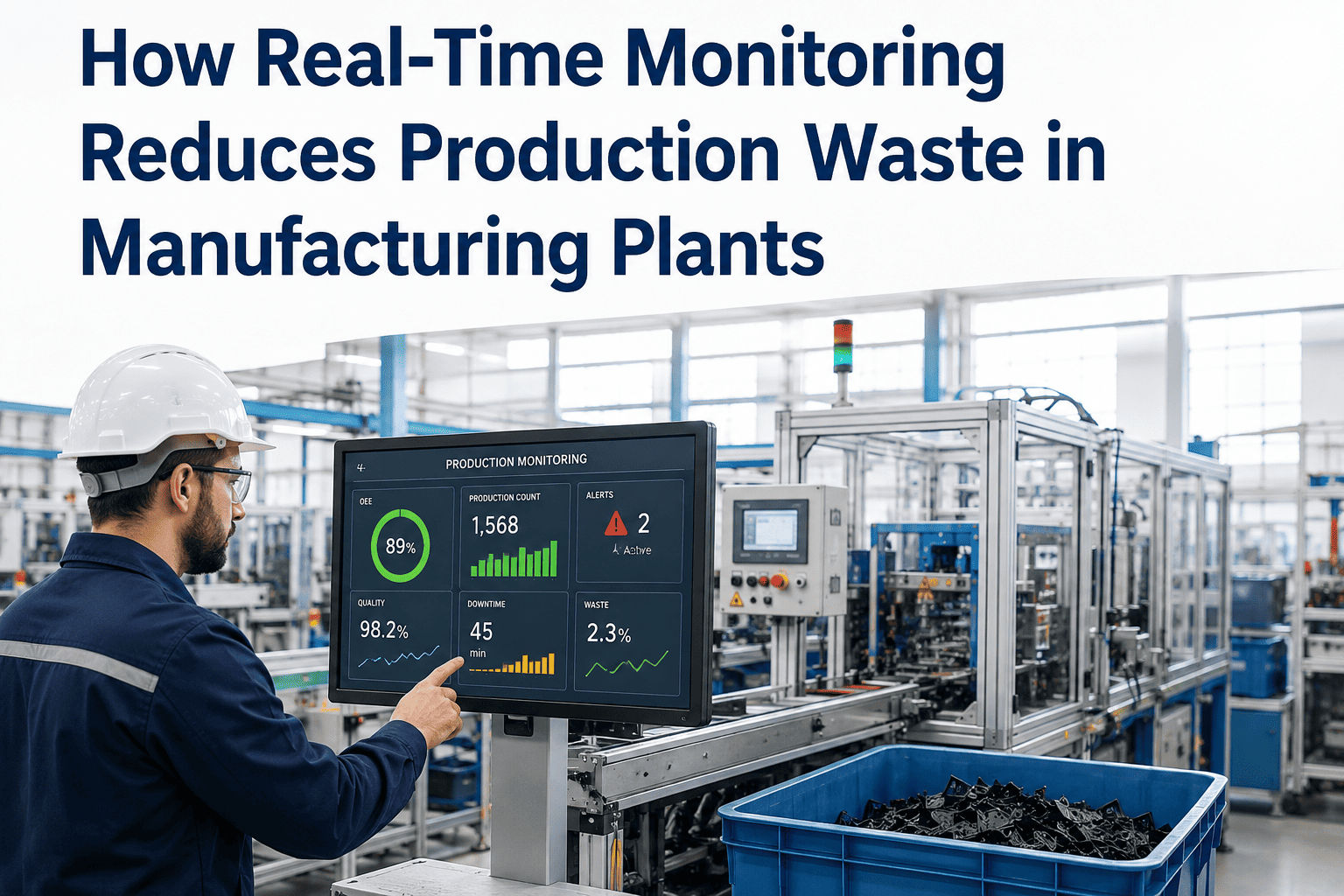
Most manufacturers are not suffering from a data shortage — they are suffering from a visibility lag. Machines stream data 24/7, yet production supervisors still discover equipment failures at shift-end reports, quality escapes three production runs too late, and bottlenecks only after delivery deadlines are already missed. Oxmaint's real-time production monitoring dashboard closes that gap by converting live machine signals, sensor readings, and operator inputs into a single factory-wide view that updates every few seconds — not every few hours. McKinsey research documents 10–15% productivity gains and up to 50% downtime reduction for plants that make the shift to real-time analytics. This guide explains what that shift looks like in practice and how you can book a 30-minute demo to see a live dashboard built from your production data.
The Visibility Lag Is Costing You More Than You Think
The time between a production problem occurring and someone with the authority to fix it seeing the data is where your biggest losses live. Here is what the same event looks like under three different visibility systems.
Event Occurs
Real-Time Dashboard
End-of-Shift Report
Weekly Report
Machine speed drop to 65% of target
Alert in <60 sec
6–8 hrs later
4–7 days later
Unplanned equipment stop begins
Alert in <60 sec
End of shift
Next weekly review
OEE drops below target threshold
Visible immediately
After shift close
Next week only
Quality defect rate rises above threshold
Immediate alert
After inspection batch
Post-shipment review
Schedule attainment falls behind target
Live progress tracking
Shift-end count only
Too late to recover
Production loss by event type
Contained within minutes
Full shift lost
Multiple runs affected
Stop Finding Out About Problems After the Shift Ends
Get Full Plant Visibility in Real Time — Starting in Under a Week
Oxmaint connects to your existing equipment signals and delivers a live production dashboard showing machine status, OEE by asset, active alerts, schedule attainment, and downtime reasons — updated every 60 seconds. No MES implementation project. No 6-month rollout. Most facilities go live on critical assets in under 5 days.
5 Dashboard Views Your Production Team Needs
A single dashboard cannot serve every role on your plant. Effective real-time monitoring delivers role-specific views — each surfacing the data that drives decisions at that level without burying the user in irrelevant metrics.
01
Shop Floor Status Dashboard
For: Operators & Supervisors
A full-floor machine status grid showing every asset's current state — running, slow, stopped, PM — with OEE by machine and real-time output counts vs. target. Color-coded so anyone on the floor reads it in under 3 seconds.
Key Metrics Displayed
Machine status (live)
Units produced vs. target
Cycle time vs. ideal
Active stop reason
Current OEE per asset
Updates every: 15–60 seconds
02
Production Performance Dashboard
For: Production Managers
Aggregates line-level output, schedule attainment, throughput rate, and first pass yield across the entire plant. Shows today's performance vs. target and highlights which lines are at risk of missing shift commitments.
Key Metrics Displayed
Schedule attainment %
Throughput by line
First pass yield live
Takt vs. cycle time
Shift output vs. plan
Updates every: 5–15 minutes
03
Maintenance & Reliability Dashboard
For: Maintenance Teams
Shows asset health scores, open work orders, upcoming PM schedules, MTBF and MTTR trends, and live alert feeds from condition monitoring sensors. Enables maintenance planners to dispatch technicians before breakdowns extend into full production halts.
Key Metrics Displayed
Asset health score
Open work orders
MTBF / MTTR trend
PM compliance rate
Sensor anomaly alerts
Updates every: Real-time alerts + hourly trend
04
Quality & Defect Monitoring Dashboard
For: Quality Engineers
Tracks defect rate, scrap rate, and rework volume by line, machine, and shift in real time. Triggers alerts when defect rates cross configured thresholds — before a full batch becomes a quality escape that reaches customer delivery.
Key Metrics Displayed
Defect rate by machine
Scrap rate real-time
Rework volume by shift
SPC control chart status
Quality alert count
Updates every: Per-unit or batch inspection
05
Executive Plant Performance Dashboard
For: Plant Managers & Leadership
Rolls up plant-wide OEE, cost per unit, on-time delivery rate, and maintenance spend against targets — with trend lines showing week-over-week and month-over-month direction. Designed for 60-second daily review, not deep drill-down.
Key Metrics Displayed
Plant OEE vs. target
On-time delivery %
Cost per unit trend
Maintenance cost / RAV
Safety incident count
Updates every: Daily roll-up with live OEE
Where AI Adds Intelligence Beyond Raw Real-Time Data
A live dashboard shows you what is happening right now. AI-powered analytics shows you what is about to happen — and why. These four AI capabilities separate a monitoring platform from a true analytics engine.
Predictive
Anomaly Detection Before Failure
AI continuously monitors sensor readings — vibration, temperature, current draw, pressure — against each asset's learned baseline. When readings deviate from normal patterns in ways that precede historical failures, the system alerts maintenance 2–4 weeks before the breakdown occurs, not during it.
50%
Downtime reduction (PwC)
2–4 wks
Early warning lead time
Diagnostic
Root Cause Surface in Real Time
When a machine stops or performance drops, AI cross-references the event against sensor history, maintenance logs, and production parameters to generate a ranked list of probable root causes — eliminating the 2–4 hour diagnostic investigation that delays repair response on complex equipment.
85%+
Root cause classification accuracy
~2 hrs
Saved per diagnostic event
Prescriptive
AI-Recommended Corrective Actions
Beyond identifying what went wrong, AI prescriptive engines suggest which corrective action has the highest probability of resolving the issue based on how similar events were resolved historically across your asset fleet — giving technicians a starting point, not a blank page.
15–20%
Production rate improvement
30–40%
Scrap rate reduction
Continuous
Shift Summary & Pattern Learning
AI generates an automated shift summary every morning — surfacing what changed, what improved, and what needs attention — so production leaders spend the first 5 minutes of their day acting on data instead of assembling it from spreadsheets and WhatsApp messages from night shift supervisors.
86%
Execs rate real-time analytics critical
31%
Higher productivity with data access
By the Numbers: Real-Time Monitoring Outcomes
These benchmarks reflect documented outcomes from manufacturing facilities that deployed real-time production monitoring and AI analytics across their plant floor operations.
McKinsey — manufacturers implementing advanced real-time analytics
PwC study on predictive maintenance + real-time monitoring integration
75%
Quality Issues Prevented
Quality Magazine Survey — preventable with proper real-time monitoring
31%
Productivity Improvement
Manufacturing Leadership Council — plants where 75%+ of employees access live production data
Share of manufacturing facilities that now rely on data analytics to improve productivity
How Real-Time Monitoring Connects to Your Plant Floor
Deployment does not require a full MES overhaul or a PLC integration project. Modern real-time monitoring platforms are designed to connect to what you already have.
| Data Source |
What It Provides |
Integration Method |
Time to Live |
| PLC / Machine Control |
Machine run/stop state, cycle counts, speed signals |
OPC-UA, Modbus TCP, direct connect |
1–3 days |
| IoT Condition Sensors |
Vibration, temperature, current, pressure readings |
MQTT, REST API, wireless gateway |
1–5 days |
| CMMS Work Orders |
Maintenance history, failure codes, repair duration |
REST API, CSV import, native integration |
Same day |
| Operator Mobile Input |
Stop reason codes, quality notes, production counts |
Oxmaint mobile app — no hardware needed |
Immediate |
| ERP / MES System |
Production schedule, job orders, material availability |
REST API, webhook, scheduled sync |
3–10 days |
| Quality Inspection |
Defect counts, scrap records, inspection results |
CSV, API, or manual entry via mobile |
1–3 days |
Oxmaint supports all six data source types and begins displaying live production metrics as each integration is connected — so you get partial value immediately, not after a complete deployment is finished.
Your Plant Floor Is Generating Data Right Now That Nobody Is Acting On
Turn That Data Into a Live Dashboard Your Entire Team Uses Every Day
86% of manufacturing executives rate real-time analytics as extremely important to their operational strategy. The plants acting on that data today are pulling ahead in OEE, delivery reliability, and cost per unit. The gap between data-driven plants and those still on shift-end spreadsheets widens every quarter. Oxmaint closes it in days, not months.
Frequently Asked Questions
What is a real-time production monitoring dashboard in manufacturing?
A real-time production monitoring dashboard is a live digital interface that aggregates machine status, OEE, throughput, downtime events, and quality metrics from your factory floor and displays them on a continuously updated screen — typically refreshing every 15–60 seconds. Unlike end-of-shift reports or daily performance reviews, real-time dashboards enable supervisors to see problems as they occur and dispatch responses within minutes rather than discovering losses the next morning.
Oxmaint's monitoring dashboard connects to existing equipment signals and displays a full plant floor view from day one without requiring a major MES implementation.
How does AI improve real-time production monitoring?
AI adds four capabilities that raw real-time data alone cannot provide: predictive anomaly detection that identifies equipment degradation 2–4 weeks before failure; automated root cause classification that explains why a machine stopped without a manual investigation; prescriptive recommendations for corrective action based on historical resolution data; and automated shift summaries that surface the most important findings from millions of data points in a 60-second morning briefing.
Book a demo to see how Oxmaint's AI layer converts live machine data into prioritized action items rather than just numbers on a screen.
How long does it take to deploy a real-time production monitoring system?
Modern cloud-based platforms connect to existing PLC signals, OPC-UA data streams, and operator mobile inputs without custom development — most facilities go live on 5–10 critical assets within 3–5 days. Full plant deployment including condition sensor integration typically takes 2–4 weeks. Unlike legacy MES projects that require months of configuration, Oxmaint's modular approach means you start seeing live data from the first connected asset and expand from there.
Start your free account to begin the integration assessment for your specific equipment and data sources.
What data sources do real-time manufacturing dashboards connect to?
Production monitoring platforms typically connect to PLCs and machine controls via OPC-UA or Modbus, IoT condition sensors via MQTT or wireless gateways, CMMS systems via REST API, ERP and MES systems via scheduled data sync, quality inspection results, and direct operator input via mobile app for facilities without automated sensors. Most plants start with 2–3 data sources and add others over time — each additional source improves the diagnostic depth of the AI analytics layer.
Schedule a technical demo to map which integration paths apply to your specific plant and equipment fleet.
What is the ROI of real-time production monitoring software?
McKinsey documents 10–15% productivity gains and up to 50% downtime reduction for manufacturers deploying real-time analytics. Plants where 75%+ of employees have access to live production data achieve 31% higher productivity improvements than those where data is restricted to management. For a facility losing $125K per hour of unplanned downtime, a 30% reduction in stop events translates to $500K–$1M in annual recovered production value — typically delivering full program payback within 6–12 months.
Start Oxmaint free and begin tracking your recovery against baseline downtime data within the first 30 days of deployment.
Can real-time monitoring work without replacing our existing systems?
Yes — modern production monitoring platforms are designed to layer on top of existing PLCs, ERP systems, and CMMS tools via standard industrial protocols rather than replacing them. Oxmaint reads data from machines and systems you already have, adds an AI analytics layer, and displays the combined view on a live dashboard — without requiring operators to change how they currently interact with equipment. This integration-first architecture is specifically designed for plants that cannot afford a full MES replacement but need real-time visibility immediately.
Book a session to walk through the integration architecture for your specific technology stack.
Every Minute Without Visibility Is a Minute of Preventable Loss
See Every Machine. Know Every Stop. Act in Minutes, Not Hours.
Oxmaint delivers the real-time production monitoring dashboard your plant floor needs — machine status, live OEE, AI anomaly alerts, downtime tracking, and automated work orders in a single platform. No blind spots. No shift-end surprises. No production losses sitting in a spreadsheet nobody acted on. Start free and see your first live plant view in under a week.

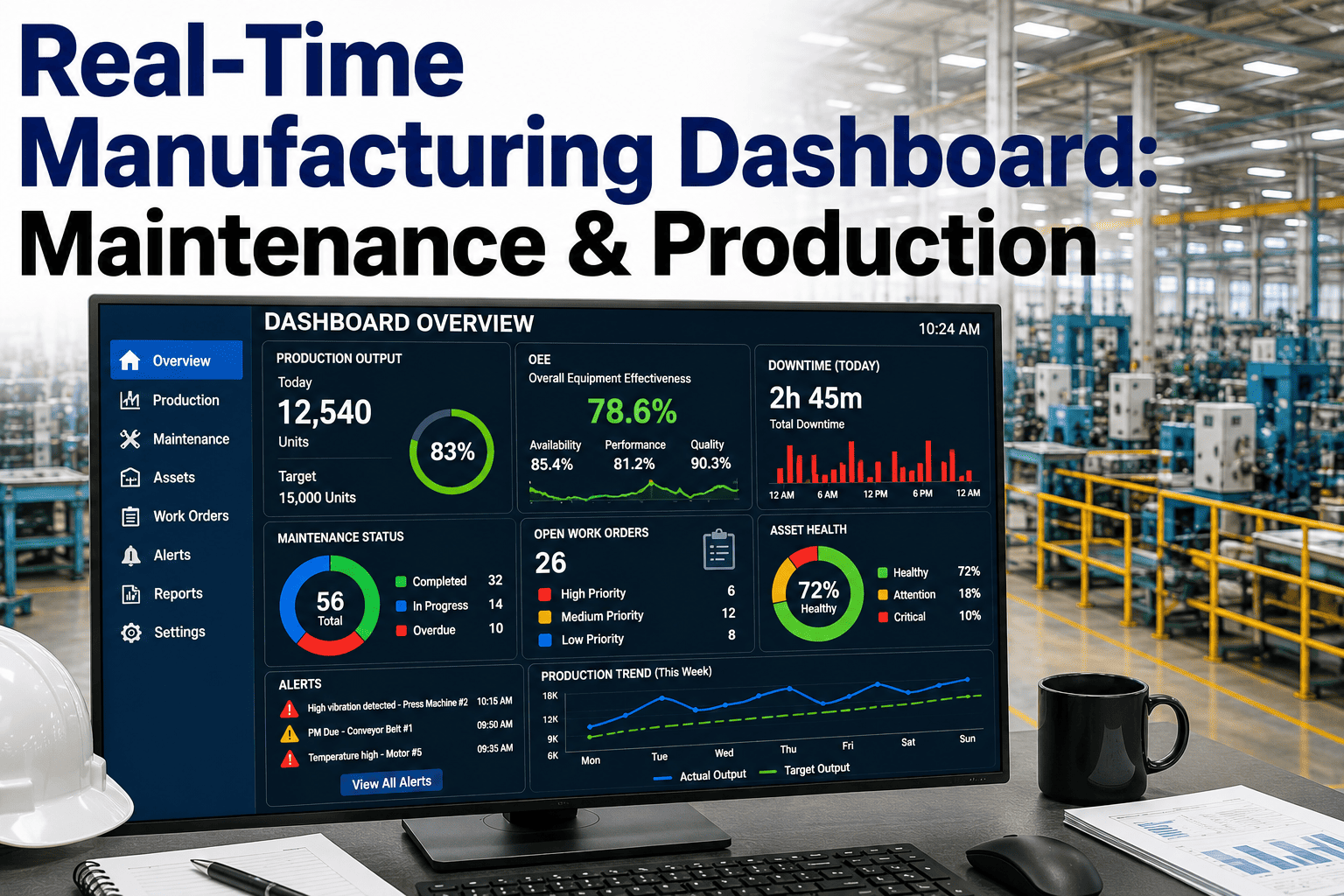

![machine-downtime-tracking-template-for-manufacturing-[excel-dashboard]](./manage-post-2k26/uploads/machine-downtime-tracking-template-for-manufacturing-[excel-dashboard].png)