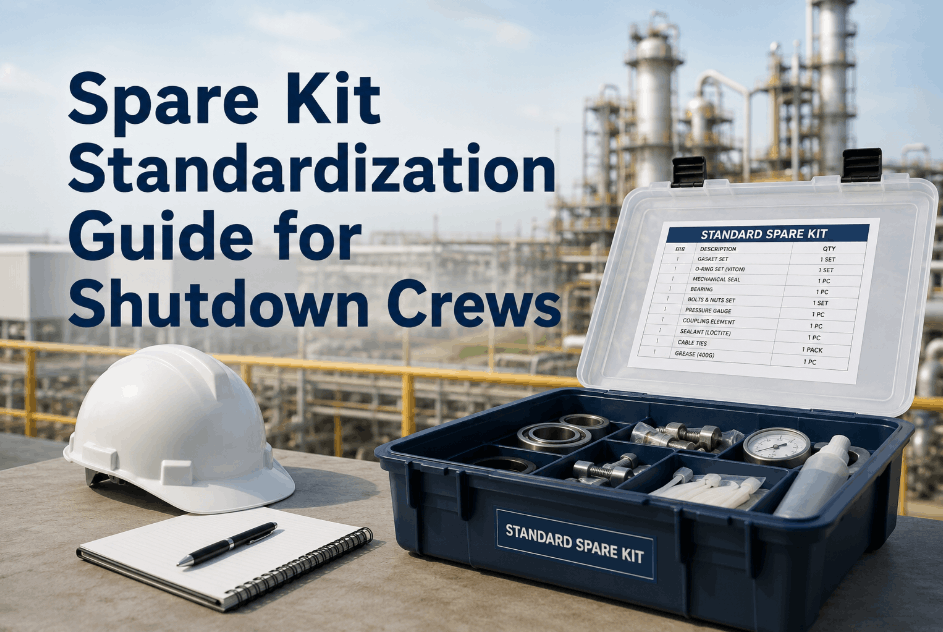
Shutdown execution quality is determined long before the first wrench turns. When spare kit contents vary by crew, by site, or by whoever built the kit last time, the result is inconsistent work quality, last-minute storeroom runs, and job completion times that drift unpredictably from planned durations. Standardized spare kits eliminate this variability at the source — ensuring every shutdown crew arrives with the exact components, consumables, and fasteners the job requires, regardless of who staged the materials or when. Maintenance operations using Sign Up Free on OxMaint can build kit templates tied directly to work order types, link kit contents to asset bill-of-materials records, and confirm kit completeness through pre-job inspection checklists before crews leave the warehouse. Spare kit standardization reduces job duration variance, eliminates mid-shutdown parts scrambles, and builds the consistency that transforms shutdown crew performance from unpredictable to measurable. Book a Demo to see how OxMaint connects kit templates to work order scheduling, inventory reservation, and shutdown planning in a single platform.
Why Spare Kit Inconsistency Undermines Shutdown Performance
Shutdown crews operating without standardized kits face a predictable problem: the parts that matter most — gaskets, seals, fasteners, lubricants — are either missing, substituted informally, or stocked in the wrong quantities because each kit was assembled from memory rather than from a controlled template. Book a Demo to see how OxMaint's work order and inventory management tools eliminate kit content variability across shutdown teams, shifts, and sites.
Six Principles of Spare Kit Standardization for Shutdown Crews
Effective spare kit standardization is not just a bill-of-materials exercise. It requires discipline across template design, inventory reservation, pre-staging, and post-job review to sustain kit quality over repeated shutdown cycles. Sign Up Free to start building work order-linked kit templates in OxMaint and establish the standardization foundation your shutdown program needs.
Work Order-Linked Kit Templates by Job Type
Kit contents should be defined at the work order template level — not assembled ad hoc for each job. Linking standard kit bills-of-materials to specific maintenance task types in OxMaint ensures the same kit is built consistently every time that job is scheduled, regardless of who prepares it.
Asset-Specific Bill-of-Materials Integration
Kit contents must reflect the actual components installed on the asset being serviced — not generic equivalents based on equipment class. Linking kit templates to asset-level bill-of-materials records in OxMaint ensures part numbers, specifications, and quantities match the real equipment being maintained.
Inventory Reservation at Work Order Creation
Kit contents should be reserved in the warehouse system at the moment a shutdown work order is created — not at the time of execution. Early reservation prevents the same parts from being allocated to competing jobs and surfaces availability gaps while procurement options are still open.
Pre-Staging Inspection and Kit Completeness Verification
A kit template is only as reliable as the pre-job verification that confirms it was assembled correctly. Pre-staging checklists in OxMaint require a physical count against the kit BOM before the job is released to the crew — catching missing items in the warehouse, not at the work site.
Approved Substitution Lists for Supply Contingencies
Standardized kits must account for the reality that primary parts are occasionally unavailable at scheduling time. Maintaining approved substitution lists in OxMaint — pre-vetted by engineering or reliability teams — enables kit completion with qualified alternates rather than informal field substitutions that introduce reliability risk.
Post-Job Kit Usage Review and Template Updates
Parts returned unused after every job are signals that kit quantities need recalibration. Post-job usage reviews in OxMaint compare kit quantities issued against quantities consumed — building the consumption data that refines kit templates over successive shutdown cycles and reduces both shortages and waste.
Standard Spare Kit Contents by Shutdown Job Type
Kit content requirements vary significantly by job type, asset class, and maintenance complexity. Mapping kit standards by job category ensures the right parts reach the right crew for every shutdown task. Book a Demo to explore how OxMaint manages work order-linked kit templates, inventory reservation, and pre-staging verification across shutdown job types.
| Shutdown Job Type | Core Kit Components | Common Missing Items | Substitution Risk | OxMaint Kit Management Lever |
|---|---|---|---|---|
| Pump Overhaul | Mechanical seals, bearings, gaskets, fasteners | Seal flush components, coupling elements | High — seal specs asset-specific | Asset BOM-linked kit template + pre-stage checklist |
| Gearbox Service | Lubricant, oil seals, breathers, gaskets | Drain plug seals, level gauge components | Medium — lubricant grade critical | Lubricant spec linked to asset record in OxMaint |
| Heat Exchanger Maintenance | Tube plugs, gaskets, bolt sets, cleaning chemicals | Correct gasket material for process fluid | High — gasket material selection | Process fluid specification linked to kit template |
| Valve and Actuator Service | Packing sets, seat rings, diaphragms, lubricants | Actuator-specific fasteners | Medium | Approved substitution list pre-loaded in work order |
| Conveyor Drive Maintenance | Belts, sprockets, bearings, lubricant, fasteners | Correct belt cross-section specification | High — drive ratio implications | Drive specification table linked to asset BOM |
How Poor Kit Standardization Compounds Shutdown Costs
Kit variability does not just slow jobs down. It creates a compounding cost pattern across labor efficiency, parts waste, informal substitution risk, and rework frequency — each of which erodes the maintenance ROI that planned shutdowns are designed to deliver. Sign Up Free to connect your shutdown work orders to standardized kit templates in OxMaint and eliminate the variability that drives these compounding costs.
Implementing a Spare Kit Standardization Program with OxMaint
Define Kit Templates for Each Recurring Shutdown Job Type
Document standard kit contents for each high-frequency shutdown task in OxMaint — part numbers, specifications, quantities, and approved substitutions. Link each template to the corresponding work order type so kits are auto-generated when jobs are scheduled.
Link Kit Templates to Asset Bill-of-Materials Records
Connect each kit template to the specific assets it supports in OxMaint's asset register. Asset-level BOM linkage ensures kit part numbers reflect installed component specifications — not class-level defaults that may not match the actual equipment.
Reserve Kit Inventory at Work Order Creation
Configure OxMaint to reserve kit parts against inventory at the time shutdown work orders are created. Early reservation surfaces stockout risks weeks before jobs are scheduled to execute — when procurement and staging options are broadest.
Deploy Pre-Staging Checklists Before Kit Release
Create pre-job inspection tasks in OxMaint that require physical kit verification against the template BOM before release to the shutdown crew. Checklists document completeness, substitution approvals, and condition checks — building a quality record for each kit issued.
Review Kit Usage Data and Refine Templates Each Cycle
Collect parts returned after each shutdown job and compare against kit quantities issued in OxMaint. Use consumption data to right-size kit quantities, update substitution lists, and retire obsolete part numbers — improving kit accuracy with each shutdown cycle completed.
Frequently Asked Questions: Spare Kit Standardization for Shutdown Crews
What is a spare kit in shutdown maintenance?
A spare kit is a pre-staged, job-specific collection of parts, consumables, and fasteners required to complete a defined maintenance task during a planned shutdown — assembled before the job window opens to eliminate mid-execution parts delays.
Why does kit standardization matter for shutdown crews?
Unstandardized kits introduce job duration variance, informal substitution risk, and last-minute storeroom runs that compress shutdown schedules and drive unplanned overtime. Standardized templates ensure every crew starts every job with the same confirmed parts package.
How does OxMaint support spare kit standardization?
OxMaint links kit templates to work order types and asset BOM records, reserves inventory at work order creation, and deploys pre-staging checklists that verify kit completeness before release to shutdown crews — closing every gap between template and execution.
What is an approved substitution list in a spare kit program?
An approved substitution list is a pre-vetted set of qualified alternate parts for each primary kit component — reviewed by engineering or reliability teams to ensure any swap meets the asset's operating specifications without requiring field-level approval under time pressure.
How often should spare kit templates be reviewed and updated?
Post-job usage reviews after each shutdown cycle identify over-stocked quantities, missing components, and obsolete part numbers. Annual engineering reviews should update templates to reflect asset modifications, part supersessions, and changes in maintenance scope.