Statistical Process Control (SPC) is one of manufacturing's most battle-tested quality methods — and when paired with AI, it becomes a real-time intelligence system that tells your team exactly when a process is drifting, why it's happening, and what to do before a single defective unit is produced. Manufacturers using AI-powered SPC platforms like Oxmaint are cutting defect rates by up to 37%, improving throughput by 22%, and saving over a million dollars annually — not by inspecting more products at the end of the line, but by controlling the process while it is running, with statistical precision that no human team can match at production speed.
What Is SPC and Why Does It Matter More Than Ever in 2025
Walter Shewhart invented control charts at Bell Labs in the 1920s. W. Edwards Deming brought SPC to Japanese industry after World War II and helped build one of the most quality-obsessed manufacturing cultures in history. A century later, the fundamentals have not changed — but what has changed is the scale, speed, and intelligence of the tools available to apply them. In today's production environment, where lines run faster, tolerances are tighter, and customers accept zero defects, SPC is no longer a nice-to-have quality tool. It is the foundation of competitive manufacturing.
Common Cause Variation
Natural, predictable process variation that is always present. Caused by normal factors like tool wear, material variation, and environmental fluctuation. The process is considered "in control" — but may still need improvement.
Predictable — Reduce by improving the process
Special Cause Variation
Abnormal variation caused by a specific, identifiable event — a broken tool, a bad material batch, a miscalibrated instrument, or an operator error. The process is "out of control" and requires immediate investigation.
Unpredictable — Act immediately when detected
SPC's entire purpose is to separate these two types of variation in real time — telling your team when to act and when not to overreact — so that every intervention is data-driven, not instinct-driven.
The Five Core SPC Control Charts — Explained Simply
X-bar & R Chart
Subgroup mean and range
Variables (continuous)
Dimensions, weight, temperature on batch lines
Individuals (I-MR) Chart
Individual measurements & moving range
Variables (one-at-a-time)
CNC machining, chemical processes, lab testing
P Chart
Proportion of defective units
Attribute (pass/fail)
Final inspection, visual quality gates
C Chart
Count of defects per unit
Attribute (count)
Surface inspection, electronics assembly
CUSUM Chart
Cumulative sum of deviations
Variables (sensitive)
Detecting small, sustained process shifts
Traditional SPC vs. AI-Powered SPC — The Real Difference
Traditional SPC
Manual data entry from operators
Single variable monitored per chart
Reactive — flags after the breach
Static control limits set at setup
Paper logs or disconnected spreadsheets
Requires statistician to interpret patterns
Limited to shift review cadence
AI-Powered SPC
Automated sensor and IoT data capture
Multivariate — monitors hundreds of variables simultaneously
Predictive — alerts before the breach occurs
Dynamic limits that adapt to process learning
Digital audit trail, fully traceable
AI interprets patterns and suggests root cause
Real-time monitoring 24 hours a day
See Real-Time SPC in Action on Your Production Line
Oxmaint connects process monitoring data, equipment calibration, and maintenance records in one platform — so when your SPC system flags a variation, your team has the full context to act fast and close the loop with a documented corrective action trail.
SPC Implementation — A Practical 6-Step Roadmap
Define Critical Parameters
Identify which process variables directly affect product quality — dimensions, temperatures, pressures, cycle times. Prioritize the ones with the highest defect-to-variation correlation. These become your SPC monitoring targets.
Establish Baseline Data
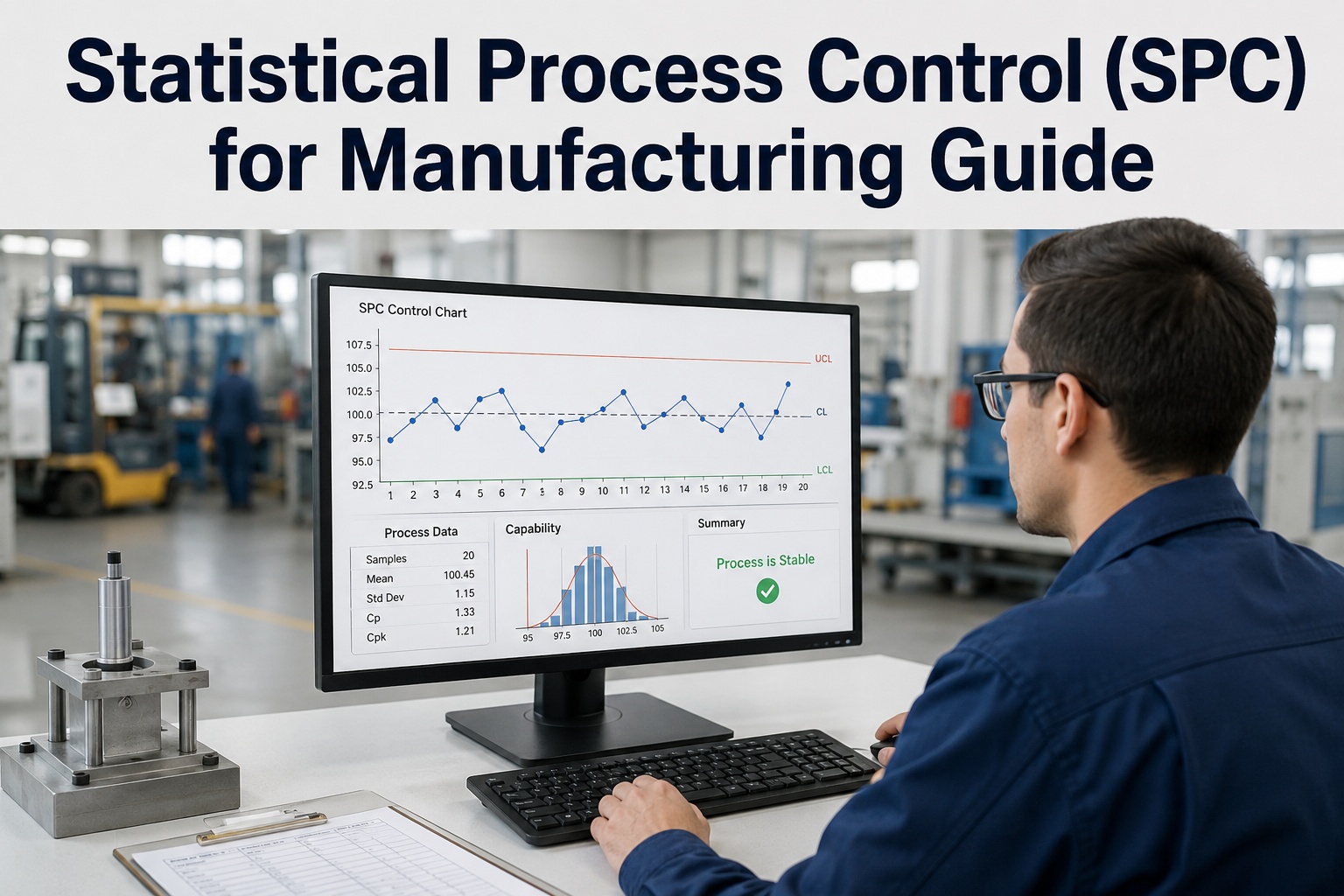
Collect at least 20 to 25 subgroups of measurements from a stable process. This baseline is used to calculate your Upper Control Limit (UCL) and Lower Control Limit (LCL) — the statistical boundaries that define normal process behavior.
Select and Deploy Control Charts
Choose the chart type that matches your data — X-bar R for subgroup variable data, I-MR for individual measurements, P or C charts for attribute data. AI-powered platforms auto-select and generate the right chart based on your data structure.
Configure Alert Rules
Apply Western Electric Rules or Nelson Rules to detect out-of-control signals beyond just a single point outside control limits. Seven consecutive points trending in one direction is as important as a single spike well outside the UCL.
Link to Corrective Action Workflow
Every out-of-control signal should automatically trigger a documented response — a work order, a CAPA record, or a calibration check — rather than relying on operators to manually log and escalate. This closes the quality loop and creates a searchable audit history.
Measure Capability and Improve
Use Process Capability Indices (Cp, Cpk) to measure how well your controlled process fits within specification limits. A Cpk above 1.33 is the industry benchmark. AI continuously re-evaluates capability as data accumulates, surfacing improvement opportunities proactively.
What SPC Delivers — The Documented Results
37%
Defect Rate Reduction
Achieved within 6 months at an automotive plant using SPC on critical machining lines
22%
Throughput Increase
Electronics manufacturer after reducing rework and scrap through SPC-driven process stability
18%
Yield Improvement
Semiconductor manufacturer within 3 months using SPC with predictive analytics
70%
Defect Reduction Ceiling
Reported by organizations using cloud-based AI-integrated SPC platforms
30%
Quality Delay Drop
Multinational electronics firm after implementing cloud-based SPC across global supply chain
45%
Fewer Customer Complaints
Consistent output quality builds downstream trust — documented across SPC-matured facilities
Process Capability — The Number Every Quality Engineer Watches
Cpk < 1.00
Process is producing defects. Immediate action required.
Cpk 1.00–1.33
Marginally capable. Vulnerable to variation shifts.
Cpk 1.33–1.67
Industry benchmark. Acceptable for most regulated industries.
Cpk > 1.67
Highly capable. Six Sigma-level performance target.
Where SPC Connects to Maintenance — The Link Most Teams Miss
Most quality teams run SPC in isolation from maintenance. But the data tells a different story — process variation spikes most often trace back to equipment issues: a tool that needs replacement, an instrument running past its calibration interval, a conveyor running at irregular speed. When SPC alerting is connected to a maintenance and calibration management platform like Oxmaint, every out-of-control signal can instantly generate a timestamped work order, trigger a calibration check, or open a CAPA record — with full traceability for audits and regulatory inspections.
01
Calibration Drift Causes Process Shifts
Measurement instruments running past their calibration interval introduce systematic bias into your SPC data. Your control chart starts flagging variation that is actually instrument error — or worse, misses real variation because the baseline is skewed.
02
PM Overruns Create Variation Spikes
Equipment running past its preventive maintenance interval introduces mechanical wear that shows up as process variation on SPC charts. Connecting PM schedules to SPC trend data reveals the correlation — and prevents it from recurring.
03
SPC Alerts Trigger Documented Corrective Action
When an out-of-control signal is linked directly to a work order and CAPA record in your CMMS, the corrective action is documented, assigned, and tracked — not buried in an email thread or verbal conversation that disappears by the next shift.
04
Audit-Ready Quality Evidence
Regulators and customers increasingly expect documented proof that process variation was detected, investigated, and resolved. An integrated SPC and CMMS system gives you that evidence automatically — no manual compilation required during an audit.
Frequently Asked Questions
What is the difference between SPC and traditional quality inspection?
Traditional inspection checks products after they are made — catching defects after the damage is done. SPC monitors the process while it is running, using statistical signals to detect variation before defective products are produced. This shift from reactive to proactive quality control is why SPC consistently delivers 20 to 40% defect reductions that inspection-based approaches cannot achieve. Connecting SPC to a platform like
Oxmaint ensures every signal becomes a traceable corrective action — not just a data point.
How does AI improve SPC beyond traditional control charts?
Traditional SPC monitors one variable at a time and flags breaches after they happen. AI-powered SPC analyzes hundreds of variables simultaneously, detects multivariate patterns that single-variable charts miss, and predicts process shifts before they breach control limits. A semiconductor manufacturer using AI-enhanced SPC improved yield by 18% within three months — an outcome traditional charts alone could not have delivered.
Book a demo to see how AI SPC connects to your maintenance workflow in real time.
What is a good Cpk value for a manufacturing process?
Industry standard benchmarks define Cpk above 1.33 as acceptable capability for most manufacturing operations, while Six Sigma targets require Cpk above 1.67. A Cpk below 1.0 means the process is actively producing defects and requires immediate intervention. AI-powered SPC platforms continuously recalculate Cpk as new data arrives — surfacing capability degradation before it becomes a defect event. Pair this with
Oxmaint's calibration and PM tracking to prevent equipment wear from degrading your Cpk over time.
Which industries benefit most from SPC implementation?
SPC is most impactful in industries where process variation directly affects product safety or regulatory compliance — automotive, electronics, pharmaceuticals, medical devices, aerospace, and food manufacturing. However, any high-volume production environment where defects create measurable cost will benefit. A single production line processing 400,000 parts annually at a 4% scrap rate loses over $440,000 per year in direct and hidden costs — SPC targets that number directly.
Talk to our team about SPC implementation for your specific industry and facility size.
How long does it take to implement SPC and see results?
Most manufacturers begin capturing SPC data within days to weeks of deployment, with baseline control limits established after 20 to 25 data subgroups. Measurable defect rate improvements are typically visible within 3 to 6 months, with one automotive plant documenting a 37% defect reduction within six months of implementation. The speed of results depends on data quality, process complexity, and — critically — how well SPC alerts are connected to corrective action workflows.
Sign up for Oxmaint to start building that integrated quality baseline today.
Stop Inspecting Defects. Start Controlling the Process That Creates Them.
SPC gives you the statistical intelligence to catch process drift before it becomes a defect. Oxmaint gives you the maintenance and calibration infrastructure to make sure your equipment stays capable of hitting those control limits — with every corrective action documented and audit-ready. Built around your production environment, or start your free account and connect your quality and maintenance workflows today.