A dam gate actuator that fails to respond during a flood event or spillway release is not a maintenance problem — it is a safety emergency. Hydraulic and electric actuators controlling spillway gates, intake gates, and sluice gates at hydroelectric facilities operate under extreme conditions: cyclic water pressure, sediment ingress, thermal swings, and extended idle periods that allow seals to dry and hydraulic fluid to degrade. Most actuator failures develop silently through gradual seal wear, hydraulic fluid contamination, and limit switch drift — none of which are detectable without structured inspections. FERC dam safety guidelines under Part 12D require documented evidence of all gate operational tests and mechanical inspections, and insurers increasingly require digital compliance records with timestamps. OxMaint CMMS digitizes actuator inspection schedules, lubrication task tracking, limit switch test records, and emergency gate readiness documentation so hydro plant operators can demonstrate compliance at any moment — explore the platform at app.oxmaint.ai.
Hydropower · Gate Systems · FERC Compliance
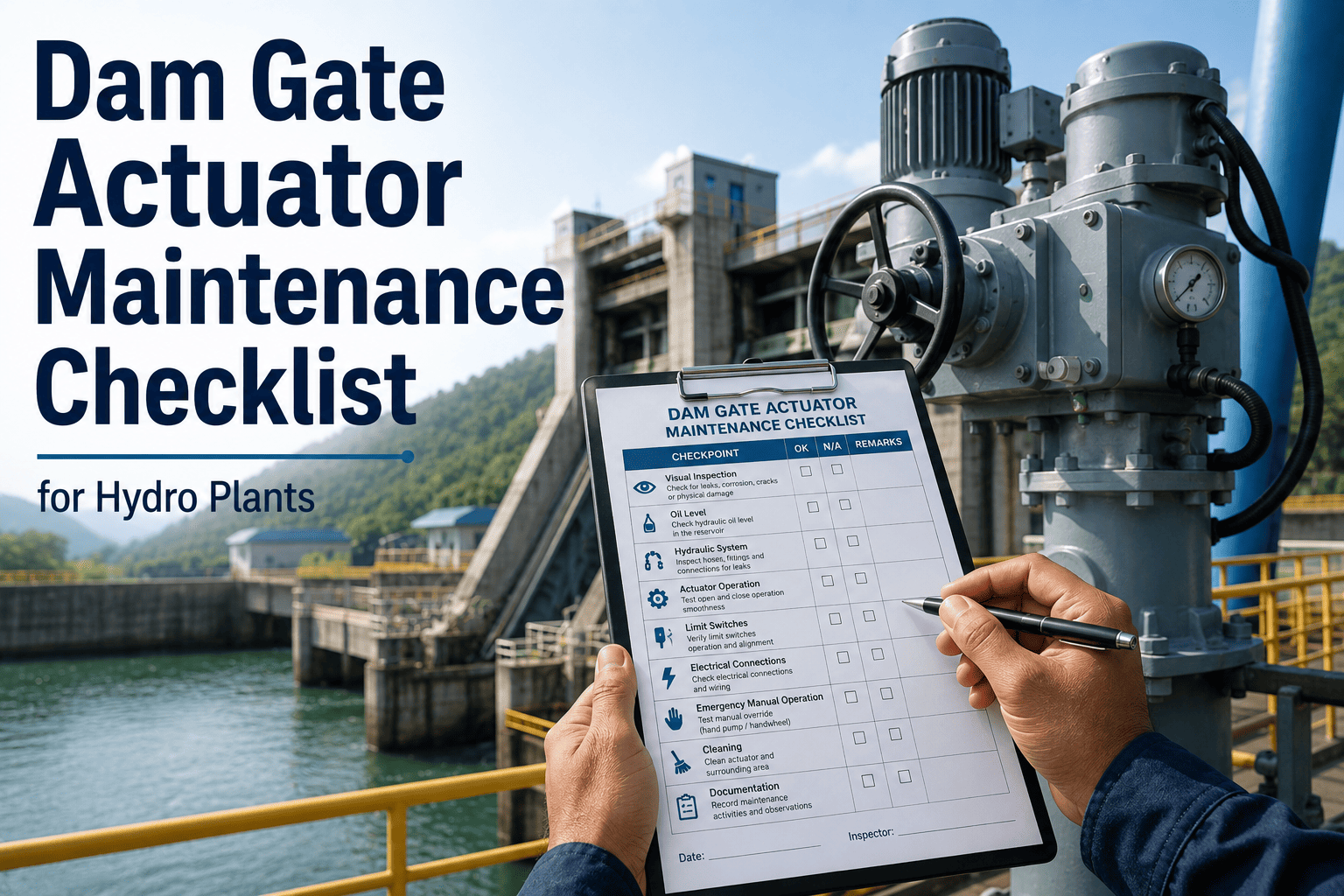
Dam Gate Actuator Maintenance Checklist for Hydro Plants
Structured inspection, lubrication, hydraulic system checks, limit switch testing, and emergency gate readiness verification for spillway and intake gate actuator systems.
Actuator Failure Risk Factors
Seal dry-out during extended idle periods
Hydraulic fluid contamination and viscosity loss
Trunnion pin and bearing corrosion
Limit switch drift causing gate misposition
Accumulator pressure loss — no emergency backup
Gearbox coupling wear under cyclic load
Monthly Inspection
Visual and Operational Condition Checks
Monthly actuator inspections identify visible deterioration in seals, hydraulic lines, structural mounting, and position indicators before they escalate into operational failures during critical water management events.
Visual Inspection — Hydraulic Actuators
Inspect hydraulic cylinders for external leakage — oil staining around rod seals, end caps, or fittings indicates seal degradation requiring immediate attention before next gate operation cycle
Frequency: Monthly · Record: Hydraulic leak log · Technician: Hydraulic Systems Tech
Check all hydraulic hoses and rigid lines for chafing, kinking, or UV damage — hoses with visible braid exposure or cracked outer jacket must be tagged for replacement before next gate cycle
Frequency: Monthly · Record: Hose condition log · Technician: Hydraulic Specialist
Inspect clevis pins, trunnion pins, and anchor bolts for corrosion, wear, or loss of cotter key retention — pin corrosion in high-moisture dam environments causes binding under load and uneven force distribution
Frequency: Monthly · Record: Pin inspection log · Technician: Mechanical Technician
Verify gate position indicator reads correctly against physical gate position — discrepancy between control panel indication and actual gate opening indicates limit switch drift or mechanical feedback failure
Frequency: Monthly · Record: Position indicator log · Technician: Instrumentation Tech
Visual Inspection — Electric Actuators
Inspect electric actuator enclosure for moisture ingress, corrosion on terminal strips, or condensation on electronics — dam environments are inherently high-humidity and actuator IP ratings must be verified annually
Frequency: Monthly · Record: Enclosure inspection form · Technician: Electrical Technician
Check gearbox output shaft coupling for backlash or play — measure coupling play against manufacturer tolerance and log trend data; excessive backlash indicates worn gear teeth or coupling bushing degradation
Frequency: Monthly · Record: Coupling condition log · Technician: Mechanical Technician
Quarterly Tasks
Lubrication, Hydraulic Fluid, and Limit Switch Testing
Quarterly service tasks address the most common actuator failure modes: lubrication breakdown in rotating components, hydraulic fluid contamination, and limit switch calibration drift that causes gate misoperation.
Lubrication Schedule
Grease trunnion pins and bearing surfaces per manufacturer specification — use marine-grade or EP water-resistant grease; apply until fresh grease purges from bearing, confirming old contaminated grease is displaced
Frequency: Quarterly · Record: Lubrication log with grease type · Technician: Mechanical Technician
Lubricate spindle, threaded stem, and gearbox internal gears per maintenance manual — failure to lubricate causes excessive operating force that can damage motor contactors, gearbox, or gate mounting hardware
Frequency: Quarterly or per manual · Record: Gearbox service log · Technician: Hydraulic Specialist
Hydraulic System Checks
Check hydraulic power unit (HPU) reservoir oil level and condition — sample oil for water content and particulate contamination; emulsified or cloudy oil requires immediate drain and refill with fresh fluid to correct specification
Frequency: Quarterly · Record: Oil sample analysis · Technician: Hydraulic Systems Tech
Verify accumulator pre-charge pressure against design specification — accumulators provide backup energy for emergency gate operation during power failure; loss of pre-charge eliminates emergency gate closure capability
Frequency: Quarterly · Record: Accumulator pressure log · Technician: Hydraulic Specialist
Test and verify relief valve setting at 2,200 psig or per design specification — relief valves protect actuator cylinders and hydraulic lines from overpressure during water hammer events and gate slam conditions
Frequency: Quarterly · Record: Relief valve test log · Technician: Hydraulic Engineer
Limit Switch Calibration
Test and calibrate open and closed limit switches — verify that switch activation corresponds to actual gate position within ±1% of full stroke; limit switch drift causes over-travel that damages gate seals and structural stops
Frequency: Quarterly · Record: Limit switch calibration form · Technician: Instrumentation Tech
Verify torque limiting switches trigger at correct values — torque switches protect the actuator drive train from overload when gates bind due to debris, sediment accumulation, or ice formation in cold climates
Frequency: Quarterly · Record: Torque switch test log · Technician: Electrical Technician
Semi-Annual and Annual
Emergency Gate Readiness and FERC Documentation
Emergency gate operability testing is mandatory under FERC Part 12D and must be performed under realistic conditions with results documented in forms suitable for regulatory review.
Full Gate Operation Test
Exercise each gate through full open-close cycle under normal operating head — record total stroke time, motor current draw, and hydraulic pressure at open, mid-stroke, and closed positions; compare against baseline
Frequency: Semi-annual · Record: Gate operation test report · Technician: Licensed Electrician + Hydro Specialist
Test emergency gate closure under simulated power failure — disconnect HPU power and verify accumulator-stored energy closes gate fully; log closure time and compare against emergency response specification
Frequency: Annual · Record: Emergency closure test form · Technician: Hydro Plant Engineer
Verify manual override operation — handwheel or manual bypass must operate gate smoothly without excessive force; manual operation capability is required by FERC as backup when automated systems fail
Frequency: Annual · Record: Manual override test log · Technician: Operations Supervisor
Compliance Documentation
Complete FERC Part 12D gate operational test documentation — include inspector name, date, water level, gate position readings, test results, and deficiencies identified with corrective action status
Frequency: Annual · Record: FERC Part 12D compliance file · Technician: Facility Safety Engineer
Update gate maintenance history file with all corrective work orders, parts replaced, and oil analysis results — FERC auditors require a complete, traceable maintenance history for all safety-critical gate systems
Frequency: Ongoing · Record: CMMS maintenance history · Technician: Plant Records Administrator
Maintenance Intervals
Dam Gate Actuator Preventive Maintenance Schedule
| Task |
Frequency |
Qualification |
FERC Required |
| Visual inspection — seals, hoses, pins, indicators |
Monthly |
Mechanical Technician |
Recommended |
| Lubrication — trunnion, spindle, gearbox |
Quarterly |
Mechanical Technician |
Yes |
| Hydraulic fluid sampling and accumulator check |
Quarterly |
Hydraulic Systems Tech |
Yes |
| Limit switch calibration and torque switch test |
Quarterly |
Instrumentation Tech |
Yes |
| Full gate operation cycle test |
Semi-annual |
Licensed Electrician + Hydro Specialist |
Yes — critical |
| Emergency closure test and manual override verification |
Annual |
Hydro Plant Engineer |
Yes — FERC Part 12D |
Common Questions
Dam Gate Actuator Maintenance FAQs
How often should dam gate actuators be exercised?
FERC guidelines recommend full stroke operation tests at minimum semi-annually for spillway gates and annually for emergency/standby gates. Gates that sit idle for extended periods experience seal dry-out and gearbox coupling wear — more frequent partial cycling maintains operability and detects developing problems.
OxMaint schedules these automatically.
What are the most common causes of gate actuator failure at hydro plants?
Hydraulic seal failure from dry-out during idle periods is the leading cause. Contaminated hydraulic fluid (water ingress from high-humidity environments) destroys pump internals and cylinder seals. Trunnion pin corrosion creates excessive operating force that overloads motor starters. Limit switch calibration drift causes gate over-travel that damages seals and structural stops.
What documentation does FERC Part 12D require for gate maintenance?
FERC Part 12D requires documented operational test results for all spillway gates including date, water level, position readings, cycle times, and technician sign-off. Corrective work orders, oil analysis results, and parts replacement history must be retained and traceable by gate number. Digital CMMS records with timestamps satisfy this requirement directly.
What type of hydraulic fluid is required for dam gate actuators?
Outdoor and submerged hydraulic applications typically require environmentally acceptable hydraulic fluids (EALs) per EPA guidelines — especially important for hydroelectric facilities operating near water bodies. Biodegradable polyol ester or polyglycol fluids are commonly specified. Always verify against the actuator manufacturer's fluid specification before changing fluid type.
How does CMMS software improve gate actuator maintenance compliance?
OxMaint creates automated work orders for every lubrication, hydraulic check, and limit switch test task. Technicians complete inspections on mobile devices at the gate structure with timestamped sign-offs, and oil analysis data is logged directly against the asset record — producing FERC-ready compliance documentation without any manual paperwork.
Gate Readiness Is Not Optional — Neither Is Documentation
OxMaint automates dam gate actuator maintenance scheduling, tracks lubrication and hydraulic fluid records, and produces FERC Part 12D-ready compliance reports from digital inspection data captured by technicians at the gate structure.