A substation fire is among the most catastrophic events a power plant can face — transformer oil fires spread rapidly, high-voltage arc flash events can cascade into total station blackouts, and suppression systems that have not been regularly tested frequently fail to activate when the threat is real. IEEE 979 Guide for Substation Fire Protection establishes the framework for fire risk management, while NFPA 70E, NFPA 25, and local AHJ requirements define inspection frequencies for suppression systems, detection devices, and fire barrier integrity. Most compliance failures during AHJ audits trace back not to missing systems, but to uninspected systems — suppression agents that have leaked below effective concentration, heat detectors with calibration drift, and oil containment sumps that were never tested for drainage capacity. Maintenance teams that digitize their fire readiness inspections using a CMMS eliminate the documentation gaps that create liability in insurance claims and regulatory enforcement actions. OxMaint's compliance tracking module automates monthly, quarterly, and annual fire readiness task scheduling, captures timestamped inspection records for every substation bay, and generates audit-ready exports — explore it at app.oxmaint.ai.
Safety · Compliance Tracking · IEEE 979 · NFPA 25
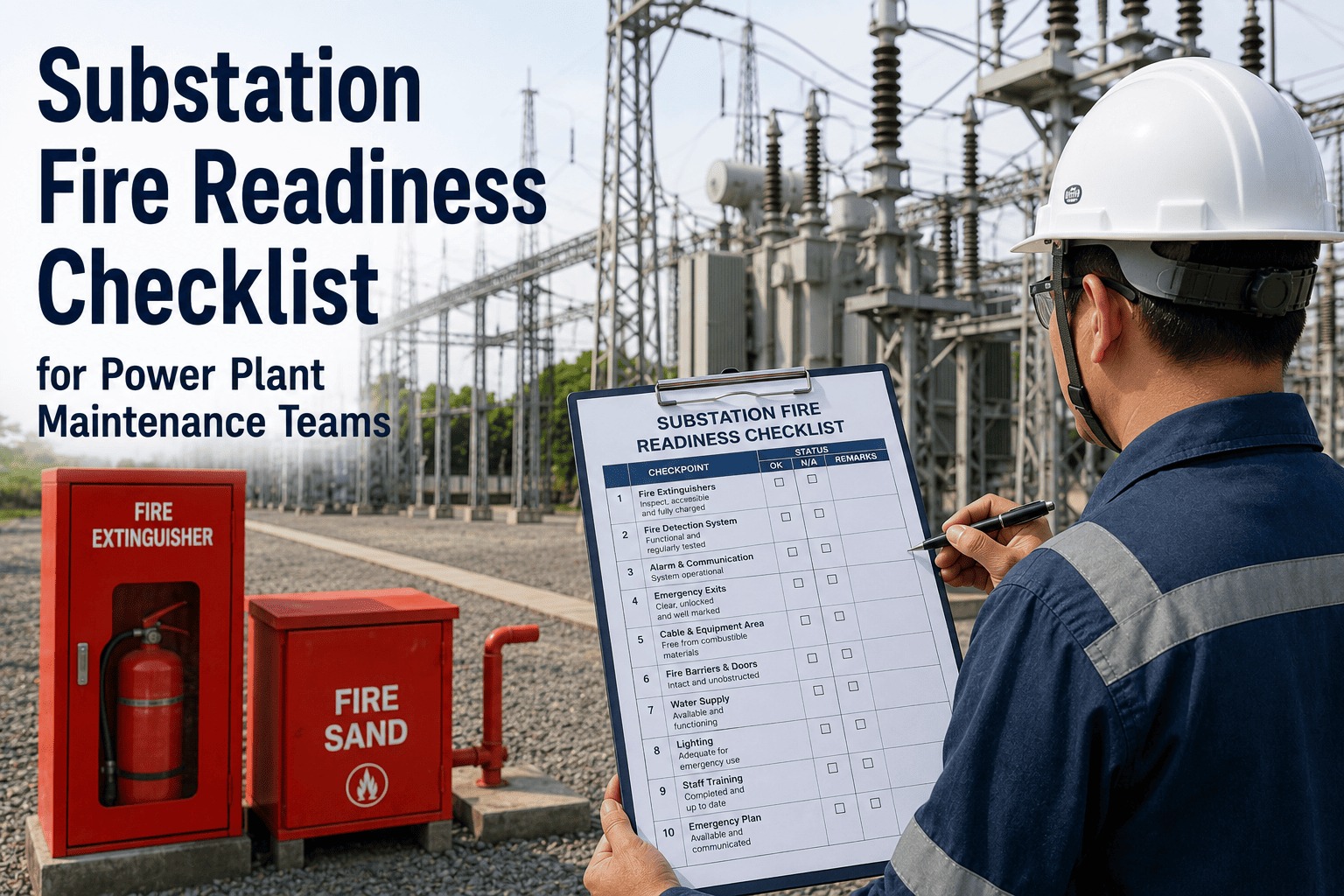
Substation Fire Readiness Checklist for Power Plant Maintenance Teams
A structured fire readiness inspection protocol covering suppression system condition, detection device testing, oil containment integrity, barrier inspections, and compliance documentation for power substation environments.
Why Substation Fires Spread Fast
30 sec
Average time for transformer oil fire to reach flashover
IEEE 979
Primary substation fire protection engineering standard
NFPA 25
Required inspection standard for fixed suppression systems
Annual
Minimum AHJ-required inspection frequency for suppression agents
Monthly Checks
Detection System and Physical Condition Inspection
Monthly fire readiness checks are the first defense against compliance drift. These inspections verify that visible system components are undamaged, access paths are clear, and alarm indicators show normal status without requiring full functional testing.
Fire Detection Devices
Visually inspect all smoke and heat detector heads in transformer bays, control rooms, and cable tunnels — check for physical damage, accumulated dust or oil film on detector surfaces, and confirm status LEDs show normal (no fault or alarm indication)
Frequency: Monthly · Record: Detector visual log · Technician: Electrical Safety Technician
Confirm fire alarm control panel shows no active faults, disabled zones, or silenced alarms — any suppressed alarm or bypassed zone must be documented with a corrective work order and restoration timeline
Frequency: Monthly · Record: Panel status log · Technician: Controls Technician
Inspect linear heat detection cables along cable trays and transformer oil piping — check cable run for physical damage, kinking, or chafing from cable tie wear; damaged LHD cable creates detection dead zones in critical areas
Frequency: Monthly · Record: LHD inspection form · Technician: Electrical Maintenance
Physical Access and Housekeeping
Verify all fire extinguishers are in designated locations, seals intact, pressure gauge in operable range, and inspection tags current — missing or discharged extinguishers in transformer areas must be replaced same day
Frequency: Monthly · Record: Extinguisher inspection log · Technician: Safety Officer
Inspect substation for combustible material accumulation — oil-soaked rags, vegetation growth near transformers, waste paper, and temporary materials left in electrical areas must be removed as an immediate fire hazard
Frequency: Monthly · Record: Housekeeping inspection · Technician: Facility Safety Inspector
Confirm fire doors and compartment barriers are closed and latched — propped-open fire doors in transformer rooms and cable tunnels defeat fire compartmentalization and are a common AHJ citation during compliance audits
Frequency: Monthly · Record: Fire barrier log · Technician: Facility Inspector
Quarterly Testing
Suppression System and Oil Containment Checks
Quarterly functional checks verify that fixed suppression systems, oil containment sumps, and detection devices are in operational condition — not just physically present.
Fixed Suppression System Verification
Inspect clean agent or CO2 suppression cylinder weight or pressure — loss of more than 5% of agent charge from baseline indicates container leakage; systems below minimum charge cannot achieve effective suppression concentration
Frequency: Quarterly · Record: Agent weight/pressure log · Technician: Suppression System Specialist
Verify suppression system control panel is in auto mode and no zones are manually isolated — suppression systems left in manual-only mode after maintenance work are a leading cause of no-discharge failures during real fire events
Frequency: Quarterly · Record: Control panel mode log · Technician: Controls Technician
Inspect sprinkler or deluge nozzle heads in oil-cooled transformer areas for corrosion, paint overspray, or mechanical damage — blocked nozzle orifices prevent agent delivery to fire seat even when system activates correctly
Frequency: Quarterly · Record: Nozzle inspection log · Technician: Fire Protection Technician
Transformer Oil Containment
Inspect transformer oil sump and gravel containment bed for oil saturation, standing water, or blockage of drain outlets — a containment system that cannot drain during a fire event creates a burning oil pool that defeats the entire fire barrier design
Frequency: Quarterly · Record: Containment inspection log · Technician: Civil/Electrical Maintenance
Verify oil drain valves, sump pump (if equipped), and collection pit are free of blockage and operational — perform a drain flow test by discharging a measured water volume and confirming drain time meets design specification
Frequency: Quarterly · Record: Drain flow test result · Technician: Civil Maintenance
Annual Compliance Tests
Functional System Tests and Audit Documentation
Annual tests verify the complete system operates as designed — from detection through suppression activation — and produce the documentation required for AHJ inspections, insurance renewals, and IEEE 979 compliance reviews.
01
Heat and Smoke Detector Functional Test
Use calibrated test equipment to verify each detector activates at its rated threshold. Detectors that fail to activate during test must be replaced immediately — dirty or calibration-drifted detectors in transformer bays are a critical life safety deficiency.
NFPA 72 · Annual · Certified Technician Required
02
Suppression System Discharge Simulation
Test suppression system activation logic without discharging agent — verify detection-to-activation signal chain, time delays, pre-discharge alarm, abort switch function, and system isolation valves operate correctly in sequence.
NFPA 2001 / NFPA 12 · Annual · Fire Protection Engineer
03
Fire Barrier and Penetration Seal Inspection
Inspect all fire-rated walls, cable penetration seals, conduit firestops, and fireproof coating on structural steel in transformer areas. IEEE 979 requires fire barriers between transformer banks to prevent cascade failure between adjacent units.
IEEE 979 · Annual · Fire Protection Inspector
04
Emergency Response Plan Review
Review and update substation fire emergency response procedures — verify evacuation routes, emergency contact lists, fire brigade assignments, and utility isolation procedures. Test emergency communication systems and confirm remote monitoring alarms reach control room staff.
OSHA 29 CFR 1910.38 · Annual · Safety Officer + Operations
05
AHJ Inspection Preparation and Documentation
Compile annual compliance package: all inspection records, test results, corrective work order histories, and outstanding deficiency status. AHJs review documentation continuity — gaps in monthly or quarterly records create liability even if annual tests pass.
NFPA 25 · Annual · Facility Manager + Safety Officer
06
Transformer Oil Sampling and Dissolved Gas Analysis
Submit transformer oil samples for dissolved gas analysis (DGA) — rising acetylene, ethylene, or hydrogen concentrations indicate internal arcing or overheating that creates fire risk from within the transformer. DGA trending is the earliest warning system for transformer fire precursors.
IEEE C57.104 · Annual · Oil Sampling Specialist
Common Questions
Substation Fire Readiness FAQs
What standards govern substation fire protection inspections?
IEEE 979 is the primary engineering guide for substation fire protection design and risk management. NFPA 25 governs inspection, testing, and maintenance of fixed fire suppression systems. NFPA 72 covers fire alarm and detection systems. NFPA 70E addresses electrical safety during maintenance. All must be consulted together for a complete compliance program. Track all tasks in
OxMaint.
How quickly can a transformer fire spread to adjacent equipment?
Transformer oil fires can reach flashover temperature within 30–60 seconds of ignition and spread to adjacent transformer bays within minutes if fire barriers are compromised or suppression systems fail to activate. IEEE 979 designs fire barriers specifically to contain single-unit fires — but those barriers only work if penetration seals and fire doors are maintained and inspected per the annual schedule.
How often must fixed suppression systems in substations be inspected?
NFPA 25 requires monthly visual inspections, quarterly functional checks, and annual comprehensive testing by a certified contractor. AHJ requirements may be more stringent than NFPA minimums — verify local authority requirements. Agent cylinder weight/pressure must be checked quarterly; full discharge simulation is required annually.
What documentation does an AHJ require during a substation fire safety audit?
AHJs typically require the full inspection history for suppression systems, detection devices, extinguisher records, and fire barrier inspections — with technician signatures and dates for every entry. Gaps in monthly or quarterly records create citation risk even when annual tests pass. Digital CMMS records with automatic timestamps eliminate documentation gaps entirely.
Can OxMaint support substation fire readiness compliance tracking?
OxMaint creates automated work orders for every monthly, quarterly, and annual fire readiness task — mapped to specific substation bays or transformer assets. Inspectors complete tasks on mobile with photo capture, and the platform generates AHJ-ready compliance reports with complete audit trails showing no gaps in the inspection schedule.
Fire Readiness Is a System — Not a Single Inspection
OxMaint automates substation fire readiness scheduling, captures mobile inspection records for every bay, and produces IEEE 979 and NFPA 25 compliance documentation that satisfies AHJ auditors and insurance reviewers without manual reporting effort.