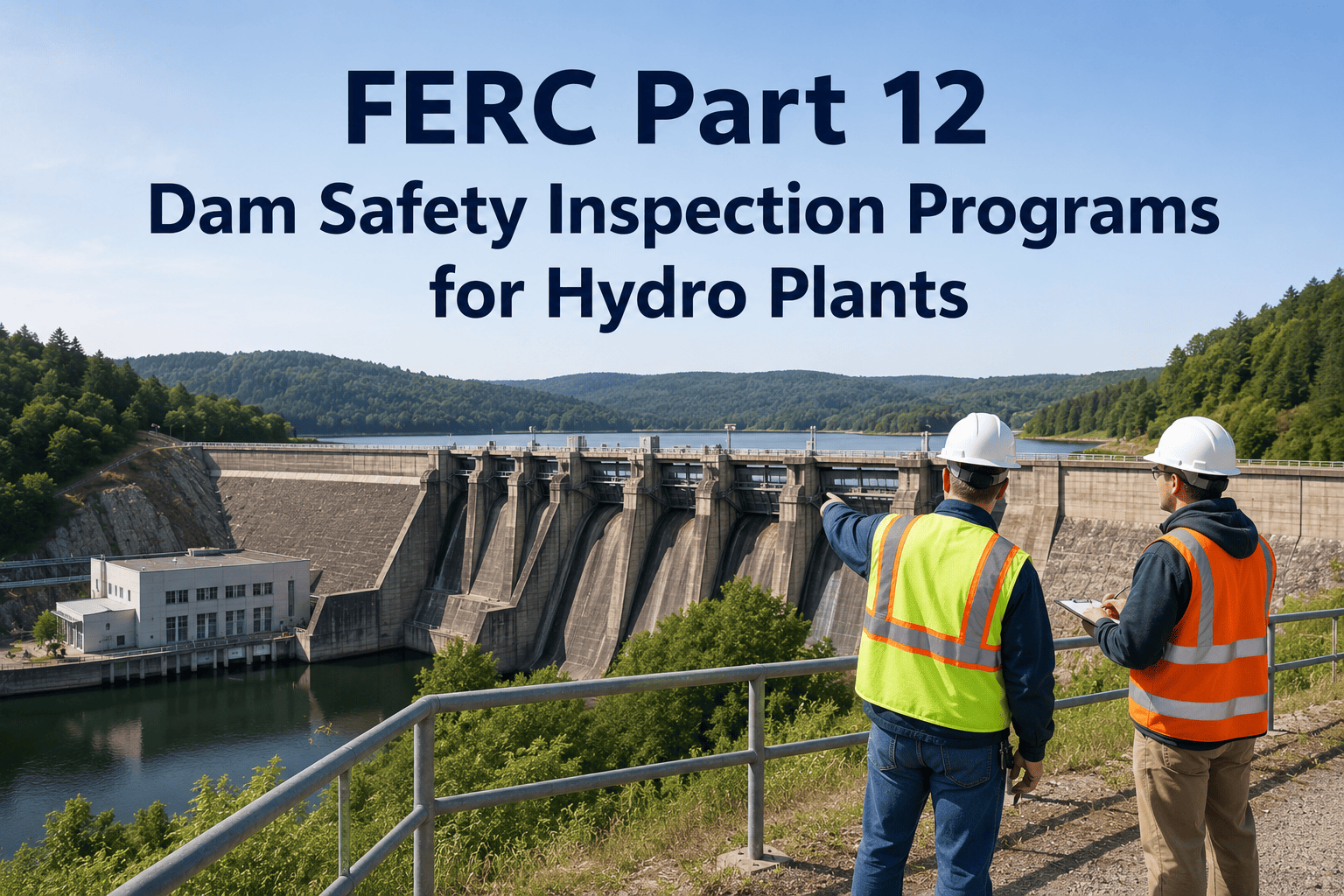
In the United States, over 91,000 dams are regulated under a patchwork of federal and state oversight — and of those, more than 15,600 are classified as high-hazard-potential structures where failure would cause loss of life downstream. The Federal Energy Regulatory Commission's Part 12 independent consultant inspection program sets the inspection standard for licensed hydropower projects, requiring comprehensive safety assessments on five-year cycles with detailed surveillance, monitoring, and instrumentation review in between. Yet the majority of dam operators still manage inspection schedules, instrumentation readings, and Emergency Action Plan updates across disconnected spreadsheets, paper logs, and email chains — a gap that grows more dangerous every year aging infrastructure ages further. Oxmaint's dam safety CMMS brings FERC Part 12 inspection scheduling, instrumentation monitoring, spillway maintenance tracking, and EAP version control into one auditable platform built for the compliance demands of licensed hydropower and non-federal dam safety programs. Book a dam safety compliance demo with an Oxmaint hydropower specialist today.
Hydropower · Dam Safety & FERC Part 12 Compliance
The CMMS That Keeps Your Dam Safe, Inspected, and FERC-Compliant — Every Day Between Inspections
Automated inspection scheduling. Real-time instrumentation monitoring. EAP tracking. Spillway and gate maintenance records — all in one platform your FERC independent consultant can review with confidence.
FERC Part 12
Independent Consultant Inspections
5-year cycle management with interim surveillance scheduling and finding closure tracking
EAP
Emergency Action Plan
Version control, annual review scheduling, and tabletop exercise documentation
Instrumentation
Monitoring & Trending
Piezometer, seepage, settlement, and strong-motion data tracked against action levels
O&M Manual
Operating Compliance
Gate, spillway, and outlet works maintenance records linked to O&M manual requirements
The Regulatory Landscape
FERC Part 12 and State Dam Safety — Understanding the Full Compliance Picture
Dam safety compliance is not a single regulation — it is a layered framework of federal licensing requirements, state safety programs, and engineering standards that interact differently depending on dam ownership, hazard classification, and whether the project generates power. Understanding this framework is the foundation of an effective CMMS strategy for dam safety.
5 yrs
FERC Part 12 Independent Consultant Inspection
Required for all FERC-licensed hydropower projects under 18 CFR Part 12. An independent licensed engineer reviews dam safety, project works, and operation and maintenance. Findings are formally reported to FERC and must be addressed with documented corrective actions and completion schedules. Failure to complete finding remediation within FERC's directed timeframe can result in license conditions or enforcement.
Annual
Owner's Dam Safety Inspection and Surveillance
Between Part 12 inspections, dam owners are required to conduct their own safety inspections — typically annual or more frequent depending on hazard classification and state requirements. These inspections must document embankment and concrete conditions, seepage, settlement, instrumentation readings, and operational readiness of gates and appurtenances. Records become the evidentiary foundation for the next Part 12 inspection.
Quarterly
Instrumentation Reading and Trending
Piezometers, weirs, settlement monuments, inclinometers, and strong-motion seismographs require scheduled readings at frequencies specified in the project's O&M Manual and FERC-approved monitoring program. Readings must be trended against baseline and action levels — with action level exceedances triggering immediate notification procedures. Manual reading programs without automated alerting are a leading source of late detection in dam safety incidents.
Ongoing
Emergency Action Plan Maintenance and Testing
FERC requires licensed projects to maintain a current, FERC-approved Emergency Action Plan covering all failure modes, inundation maps, notification trees, and response procedures. EAPs must be reviewed annually, updated whenever dam configuration or downstream conditions change, and exercised through tabletop drills with documented results. An outdated EAP with incorrect notification contacts is a significant regulatory deficiency.
Failure Consequence Data
What the Data Says About Dam Safety Inspection Gaps
Dam failures do not happen without warning. They happen when warning signs exist and are not caught — because monitoring programs lapse, instrumentation readings are not trended, inspection findings are not tracked to closure, or maintenance on critical gates and spillways is deferred until a flood event demands operation of equipment that has not been tested in years.
Primary Causes of Dam Incidents in High-Hazard Dams
Overtopping / Spillway Inadequacy
Seepage / Piping Through Embankment
Foundation Failure or Settlement
Gate and Mechanical Failure
Structural Deficiency (Concrete / Masonry)
Source: ASDSO Dam Failures and Incidents Database — High-Hazard-Potential classification events
$4.7M
Median emergency response cost
for a high-hazard dam incident requiring evacuation — before property damage, litigation, or license penalties are calculated.
78%
Of dam incidents
involve a failure mode that was observable in instrumentation or inspection data at least 6 months before the incident — but was not acted upon.
3,100+
High-hazard dams in the US
are rated in poor or unsatisfactory condition by state dam safety programs — representing known, documented risk without adequate monitoring or maintenance programs in place.
See How Oxmaint Manages FERC Part 12 Compliance for Your Licensed Hydropower Project
Request a demo scoped to your specific dam type — embankment, concrete gravity, arch, or roller-compacted concrete — with your instrumentation monitoring program and current inspection finding status in view.
Platform Capabilities
What Oxmaint Delivers for Dam Safety Programs
01
FERC Part 12 Finding Tracking
Every finding from a Part 12 inspection is entered in Oxmaint with priority classification, responsible engineer assignment, committed remediation date, and FERC-directed completion deadline. Finding status is tracked from open through corrective action implementation and verification — with automated escalation alerts when deadlines approach and evidence documentation attached to each finding record before formal closure.
02
Instrumentation Monitoring and Action Level Alerts
Scheduled instrumentation readings — piezometers, weirs, settlement monuments, crack gauges, and inclinometers — are assigned to technicians in Oxmaint with reading frequency, location, and prior baseline values. When a submitted reading crosses an established action level, the system immediately notifies the dam safety engineer and generates a condition report. Trend data is displayed graphically against historical readings and action level thresholds — making slow-developing anomalies visible before they become critical conditions.
03
Spillway, Gate, and Outlet Works Maintenance
Tainter gates, radial gates, slide gates, and outlet works valves require periodic operation testing, lubrication, structural inspection, and mechanical servicing on schedules specified in the project O&M Manual. Oxmaint links every maintenance task to its O&M Manual basis — so when a FERC independent consultant asks for gate maintenance records during a Part 12 inspection, the complete history is retrievable in seconds, not reconstructed from paper logs over several days.
04
Emergency Action Plan Version Control
Oxmaint maintains a complete version history of the project EAP — tracking every revision, the triggering change, review date, and FERC submission status. Annual EAP review is scheduled as a recurring maintenance work order. When downstream conditions change — new development in the inundation zone, updated emergency contacts, or revised evacuation routes — the EAP update workflow is initiated directly from the change event, ensuring the plan never lags behind the conditions it is designed to address.
05
Owner's Inspection Documentation
Annual and semi-annual owner's inspection work orders are structured in Oxmaint using the inspection checklist format aligned with FERC's Guidelines for Dam Safety. Inspectors complete the checklist in the field using Oxmaint's mobile interface — attaching photographs to specific inspection items, flagging deficiencies for follow-up work orders, and submitting the completed inspection report without returning to an office to transcribe field notes.
06
Corrective Action and Finding Closure Audit Trail
From initial observation during an owner's inspection through Part 12 finding designation, corrective design, construction, and post-construction verification — every step in the dam safety corrective action lifecycle is documented in Oxmaint with timestamped records and responsible party attribution. When FERC requests documentation of finding closure, the complete evidence package is assembled from Oxmaint and submitted — without manual record reconstruction that risks gaps or inconsistencies.
Compliance Comparison
Dam Safety Program — Manual Methods vs. Oxmaint CMMS
| Program Area |
Without Oxmaint |
With Oxmaint |
| FERC Part 12 Finding Tracking |
Spreadsheet with manual status updates — findings fall through cracks approaching deadlines |
Structured tracking with FERC deadline alerts, evidence attachment, and automated escalation |
| Instrumentation Reading Program |
Paper field logs, manual data entry, trend analysis done periodically if at all |
Scheduled work orders, mobile data capture, automated trending against action levels |
| Gate and Spillway Maintenance |
Maintenance history in paper files — inaccessible during Part 12 inspection preparation |
Complete O&M-linked maintenance history retrievable by asset, date, or work type instantly |
| Emergency Action Plan Currency |
EAP review date tracked in calendar — update triggers missed when conditions change mid-year |
Annual review as work order; change-triggered update workflow; version history maintained |
| Owner's Inspection Reports |
Field notes on paper, typed up later — deficiency follow-up tracked informally |
Mobile checklist completion in field, photo attachment, auto-generated deficiency work orders |
| FERC Inspection Preparation |
2–4 weeks of manual record compilation, incomplete histories, reconstruction errors |
Complete inspection-ready package generated on demand — days become hours |
Frequently Asked Questions
What Dam Safety Engineers and Hydropower Asset Managers Ask Before Selecting a CMMS
How does Oxmaint structure FERC Part 12 inspection finding tracking through to closure?
Each Part 12 finding is entered in Oxmaint with the finding number from the independent consultant's report, hazard classification, recommended corrective action, committed completion date, and the FERC-directed deadline from any subsequent order or license amendment. As corrective actions are designed, procured, and constructed, work orders link directly to the finding record — capturing cost, labor, contractor information, and completion evidence. When all corrective actions are complete and verified, the finding is formally closed in the system with the closure documentation package that is submitted to FERC.
Book a walkthrough to see how finding tracking maps to your current Part 12 open items.
Can Oxmaint track and alert on instrumentation action level exceedances automatically?
Oxmaint stores the action level thresholds defined in each project's FERC-approved monitoring program for every instrumentation point — piezometers, weirs, settlement monuments, crack gauges, and seismograph triggers. When a field reading is submitted that crosses an action level, the system generates an immediate alert to the designated dam safety engineer and creates a condition report requiring investigation and response documentation. Readings are automatically plotted on trend charts against historical data and the applicable action level line, making gradual threshold approaches visible to any engineer reviewing the monitoring dashboard.
Start a free trial to configure action levels for your instrumentation program.
Does Oxmaint support multi-dam portfolios for utilities or state dam safety agencies managing dozens of structures?
Oxmaint supports multi-structure portfolios with a unified dashboard that provides inspection compliance status, open finding counts, overdue instrumentation readings, and upcoming FERC filing deadlines across every dam in the portfolio simultaneously. Each structure has its own asset hierarchy, instrumentation program, inspection schedule, and finding register — while portfolio-level reporting aggregates compliance health across all structures for executive and regulatory reporting. Several Oxmaint customers manage portfolios of 15 to 40 structures from a single account with site-specific access controls.
Request a multi-structure portfolio demo for your organization.
How does Oxmaint handle Emergency Action Plan updates when downstream conditions change?
Whenever a change event affecting the EAP is identified — new downstream development, updated emergency contacts, revised inundation mapping, or changes to reservoir operating range — Oxmaint initiates an EAP review and update work order assigned to the dam safety engineer. The system tracks the update through revision, internal review, FERC submission, and approval — with the prior approved version retained in the version history until the new version receives FERC acceptance. Tabletop exercise scheduling and documentation are managed as separate recurring work orders linked to the current approved EAP version.
Explore EAP version control with a free trial account.
How quickly can Oxmaint be deployed for a hydropower project that currently manages dam safety with spreadsheets?
For a single-structure hydropower project transitioning from spreadsheet-based dam safety management, Oxmaint's implementation typically takes 2 to 4 weeks — covering asset and instrumentation setup, historical finding migration, inspection checklist configuration aligned with FERC's Guidelines for Dam Safety, and O&M Manual task import. The implementation does not require software developers or IT integration work. Your dam safety engineer or O&M coordinator can complete the setup using Oxmaint's guided configuration workflow, with support from Oxmaint's hydropower implementation team for any site-specific requirements.
Book a scoping call to receive a site-specific implementation timeline for your project.
Dam Safety CMMS · FERC Part 12 Compliance
Every Dam Between Inspections Is Either Getting Safer or Getting Closer to Failure. Oxmaint Makes the Difference.
FERC Part 12 findings tracked to closure. Instrumentation readings trending against action levels in real time. Spillway and gate maintenance records linked to your O&M Manual. Emergency Action Plans current, versioned, and exercise-documented. Oxmaint delivers the dam safety program infrastructure that keeps your license, your structure, and the communities downstream protected.