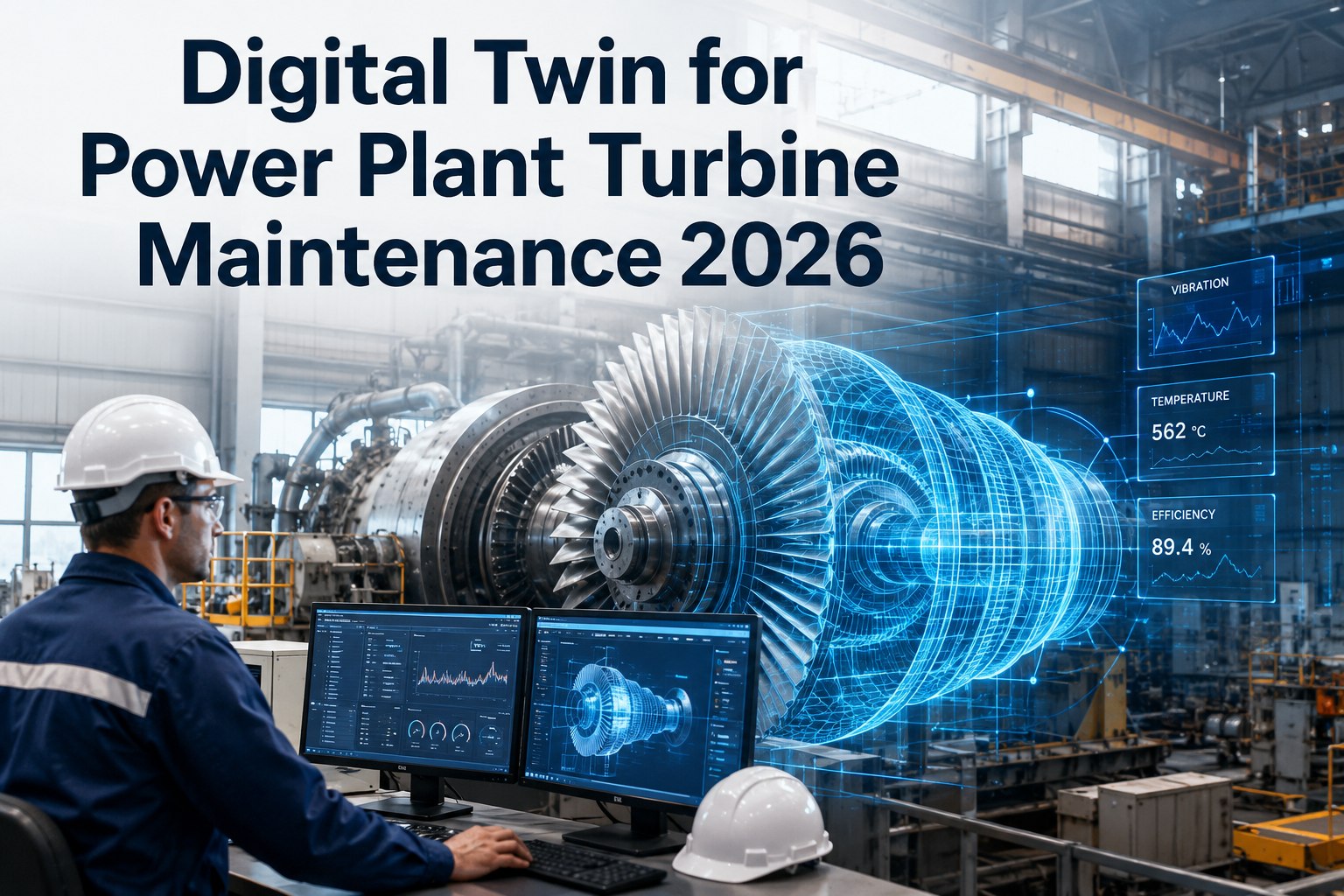
A 500 MW gas turbine in the U.S. Midwest ran at 89.4% efficiency on every monitoring screen in the control room. Its digital twin — a real-time physics-based simulation running in parallel — had already calculated a 2.8% compressor stage efficiency loss from progressive blade fouling. Over six months, that invisible degradation cost $1.1 million in excess fuel consumption before a scheduled inspection finally caught it. Digital twin technology eliminates that six-month blind spot. Power plants deploying OxMaint's digital twin platform detect efficiency degradation within days, predict equipment failures 4–26 weeks ahead, and run unlimited failure simulations in a risk-free virtual environment before making any real-world decision. Book a Demo to see how OxMaint builds a living digital twin of your power plant's critical assets.
Your Power Plant — Simulated, Predicted, and Optimized Before Anything Breaks
OxMaint creates real-time physics-based digital replicas of every critical rotating asset in your plant — turbines, generators, boilers, pumps. The virtual plant sees failures coming. Your team acts before they happen.
The Visibility Gap That Costs Power Plants Millions Every Year
SCADA and condition monitoring systems tell you what your instruments are reading. They cannot tell you what is happening inside your equipment — the blade stress distributions, heat transfer degradation, and bearing load profiles that precede every catastrophic failure. Digital twins close that gap with continuous physics-based simulation. Plants that deploy digital twin management through OxMaint convert invisible degradation into scheduled interventions that cost 3–8 times less than emergency repairs.
What OxMaint's Digital Twin Monitors Across Every Critical Asset
Each category of power plant equipment has distinct physics — and distinct failure signatures. OxMaint's pre-built simulation models are configured to monitor the exact parameters that predict each asset category's most consequential failures, at the lead times that make planned intervention possible.
See Your Plant's Digital Twin in Action
OxMaint connects to your existing SCADA, DCS, and historian infrastructure in weeks — no rip-and-replace required. See live simulation results from your own equipment in a personalized platform walkthrough.
Digital Twin ROI: Where the Financial Returns Come From
Digital twin ROI for power plants compounds across five distinct value streams simultaneously. Unlike single-purpose monitoring tools, a physics-based simulation platform that predicts failures also optimizes fuel consumption, guides capital spending decisions, and trains operators without real-world risk. Plants using OxMaint's digital twin and CMMS integration quantify every value stream automatically through live ROI dashboards.
From Real Plant to Living Digital Twin: Four Deployment Phases
Most digital twin projects fail because they are scoped as custom software development projects. OxMaint eliminates that barrier with pre-built physics models for every major power generation asset category. Deployment is a configuration and connection exercise — not a development project — which means your twin is producing actionable intelligence within six weeks of kickoff. Schedule a demo to see OxMaint's deployment timeline modeled for your plant's specific asset inventory.
Frequently Asked Questions
What is a digital twin for a power plant and how is it different from SCADA monitoring?
SCADA monitoring reports what your instruments are measuring at this moment. A digital twin runs a continuous physics-based simulation of how your equipment actually behaves — including internal states no sensor can directly measure, such as blade stress distributions, heat transfer resistance, and bearing load profiles. The twin processes live sensor data through mathematical models of thermodynamics, fluid mechanics, and materials science to calculate what is happening inside the asset, what is degrading, and when that degradation will cause a failure. This is what enables prediction windows of 4–26 weeks and efficiency loss quantification in dollars per day — capabilities fundamentally impossible with sensor monitoring alone.
How long does it take to deploy a digital twin with OxMaint, and does it require replacing existing systems?
OxMaint's digital twin platform deploys in 4–6 weeks using your existing SCADA, DCS, and historian infrastructure. No control system modifications or replacement is required. OxMaint connects through standard industrial protocols including OPC-UA, Modbus, and OSIsoft PI historian APIs. For assets with limited instrumentation, standalone wireless vibration and temperature sensors can be added for $200–$800 per monitoring point. Week one and two are dedicated to data connection. Weeks three and four configure the physics models to your plant's specific parameters. By week six, your twin is producing live failure predictions and automated work orders — without disrupting any existing monitoring infrastructure.
How accurate are digital twin failure predictions, and what percentage of failures can be predicted?
OxMaint's digital twin models reach 82–92% prediction accuracy by month three as the simulation calibrates to your plant's specific operating patterns. Gas turbines and steam turbines, with their extensive instrumentation, typically achieve the highest accuracy levels. All gradual wear-based failures — bearing degradation, compressor fouling, seal deterioration, tube erosion — are detectable through simulation divergence from baseline weeks before they reach alarming levels. The 8–18% of failures not predicted are sudden catastrophic events: foreign object damage, manufacturing defects in replacement parts, or sudden external impacts. These produce no preceding degradation pattern and cannot be predicted by any monitoring or simulation technology currently available.
How does the digital twin improve heat rate and fuel efficiency?
The digital twin continuously calculates your plant's actual heat rate against the theoretical optimum given current ambient conditions, fuel composition, and equipment states. When the twin detects compressor fouling reducing gas turbine efficiency by 1–3%, or condenser tube fouling increasing backpressure, or boiler convection tube deposits increasing thermal resistance, it quantifies these losses in dollars per day and flags the optimal cleaning or adjustment window. Plants typically recover 1.5–3% heat rate improvement within the first operating year — translating to $400,000–$900,000 in annual fuel savings for a 500 MW gas plant. Sign up for OxMaint to start tracking your plant's efficiency KPIs alongside asset health.
Can the digital twin be used for operator training and failure scenario simulation?
Yes — virtual simulation for operator training is one of the highest-value applications of a mature digital twin. Once your twin has established accurate baselines, it can inject simulated fault scenarios — turbine bearing failures, generator hydrogen seal leaks, boiler tube ruptures — and allow operators to practice detection and response procedures without any risk to the physical plant. New operators accelerate competency development significantly when they can experience and respond to abnormal events in a virtual environment before encountering them on actual equipment. OxMaint's twin simulation environment supports custom scenario scripting, timed response assessment, and procedure validation — all running against your plant's actual physics model rather than a generic textbook simulation.
Your Turbines and Generators Are Running a Simulation Right Now. You Just Can't See It Yet.
OxMaint makes the invisible visible — building a physics-based digital twin of every critical asset in your power plant, continuously predicting failures, quantifying efficiency losses, and prescribing optimal maintenance timing. Start with your highest-consequence assets. Prove ROI in the first quarter. Expand with data your finance team cannot argue with.