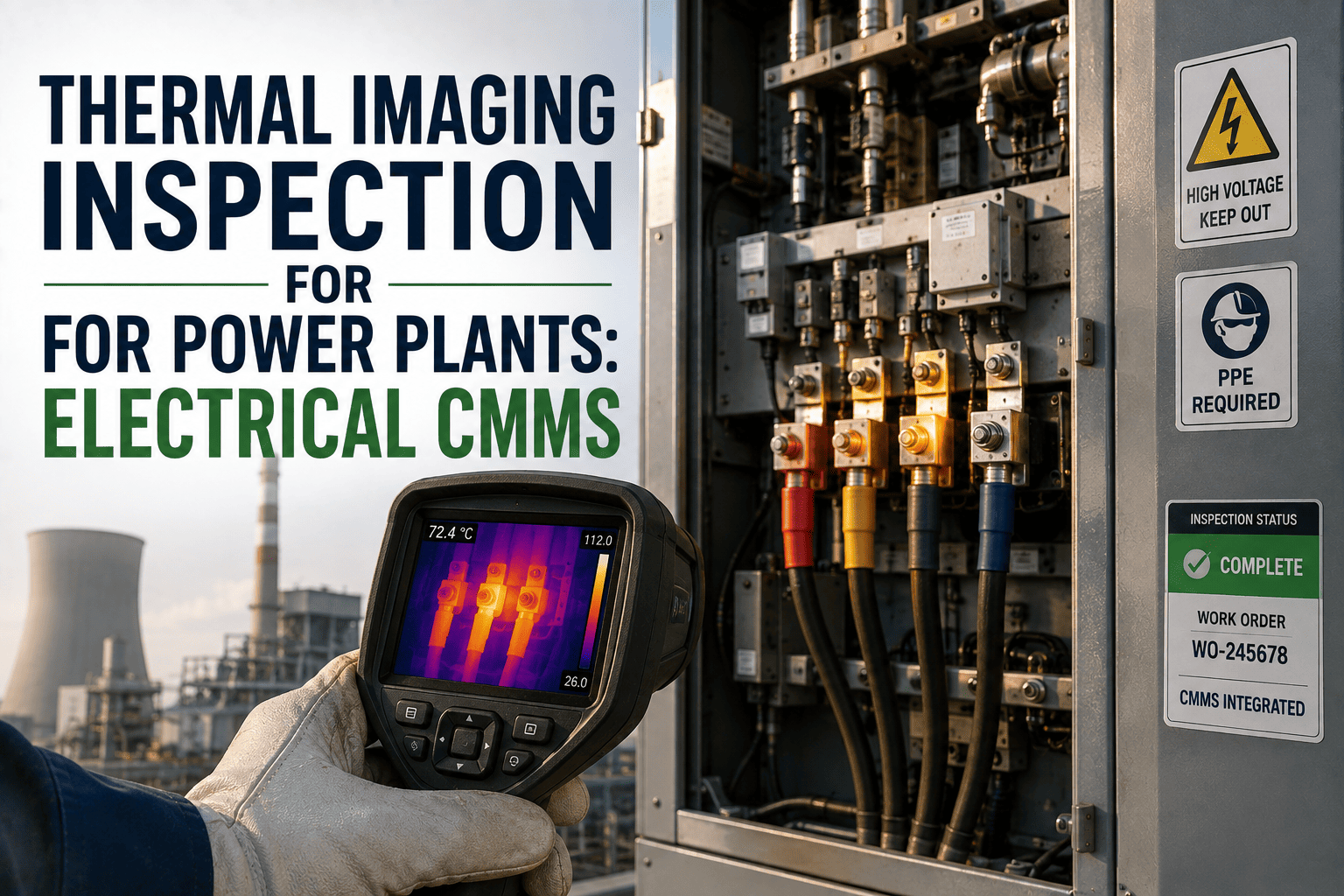
Electrical cable degradation is one of the most underreported failure contributors in power plant maintenance programs. Unlike rotating equipment that announces failure through vibration, heat, or noise, cable insulation breakdown is invisible until it causes a fault — and by then the consequences include forced outages, arc flash events, and equipment damage that cascades across protection zones. A 500 MW thermal plant may carry 500 to 1,500 kilometres of cable across control, power, instrumentation, and communication circuits, each segment aging at a different rate depending on thermal load, ambient temperature, chemical exposure, and mechanical stress history. Tracking cable condition without a structured system means relying on the institutional memory of the longest-serving electrician — a dependency that cannot survive retirements, restructuring, or regulatory audits. A CMMS that integrates cable route documentation, insulation test records, termination inspection history, and heat-affected zone assessments into a unified asset record gives maintenance teams the visibility to prevent cable failures rather than respond to them. Book a demo to see how Oxmaint structures cable asset records, insulation test schedules, and electrical maintenance tracking for power plant portfolios.
38%
of unplanned electrical outages in thermal power plants are linked to cable insulation failure — IEEE reliability data
20–40 yr
design life of HV cable insulation — actual degradation rate varies 3x based on thermal cycling history
$1.2M
average cost of a single high-voltage cable fault in a generation facility including repair, downtime, and lost revenue
60%
of cable failures occur in segments that had no documented inspection history in the prior maintenance cycle
What Makes Cable Maintenance Different from Other Asset Classes
Most CMMS implementations focus on rotating equipment — turbines, pumps, fans — because those assets have obvious failure indicators and standard PM intervals. Cable is harder. A transformer gets a quarterly oil sample. A cable segment gets visual attention only when something nearby fails. This asymmetry between risk and maintenance attention is where power plant electrical failures originate. Three factors make cable maintenance distinctly challenging and distinctly important.
Degradation Is Hidden Until Failure
Insulation breakdown, moisture ingress, and thermal aging do not produce observable symptoms before the cable fails. Only periodic insulation resistance testing, tan delta measurement, or partial discharge scanning reveals actual condition — and these tests only prevent failures when their results are tracked over time to spot trends, not just recorded as pass/fail snapshots.
Route Documentation Erodes Over Time
Cable routes installed during original construction are documented in as-built drawings that are rarely updated as modifications are made. Cables are rerouted during outages, new circuits are added through existing trays, and damaged markers are never replaced. After ten years, the as-built drawings describe a plant that no longer exists — and no one knows which cable occupies which route segment.
Heat-Affected Zones Are High-Risk and Under-Inspected
Cables routed near steam lines, exhaust ducts, or high-temperature process equipment age at multiples of their rated rate. Without a CMMS that flags heat-affected zone segments for elevated inspection frequency, these high-risk cable runs receive the same inspection interval as cables in climate-controlled cable basements — and fail first.
Cable Asset Types and CMMS Maintenance Tasks
| Cable Type |
Voltage Class |
Key Maintenance Tests |
Recommended Interval |
CMMS Record Output |
| Generator Output Cable |
11–33 kV |
Tan delta, partial discharge, insulation resistance (IR) |
Annual during planned outage |
Test result trend chart, delta IR value, corrective WO if threshold exceeded |
| Switchyard Power Cable |
66–400 kV |
Hipot test, sheath resistance, thermal imaging of terminations |
Every 3–5 years (per IEEE 400) |
Hipot pass/fail record, thermal image attached, cable ID and route logged |
| Motor Feeder Cable |
3.3–11 kV |
Insulation resistance, polarisation index (PI) |
Before and after each major outage |
IR value, PI ratio, comparison to previous test, replacement flag if PI below 2.0 |
| Control Cable |
600V–1 kV |
Continuity check, insulation resistance, termination torque inspection |
Every 2 years or after fault event |
Circuit continuity record, IR per core, torque verification sign-off |
| Instrumentation Cable |
Signal level |
Shield continuity, ground loop check, termination inspection |
Annual during calibration cycle |
Shield integrity record, noise measurement baseline, calibration linkage |
| Heat-Affected Zone Cables |
All classes |
Visual inspection, IR test, thermal scan of cable surface |
6-monthly — elevated frequency due to thermal stress |
Visual condition score, IR trend, temperature proximity flag in asset record |
How a CMMS Structures Cable Maintenance — From Route to Record
1
Cable Asset Registry with Route Attributes
Each cable segment gets a CMMS asset record carrying from-to location, route path, voltage class, insulation type, installation year, and heat-affected zone flag. Route survey data and as-built drawing references attach directly to the asset record.
2
Test-Specific PM Schedules Per Cable Class
Annual IR tests for motor feeders, three-year hipot cycles for HV cables, and six-monthly inspections for heat-affected zone segments all run as separate PM series tied to each asset. Test intervals adjust automatically when a cable is reclassified based on condition history.
3
Trend Tracking Across Test Cycles
IR values, polarisation index ratios, and partial discharge magnitudes are logged per test and plotted over time. A cable that passes every individual test but shows a declining IR trend over five years flags for investigation before it fails — this is the capability that separates condition-based cable maintenance from calendar-based inspection.
4
Termination Inspection Records with Photo Evidence
Cable terminations — the highest-failure-probability point in any cable circuit — get their own inspection checklist covering conductor condition, compression joint integrity, heat shrink condition, and gland sealing. Photos attach to the work order before it closes.
5
Fault Event Triggers Route Survey Work Order
When a cable fault occurs, the CMMS automatically generates a route survey work order for all cables sharing the same tray or duct run. Adjacent cables in the same thermal or mechanical environment are inspected proactively, not reactively after the second failure.
Cable Maintenance Management
Turn Cable Test Results Into a Condition Trend — Not Just a Pass/Fail Record
Oxmaint stores insulation test values per asset over time, flags declining trends before threshold failure, and schedules elevated inspections for heat-affected zone cables automatically. No spreadsheet can do this at scale.
Cable Maintenance Maturity: Four Levels Power Plants Operate At
Most power plant electrical teams fall into one of four cable maintenance maturity levels. Each level describes real operating conditions, not theoretical models. Identifying where your team sits today is the first step toward moving to the next level.
Level 1
Reactive
Cable maintenance occurs after fault events only. No scheduled IR testing. Route documentation is original as-builts, rarely updated. Cable failures are treated as unpredictable acts of equipment.
Risk: High — unplanned outages are frequent and expensive
Level 2
Calendar-Based
Annual IR tests conducted during planned outages. Results recorded in spreadsheets. No trend analysis. Heat-affected zones receive the same inspection frequency as standard routes.
Risk: Medium — calendar tests catch gross failures but miss degradation trends
Level 3
CMMS-Managed
Cable assets registered in CMMS with route attributes. Test results logged per asset. PM schedules differentiated by voltage class and thermal zone. Termination inspections on separate cycle from insulation tests.
Risk: Low — trend data available; most degradation caught before failure
Level 4
Condition-Based
CMMS stores multi-year test trends. PM intervals adjust dynamically based on condition score. Partial discharge scanning integrated into high-risk segments. Route surveys triggered automatically by adjacent fault events.
Risk: Minimal — predictive replacement replaces emergency response
Frequently Asked Questions
How does Oxmaint handle cable assets with multiple test types on different cycles?
Each cable asset supports multiple concurrent PM schedules — an annual IR test, a three-year hipot cycle, and a six-monthly termination inspection can all run independently on the same asset. Results from each test type store separately and feed the asset's condition history without conflating different test parameters.
Can test results like IR values be stored numerically for trend analysis?
Yes. Work order forms support numeric input fields configured per test type — IR in megaohms, PI ratio, tan delta angle, partial discharge magnitude. Values store in the asset record and can be reviewed as a time-series trend across multiple test cycles to identify deterioration before failure threshold is reached.
How are heat-affected zone cables identified and managed differently?
Cable assets include a location attribute that can flag heat-affected zone status based on proximity to high-temperature equipment. This flag drives a separate PM schedule with elevated inspection frequency — typically six-monthly versus annual — and the flag can be set in bulk for entire cable routes sharing the same thermal environment.
Can cable route survey findings update asset records in the field?
Yes. Technicians complete route survey work orders on mobile, including route condition scores, photo capture of cable tray fill levels and labelling condition, and notes on any deviations from as-built documentation. Survey results attach to the route asset record and remain available for the next survey cycle comparison.
How does a fault event trigger inspection of adjacent cables in the CMMS?
When a fault work order is created and tagged to a cable segment, a follow-up PM work order can be automatically generated for all cables sharing the same tray ID or route tag. This ensures that cables in the same thermal and mechanical environment are proactively inspected before a second fault occurs in the same zone.
Every Cable Segment. Every Test Result. Every Trend — Tracked in One System.
Oxmaint gives power plant electrical teams a structured cable asset registry, differentiated PM schedules by voltage class and thermal zone, and multi-cycle test trend records that turn insulation data into actionable maintenance decisions — not just annual pass/fail logs.