A gas turbine in a combined cycle plant is not just a prime mover — it is the thermal engine that drives the entire plant's economics. When it runs cleanly and reliably, the HRSG captures exhaust heat efficiently, the steam turbine generates bonus megawatts at near-zero fuel cost, and your plant operates at 58–62% efficiency. When it degrades — fouled compressor blades, worn combustion liners, cracked hot gas path components — every 1% drop in turbine efficiency costs $200,000–$600,000 per year in additional fuel burn, and that is before accounting for forced outage losses at $50,000–$150,000 per hour. Start your free OxMaint trial to manage your entire CCGT maintenance program in one place, or book a demo to see live CCGT maintenance workflows built for combined cycle operations.
Why CCGT Maintenance Is Different From Every Other Power Asset
Combined cycle plants are the most maintenance-complex asset in power generation — not because individual components are harder to service, but because three tightly coupled systems must be tracked as one. A gas turbine combustion anomaly creates abnormal flue gas temperatures that immediately accelerate HRSG superheater tube degradation. A cooling water chemistry drift in the BOP causes condenser fouling that backpressures the steam turbine, raising LP blade stress. These cascade failure pathways are invisible if you manage each system in a separate spreadsheet or standalone work order system.
The Four Gas Turbine Inspection Tiers: When, What, and Why
OEM-aligned gas turbine maintenance is organized around four inspection tiers, each triggered by equivalent operating hours (EOH) — a weighted measure that counts start-stop cycles and peak load events more heavily than steady-state run hours, because thermal cycling is the primary failure driver in modern CCGT operations.
Compressor Washing: The Highest ROI Maintenance Activity in CCGT
Axial compressor fouling is the single largest source of recoverable performance degradation in gas turbines. Airborne salt, dust, oil mist, and hydrocarbon aerosols deposit on compressor blades within 500–2,000 operating hours, reducing blade aerodynamic efficiency and dropping turbine output by 2–5% before any visible signs of wear appear. Compressor washing recovers this performance at a fraction of the cost of accepting the degraded output.
Hot Gas Path: The Highest-Consequence Maintenance Zone
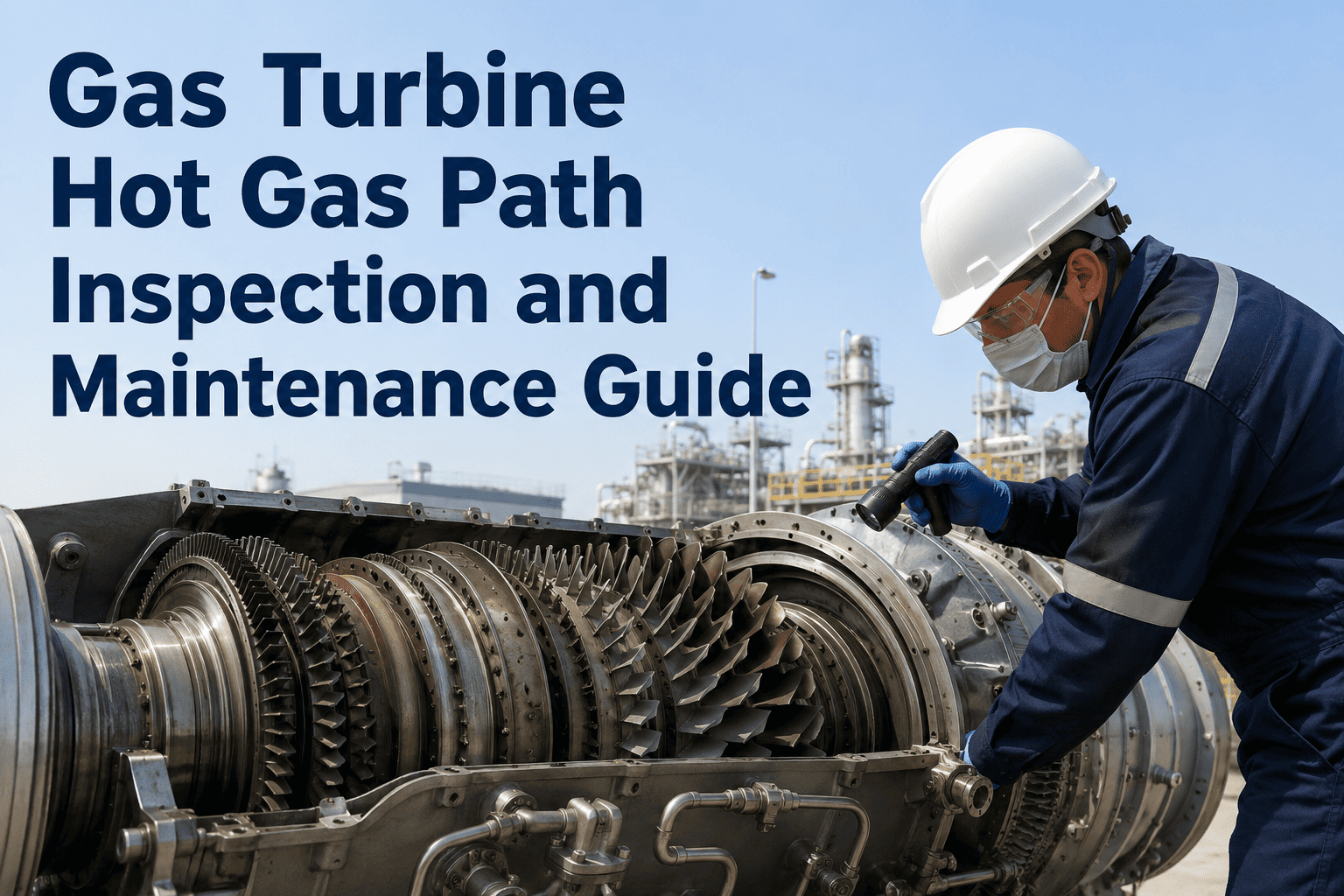
The hot gas path — comprising combustion liners, transition pieces, first-stage nozzles, and turbine buckets — operates at metal temperatures of 900–1,100°C with cooling air reducing surface temperatures to survival range. These components degrade through three simultaneous mechanisms: oxidation of thermal barrier coatings, thermal-mechanical fatigue cracking at trailing edges, and creep elongation of bucket airfoil geometry. Missing an HGP inspection interval by even 1,000–2,000 EOH can convert a scheduled repair into a catastrophic failure that damages the rotor casing.
| Component | Primary Failure Mode | Inspection Method | Action Trigger | Replace Interval |
|---|---|---|---|---|
| Stage 1 Bucket | TBC spallation + creep | Visual + dimensional CMM | >0.5mm trailing edge loss | Every HGP (16K EOH) |
| Stage 1 Nozzle | Oxidation + cracking | Borescope + dye penetrant | Any through-crack detected | Every 1–2 HGP cycles |
| Combustion Liner | Burnthrough + fatigue | Visual + wall thickness UT | Wall <60% of original | Every combustion (8K EOH) |
| Transition Piece | Burnthrough + oxidation | Visual + thermal paint | Hot spot or burn mark | Every combustion (8K EOH) |
| Fuel Nozzle | Coking + flow imbalance | Flow bench test | >5% flow deviation | Every combustion (8K EOH) |
| Shroud Block | Erosion + hot corrosion | Dimensional measurement | Tip clearance >design | Every HGP (16K EOH) |
Equivalent Operating Hours: The Number That Drives Everything
Most CCGT operators track run hours. World-class operators track equivalent operating hours — and the difference determines whether you catch degradation before failure or after. EOH accounts for the fact that a single cold start inflicts the same fatigue damage on hot-section components as 100–200 hours of steady-state operation, because thermal cycling from ambient to 1,100°C and back creates stress that run hours alone cannot capture.
CMMS-Managed PM Program: What Best-in-Class Looks Like
A CCGT maintenance program that relies on spreadsheets and calendar reminders will always be reactive — because the triggers that matter (EOH accumulation, exhaust temperature exceedances, vibration trend shifts) are dynamic data that a static spreadsheet cannot process automatically. A CMMS built for power generation connects operational data to maintenance scheduling, so inspection work orders are triggered by physics, not calendar dates.
Reliability Benchmarks: Where Does Your CCGT Stand?
Plant availability and heat rate degradation are the two financial metrics that plant leadership, capacity market contracts, and PPA counterparties care about most. These benchmarks from operating CCGT fleets separate world-class programs from average — and identify which lever to pull first.
LTSA vs. Self-Managed Maintenance: The Real Trade-Off
Long-term service agreements with OEMs (GE, Siemens Energy, Mitsubishi) offer guaranteed inspection intervals, parts supply, and technical support in exchange for a fixed or variable annual fee. Self-managed programs offer cost savings of 20–40% but require in-house EOH tracking, spare parts inventory management, and OEM-independent inspection capability. Most plants land somewhere between these extremes — using LTSAs for major overhauls and self-managing combustion and routine inspections.