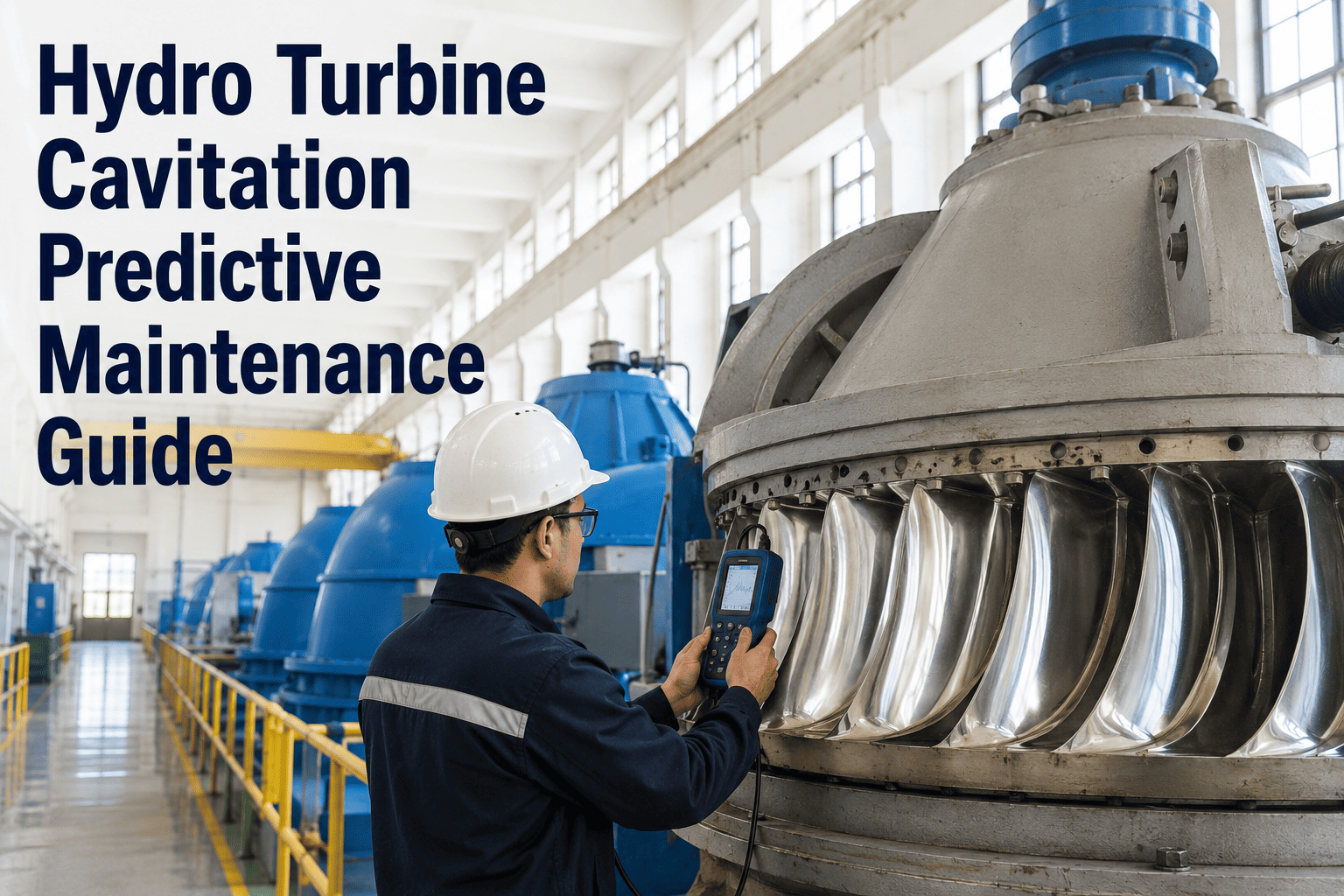
Cavitation is the single most destructive force acting on a hydro turbine runner — and it operates silently, invisibly, and continuously until the damage it causes shows up as a 4% efficiency drop, a cracked runner blade, or an unplanned outage costing your facility over $200,000 in lost generation revenue and emergency repair costs. The turbine maintenance teams who catch cavitation early — before pitting becomes cracking and cracking becomes structural failure — are using CMMS platforms that track cavitation severity, log runner wear measurements, trend efficiency curves, and schedule condition-based repairs in one connected system. This guide is built for hydro plant engineers, turbine maintenance supervisors, and reliability managers who need to move beyond paper-based inspection logs and disconnected spreadsheets — toward a maintenance operation that actually protects the most expensive rotating equipment on the site.
Hydro Turbine Maintenance: Cavitation Monitoring, Runner Repair and Efficiency Performance Tracking
The complete operational guide for turbine maintenance teams who need to detect degradation earlier, justify repairs with condition data, and recover lost generation efficiency — unit by unit, season by season.
What Cavitation Actually Does to a Hydro Turbine — And Why Tracking It Matters
Cavitation occurs when local water pressure drops below the vapor pressure of water, forming vapor bubbles that collapse violently against the runner surface. Each bubble collapse generates a micro-jet of water at pressures exceeding 60,000 psi — and in a turbine operating at full load, billions of these collapses happen every second. The cumulative effect is material erosion: pitting that deepens into cracking, cracking that propagates under cyclic hydraulic stress, and structural failure that can damage runner blades, draft tubes, and even the turbine shaft if left unaddressed. The tragedy of most cavitation damage is not that it was inevitable — it is that the warning signs were present weeks before the damage crossed from manageable to catastrophic, and no one had a system for tracking them.
Acoustic emission sensors detect high-frequency noise characteristic of bubble formation. Vibration baseline shows subtle broadband increase. No visible surface damage yet — but the erosion clock has started.
Runner surface shows visible pitting on low-pressure blade faces. Vibration amplitude has increased measurably. Efficiency curve shows 1–2% degradation at peak flow conditions. First inspection entry created in CMMS.
Pitting has deepened to create stress concentration sites. Dye penetrant or UT inspection confirms crack initiation at blade trailing edges or hub junction. Efficiency loss reaches 3–5%. Unit may still be operational but risk is escalating.
Crack propagation has reached critical length. Blade fragment separation risk is real. Vibration exceeds trip thresholds. Emergency shutdown required. Repair cost is now 3–5× what planned intervention at Stage 2 would have cost.
Cavitation Monitoring: The Data Points That Tell the Real Story
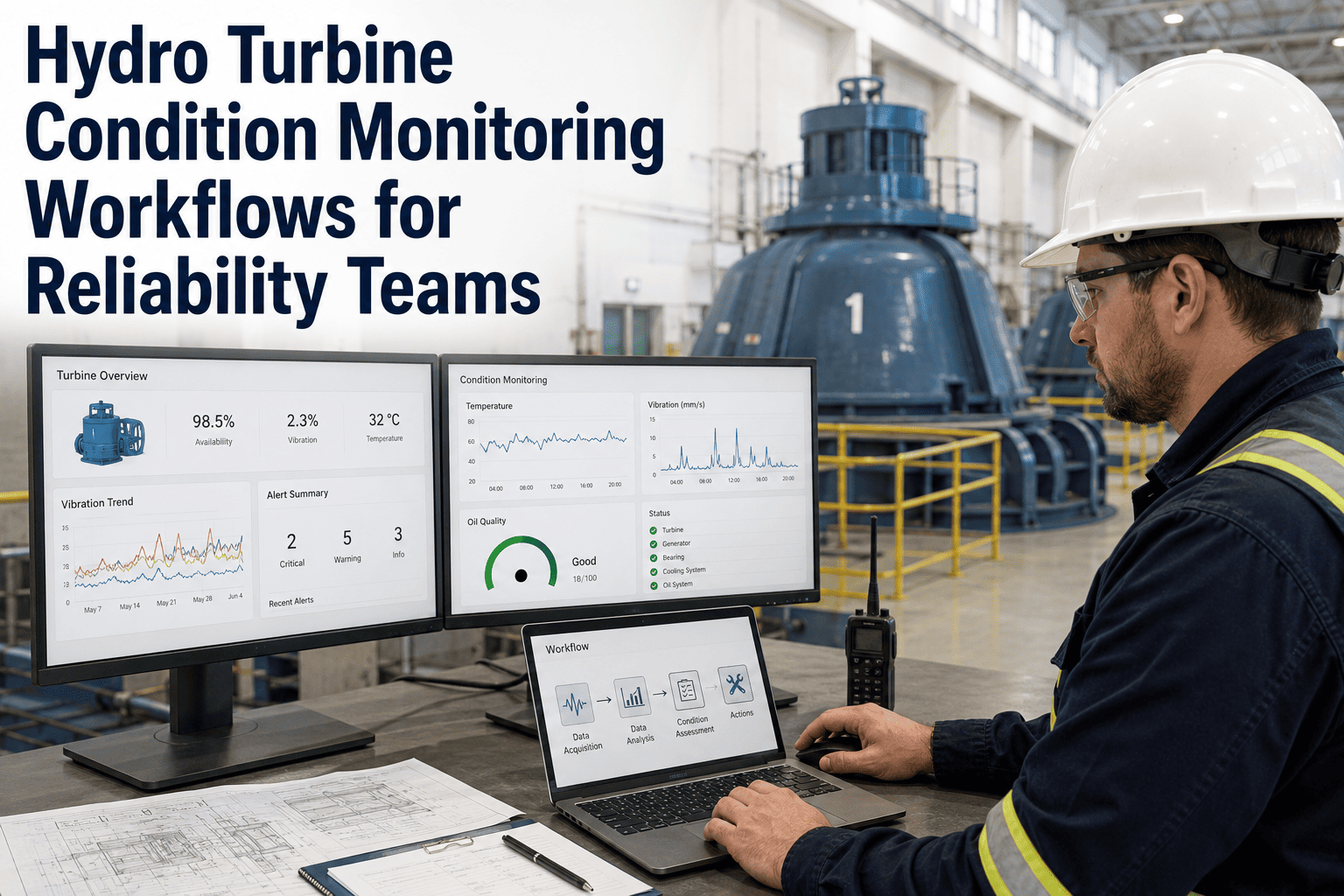
Effective cavitation monitoring is not a single sensor reading — it is the intersection of acoustic data, vibration trends, efficiency curves, and physical inspection measurements tracked over time for each individual turbine unit. The mistake most hydro facilities make is collecting some of this data in isolation — vibration readings in one spreadsheet, efficiency reports in another, inspection findings on paper forms — without a system that connects them into a coherent unit health picture. When you can see all of these signals together for a specific runner, over its specific operating history, the cavitation story becomes readable weeks before it becomes urgent.
Acoustic sensors mounted on turbine covers detect the characteristic high-frequency signature of bubble collapse — distinguishable from normal hydraulic noise by frequency band and amplitude envelope. Trending acoustic emission intensity over weeks gives the earliest available warning of active cavitation zones before any surface damage is visible.
Shaft and bearing vibration at runner frequency harmonics increases measurably as cavitation damage creates flow asymmetry and blade imbalance. Trending RMS vibration and spectral content against the unit's own historical baseline — not generic thresholds — provides early warning that is specific to each runner's condition.
Comparing actual power output against expected output at measured head and flow — on a per-unit, per-season basis — reveals the efficiency loss that runner degradation causes. A 2% efficiency gap at peak flow on a 30 MW unit costs over $160,000 per year in unrealized generation and is the most direct financial case for planned runner restoration.
During planned outages and forced outages, blade surface pit depths are measured at standardized measurement zones per runner and logged against previous inspection values. Tracking pit depth progression per zone per inspection cycle gives maintenance teams the deterioration rate they need to schedule the next repair before damage crosses the weld repair threshold into blade replacement territory.
See Every Turbine's Cavitation History and Efficiency Trend Before Your Next Shift Meeting
OxMaint's Cavitation Tracking and Efficiency Trending modules connect acoustic readings, vibration data, pit measurements, and efficiency curves into a single runner health picture — updated after every inspection and every operating data pull.
Turbine Types and Their Specific Cavitation Profiles
Different turbine designs experience cavitation in different locations, at different operating conditions, and with different failure timelines. A Pelton wheel and a Kaplan unit operating on the same river system face completely different degradation profiles — and a CMMS that treats them the same way will miss the warning signals that are specific to each design. Understanding where cavitation attacks each turbine type is the foundation of building an effective monitoring and repair program.
Efficiency Trending: Turning Performance Data into Repair Justification
The financial case for turbine repair is most compelling when it is built from actual measured efficiency loss — not from estimated degradation or manufacturer curves. When your CMMS tracks actual power output against expected output at the same head and flow conditions, the efficiency gap becomes a real number: megawatt-hours not generated, revenue not captured, and a payback calculation for runner restoration that your finance team can evaluate. Facilities that build this case from measured data consistently win capital approval for turbine maintenance faster than those relying on inspection findings alone.
How OxMaint Tracks Cavitation and Efficiency — Unit by Unit
OxMaint's cavitation tracking and efficiency trending capabilities are built around the individual generating unit — not the plant average. Every runner has its own inspection history, its own pit depth progression, its own vibration baseline, and its own efficiency curve. This unit-level data model is what allows maintenance supervisors to make decisions about specific turbines based on their actual condition — not the fleet average that hides the worst-performing unit inside an acceptable-looking number.
Each turbine unit is registered in OxMaint with its design efficiency curve, rated head and flow parameters, runner material specification, and inspection zone map. This baseline is what every subsequent measurement is compared against — making degradation visible from the first data point forward.
During inspections, technicians log cavitation observations using a standardized severity scale (0–5) per inspection zone — with photo attachments, pit depth measurements in millimeters, and affected surface area estimates. Every entry is timestamped, attributed, and linked to the specific runner zone map.
OxMaint ingests actual power output, head, and flow readings — from PI Historian, SCADA export, or manual entry — and calculates the efficiency gap against the unit's own design curve. The gap is plotted over time, seasonally adjusted, and converted into lost revenue for direct presentation to operations management.
When cavitation severity or efficiency loss reaches defined thresholds, OxMaint auto-generates a repair work order with the unit's full inspection history attached. After repair completion, a post-repair efficiency test is logged and compared against pre-repair baseline — documenting the actual performance recovery achieved.
Know Exactly Which Runner Needs Attention — Before Your Next Outage Window Closes
OxMaint gives turbine maintenance teams the per-unit condition intelligence to schedule the right repair at the right time — backed by measured efficiency data that justifies the cost before the work order is approved. See how OxMaint tracks cavitation and efficiency across multiple units in a live demonstration.
Frequently Asked Questions — Hydro Turbine Cavitation and Efficiency Tracking
Your Turbines Are Telling You What They Need. OxMaint Makes Sure You Are Listening.
Every cavitation severity reading, every pit depth measurement, every efficiency gap calculation — stored, trended, and acted on in one system that gives your turbine maintenance team the per-unit intelligence to protect the most expensive rotating equipment on your site. Stop managing cavitation damage after the fact. Start tracking it from the first signal.