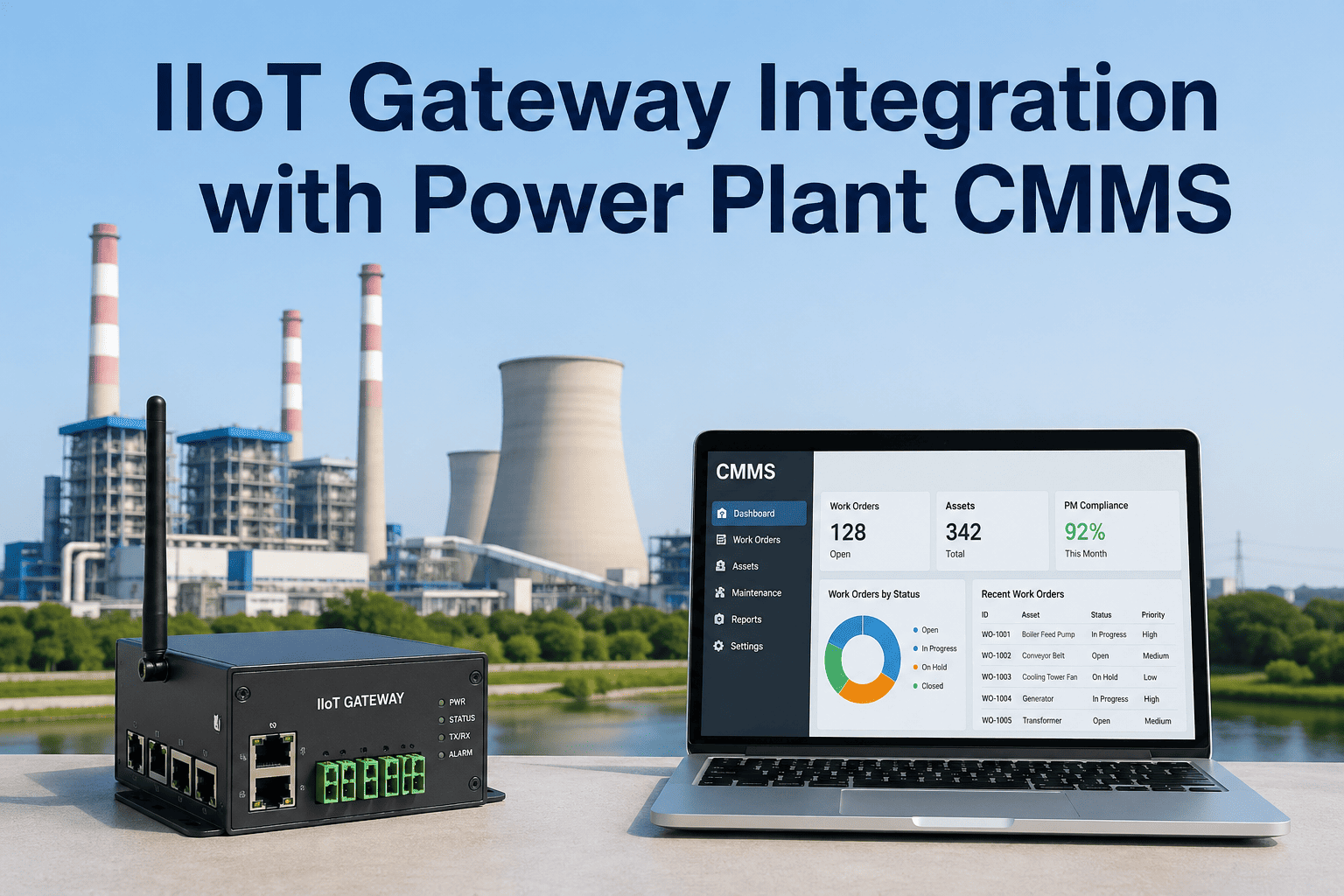
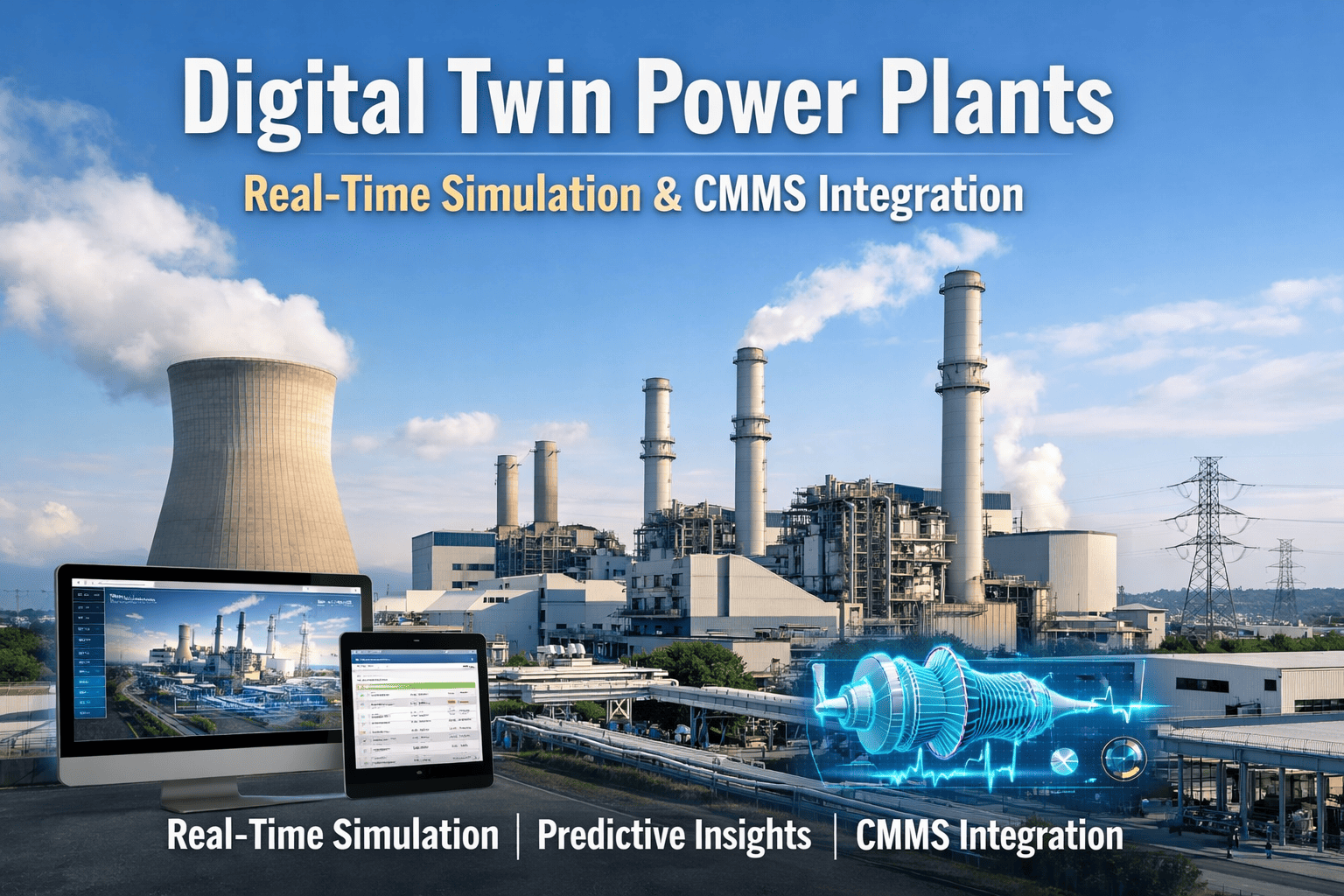
Power generation is entering its most consequential maintenance transformation in a century. Industry 4.0 — the convergence of AI, IIoT sensors, digital twins, and CMMS platforms — is replacing reactive repair cycles with predictive and autonomous maintenance systems that catch failures before they happen, optimize maintenance resources in real time, and reduce unplanned downtime by over 50%. For power plant operations managers and asset directors, the window to implement these technologies before competitors do is closing fast — and the early movers are already seeing 3–5x ROI in year one.
Industry 4.0 Smart Maintenance for Power Plants: AI, IIoT, and CMMS in Practice
A comprehensive guide to how AI predictive models, Industrial Internet of Things sensors, digital twins, and smart CMMS platforms are transforming power plant maintenance from reactive repair to autonomous optimization.
What Industry 4.0 Actually Means for Power Plant Maintenance
Industry 4.0 is not a single product or system — it is a framework of interconnected technologies that, when integrated correctly, fundamentally change how maintenance decisions are made. In power generation, this means moving from calendar-based PM schedules and reactive repair calls toward condition-driven maintenance orders generated automatically by sensor networks, analyzed by AI models, and executed through CMMS workflows that track every outcome.
The core principle is simple: every asset should communicate its own health status continuously, and maintenance actions should be triggered by that data — not by time intervals or equipment failures. Achieving this requires four technology layers working together: IIoT sensors generating data, AI models analyzing it, digital twins simulating outcomes, and a CMMS orchestrating response and documentation.
The Four Technology Pillars of Industry 4.0 Maintenance
Each technology layer contributes a distinct capability — and it is their integration that creates the compounding value power plants are reporting in production deployments.
AI models process sensor streams, maintenance history, and environmental data to predict when assets will fail and prescribe optimal maintenance actions — before human operators detect any symptoms.
- Remaining useful life estimation
- Anomaly and fault pattern detection
- Maintenance priority scoring
- Work order optimization routing
- Root cause analysis automation
Wireless and wired sensors deployed on turbines, generators, transformers, pumps, and auxiliary systems stream real-time vibration, temperature, pressure, and electrical quality data to central analytics platforms.
- Vibration and bearing analysis
- Thermal and current monitoring
- Pressure and flow measurement
- Partial discharge detection
- Environmental condition tracking
Digital twin models create real-time virtual replicas of physical assets — simulating operating conditions, stress scenarios, and maintenance interventions to predict outcomes before committing physical resources.
- Real-time asset state mirroring
- Failure scenario simulation
- Maintenance impact modeling
- Remaining life projection
- Operational envelope optimization
The CMMS is the operational layer that receives AI-generated alerts, creates and assigns work orders, tracks completion, and builds the maintenance history database that improves model accuracy over time.
- AI alert to work order automation
- Technician dispatch and tracking
- Parts and cost management
- Compliance documentation
- Performance analytics dashboard
Edge devices process sensor data locally at the asset level — enabling sub-second fault detection and response without cloud round-trip latency, critical for protection systems and real-time control applications.
- Local AI model inference
- Latency-sensitive alerting
- Network outage resilience
- Data pre-processing and filtering
- Cloud synchronization management
Cloud platforms aggregate data from multiple plants and assets — enabling fleet-wide pattern analysis, cross-site benchmarking, and model retraining on failure events that improve detection accuracy continuously.
- Multi-plant data aggregation
- Long-term trend analysis
- Model training on failure events
- Portfolio-level benchmarking
- Regulatory reporting automation
The Industry 4.0 Maintenance Maturity Model
Power plants don't need to implement everything at once. This maturity ladder describes the progression from traditional reactive maintenance to fully autonomous operations — with measurable value at each stage.
Fix When Broken
No sensors, manual inspection, paper work orders. Highest emergency costs and unplanned downtime.
Calendar-Based PM
Scheduled maintenance intervals with basic CMMS tracking. Reduces some failures but creates over-maintenance waste.
Sensor-Driven Alerts
IIoT sensors + AI models trigger condition-based maintenance. Right work at the right time — 40–50% cost reduction.
Self-Optimizing
AI schedules, dispatches, and learns from outcomes. Minimal human intervention — continuous self-improvement cycle.
IIoT Sensor Applications Across Power Plant Asset Classes
Different asset classes require different sensor strategies. Here is how IIoT monitoring is deployed across the key equipment categories in thermal, hydro, and combined-cycle plants.
Turbines and Generators
Vibration sensors on rotor bearings, shaft displacement sensors, thermal imaging on stator windings, and lube oil particle counters provide comprehensive health monitoring for the highest-value assets in the plant.
Transformers and Switchgear
Dissolved gas analysis sensors, thermal cameras, partial discharge detectors, and bushing monitor systems detect insulation degradation and thermal anomalies months before catastrophic failure events occur.
Pumps and Compressors
Vibration signatures, suction and discharge pressure differentials, motor current draw, and temperature profiles detect cavitation, seal wear, and impeller degradation — the most common failure modes in rotating auxiliaries.
Cooling and HVAC Systems
Delta-T monitoring across heat exchangers, condenser tube fouling detection via performance deviation analysis, and cooling tower fan vibration analysis prevent the thermal derating events that reduce plant output efficiency.
Boilers and Pressure Vessels
Ultrasonic wall thickness sensors, high-temperature corrosion probes, and combustion efficiency analyzers track boiler tube degradation and optimize fuel consumption — reducing both maintenance risk and operating cost simultaneously.
Electrical Protection Systems
Relay performance monitoring, protection system response time measurement, and circuit breaker operation counters ensure the safety-critical electrical infrastructure performs when most needed.
Predictive vs Preventive Maintenance: Performance Comparison
The shift from time-based preventive maintenance to condition-based predictive maintenance is the most impactful operational change most power plants can make — and the data consistently shows significant value across every performance metric.
| Performance Metric | Calendar PM (Level 2) | IIoT Predictive (Level 3) | Improvement |
|---|---|---|---|
| Unplanned Downtime Hours / Year | 180–240 hours | 60–90 hours | 60% Reduction |
| Maintenance Cost per MW | $18–24 / MWh | $9–14 / MWh | 40% Lower |
| Over-maintenance Rate | 35–45% of PM tasks | Under 8% | Near Elimination |
| Mean Time Between Failures | Baseline | 2.4x longer MTBF | Significant Gain |
| Spare Parts Inventory Carrying | High — safety stock buffers | 35% reduced inventory | Working Capital Free |
| Safety Incidents (Inspection) | Moderate — manual entry | Low — remote sensing | Risk Reduction |
| Regulatory Compliance Rate | 75–85% | 95–99% | Near Perfect |
See How OxMaint Connects IIoT Sensors to Smart Maintenance Workflows
OxMaint is the CMMS layer that receives sensor alerts, creates work orders, tracks outcomes, and builds the asset history that makes every AI model more accurate. Book a 30-minute walkthrough to see the integration live.
Your Industry 4.0 Implementation Roadmap
A phased approach delivers measurable ROI at each stage while building toward fully connected smart maintenance operations. Most power plants move through Phase 1 in under 90 days.
Foundation: CMMS + Key Sensor Coverage
Deploy OxMaint CMMS across all maintenance workflows. Add IIoT sensors to the 20% of assets that drive 80% of unplanned downtime. Establish baseline health data for all critical equipment. Target: 25% downtime reduction in 90 days.
Intelligence: AI Integration and Alert Automation
Connect sensor streams to AI predictive models. Configure automatic work order creation on alert triggers. Build asset fault history library. Enable dashboard monitoring across all sensor-connected assets. Target: 40% maintenance cost reduction.
Optimization: Digital Twins and Autonomous Scheduling
Commission digital twin models for highest-value assets. Enable adaptive PM scheduling driven by condition data. Implement edge computing for latency-sensitive protection systems. Target: Level 4 autonomous operations for core asset classes.
Frequently Asked Questions
Your Competitors Are Already Deploying Industry 4.0 Maintenance
Power plants that move first on predictive maintenance capture years of competitive advantage in maintenance cost, availability, and safety performance. OxMaint is the CMMS that connects your IIoT investment to structured maintenance outcomes. Start your first deployment in under a week.