The energy transition is not a single decision — it is a sequence of decisions, capital commitments, regulatory filings, and operational changes that has to be planned a decade in advance and executed unit by unit. Power plant operators who wait for a complete picture before starting their decarbonization roadmap will find themselves without one when regulators and investors demand it. The practical reality is that most thermal fleets have three to five meaningful options on the table simultaneously: coal retirement with replacement capacity, carbon capture and storage retrofits, hydrogen co-firing trials, biomass co-firing, and efficiency improvements that reduce emissions intensity without touching the fuel type. Each option has a different capex profile, lead time, technical risk, and regulatory pathway. A structured decarbonization roadmap template turns that complexity into a sequence of milestones that can be tracked, reported, and audited — and when it is linked to your Oxmaint CMMS, the technical evidence behind each milestone lives in the same system as your maintenance records and asset condition data.
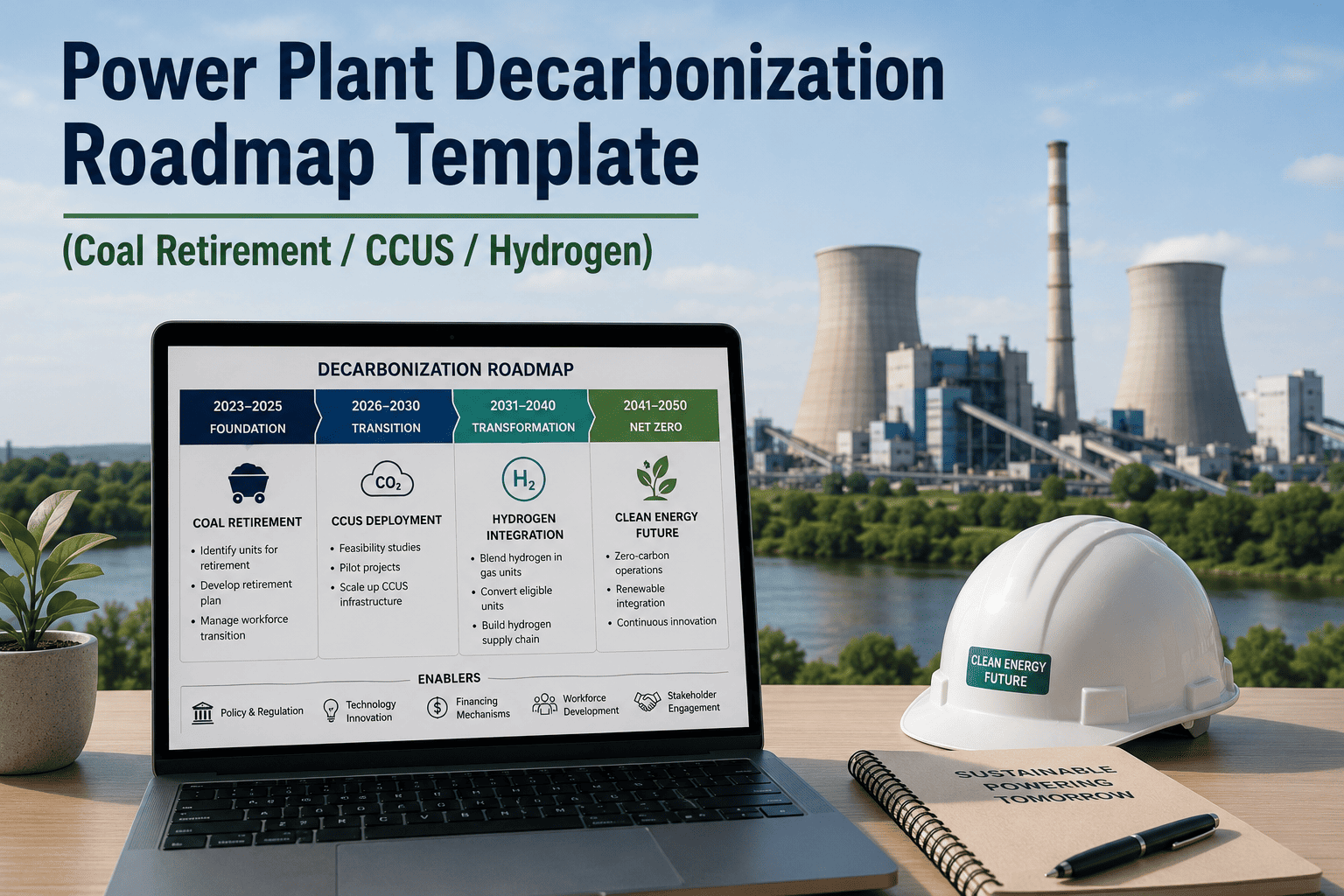
Power Plant Decarbonization Roadmap Template
Coal retirement, CCUS, hydrogen co-firing, and Net Zero milestones — structured, trackable, audit-ready, and connected to the assets that have to deliver the transition.
The Four Pathways Every Thermal Plant Roadmap Must Evaluate
No two plants will follow the same path. But every roadmap must start with a honest assessment of which pathways are technically and commercially viable for each unit in the fleet.
Planned retirement of coal-fired capacity before end of technical life, replaced by renewables with storage, gas peakers, or grid import. Requires transmission planning, stranded asset accounting, just transition provisions for affected workers, and regulatory decommissioning approval.
Post-combustion carbon capture installed on existing flue gas stacks. Captured CO2 transported to geological storage or industrial utilization. Requires site assessment, CO2 transport infrastructure, storage permit, and a significant auxiliary power derating (typically 20–25% of unit output consumed by capture process).
Blending hydrogen with natural gas or coal in existing boilers and gas turbines to reduce carbon intensity without full fuel replacement. Most gas turbines can accept 20–30% H2 blends with combustor modifications. Higher blends require more significant hardware changes and dedicated fuel handling infrastructure.
Heat rate improvement, waste heat recovery, steam cycle optimization, and auxiliary power reduction to reduce CO2 per MWh without changing fuel. Not a Net Zero pathway on its own, but the fastest and highest-return near-term action — and the one most often undervalued in decarbonization planning.
Decarbonization Milestones Backed by CMMS Evidence, Not Spreadsheets
Every technical claim in your roadmap needs supporting evidence. Oxmaint keeps the asset condition data, maintenance records, and emission-relevant work orders in one place — audit-ready when regulators and investors ask for it.
How the Template Structures the Decarbonization Timeline
Establish verified emissions baseline (Scope 1 and 2), complete heat rate improvement audit, implement low-cost auxiliary power reductions, begin hydrogen co-firing feasibility study, register carbon inventory in GHG Protocol framework.
Commission hydrogen co-firing at pilot scale, submit CCUS pre-FEED study, begin regulatory engagement on retirement timeline for oldest units, implement waste heat recovery projects, establish carbon credit procurement strategy under Article 6.
Final investment decision on CCUS (if economically viable), scale hydrogen co-firing to full commercial blend on eligible units, begin decommissioning of first retirement-scheduled units, integrate replacement capacity into dispatch planning.
Complete planned coal retirements, operate CCUS at commercial scale, achieve Net Zero or Net Negative emissions target across the remaining fleet, transition remaining staff to new asset types, close carbon registry entries.
What Evidence Each Milestone Needs — and Where to Store It
| Milestone | Evidence Required | Stored In | Audit Frequency |
|---|---|---|---|
| Verified emissions baseline | Fuel records, meter readings, GHG Protocol calculation workbook | CMMS asset records + GHG registry | Annual third-party verification |
| Heat rate improvement | Before/after DCS data, work order trail, performance test results | Oxmaint work orders + energy KPI module | Quarterly internal review |
| H2 co-firing pilot | Fuel analysis, burner modification records, emissions monitoring data | CMMS asset records + lab certificates | Per trial period |
| CCUS commissioning | Performance test certificates, capture rate data, storage permit, T&C records | CMMS document store + regulatory filings | Annual regulatory audit |
| Unit retirement | Decommissioning permit, final emissions report, stranded asset documentation | CMMS asset closure record + regulator | One-time regulatory closure |
| Net Zero declaration | Cumulative emissions ledger, offset retirement certificates, third-party attestation | GHG registry + CMMS audit trail | Annual third-party verification |
Decarbonization Roadmap — FAQ
What is the difference between a decarbonization roadmap and a Net Zero commitment?
A Net Zero commitment is a target — typically a year by which the organization aims to reach net zero emissions. A decarbonization roadmap is the structured plan showing how each unit, each pathway, and each milestone will get you there. A commitment without a roadmap has no audit trail and no accountability mechanism. The template provides the roadmap structure that makes the commitment credible.
Does the template cover Article 6 carbon credit mechanisms?
Yes. The roadmap includes a carbon credit register tab: credit type (Article 6.2, 6.4, or voluntary market), vintage year, project ID, quantity, retirement status, and the emissions period they offset. This gives auditors and investors a clean view of which reductions are physical and which are credit-backed. Start a free trial to configure your carbon registry integration.
How is technical risk captured for CCUS and hydrogen projects?
The template includes a project risk register per major capital decision: technical readiness level (TRL), key risk items, mitigation actions, probability/impact scores, and fallback pathway if the project does not proceed. This allows leadership and investors to understand the confidence level behind each roadmap assumption without requiring a separate risk document.
Can Oxmaint store decarbonization evidence alongside maintenance records?
Yes. Oxmaint links emissions-relevant work orders, performance tests, and lab certificates directly to the asset record. When a regulator asks for evidence that a heat rate improvement project was completed and delivered its projected emission reduction, the work order, before/after performance data, and sign-off are all in one place. Book a demo to see how the evidence trail works.
Turn Your Decarbonization Commitment Into a Trackable, Auditable Plan
The utilities that navigate the energy transition successfully will be the ones with structured plans, documented evidence, and operational systems that connect milestones to the assets that have to deliver them. Oxmaint is that system.