The power plant maintenance workforce is not just aging — it is disappearing faster than it can be replaced. Sixty-nine percent of maintenance professionals are 50 or older, and the skilled trades pipeline that once fed power plants with qualified instrument technicians, rotating equipment mechanics, and electrical maintainers has been contracting for two decades. When a senior technician with 30 years of turbine-specific knowledge retires, the organisation loses more than headcount: it loses accumulated fault pattern recognition, institutional memory of equipment quirks, and informal coaching that never made it into a procedure document. The problem is structural, not temporary, and the plants that are managing it well are not just hiring faster — they are building systems to capture, preserve, and transfer knowledge before the retirements compound into a reliability crisis. This page covers the workforce shortage drivers, apprenticeship programme design, tribal knowledge capture methods, and how AI-assisted CMMS procedures are changing the speed at which new technicians reach productive competence. To see how OxMaint supports knowledge capture and workforce productivity at your plant, book a 30-minute demo or start your free trial.
Power Plant Workforce · Skills Shortage · Knowledge Management
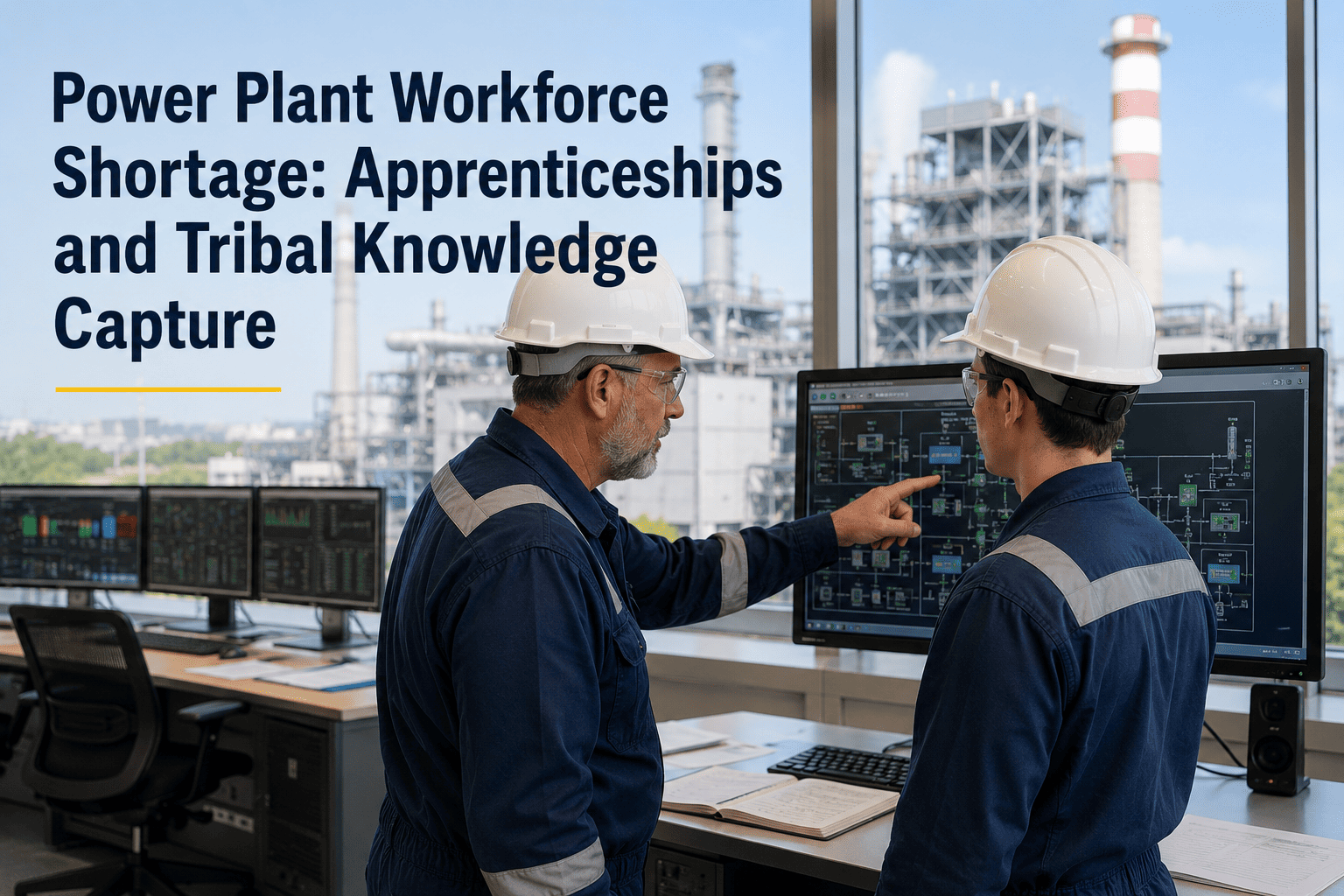
Power Plant Workforce Shortage: Apprenticeships and Tribal Knowledge Capture
69% of maintenance professionals are 50 or older. When they retire, decades of equipment-specific knowledge walks out the door — unless your plant has a system to capture it before it leaves.
69%
Maintenance professionals aged 50 or older — the largest age cohort in the industry
2.5M
Skilled manufacturing and energy trades jobs projected to go unfilled by 2028 (Deloitte)
3–5 yrs
Time to develop a fully competent rotating equipment technician from apprentice entry
88%
Of plants outsource some maintenance because they cannot find institutional knowledge internally
The Knowledge Problem
What "Tribal Knowledge" Actually Means — and Why Losing It Costs More Than a Hire
Tribal knowledge is not a soft concept. It has a hard reliability cost. When a senior turbine technician knows from experience that this particular unit's lube oil pressure dips by 2 psi during the fifth hour of a cold start, and that it always resolves before triggering an alarm — and that knowledge exists only in his head — the value of that information is quantifiable in avoided false shutdowns, avoided investigations, and avoided OEM callouts. Here are the four categories of tribal knowledge that most power plants are losing right now.
01
Equipment Fault Signatures
Experienced technicians have catalogued failure patterns over years of hands-on observation — the specific vibration frequency that precedes a particular bearing failure, the temperature spread pattern that indicates a combustion liner hot spot, the sound that comes from a lube oil pump cavitating. These diagnostic heuristics take years to develop and are rarely captured in OEM manuals.
02
Workarounds and Non-Standard Procedures
Every plant has documented procedures and then the way things actually get done safely and efficiently given the specific equipment configuration at that site. A valve that requires a specific partial-open sequence to avoid water hammer, a torque value that the procedure specifies at 80 Nm but experienced technicians always do at 75 Nm because the studs on this unit were re-tapped and stretch more. These are reliability-critical adaptations that live entirely in the workforce.
03
Historical Failure Context
The senior instrument technician remembers that the current abnormal reading on TE-302 correlates with a thermosleeve problem that first appeared in 2011 and was temporarily resolved with a calibration offset before the hardware was replaced in 2013. Without CMMS records that captured that history, every new symptom on TE-302 requires a full investigation from zero — at significant cost in time and parts.
04
Vendor and Contractor Relationships
Knowing which specific OEM field service engineer has deep knowledge of this turbine model, which local machining shop has the right tooling for the shaft seal bore, and which spare parts supplier stocks the non-standard filter housings — this vendor knowledge has real commercial value and is frequently invisible to procurement teams when the technician who holds it retires.
Knowledge Capture in OxMaint
Every Work Order Your Senior Technician Closes Becomes a Knowledge Asset
OxMaint converts every closed work order into searchable asset history — including photos, technician notes, root cause codes, and linked failure patterns. When a senior technician retires, the next person to work on that asset opens OxMaint and sees three to five years of documented failure context, not a blank screen. Knowledge capture does not require an extra programme — it happens automatically as part of the daily work order flow.
Apprenticeship Programme Design
Building an Apprenticeship Programme That Actually Produces Competent Plant Technicians
Effective power plant apprenticeship programmes are not generic trades training with a power plant orientation week tacked on. They are structured three to five year competency development tracks built around the specific equipment, systems, and failure modes at the host plant — with defined milestones, mentorship pairing, and CMMS-embedded task progression tracking.
Technical Skills
Plant systems familiarisation — P&ID reading and equipment identification across all five tiers of the asset hierarchy
Basic rotating equipment maintenance: bearing replacement, coupling alignment, mechanical seal installation
Lubrication fundamentals: oil types, sampling, contamination recognition
Work permit system and isolation procedures — safety-critical foundations
CMMS Productivity Milestones
Complete first 50 work orders with structured asset tags and root cause codes
Pass OxMaint mobile work order flow proficiency check — work orders closing in under 3 minutes
Use asset QR scan to access historical work order records before starting any PM task
Technical Skills
Vibration analysis: route measurement, spectrum interpretation, trending — Level I certification target
Combustion turbine inspection techniques: borescope procedure, compressor wash, inlet system PM
Electrical maintenance fundamentals: motor testing, relay coordination, protection system verification
FMEA participation — contribute to failure mode identification for assigned equipment systems
Knowledge Transfer Activities
Shadow senior technician on minimum 10 unplanned fault investigations — document findings in CMMS
Conduct structured interview with assigned senior mentor: document 5 equipment-specific fault signatures in CMMS procedure library
Lead first independent PM on A-criticality rotating equipment — senior technician signs off
Technical Skills
Root cause analysis facilitation — lead RCA on repeat failures for assigned system boundary
Predictive maintenance interpretation: integrate vibration, thermography, oil analysis into maintenance decisions
Outage planning contribution: scope development, task sequencing, contractor supervision
Knowledge Contribution
Develop or update minimum 3 PM procedures for assigned equipment based on failure history
Contribute to next generation apprentice onboarding — deliver system familiarisation sessions
Complete reliability engineering fundamentals course — CMRP or equivalent certification target
AI-Assisted Procedures
How AI-Assisted Maintenance Procedures Are Changing Apprentice Ramp-Up Time
The traditional procedure library — a PDF in a shared drive, or a laminated card in the equipment locker — cannot keep pace with the knowledge transfer challenge facing power plants today. AI-assisted procedure generation and CMMS-embedded guidance are compressing the gap between an apprentice's documented knowledge and their senior mentor's tacit knowledge. Here is how the technology is being applied effectively.
Dynamic Work Instructions on Mobile Devices
When an apprentice scans an asset QR code to start a work order, OxMaint presents the relevant PM procedure, the last three work order records for that asset, and any open operator-reported symptoms — all before the technician touches the equipment. This context replaces the informal coaching that used to happen only when a senior technician was physically present and available. Apprentices report 40% fewer procedure clarification calls to senior technicians when contextual work instructions are embedded in the CMMS work order flow.
AI-Generated Procedure Drafts from Failure History
Failure patterns stored in the CMMS — recurring root cause codes, component replacement frequencies, technician notes from fault investigations — can be used to generate first-draft updated procedures that reflect actual failure experience rather than OEM generic guidance. The senior technician reviews and validates the draft; the AI compiles the evidence base from work order history. This approach has been shown to reduce procedure update cycles from 12–18 months to 6–8 weeks at plants where work order coding discipline is high.
Structured Knowledge Interviews Before Retirement
A structured retirement knowledge transfer programme — typically 3 to 6 months before a senior technician's last day — captures equipment-specific fault signatures, workaround procedures, and vendor relationships through a structured interview process. The output is a set of documented CMMS procedure notes and failure mode addenda attached to the relevant asset records. OxMaint supports this with a knowledge capture work order type that stores technician interview notes directly in the asset history.
Retention and Culture
Why Apprenticeship Alone Is Not Enough — Retention Is the Other Half
Hiring and developing skilled technicians is expensive — $15,000 to $30,000 per hire in training and onboarding costs for a power plant maintenance role, plus 12 to 18 months before full productivity. The plants that are winning the workforce challenge are not just training more apprentices; they are building the operational environment that makes skilled technicians want to stay.
| Retention Factor |
What High-Retention Plants Do |
What Low-Retention Plants Do |
Impact on Workforce Stability |
| Tool and System Quality |
Mobile-first CMMS that makes the technician's day easier and reduces paperwork |
Desktop-only CMMS the technician avoids, with manual paper-based fallback |
Skilled technicians cite poor tools as a top 3 reason for leaving |
| Recognition and Visibility |
Technician KPIs visible on dashboard — PM compliance, work order quality recognised at shift level |
Work quality invisible — no feedback loop between effort and measured outcome |
High performers leave environments where good work is indistinguishable from poor work |
| Career Development |
Clear path from apprentice to specialist to reliability engineer — milestones tracked in CMMS |
Undefined progression — skilled technicians have no visibility into advancement criteria |
Plants with defined career paths retain skilled technicians 3 years longer on average |
| Knowledge Contribution |
Technician knowledge is actively captured, documented, and credited — people feel their expertise matters |
Tacit knowledge is taken for granted — no structured capture, no recognition for knowledge sharing |
Senior technicians who feel valued for their expertise retire 18 months later on average |
Frequently Asked Questions
Power Plant Workforce and Knowledge Transfer — Common Questions
How quickly can a new apprentice become productive in a power plant maintenance role?
Basic productivity — completing routine PMs independently — typically takes 12–18 months. Full competency for unplanned fault response on critical equipment takes 3–5 years. Plants using CMMS-embedded work instructions and structured knowledge capture programmes report reducing the basic productivity milestone by 30–40%, because apprentices have documented failure context available from day one.
See how OxMaint accelerates onboarding.
What is the best way to capture knowledge from a senior technician who is retiring in six months?
Start with the assets they have worked on most frequently — pull the CMMS work order history for those assets and identify the recurring patterns they resolved. Conduct structured weekly sessions where they walk through fault signatures and non-standard procedures, documented directly in CMMS procedure notes. The goal is to convert tacit pattern recognition into searchable CMMS records before the retirement date. Six months is enough time to capture 70–80% of the highest-value knowledge if the process starts immediately.
Book a demo to see the OxMaint knowledge capture workflow.
Should power plants partner with community colleges or trade schools for apprenticeship pipelines?
Yes — formal education partnerships reduce the first-year training investment and improve apprentice retention by giving the programme credential recognition. The most effective model combines a two-year technical programme at a partner institution with a concurrent on-site apprenticeship, so classroom theory is immediately reinforced by plant-specific application. Partnership with a local institution also gives the plant visibility in the local workforce market and access to pre-screened candidates.
Can OxMaint track apprentice competency progression as part of the CMMS workflow?
Yes. OxMaint supports technician skill level assignment per equipment class — work orders can be automatically routed to technicians at the appropriate competency level, and completed work orders build a documented competency record. Supervisors can track first-time quality rate, procedure adherence score, and work order completion time per apprentice, making competency development visible and objective rather than purely subjective.
Explore the workforce management features in a free trial.
What is the business case for investing in structured knowledge capture before senior retirements?
A single avoidable forced outage on a gas turbine costs $150,000–$500,000 in lost generation and emergency services. If structured knowledge capture prevents even one such outage per unit per year that would otherwise have been avoided by an experienced technician, the return on the knowledge programme investment is 10–50 times the cost of the programme. The business case is not speculative — it is documented in the repeat-failure rates of plants that lost key technical staff without a knowledge transfer programme in place.
OxMaint · Workforce and Knowledge Platform
The Retirements Are Coming. Make Sure the Knowledge Stays.
Every senior technician retirement is a knowledge transfer event — either managed or unmanaged. OxMaint gives power plant maintenance teams the tools to capture equipment-specific fault signatures and procedure knowledge in the CMMS as part of the daily work order flow, accelerate apprentice ramp-up with contextual work instructions and asset history, and build the operational environment that retains skilled technicians once you have developed them. The workforce shortage is structural. The knowledge loss is preventable.