Every turbine bearing, gearbox, and hydraulic actuator in a power plant is telling you something through its oil — but only if someone is listening on the right schedule. Most plants discover wear metal spikes or viscosity drift after the damage is already underway, not because the lab missed anything, but because no one mapped out which machine gets sampled, from which port, how often, and by whom. A structured oil sampling schedule changes that: it turns a reactive lab-report habit into a proactive early-warning system that catches problems 4–8 weeks before they become failures. If your team is still tracking routes on paper or a shared spreadsheet that nobody trusts, Oxmaint's CMMS gives you a smarter way to own every sample point, route, and result in one place across every unit in the fleet.
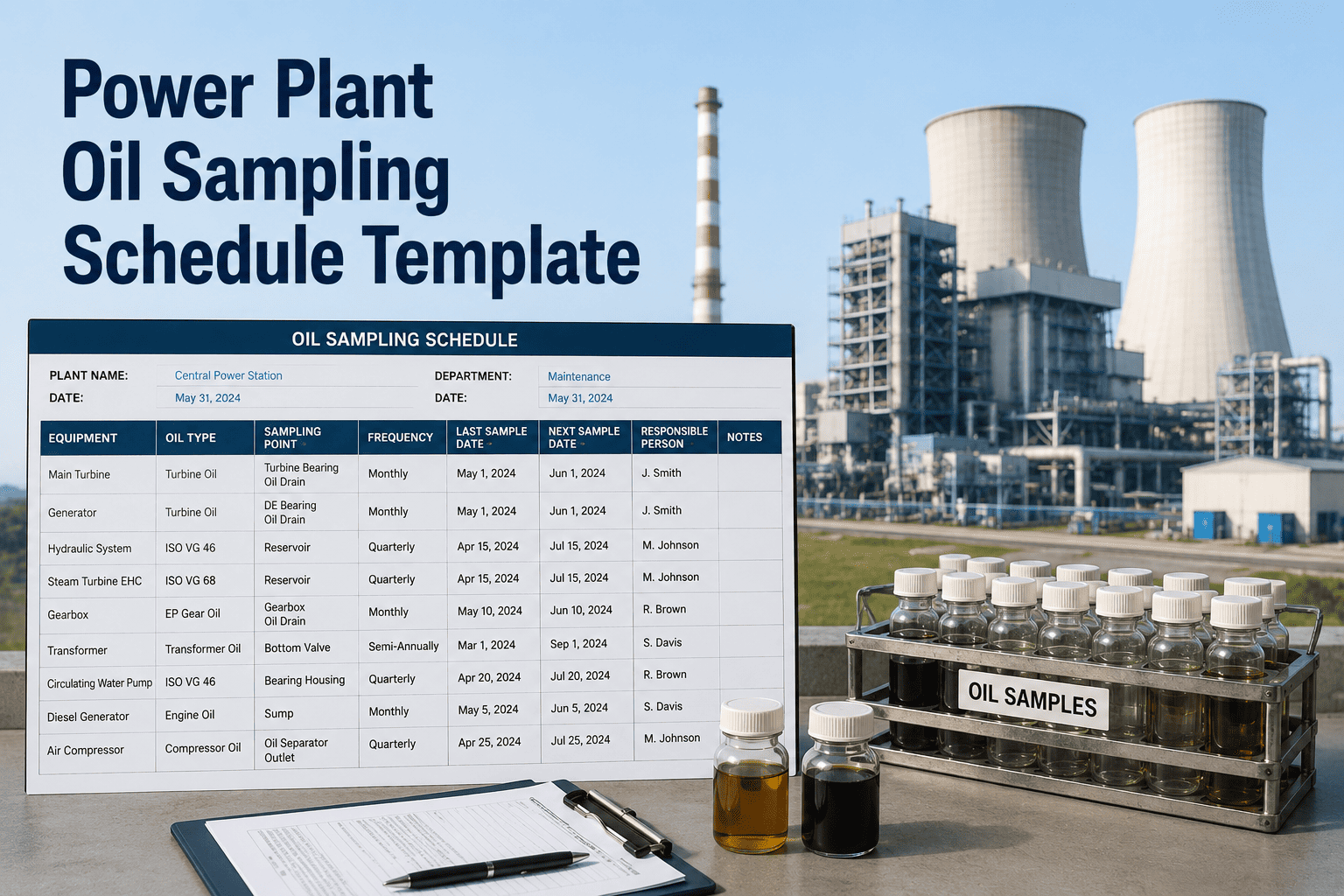
Power Plant Oil Sampling Schedule Template
Map every sample point, assign routes, set frequencies, and track results — all in one structured program your reliability team will actually use.
What Breaks Without a Proper Sampling Schedule
Sampling from a drain port after shutdown gives you settled sediment, not a representative live-machine picture. Without port mapping, technicians take the path of least resistance — and the lab gets a misleading sample every time.
A boiler feed pump bearing running on degraded oil for three extra months is not a lab failure — it is a route gap. If the equipment is not on the schedule, the sample never gets taken, and the trend never exists.
Rate-of-change analysis — the metric that predicts failure velocity — needs evenly spaced samples. When intervals drift from quarterly to "whenever someone remembers," the rate calculation becomes meaningless.
When sampling belongs to everyone, it gets done by no one. A named route with a named technician and a deadline turns oil sampling from an intention into an accountable work order.
What Every Column in the Template Should Capture
A complete oil sampling schedule is more than a list of machines. Each row is a full diagnostic instruction set for the technician in the field.
Every Sample Point. Every Route. Every Result. One System.
Oxmaint links your oil sampling schedule directly to CMMS work orders, auto-triggers exception tests when thresholds are crossed, and keeps a live trend per asset — no manual data entry required.
How Often Should Each Machine Be Sampled?
| Equipment Type | Criticality | Normal Interval | Alert-State Interval | Key Tests |
|---|---|---|---|---|
| Steam Turbine (main) | Critical | Monthly | Weekly | Elemental, viscosity, RPVOT, particle count |
| Boiler Feed Pump | Critical | Monthly | Bi-weekly | Elemental, water content, viscosity |
| Generator Bearing | Critical | Monthly | Weekly | Elemental, ferrography (exception), particle count |
| ID / FD Fans (gearbox) | Moderate | Quarterly | Monthly | Elemental, viscosity, FTIR |
| Cooling Water Pumps | Moderate | Quarterly | Monthly | Elemental, water content |
| Hydraulic Actuators | Moderate | Quarterly | Monthly | Particle count, viscosity, water content |
| Coal Mill Gearbox | Moderate | Quarterly | Monthly | Elemental, ferrography (exception), viscosity |
| Auxiliary / Service Pumps | Lower | Semi-annual | Quarterly | Viscosity, acid number, elemental |
When to Trigger Ferrography as an Exception Test
Analytical ferrography is not a routine test for every machine on every cycle — it is a targeted investigation triggered when routine results raise a specific question about wear mode or particle morphology.
ISO 4406 cleanliness code climbs two or more code levels between samples. Ferrography identifies whether particles are fatigue flakes, sliding wear, cutting wear, or corrosion — which changes the maintenance response entirely.
Iron, copper, or chromium increases by more than 25% over baseline in a single cycle. Elemental analysis tells you what metal; ferrography tells you from which component and by what wear mechanism.
Viscosity deviation beyond plus or minus 15% of the ISO VG grade midpoint — combined with elevated wear metals — suggests that lubricant breakdown is accelerating component wear, not just degrading the oil.
A ferrography run 30–60 days before a planned outage establishes the machine's wear state entering the shutdown — so inspectors know exactly which components to prioritize on teardown.
What the Downloadable Oil Sampling Schedule Includes
All sampled equipment listed with tag number, lube system type, oil grade, sump capacity, and criticality tier. The foundation every route is built on.
Equipment grouped by physical location for efficient field routes. Port type, sampling method, required PPE, and lab bottle type specified per row.
Monthly grid showing which assets are due in each period. Color-coded by criticality. Overdue flags appear automatically when sample dates are not updated.
Standard and exception test panels per equipment type. Covers elemental, viscosity, FTIR, acid number, particle count, and ferrography trigger logic.
Per-machine result log with conditional formatting for out-of-limit values. Each flagged result links to a corrective action field so nothing falls through the cracks.
Column headers pre-matched to Oxmaint import fields. Drop the template's data directly into the CMMS without manual re-keying — the asset record stays up to date automatically.
Oil Sampling Schedule — FAQ
What is the difference between routine and exception oil testing?
Routine testing runs on a fixed schedule — elemental analysis, viscosity, and particle count every month or quarter. Exception testing like ferrography or RPVOT is triggered only when a routine result crosses a defined limit. This keeps lab costs controlled while ensuring deeper investigation happens exactly when it is needed.
How do I decide which sample port to use on each machine?
ISO 4021 recommends sampling from a live pressurized line or pitot-tube valve while the machine is running. Drain-port sampling should be used only when no other access exists. Document the port used on each sample to ensure consistent results between cycles. Book a demo to see how Oxmaint records sample point details per asset.
Can the template handle a fleet with both steam and gas turbines?
Yes. The master asset register includes a machine-type column that drives different test panels and frequency tiers for steam turbines, gas turbines, and auxiliary equipment. Each machine type can carry its own alert thresholds and ferrography trigger logic.
How does Oxmaint replace the spreadsheet once the program is running?
Oxmaint converts sampling routes into scheduled work orders, auto-flags overdue samples, imports lab results by asset tag, and shows a trend chart per machine — all without manual data entry. Start a free trial to load your fleet and activate the full sampling workflow.
What happens when a sample result triggers an alert?
In Oxmaint, a flagged result auto-generates a corrective work order against the asset, escalates to the assigned reliability engineer, and increases the sampling frequency until the parameter returns to normal. The full alert-to-close trail stays on the asset record.
Your Oil Sampling Schedule Deserves More Than a Spreadsheet
The template gets you started. Oxmaint keeps the program running — with CMMS-backed work orders, auto-triggered alerts, and a full trending record per machine that grows more valuable with every sample.