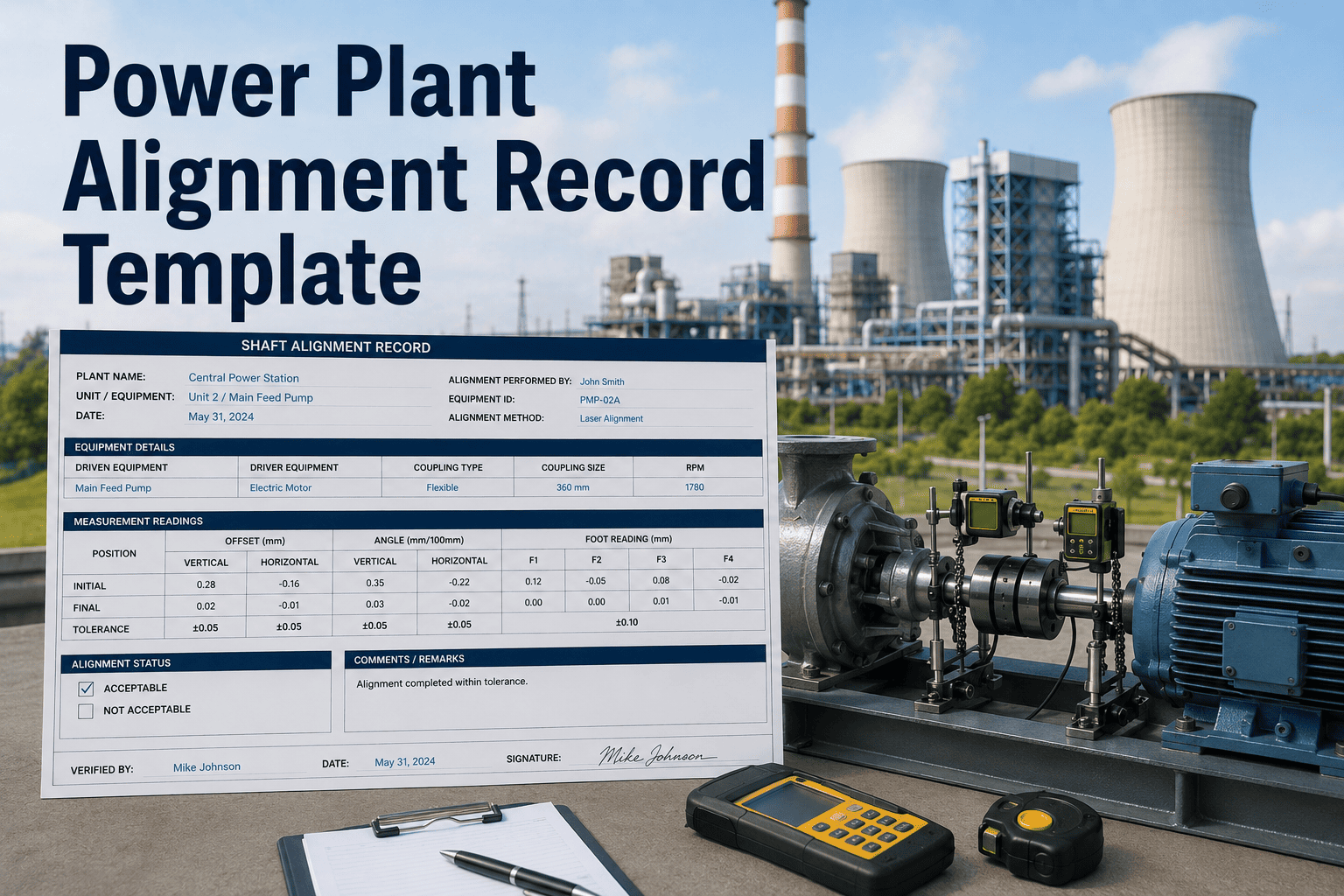
A misaligned shaft coupling does not fail suddenly — it fails slowly, in stages, wearing out seals and bearings over weeks while vibration levels climb and nobody connects the dots. Laser shaft alignment is one of the highest-return maintenance activities in a power plant: correcting an offset of 0.1 mm on a boiler feed pump can extend bearing life by a factor of three or more. The problem is not technique — most technicians know how to align. The problem is records. When the pre-alignment readings, soft-foot measurements, thermal growth offsets, and final as-left values are not captured in a structured format tied to the specific machine, the alignment job may as well not have happened. The next team has no baseline, the planner has no audit trail, and the reliability engineer has no data to trend. A proper alignment record template, linked to the Oxmaint CMMS, closes that gap permanently — every alignment job documented, every machine's history preserved, every future technician informed before they touch the first bolt.
Power Plant Alignment Record Template
Laser, optical, soft foot, thermal growth, and sign-off records — one structured form per machine, every alignment job documented for the life of the asset.
Four Alignment Methods Your Records Must Cover
Not every alignment job uses the same method. Your template needs to accommodate each approach — and capture different data fields depending on which one was used.
The current standard for precision coupling alignment in power plants. Laser targets are mounted on each shaft; the system computes horizontal and vertical offset and angularity simultaneously. Records must capture pre- and post-correction readings in both planes, instrument serial number, and correction method.
Still used for large, slow-rotating equipment where laser access is restricted. More sensitive to bar sag corrections and bracket setup. Records must include sag correction values, bracket stiffness check results, and full dial readings at 12, 3, 6, and 9 o'clock positions.
A prerequisite for any alignment — not a separate job. Soft foot distorts the machine frame as bolts are tightened, making post-correction readings meaningless. Records must show each foot's indicator reading before shimming and the final as-corrected reading. No alignment is valid without a passing soft foot check.
A shaft aligned cold to zero offset may be misaligned hot by 0.15 mm or more, depending on the machine's operating temperature and footprint. Records must store the thermal growth offsets used — whether from OEM specs, thermal imaging data, or DBSE calculations — and show the intentional cold offset that was applied.
No More Alignment Records Lost in the Outage Folder
Oxmaint links alignment records directly to the equipment asset — so next year's team knows the baseline, the shim stack, and exactly how the machine was left.
Every Section the Alignment Record Template Contains
Work order number, equipment tag, machine description, drive and driven unit identification, date, shift, and technician names. Links the physical record to the CMMS work order from the start.
Ambient temperature at time of alignment, machine operating temperature during last run, coupling type and span, coupling condition check, and whether the machine was isolated and locked out correctly.
Indicator reading at each foot with bolts loose. Any foot exceeding 0.05 mm (0.002 in) requires shimming before alignment proceeds. Final soft foot readings after correction, with pass threshold documented.
As-found condition — horizontal offset, vertical offset, horizontal angularity, vertical angularity. This baseline is as important as the final reading: it tells the reliability engineer how far the machine moved since the last job.
Source of thermal data (OEM specification, thermal survey, DBSE calculation), hot target tolerance band, and the intentional cold offset built into the final alignment target. Without this, cold-zeroed machines will be misaligned under load.
Shim material, thickness, and location for each foot that was adjusted. Horizontal move direction and distance for both front and rear feet of the moveable machine. These are the instructions for undoing the job if needed.
As-left offset and angularity in both planes, compared against the tolerance target. Pass or fail flag per parameter. Machine is not handed back without all values within tolerance and this section signed off.
Technician, supervisor, and reliability engineer signatures. Work order closure code in CMMS. Completed record attached to the asset in Oxmaint — not filed in a paper folder or a network drive no one can find.
Precision Alignment Tolerance Guide by Equipment Type
| Equipment Type | Speed Range (RPM) | Offset Tolerance (mm) | Angularity Tolerance (mm/m) | Soft Foot Limit (mm) |
|---|---|---|---|---|
| Steam Turbine — HP/IP | 3,000 / 3,600 | 0.025 – 0.05 | 0.025 – 0.05 | 0.025 |
| Boiler Feed Pump | 3,000 – 6,000 | 0.03 – 0.05 | 0.03 – 0.05 | 0.025 |
| Generator | 3,000 / 3,600 | 0.025 – 0.05 | 0.025 | 0.025 |
| ID / FD Fan (coupled) | 700 – 1,500 | 0.05 – 0.10 | 0.05 – 0.10 | 0.05 |
| Condensate Extraction Pump | 1,450 – 2,900 | 0.05 | 0.05 | 0.05 |
| Cooling Water Pump | 750 – 1,500 | 0.08 – 0.12 | 0.08 – 0.12 | 0.05 |
| Coal Crusher / Mill | 300 – 1,000 | 0.10 – 0.15 | 0.10 – 0.15 | 0.10 |
Tolerances shown are general industry guidance. Always apply OEM specifications for the specific machine. Tighter tolerances apply at higher speeds.
Alignment Records and CMMS — FAQ
Why is soft foot measured before the main alignment, not after?
Soft foot distorts the machine frame as anchor bolts are torqued down, introducing alignment errors that cannot be corrected by coupling adjustment alone. Correcting it first means the subsequent laser readings reflect the true shaft position — not the frame's deformation. Any post-alignment soft foot check above 0.05 mm invalidates the final readings.
Does the template support both metric and imperial units?
Yes. The template includes a unit-selection flag at the job header level — all calculated fields switch between mm and inches accordingly. Oxmaint stores values in both for cross-fleet consistency. Start a free trial to configure unit preferences per plant or fleet.
How does thermal growth compensation get captured in the record?
Section 5 of the template records the growth offset source (OEM, thermal imaging, DBSE), the hot target in each plane, and the cold intentional offset actually set. This means future technicians can verify whether the thermal data used was current or outdated and recalculate if the machine's operating conditions have changed.
Can completed alignment records be stored against the asset in Oxmaint?
Yes. Each alignment job closes as a work order in Oxmaint, with the completed record attached as a PDF or form fill. The asset's full alignment history is visible from the equipment record — including as-found, as-left, shim log, and technician sign-off. Book a demo to see the workflow in action.
What is the minimum data a record must have to be audit-valid?
For regulatory and insurance audit purposes, a valid alignment record must include: soft foot measurements before and after correction, pre-alignment as-found readings, thermal offsets applied, post-alignment final readings in both planes, tolerance pass/fail result, and two signatures — technician and supervisor. Oxmaint enforces this checklist at work order closure.
Keep Every Alignment Record on the Asset, Not in Someone's Filing Cabinet
When the engineer who did the last alignment leaves, the shim stack and thermal offset data should not leave with them. Oxmaint keeps every record alive on the asset for the machine's full operational life.