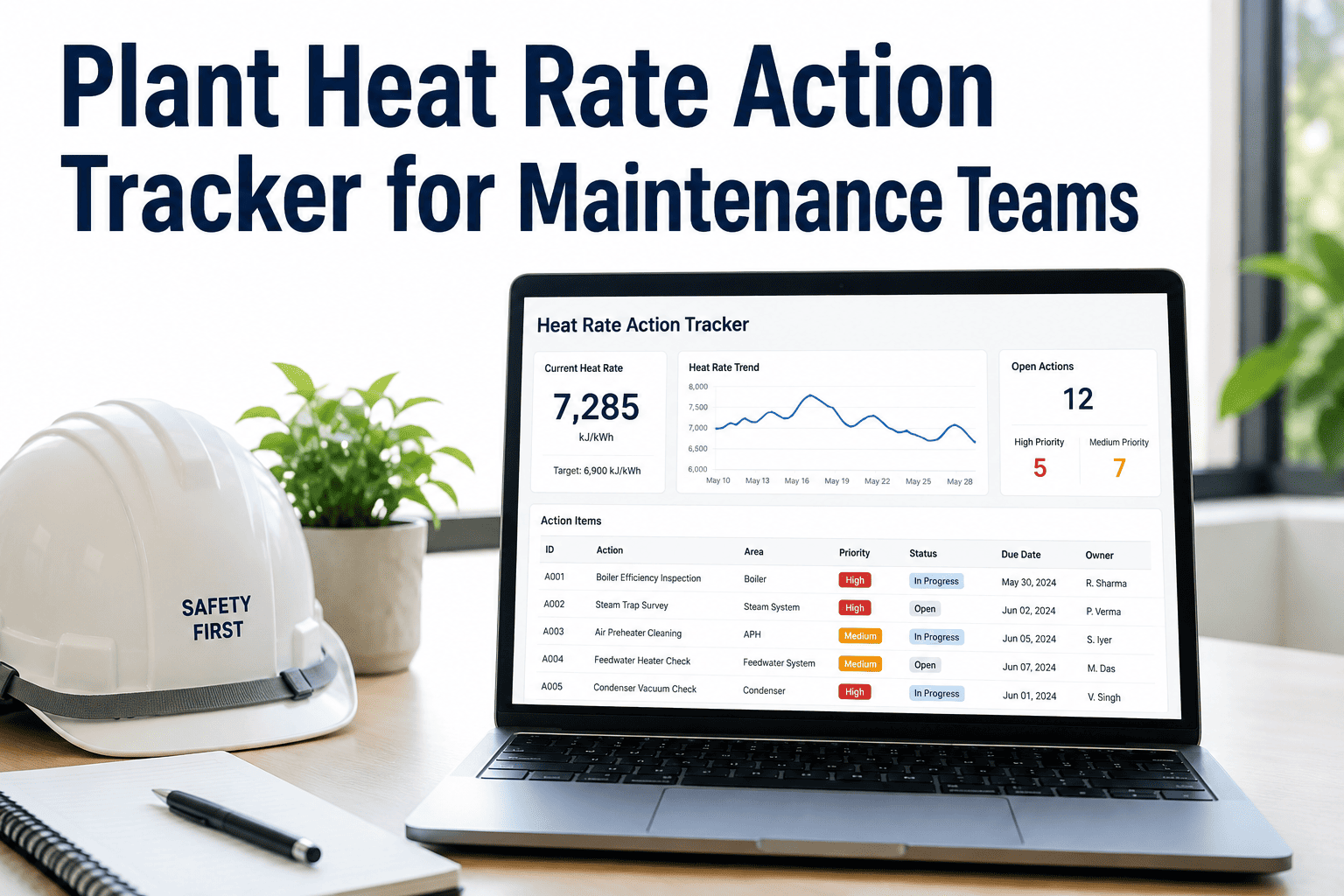
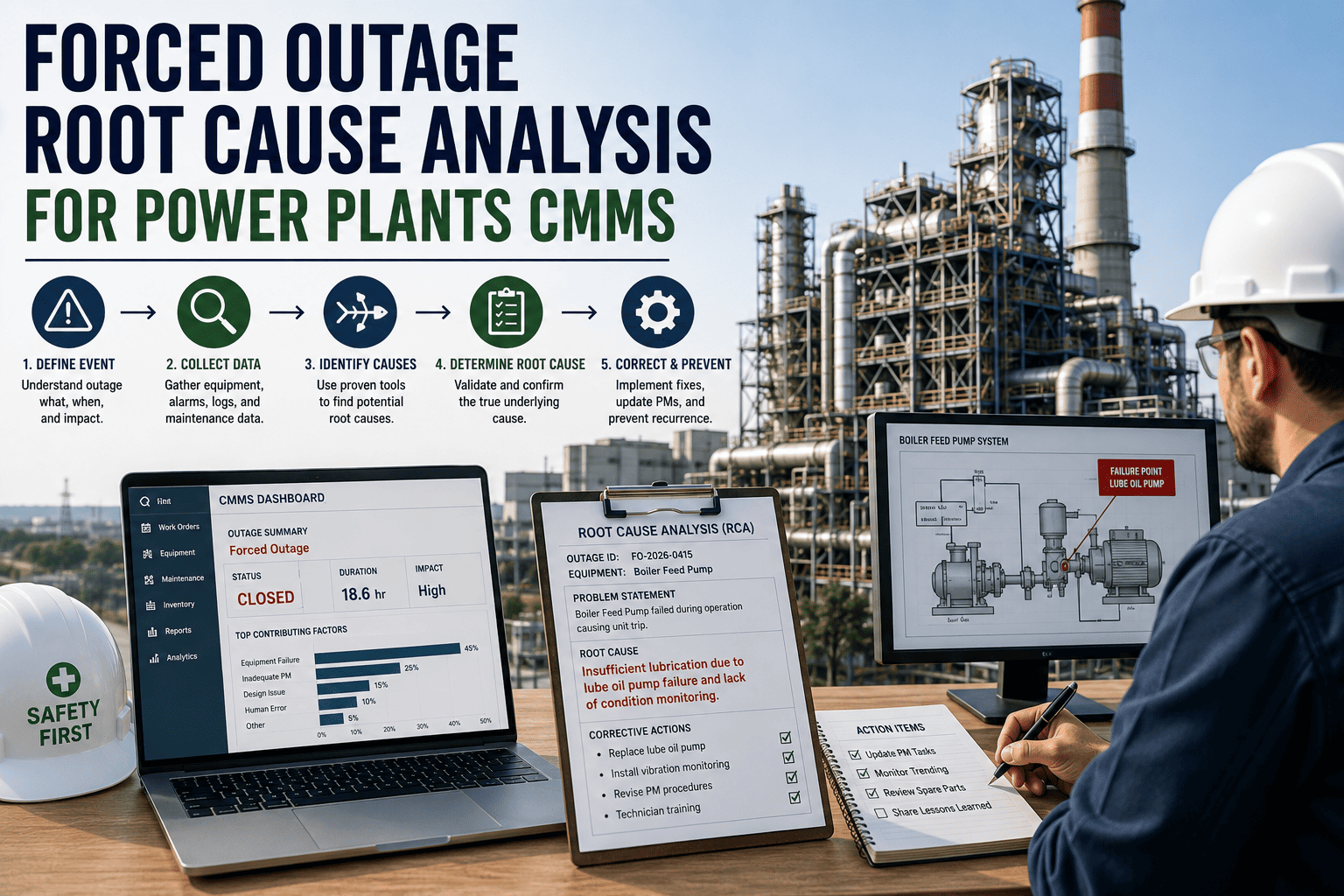
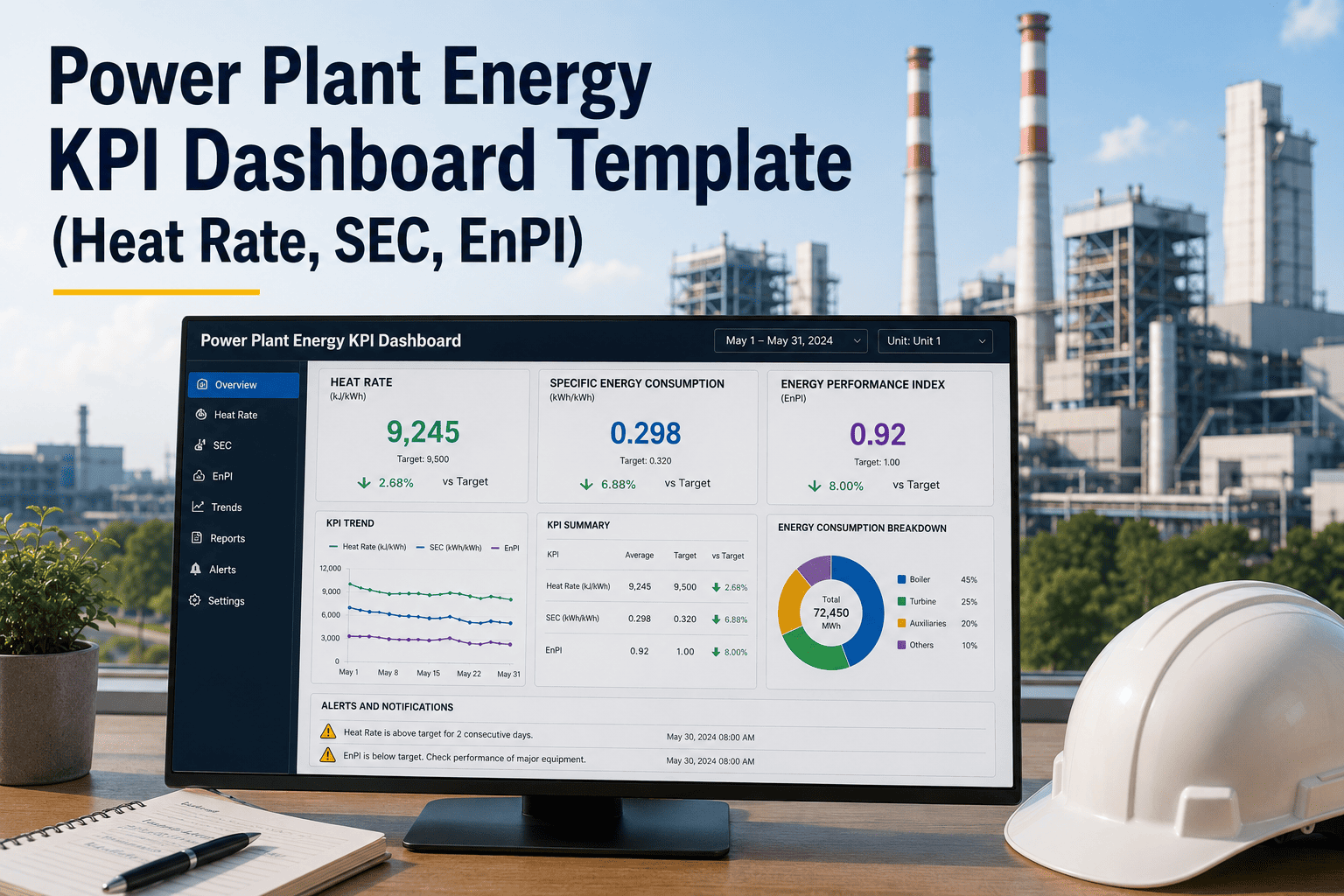
For a 500 MW coal plant, a 1% heat rate degradation costs over $1 million in additional fuel annually — but that number means nothing to a maintenance team staring at a backlog of work orders without a clear line between what they fix and what it saves. The gap between performance engineering and maintenance execution is where heat rate improvement programs fail: engineers identify losses in turbine efficiency, condenser backpressure, or air preheater leakage, then hand a spreadsheet to a maintenance team that has no system to track which actions were completed, who owned them, or whether the efficiency actually recovered. A heat rate action tracker integrated with CMMS closes this gap permanently — converting each identified heat rate deviation into a maintenance work order with asset ownership, root cause documentation, a fuel savings estimate in dollars, and a closure status visible to both performance engineers and maintenance leadership. Start converting heat rate losses into maintenance actions on OxMaint.
Analytics and Reporting · Performance Optimization · CMMS
Plant Heat Rate Action Tracker for Maintenance Teams
Convert every heat rate deviation into a trackable maintenance action — with asset ownership, dollar-value savings estimates, root cause documentation, and a real-time closure dashboard that both performance engineers and maintenance managers can trust.
45–75%
of power plant operating costs are fuel
1%
heat rate improvement = $1M+ annual fuel savings at 500 MW scale
$4,200
daily fuel cost of a 0.3% heat rate loss at $45/MWh
4–8 wks
time to measurable heat rate improvement with structured action tracking
The Core Problem
Why Heat Rate Improvement Programs Stall After the Engineer's Report
Every power plant performance team knows the theory: identify the deviation, quantify the loss, assign a corrective action, track to closure, verify the improvement. The breakdown happens at step three. Without a CMMS-integrated action tracker, identified heat rate losses live in spreadsheets that nobody updates, assigned to maintenance leads who have no system to mark them complete, with no visibility into whether the efficiency actually recovered after the repair.
01
Actions Without Owners
Heat rate deviation lists are shared in meetings. No specific asset owner, no deadline, no work order. The action exists in a spreadsheet row that nobody is accountable for.
02
No Dollar Context for Prioritization
Maintenance teams receive a list of recommended actions with no financial framing. A condenser cleaning that recovers $800/day in fuel costs gets deprioritized below routine tasks with no quantified value.
03
No Closure Verification
Even when maintenance completes the work, there's no mechanism to confirm that heat rate recovered. The performance team runs the next analysis cycle and finds the same loss still there — action "completed" but efficiency never verified.
04
Recurrence Without Pattern Recognition
Condenser fouling is addressed reactively each time. Nobody tracks that it returns every 90 days or that it's worse in summer — data that would shift the approach from reactive cleaning to optimized PM intervals.
How OxMaint Works
From Heat Rate Deviation to Closed Maintenance Action — In One System
Identify and Quantify the Deviation
Performance data — turbine efficiency, condenser backpressure, air preheater leakage fraction, boiler excess air — is logged against design baseline in OxMaint's analytics module. Each deviation is automatically quantified in heat rate points (BTU/kWh) and converted to a daily fuel cost using the plant's actual fuel price and capacity factor.
Example: Condenser backpressure 4 mbar above design → 0.3% heat rate loss → $4,200/day fuel cost at current load
Create Asset-Linked Action with Root Cause
Each deviation becomes a maintenance action in OxMaint — linked to the specific asset (condenser tube bundle, turbine stage, air preheater basket), documented with root cause category (fouling, wear, leakage, calibration), assigned to a named technician or crew, with the savings estimate and priority visible on the work order.
Work order: "Condenser tube bundle cleaning — Unit 2" | Owner: Mechanical crew B | Estimated savings: $4,200/day | Root cause: Tube fouling — Mackinac clam season
Track Action Status in Real-Time Dashboard
The heat rate action dashboard shows every open action with its current status — pending, in progress, waiting on parts, completed pending verification. Maintenance leadership and performance engineers see the same view. Overdue high-value actions trigger automatic escalation alerts to plant management.
Dashboard: 12 open actions | $47,000 daily fuel cost at risk | 3 actions overdue | 8 actions in progress
Verify Recovery and Close the Evidence Loop
After maintenance completion, OxMaint prompts the performance engineer to log the post-action efficiency measurement — confirming that backpressure returned to design, turbine efficiency recovered, or air preheater leakage dropped to baseline. This verification closes the action with documented evidence of the efficiency gain achieved versus estimated.
Closure record: Condenser cleaning completed → Backpressure returned to 42 mbar design → Heat rate recovered 0.28% → Actual savings $3,900/day confirmed
OxMaint Heat Rate Action Tracker
Turn Every Heat Rate Loss into a Trackable, Closeable Maintenance Action
OxMaint gives performance engineers and maintenance managers one shared system — heat rate deviations become work orders with asset owners, dollar savings estimates, root cause records, and verified closure. See the dashboard live in 30 minutes.
Top Heat Rate Actions
The Eight Maintenance Actions That Drive the Most Heat Rate Recovery
| Maintenance Action |
Typical Heat Rate Improvement |
Frequency Basis |
Failure Indicator |
| Condenser tube cleaning |
0.2 – 0.8% |
Backpressure trend above baseline |
Rising condenser pressure at constant load |
| Steam turbine online / offline water wash |
0.3 – 1.5% |
Turbine efficiency drop below threshold |
HP/IP efficiency below design by 1%+ |
| Air preheater basket cleaning |
0.2 – 0.6% |
Leakage fraction above 8% |
Exit flue gas temperature rise |
| Boiler tube leak detection and repair |
0.1 – 0.4% |
Makeup water consumption increase |
Elevated feedwater flow vs steam output |
| Burner tip inspection and cleaning |
0.1 – 0.3% |
NOx trend above baseline at same load |
Uneven flame pattern, increased excess air |
| Feed pump efficiency test and service |
0.1 – 0.5% |
Pump head-flow curve degradation |
Motor current above design at rated flow |
| Turbine seal replacement |
0.2 – 0.7% |
Internal steam leakage rate increase |
Low exhaust pressure relative to inlet |
| Cooling tower fill and distribution inspection |
0.1 – 0.4% |
Approach temperature above target |
Condenser inlet cooling water temperature rise |
Common Questions
Heat Rate Action Tracker — FAQs
How does OxMaint calculate the fuel savings estimate for each heat rate action?
OxMaint uses the plant's actual fuel cost per BTU and capacity factor to convert any heat rate deviation into a daily dollar cost. Performance engineers input the deviation in BTU/kWh or percentage; the system calculates the financial urgency signal automatically. This quantification drives maintenance prioritization based on actual economic impact.
Configure your plant's fuel cost parameters in a free trial.
Can the system track recurrence patterns for the same heat rate loss?
Can performance engineers and maintenance teams both access the same action tracker?
Yes. OxMaint uses role-based access — performance engineers can create actions, log deviation data, and verify closure measurements; maintenance leads can view their assigned work orders, update status, and record completion. Both roles see the same real-time dashboard showing open actions and cumulative fuel cost at risk.
How does OxMaint verify that a heat rate action actually delivered the expected savings?
After a maintenance action is marked complete, OxMaint prompts the performance engineer to log the post-action measurement — backpressure, turbine efficiency, or air preheater leakage — and compares it against both the pre-action baseline and the estimated recovery. This closes the evidence loop with documented actual versus estimated savings.
Can OxMaint generate management reports on heat rate improvement savings achieved?
Yes. OxMaint's report builder generates heat rate improvement summaries by unit, time period, and action category — showing cumulative fuel cost avoided, actions completed versus open, and average time-to-closure per deviation type. These reports support capital investment justification and maintenance budget reviews.
See the reporting capabilities in your free trial.
Stop Losing Fuel Cost to Heat Rate Deviations Nobody Tracks to Closure
OxMaint converts heat rate losses into CMMS work orders with asset ownership, root cause documentation, dollar savings estimates, and verified closure — giving performance engineers and maintenance managers one shared system to drive real efficiency recovery.