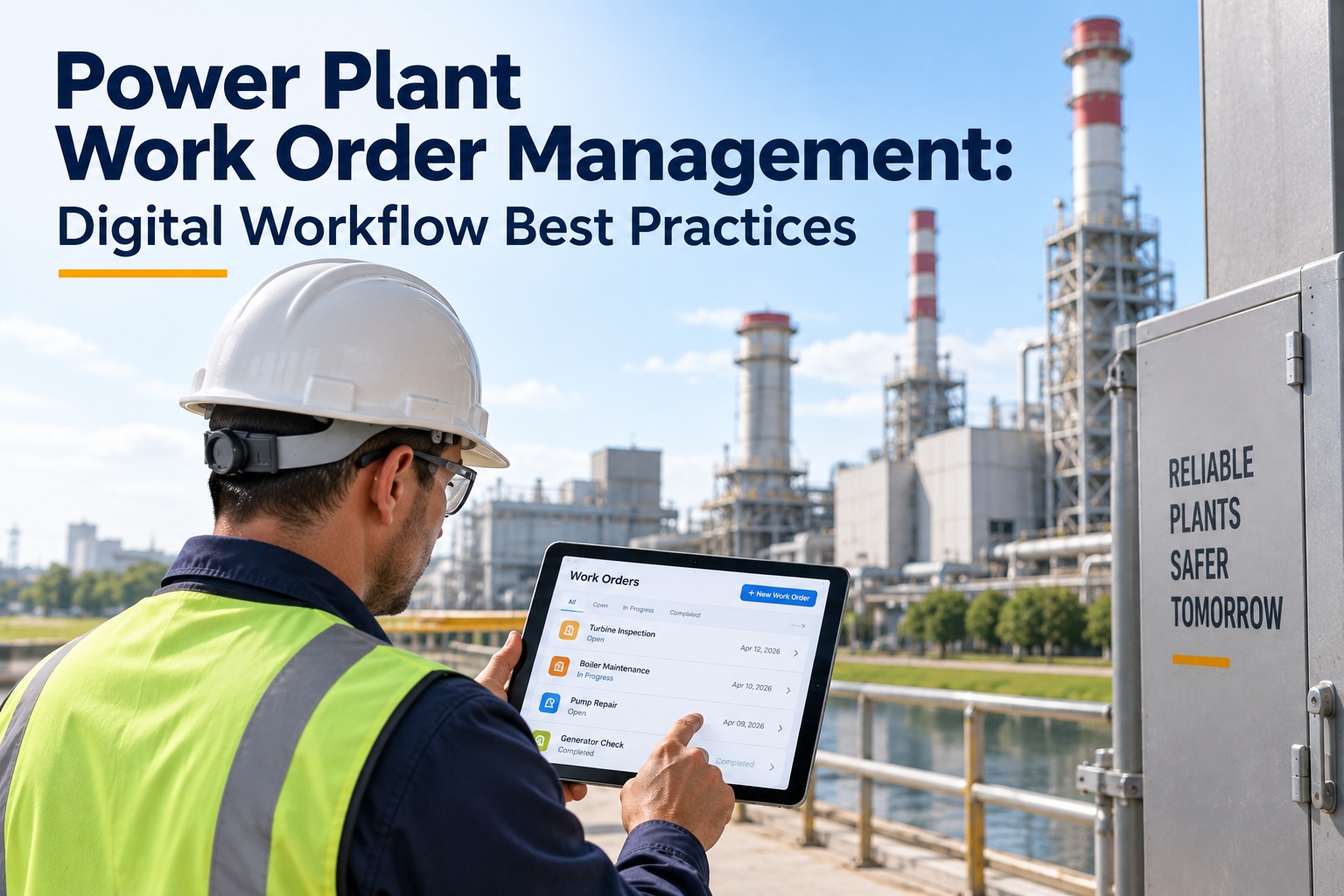
Power Plant Maintenance Software Guide: Features, Pricing & Best Picks
By Johnson on March 18, 2026
If your maintenance team is still printing work orders, chasing down equipment history in filing cabinets, or discovering asset failures the hard way — during a forced outage — the problem is not your people. It is the tools. Power plant maintenance software has evolved dramatically over the last five years, and the gap between facilities running modern platforms and those managing on spreadsheets is now measured in millions of dollars per year. This guide gives you everything you need to evaluate, compare, and choose the right solution for your plant — whether you run gas turbines, steam units, renewables, or a mixed portfolio.
2026 Buyer's Guide — Power Generation
Power Plant Maintenance Software: Features, Pricing & Best Picks
From work order chaos to predictive asset intelligence — your complete roadmap to choosing maintenance software that pays for itself in months, not years.
$260KAvg annual loss from reactive maintenance per plant
38%Maintenance cost reduction with modern CMMS
6 MoTypical payback period for AI-powered platforms
3.4xMore uptime for plants using predictive maintenance
5 Signs Your Plant Needs Better Maintenance Software Right Now
Most plant managers know something is off long before they act on it. These are the five clearest indicators that your current system — or lack of one — is costing you more than a modern platform would.
01
You discover failures at the worst possible time
Forced outages during peak demand, failures found during shutdown inspections — reactive maintenance means your team is always playing catch-up instead of getting ahead.
02
Work orders live in email threads and whiteboards
When job status requires a conversation instead of a dashboard glance, work falls through the cracks and accountability disappears. That gap directly creates safety and compliance risk.
03
Your asset history is scattered across systems
Equipment age, last inspection date, repair cost history, and OEM service bulletins should live in one place. If your team hunts through multiple systems to get a clear picture of any asset, decisions suffer.
04
Compliance audits are a manual scramble
NERC CIP, OSHA, EPA, and insurance inspections should be pull-and-submit operations. If each audit cycle involves weeks of document assembly, your documentation process is broken — not your people.
05
You cannot answer: what did maintenance cost last quarter?
If labor, parts, contractor costs, and downtime impact cannot be pulled into a single report in under five minutes, you cannot manage what you cannot measure — and neither can your budget owners.
Core Features Every Power Plant Maintenance Platform Must Have
Not all CMMS platforms are equal — and not all "features" matter equally in a power generation environment. These are the capabilities that separate platforms built for industrial complexity from generic work order tools dressed up with energy sector branding.
Foundation
Asset Management
Complete asset registry with equipment hierarchy, OEM specifications, warranty tracking, maintenance history, and document storage. Every component from a gas turbine blade to a cooling tower valve should have a full digital record.
Full work order lifecycle from creation through closure — with priority scoring, technician assignment, parts reservation, labor time capture, and automatic escalation for overdue jobs. Mobile-first execution for field teams.
Auto-schedulingMobile WOParts linkageEscalation
Intelligence
Predictive Maintenance AI
Sensor data integration with anomaly detection models that flag degradation trends weeks before failure. Remaining useful life estimation per component, with auto-generated work orders timed to planned outage windows.
Sensor ingestionAnomaly alertsRUL estimation
Intelligence
Outage Planning & Scheduling
Multi-unit outage coordination with critical path scheduling, resource leveling, contractor management, and parts pre-staging. Forced and planned outage scenarios managed in the same workflow.
Critical pathResource levelingContractor mgmt
Compliance
Regulatory Compliance
NERC CIP documentation auto-captured on every relevant work order. OSHA, EPA, and insurance inspection records stored in audit-ready format. One-click compliance package generation per standard.
NERC CIPOSHA recordsAudit packages
Compliance
Reporting & KPI Dashboards
Real-time dashboards for MTBF, MTTR, maintenance cost per MWh, PM compliance rate, and backlog aging. Executive and technician views configurable by role — no custom reporting required.
MTBF / MTTRCost per MWhPM compliance
2026 Pricing Benchmarks for Power Plant Maintenance Software
Pricing in this market varies wildly — from $50/month tools that cannot handle industrial complexity to enterprise contracts exceeding $2 million annually. Understanding what you actually get at each price tier prevents expensive mistakes in both directions.
Entry Level
$80 – $400/mo
Generic CMMS tools suitable for simple facilities. Limited to basic work orders and PM scheduling. Not designed for power generation complexity.
Basic work order management
Simple asset register
PM scheduling
No sensor / DCS integration
No NERC CIP compliance
No predictive AI
No outage planning
Not suitable for power plants
Mid-Market
$500 – $3K/mo
Industrial CMMS platforms with asset management depth and basic condition monitoring. Suitable for smaller generation facilities with limited compliance requirements.
Asset hierarchy and history
Preventive maintenance scheduling
Basic condition monitoring
Mobile work order execution
NERC CIP (manual documentation)
No native predictive AI
Limited outage planning
Adequate for <100 MW facilities
Best Value 2026
AI-Native Platforms
$15K – $350K/yr
Purpose-built for power generation with full predictive intelligence, compliance automation, and outage planning. Oxmaint delivers this tier with the fastest deployment in market.
IBM Maximo, SAP PM — deeply integrated with enterprise ERP stacks. High capability but long implementation timelines, heavy IT dependency, and significant customization costs.
Deep ERP integration
Enterprise asset management
Full outage scheduling
AI requires costly add-on modules
Compliance via GRC integration
12–36 month implementation
Heavy IT resource requirement
For Fortune 500 utilities only
Asset Management: The Foundation of Every Dollar You Save
Poor asset data is the root cause of most maintenance overspending. When technicians cannot quickly access equipment history, OEM specs, or the last inspection result, they default to conservative over-maintenance — replacing components with significant remaining life or missing early degradation signals entirely. Oxmaint's asset management module eliminates this information gap.
23%of maintenance labor is wasted on finding asset information
$180Kaverage annual cost of over-maintained assets at a 500 MW plant
67%faster root cause analysis with complete asset history
Full Equipment HierarchyPlant → Unit → System → Component → Sub-component. Every asset in context, with parent-child relationships that make impact analysis instant.
Complete Maintenance HistoryEvery work order, part replacement, inspection result, and failure code linked to the asset record — searchable and exportable for audit or engineering analysis.
OEM Specs & Document VaultManufacturer manuals, P&IDs, wiring diagrams, warranty documents, and service bulletins stored and accessible from mobile devices in the field — no more trips back to the control room.
Lifecycle Cost TrackingTotal cost of ownership per asset — labor, parts, downtime impact, and contractor spend accumulated automatically from work orders. Know exactly when replacement beats repair.
Work Order Management: Where Maintenance Efficiency Is Won or Lost
Work orders are the daily currency of every maintenance operation. At a power plant, a poorly managed work order is not just an administrative problem — it is a safety risk, a compliance gap, and a budget leak. Oxmaint's work order engine was built for the complexity of multi-unit generation facilities, not generic facilities management.
1
Trigger
Sensor anomaly, PM schedule, operator request, or inspection finding automatically creates a prioritized work order with asset context pre-loaded
2
Plan
Parts reserved from inventory, labor estimated, contractor notified if needed, and work aligned to next available planned outage window
3
Execute
Technician receives job on mobile device with step-by-step instructions, safety permits, and torque specs. Time and parts captured in real time
4
Close
Completion data feeds asset history, updates next PM due date, triggers parts replenishment if stock falls below reorder point, and logs compliance documentation
Measured Outcomes — Oxmaint Work Order Engine
47%Reduction in work order backlog within 90 days
35%More technician wrench time vs. admin time
92%PM compliance rate (industry avg: 61%)
4 hrsAvg NERC CIP audit package generation time
ROI Breakdown: What Modern Maintenance Software Actually Delivers
The financial case is not theoretical. Every line below reflects documented outcomes from power generation facilities that transitioned from calendar-based or reactive maintenance to an AI-native platform. A 300–600 MW combined-cycle plant is the reference baseline.
Prevented Forced Outages
65% fewer forced outages$1.2M – $3.8M saved/yr
Heat Rate & Efficiency Recovery
1.5% efficiency gain from AI-detected fouling$400K – $800K saved/yr
Parts & Inventory Optimization
25% reduction in safety-stock over-ordering$280K – $420K saved/yr
Compliance Labor Reduction
Audit prep time down from 6 weeks to 4 hours$120K – $200K saved/yr
Extended Hot-Section Life
20% blade life extension via optimal inspection timing$400K – $600K deferred/yr
Total Annual Value — 300–600 MW Plant$2.4M – $5.8M
Buyer's Checklist: 10 Questions to Ask Every CMMS Vendor
Before signing any contract, run every vendor through this checklist. The answers separate platforms built for power generation from those retrofitted to look like they are.
01
Can it ingest live data from our DCS and SCADA without replacing existing systems?
Platforms that require DCS replacement add 12–24 months and $500K+ before you get value. Look for native OPC-UA, Modbus, and OSIsoft PI support.
02
How does the AI detect anomalies — rule-based thresholds or learned baselines?
Threshold-based alerts catch obvious failures. Machine learning baselines detect subtle degradation weeks earlier. Only the latter justifies "predictive maintenance" claims.
03
Is NERC CIP documentation captured automatically or entered manually?
Manual compliance documentation doubles labor cost and introduces audit risk. Auto-capture on every relevant work order is the only acceptable answer for BES assets.
04
What is the realistic deployment timeline — not the sales deck answer?
Enterprise CMMS vendors routinely quote 6 months and deliver in 18–24. Ask for customer references with actual go-live timelines, not projections.
05
Can the system handle multiple asset types — gas turbines, steam, renewables — in one platform?
Separate tools for separate asset classes creates data silos, duplicate training, and disconnected maintenance histories. One platform for the full portfolio is the standard to aim for.
06
Does the mobile app function offline in substation and switchyard environments?
Connectivity dead zones are common in plant field environments. A mobile app that requires WiFi is not suitable for generation facilities.
07
How does outage planning handle multi-unit coordination and resource conflicts?
Basic scheduling tools cannot manage overlapping outage windows across multiple units with shared resources. Look for critical path visualization and automatic conflict resolution.
08
What integrations exist with spare parts and procurement systems?
A maintenance system disconnected from your parts inventory creates manual re-entry errors and stock-out surprises at the worst possible time.
09
Can you show a documented ROI case from a comparable facility?
Projected ROI from a vendor is marketing. Documented ROI from a 400 MW gas plant with a named contact and verifiable numbers is evidence. Require the latter.
10
What does the training and ongoing support model look like after go-live?
Many platforms provide strong implementation support then disappear. Ask specifically about ongoing customer success coverage and what happens when your senior technician leaves and you need retraining.
Frequently Asked Questions
What is the difference between CMMS and EAM software for power plants?
A CMMS (Computerized Maintenance Management System) focuses on work order management, preventive maintenance scheduling, and asset history. An EAM (Enterprise Asset Management) system extends this to include full lifecycle cost tracking, procurement integration, and capital planning. For most power plants under 1 GW, a modern AI-native CMMS like Oxmaint delivers everything needed — EAM complexity is generally only justified when deep ERP integration with SAP or Oracle is a hard requirement driven by corporate finance systems.
How long does it take to implement power plant maintenance software?
Deployment time ranges from days to years depending on the platform. Cloud-native platforms like Oxmaint achieve initial integration with existing DCS and SCADA systems in 2–4 weeks, with AI baseline learning beginning immediately on data connection. Enterprise ERP-based solutions (IBM Maximo, SAP PM) typically require 12–36 months of implementation work. For most generation facilities, the faster deployment path delivers positive ROI before an enterprise implementation would even be completed.
Does Oxmaint replace our existing DCS or SCADA system?
No — and any platform that requires DCS replacement should raise immediate red flags in your evaluation. Oxmaint connects to existing control systems via standard industrial protocols including OPC-UA, Modbus TCP, OSIsoft PI, and DNP3, adding predictive intelligence as a layer on top of your current infrastructure. Your operations team continues working in the same DCS environment they know; Oxmaint adds the maintenance intelligence layer that existing DCS platforms were never designed to provide.
What KPIs should I track to measure maintenance software performance?
The five most important KPIs for power plant maintenance operations are: MTBF (Mean Time Between Failures) per critical asset class, MTTR (Mean Time to Repair) for forced and planned outages, PM Compliance Rate (target: above 90%), Maintenance Cost per MWh generated, and Forced Outage Rate per unit per year. Oxmaint tracks all five natively and provides real-time dashboard views for operations leadership, maintenance managers, and technicians — each with role-appropriate depth and context.
Is cloud-based maintenance software safe for NERC CIP-regulated environments?
Yes — when the platform is specifically designed with CIP compliance in mind. Oxmaint's architecture separates operational technology (OT) data flows from the cloud analytics layer in compliance with NERC CIP-005 and CIP-007 requirements. Data at rest and in transit is encrypted to FIPS 140-2 standards, access is role-based with full audit logging, and the platform supports on-premise deployment options for facilities with strict data residency requirements. Over 60% of new NERC-regulated facility CMMS deployments in 2025 were cloud-based — the regulatory framework supports this architecture when implemented correctly.
Your Plant Already Has the Data. Oxmaint Turns It Into Decisions.
Every sensor, every work order, every inspection record in your plant is generating information that should be preventing failures, cutting costs, and protecting compliance. Oxmaint connects to your existing infrastructure in weeks — not years — and starts delivering measurable value from day one. No DCS replacement. No 18-month implementation. No guesswork.