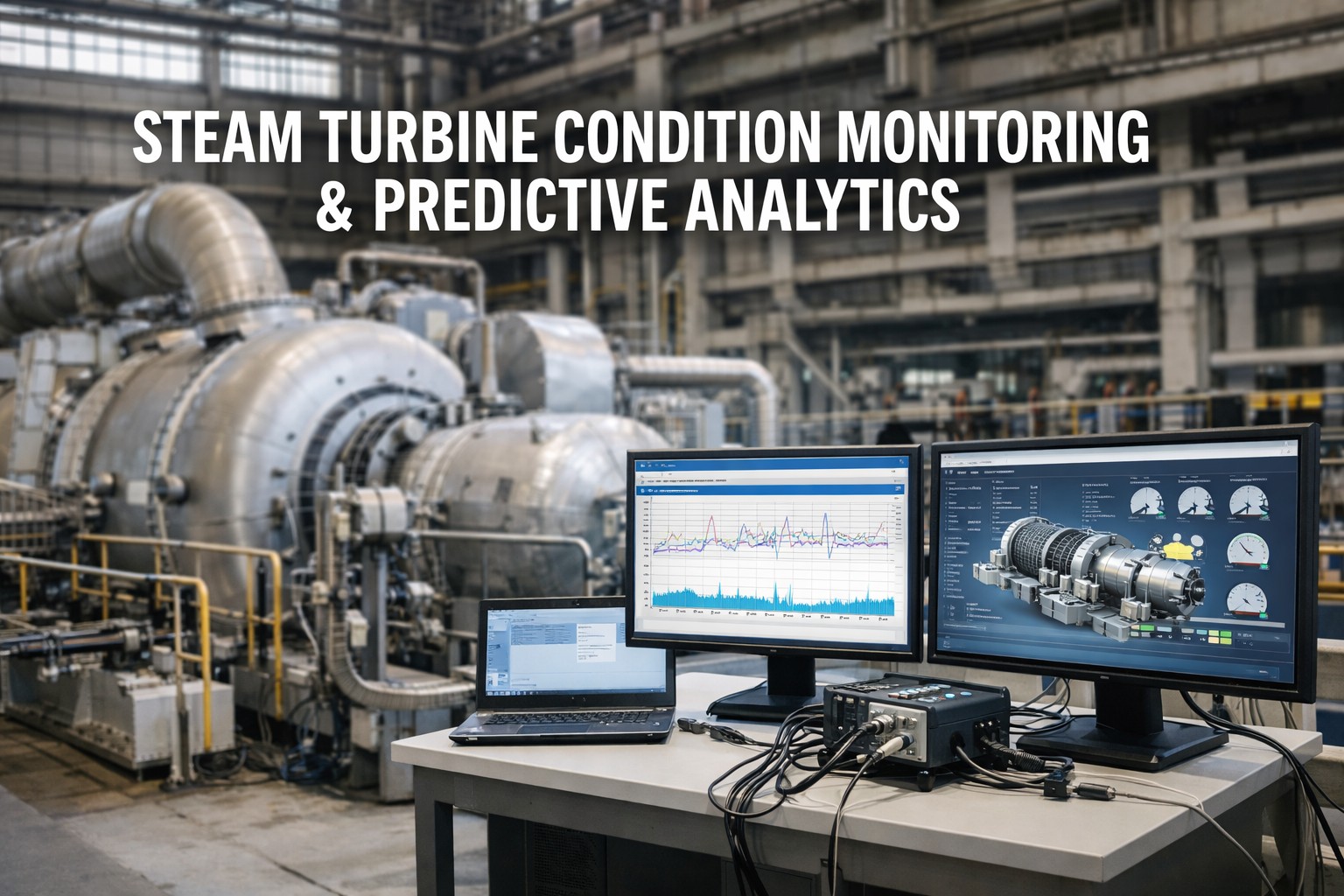
Steam turbines are the backbone of thermal power generation — converting high-pressure steam into mechanical energy that drives generators producing megawatts of electricity. When a steam turbine operates with degraded bearings, misaligned shafts, or contaminated lube oil, it does not simply underperform — it accumulates damage silently until an unplanned outage forces a shutdown that can last weeks and cost millions. OxMaint's Predictive Maintenance AI continuously monitors vibration signatures, lube oil conditions, thermal performance, and electrical output in parallel — building a living health model of each turbine and triggering maintenance work orders 3 to 6 weeks before a developing fault becomes a forced outage.
Steam Turbine Reliability Starts With the Right Data
Unplanned turbine outages don't happen without warning — they happen when warnings go unread. The difference between a $1,200 bearing replacement and a $2.4 million forced outage is measured in weeks of lead time.
3–6 wks
Advance fault detection before turbine failure
$2.4M
Average cost of an unplanned steam turbine outage
72%
Of turbine faults show measurable signals weeks in advance
Why Steam Turbines Demand Predictive Monitoring
A steam turbine operates under extreme conditions — rotor speeds of 3,000 to 3,600 RPM, steam temperatures exceeding 540°C, and shaft loads that change with grid demand every few minutes. These conditions create a unique failure environment where faults develop gradually but accelerate rapidly once initiated.
Traditional time-based maintenance — overhaul every 25,000 hours — misses faults that develop between intervals and over-maintains components that are performing well. Condition-based monitoring without AI correlation produces alert fatigue: too many single-sensor alarms that technicians learn to ignore. OxMaint's multi-signal approach filters noise and surfaces only confirmed, actionable fault patterns.
Unplanned Outage
- Emergency turbine shutdown: $180K–$400K/day lost generation
- Parts lead time: 4–12 weeks for major components
- Forced purchase of replacement power at spot prices
- Regulatory reporting obligations and penalties
- Full rotor replacement: $800K–$2.4M
Fault Detected 3–6 Weeks Early
- Planned bearing replacement: $1,200–$3,500
- Parts pre-ordered at normal lead times
- Outage scheduled during low-demand window
- No secondary component damage
- Asset life extended by years
4 Monitoring Pillars That Predict Turbine Failure
No single measurement tells the whole story. Reliable turbine failure prediction requires four data streams monitored simultaneously and correlated against a dynamic baseline.
01
Vibration Analysis
Detects: Bearing wear · Shaft bow · Rotor imbalance · Blade fouling
Shaft vibration measured at bearing housings reveals the mechanical condition of every rotating component. A 1× running speed peak rising alongside a 2× harmonic is a textbook early indicator of shaft misalignment — detectable 14 to 28 days before the misalignment causes measurable bearing damage. OxMaint's frequency spectrum analysis tracks bearing pass frequencies (BPFO, BPFI) and subharmonic resonance that indicate loose components — signals that no fixed-threshold alarm system catches.
Detection lead: 14–28 days before bearing failure
Saves: $35,000–$800,000 vs. catastrophic rotor damage
02
Lube Oil Monitoring
Detects: Bearing surface wear · Oil degradation · Contamination · Journal bearing damage
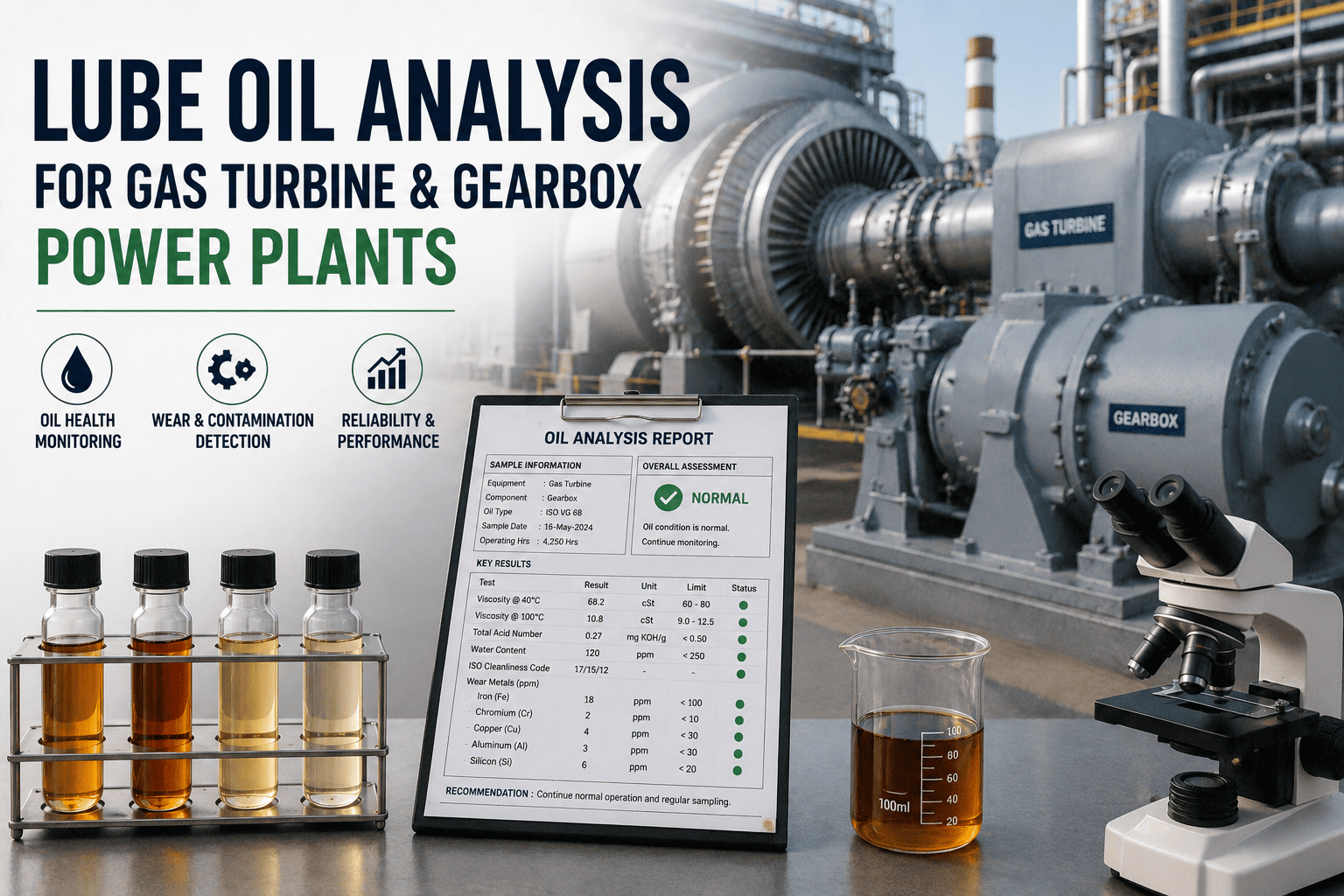
Lube oil is the turbine's circulatory system — and it carries the earliest evidence of internal component wear. Iron particle counts rising in oil analysis confirm journal bearing surface degradation weeks before vibration escalates. Oil viscosity trending outside specification alongside rising bearing temperature is a two-signal pattern that OxMaint flags as high-priority even when vibration appears normal — because oil failures can accelerate from detectable to catastrophic in 72 hours.
Detection lead: 2–6 weeks before journal bearing failure
Saves: $120,000–$650,000 vs. journal bearing seizure
03
Thermal Performance Monitoring
Detects: Blade fouling · Steam path degradation · Seal wear · Thermal asymmetry
Turbine thermal efficiency — expressed as heat rate (BTU/kWh) — degrades measurably as blades foul, seals wear, and steam path losses increase. A heat rate creeping 2–4% above baseline while throttle steam conditions remain constant confirms internal steam path deterioration. OxMaint tracks approach temperature, exhaust temperature differential, and stage efficiency across the turbine expansion path — pinpointing exactly which stage section is degrading and estimating the remaining efficiency loss before an outage becomes necessary.
Detection lead: 2–5 weeks before forced efficiency shutdown
Identifies: 3–8% efficiency loss averaging $90K/year in avoidable fuel cost
04
Electrical Output Correlation
Detects: Load imbalance · Governor response degradation · Mechanical-electrical coupling faults
Generator output correlated against throttle steam flow and turbine speed reveals hidden mechanical losses that thermal or vibration monitoring may not surface independently. A turbine producing 2.3% less electrical output for the same steam input than its 90-day baseline is experiencing mechanical friction or steam path loss — a composite signal that only cross-domain correlation identifies. OxMaint's multi-parameter correlation engine integrates electrical, mechanical, and thermal data streams to confirm developing faults with near-zero false positive rates.
Detection lead: 1–4 weeks before efficiency-triggered derating
Prevents: Forced derating costing $45,000–$180,000 in lost generation capacity
See OxMaint Running on Your Turbine Fleet
OxMaint connects to existing SCADA systems, OSIsoft PI historians, and wireless IIoT sensors. Most power plant fleets are fully monitored within 2–4 weeks of deployment — with automatic work orders from day one.
Steam Turbine Failure Modes: Detection Timeline and Cost Impact
| Failure Mode |
Primary Signal |
Detection Lead |
Undetected Cost |
Early Intervention Cost |
| Journal bearing wear |
Vibration 1× + Oil iron content |
2–4 weeks |
$120K–$650K seizure damage |
$3,500–$8,000 planned replacement |
| Shaft misalignment |
Vibration 2× harmonic + temp |
14–28 days |
$250K–$900K rotor/coupling damage |
$8,000–$22,000 alignment service |
| Blade fouling / deposits |
Heat rate drift + Stage pressure |
2–5 weeks |
$90K/yr efficiency loss + forced outage |
$12,000–$35,000 wash/cleaning |
| Steam seal degradation |
Exhaust temp + Leakoff pressure |
1–3 weeks |
$45K–$180K derating + repair |
$4,000–$12,000 seal replacement |
| Thrust bearing failure |
Axial position + Vibration |
7–21 days |
$800K–$2.4M full rotor damage |
$15,000–$45,000 planned bearing job |
| Lube oil system fault |
Oil pressure + Temp + Viscosity |
48–72 hrs to 2 wks |
$200K–$1.2M bearing/journal seizure |
$2,500–$7,000 oil service + seal repair |
From Sensor to Work Order: OxMaint's Turbine Monitoring Pipeline
Most monitoring programs fail because data collection and maintenance action are separated by human review that happens too infrequently. OxMaint closes this gap automatically.
S
Signal Ingestion
Vibration, lube oil, temperature, pressure, and electrical output data stream via OPC-UA, OSIsoft PI, MQTT, or direct SCADA integration. Reading intervals as short as 1 second for vibration; 15-minute averages for thermal performance.
B
Dynamic Baseline Building
OxMaint builds a 90-day rolling statistical baseline per sensor per turbine, adjusted for load variation, steam conditions, and seasonal ambient temperature. Faults are measured against this dynamic baseline — not fixed thresholds that trigger false alarms at peak load.
C
Multi-Signal Fault Confirmation
A turbine fault is only confirmed when two or more independent signal domains deviate simultaneously in a pattern matching a known failure signature. Single-sensor drift is logged as a watch item — not escalated to a work order. This eliminates the alert fatigue that undermines fixed-threshold systems.
W
Automatic CMMS Work Order
Confirmed fault creates a work order pre-populated with fault type, affected component, deviation magnitude, trend chart, and recommended parts list — routed to the planner's queue within minutes.
R
Remaining Useful Life Estimate
Dashboard displays RUL — for example, "Probable outer race bearing fault — estimated 14–20 days to functional failure at current degradation rate." Technicians arrive with the correct part, the right diagnosis, and a scheduled window.
Monitoring by Turbine Type and Application
HP / IP Steam Turbines
200 MW+ base load generation
Priority signal: Shaft vibration at 1× and 2× — axial and radial displacement from proximity probes
Watch for: Differential expansion trends indicating blade/casing thermal asymmetry
Key risk: Thrust bearing failure — detected via axial position sensor before catastrophic rotor contact
LP Steam Turbines
Condensing, back-pressure, extraction types
Priority signal: Exhaust steam temperature and condenser pressure — LP blade erosion traced via efficiency decline
Watch for: LP last-stage blade erosion from water ingestion — detected via vibration spectral changes
Key risk: Blade-tip cracking — correlated from vibration subharmonics and efficiency trending
Industrial / CHP Turbines
Process plants, district heating, cogeneration
Priority signal: Extraction pressure stability and governor valve response time for load-following performance
Watch for: Control valve sticking — detected via pressure step-response analysis before it causes load instability
Key risk: Coupling misalignment with driven load — monitored via 2× vibration and coupling temperature
Geothermal / Biomass Turbines
Renewable generation, waste-to-energy
Priority signal: Rapid blade fouling from steam contaminants — tracked via heat rate degradation rate vs. baseline
Watch for: Silica/mineral scaling from geothermal steam — detected via stage efficiency decline and pressure ratio shift
Key risk: Accelerated corrosion from contaminant steam chemistry — oil analysis confirms early material degradation
Frequently Asked Questions
How does vibration analysis detect turbine bearing failures weeks in advance?
As a bearing develops a fatigue crack, it produces vibration energy at mathematically predictable frequencies — bearing pass frequencies (BPFO, BPFI) — that appear in the vibration spectrum 14 to 28 days before the fault becomes audible or produces measurable temperature change. OxMaint monitors these frequencies continuously and confirms a bearing fault only when vibration deviates alongside at least one other signal domain, eliminating false positives. Learn how
OxMaint's AI platform applies this to your turbine fleet.
What sensors are required to monitor a steam turbine predictively?
A minimum viable setup requires proximity probes at each bearing housing (radial and axial), thermocouples on bearing drain oil and exhaust steam, and pressure transducers on steam inlet and extraction points. Most power plants already have these signals available via their DCS or OSIsoft PI historian — OxMaint connects directly without additional hardware. For assets without existing instrumentation, wireless IIoT sensors can be retrofit-mounted in under four hours.
Book a demo to review your existing sensor coverage.
How does OxMaint integrate with existing power plant CMMS and DCS systems?
OxMaint integrates with OSIsoft PI, Maximo, SAP PM, and most major DCS platforms via OPC-UA and REST API. Sensor data flows from existing historians directly into OxMaint's anomaly detection engine. Work orders are created automatically in your CMMS when a fault pattern is confirmed — no manual data export required. Most integrations are completed within 1–2 weeks of deployment.
How accurate is OxMaint's remaining useful life estimate for turbine components?
RUL estimates are derived from the current degradation rate compared to the 90-day baseline for that specific asset — not from generic failure curves. Accuracy improves as OxMaint accumulates more operating history per turbine. In practice, RUL windows of ±30% are typical for bearing faults; thermal degradation estimates tend to be more conservative. The estimate is a planning tool, not a guarantee — but it is consistently accurate enough to schedule the right maintenance window and pre-order the correct parts.
Can OxMaint monitor steam turbines alongside gas turbines and generators in one dashboard?
Yes. OxMaint provides a unified asset health dashboard for all rotating machinery — steam turbines, gas turbines, generators, pumps, and fans — across multiple plant sites. Multi-site operations see all critical asset alerts aggregated on a single portfolio view.
Start a free trial to see the full dashboard.
Start Monitoring Your Steam Turbines This Week
OxMaint connects to your existing plant instrumentation — OSIsoft PI, DCS, SCADA — and begins detecting developing faults within days of deployment. Most power plant teams see their first confirmed anomaly within the first week of live monitoring.