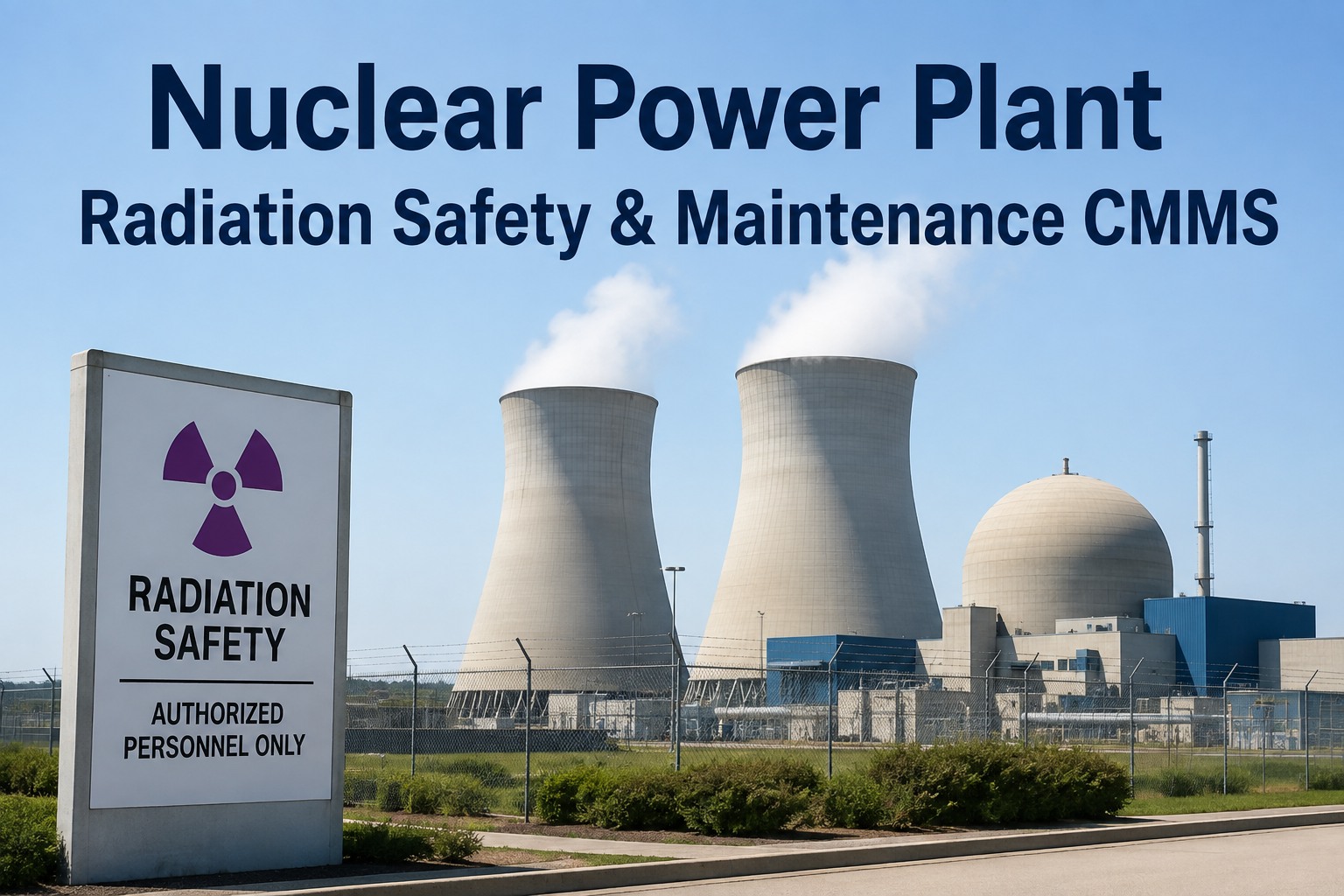
Radioactive waste management is one of the most tightly regulated maintenance disciplines in the world — where every worker entering a contamination zone must have their dose exposure tracked in real time, every waste container must be classified, labeled, and manifested to NRC standards, and every decontamination work order must carry documented ALARA justification before a single task begins. The consequences of inadequate documentation are not just operational — they are criminal liability, license jeopardy, and public safety failures that no plant can recover from quickly. Oxmaint's nuclear-grade CMMS brings dose tracking, contamination zone work control, ALARA compliance workflows, and radioactive waste manifest management into one auditable platform — purpose-built for the radiological realities of operating nuclear facilities. Book a demo with a nuclear compliance specialist to see how Oxmaint manages contamination zone maintenance end-to-end.
Nuclear Power · Radiological Waste & ALARA Compliance
Dose Tracking. Contamination Zone Work Control. ALARA Compliance. One CMMS.
Every worker. Every mrem. Every waste container. Every decontamination task — documented, tracked, and audit-ready before the next NRC inspection or Agreement State review.
ALARA
As Low As Reasonably Achievable
Documented justification for every dose-significant task
10 CFR 20
Radiation Protection Standards
Occupational dose limits tracked per worker per quarter
10 CFR 61
Low-Level Waste Disposal
Waste classification, manifesting, and disposal tracking
NUREG-1.8
Occupational Dose Records
Lifetime dose records maintained and reportable on demand
The Stakes
What Inadequate Radiological CMMS Actually Costs a Nuclear Facility
A missed dose entry, an undocumented contamination spread event, or a waste container without a complete chain-of-custody record does not stay an internal problem. In nuclear, documentation failures become regulatory findings — and regulatory findings become enforcement actions with public dockets that follow a plant's operating license for its remaining life.
$140K
Average NRC civil penalty per radiation protection violation (Severity Level II)
34%
Of all NRC inspection findings in nuclear plants relate to radiation protection and ALARA program deficiencies
6.2 hrs
Average time lost per contamination spread event requiring unplanned zone extension and re-survey
$2.8M
Average cost of an unplanned radiological release event including decontamination, regulatory response, and dose reconstruction
ALARA Framework
How Oxmaint Enforces ALARA Principles Across Every Contamination Zone Work Order
ALARA is not a philosophy — it is a regulatory requirement with documented justification obligations. Oxmaint builds ALARA review directly into the work order workflow so that dose planning, exposure estimation, and optimization decisions are captured before workers enter any radiologically controlled area.
Time Minimization
Oxmaint tracks planned versus actual task duration for every RCA work order. When a task runs longer than the ALARA-estimated time, an automatic flag triggers a dose review and supervisor notification before cumulative dose thresholds are approached.
Distance Optimization
Work packages include dose rate maps linked to specific contamination zone coordinates. Oxmaint surfaces the nearest low-dose work position for each task — ensuring technicians are not working in higher-dose areas when equivalent positions are available within the same zone.
Shielding Utilization
Shielding requirements are specified in the work package before job initiation. Oxmaint tracks whether required shielding was installed, verified by RP survey, and documented prior to task start — preventing the shortcut of skipping shielding on short-duration tasks where dose accumulation is still significant.
Pre-Job ALARA Review Completion
Before any dose-significant work order is released in Oxmaint, the pre-job ALARA review checklist must be completed and approved by the Radiation Protection supervisor. The system will not authorize work package execution until all review steps are documented — eliminating verbal approvals that leave no audit trail.
Dose Tracking
Real-Time Occupational Dose Tracking — Per Worker, Per Work Order, Per Quarter
10 CFR 20 establishes annual occupational dose limits of 5 rem total effective dose equivalent (TEDE) for radiation workers, with action levels typically set at 2 rem for elevated monitoring. Oxmaint tracks cumulative dose against each limit in real time — preventing workers from being assigned to additional contamination zone tasks when their dose budgets have been consumed.
Worker Dose Budget Dashboard
Technician A — Mechanical
1,900 mrem usedAction Level: 2,000 mremLimit: 5,000 mrem
Technician B — Electrical
3,100 mrem usedAction Level: 2,000 mrem — EXCEEDEDLimit: 5,000 mrem
Technician C — RP Surveyor
900 mrem usedAction Level: 2,000 mremLimit: 5,000 mrem
Workers approaching action levels are automatically reassigned in Oxmaint — no manual tracking required by supervisors during outage execution.
Lifetime Dose Records
Every worker's dose history is maintained from first entry into a radiologically controlled area through retirement — accessible instantly for new plant assignments, contractor badging, or NRC records requests without paper file retrieval.
Work Order Dose Assignment
Each work order in a contamination zone carries a planned dose estimate. Oxmaint compares the planned dose against each assigned worker's remaining dose budget before releasing the work package — preventing budget overruns before the task begins.
ALARA Goal Reporting
Quarterly and annual ALARA dose reports generate automatically from Oxmaint — comparing actual collective dose against plant goals, identifying the highest-dose tasks, and flagging work categories where ALARA optimization offers the greatest dose reduction opportunity for future planning.
See How Oxmaint Manages Dose Tracking and ALARA Compliance in a Live Demo
Request a walkthrough built around your plant's specific contamination zone structure, dose tracking requirements, and current RP program gaps. No generic product tour — a session built for your facility.
Waste Management Workflow
Radioactive Waste Classification, Manifesting, and Disposal Tracking — From Generation to Disposal Site
10 CFR 61 classifies low-level radioactive waste into Class A, B, and C categories based on radionuclide concentrations. Each class carries different packaging, labeling, and disposal facility requirements. Oxmaint tracks every waste container from generation through disposal — creating the unbroken chain of custody that Agreement State inspectors and disposal facility operators require.
A
Waste Generation & Initial Classification
At the point of generation — contaminated tools, PPE, filters, or resins — the work order in Oxmaint captures waste type, estimated activity, generating work order, and initial classification per 10 CFR 61 Appendix B radionuclide concentration limits. Classification is tied to the specific radionuclides identified in the waste stream from the work scope.
B
Container Survey, Labeling, and Segregation
Oxmaint generates the required container label data — waste class, contents description, dose rate at contact and 30 cm, activity estimate, and survey date — linked to the container record. Segregation requirements for mixed waste (radiological plus hazardous chemical) trigger additional RCRA handling workflow steps automatically when applicable waste streams are identified.
C
Controlled Storage Area Management
All containers in the Radioactive Material Storage Area (RMSA) are tracked by location, container ID, class, and storage age in Oxmaint. When storage time limits approach or container dose rates require periodic re-survey, the system generates maintenance work orders automatically — ensuring the RMSA inventory never falls behind survey requirements or NRC storage time limits.
D
Manifest Generation and Disposal Shipment
When a disposal shipment is ready, Oxmaint generates the NRC Uniform Low-Level Radioactive Waste Manifest — NRC Form 540, 541, and 542 — directly from the accumulated container records. The manifest includes all required radionuclide activity data, packaging certifications, and shipper certifications. Disposal records are retained and retrievable for the life of the plant license plus the required post-shutdown period.
Regulatory Compliance Matrix
Radioactive Waste and Contamination Zone Compliance Requirements — Mapped to Oxmaint Capabilities
| Regulatory Requirement |
Regulation |
Oxmaint Capability |
| Annual occupational dose limit tracking (5 rem TEDE) |
10 CFR 20.1201 |
Real-time cumulative dose tracking per worker with limit alerts and work restriction triggers |
| ALARA program documentation and review |
10 CFR 20.1101 |
Pre-job ALARA review workflow integrated into every RCA work order release process |
| Radioactive waste classification and manifesting |
10 CFR 61 |
Waste stream classification engine with automated NRC Form 540/541/542 manifest generation |
| Contamination area posting and access control records |
10 CFR 20.1902 |
Zone status records with posting history, dose rate survey data, and access authorization logs |
| Radiation survey records and RP surveillance |
10 CFR 20.1501 |
Survey work orders auto-generated by zone status; survey results linked to specific zone coordinates |
| Occupational dose records retention (NRC Form 5) |
10 CFR 20.2106 |
Lifetime dose records maintained per worker; NRC Form 5 generation on demand for any period |
| Radioactive effluent and release records |
10 CFR 50 App. I |
Effluent monitoring records linked to affected system maintenance work orders and contamination events |
Frequently Asked Questions
What Radiation Protection Managers Ask Before Deploying a Nuclear CMMS
How does Oxmaint track individual worker dose across multiple outage work orders simultaneously?
Each worker in Oxmaint has a permanent dose record that accumulates in real time as completed work orders report actual dose received. When a new work order is assigned in a contamination zone, Oxmaint automatically checks the worker's current cumulative dose against the plant-defined action level and annual limit — blocking assignment if dose budget is insufficient. The system also tracks dose by source — planned maintenance, corrective maintenance, surveillance, or decontamination — enabling the quarterly ALARA trending analysis that RP supervisors are required to perform.
Explore the dose tracking module with a free trial.
Can Oxmaint generate NRC-required radioactive waste manifests directly from work order data?
Oxmaint generates NRC Uniform Low-Level Radioactive Waste Manifests — including Forms 540, 541, and 542 — directly from accumulated container records, eliminating the manual data entry and transcription errors that create manifest discrepancies during disposal facility receipt inspections. Container records include all required data fields: radionuclide identities, activity per isotope, physical form, container type, packaging certification, and survey date. Completed manifests are retained in the system as permanent plant records linked to each disposal shipment.
Book a demo to see manifest generation from your waste stream data.
How does Oxmaint handle contamination spread events that require unplanned zone boundary changes?
When a contamination spread event occurs, Oxmaint immediately creates a condition report, suspends active work orders in the affected area, and initiates the contamination control workflow — which includes required survey tasks, temporary boundary extension documentation, and notification to RP supervision. All affected work orders are placed on hold with the contamination event as the blocking condition, and cannot be reactivated until the zone survey is completed, boundaries are re-established, and RP supervision provides documented clearance within the system.
See the contamination event workflow in a live walkthrough.
Does Oxmaint support ALARA goal-setting and tracking for collective dose reduction programs?
Oxmaint tracks collective dose goals at the plant level, work category level, and individual outage level — comparing planned collective dose from all outage work packages against the ALARA goal established during pre-outage planning. Variance from goal triggers an automatic ALARA review flag on the specific work categories driving the overrun, which feeds directly into the post-outage ALARA lessons-learned documentation that INPO and NRC review during performance assessments. Plants using Oxmaint have reduced collective dose by an average of 22% within two refueling outage cycles.
Start a free trial to configure your plant's ALARA dose goals.
What integration does Oxmaint offer with electronic dosimetry systems and real-time dose alarm networks?
Oxmaint integrates with leading electronic dosimetry management platforms including Mirion Technologies and Thermo Fisher Scientific dosimetry systems via standard data export formats and API connections. Real-time dose readings from electronic personal dosimeters are imported into Oxmaint worker records at configurable intervals — providing supervisors with live collective dose visibility across all active contamination zone work orders without requiring manual dose reporting from workers in the field.
Book a technical integration session for your specific dosimetry platform.
Nuclear CMMS · ALARA & Dose Compliance
Every mrem Matters. Every Container Has a History. Every Zone Has a Record.
Oxmaint manages radioactive waste and contamination zone maintenance with the rigor that licensed nuclear facilities require — real-time dose tracking per worker, ALARA review integrated into every work package, waste manifests generated directly from container records, and contamination event workflows that protect your team and your license.