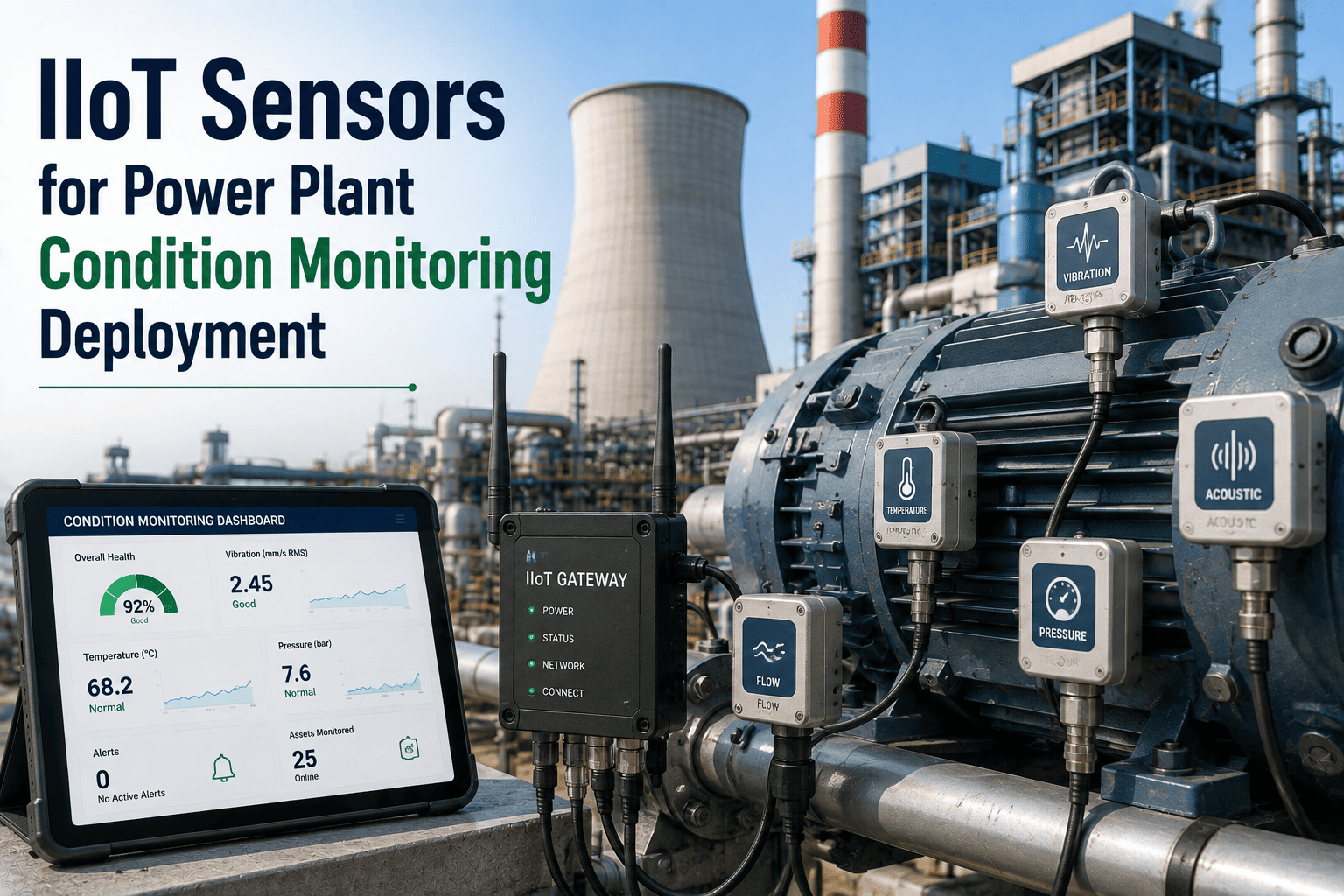
Selecting the wrong sensor for a power plant asset is not just a technical mistake — it is a budget waste and a missed failure. With the global predictive maintenance sensor market reaching $5.9 billion in 2024 and growing at 17.8% annually, the pressure to deploy smart sensors correctly is intensifying. This guide cuts through the complexity: which sensor type belongs on which asset, what each one detects, and how to connect it all to a CMMS that closes the loop from alert to repair. If you want to see how OxMaint integrates every sensor type into automated work orders and live asset health scoring, book a demo with our IoT integration team.
Smart Sensor Selection Guide for Power Plant Predictive Maintenance
Not every sensor belongs on every asset. A vibration sensor on a transformer tells you almost nothing. A thermal camera on a bearing housing misses what a MEMS accelerometer catches in milliseconds. This guide gives power plant maintenance leaders a complete, asset-by-asset sensor selection framework — with market data, cost ranges, detection windows, and OxMaint integration paths for every technology.
The Sensor Mismatch Problem Costing Power Plants Millions
Most power plant sensor deployments fail not because of bad technology — but because of mismatched technology. Vibration sensors on assets with no rotating components generate meaningless data. Thermal cameras on enclosed switchgear panels with poor line-of-sight miss 60% of hot spots. Acoustic emission sensors on non-pressurised components generate false alerts that desensitise maintenance teams.
The right sensor selection framework starts with the failure mode — not the sensor catalogue. Every asset has a defined set of likely failure mechanisms. Each mechanism has a measurable physical parameter that changes before visible failure. The sensor that best captures that parameter change, earliest, with the least noise, is the right sensor for that asset.
When your selected sensors feed into OxMaint's IoT integration layer, every parameter breach becomes an automatically prioritised work order — assigned, tracked, and closed with full compliance documentation. Start your free trial and connect your first sensor network in under 60 minutes.
The 4-Step Sensor Selection Framework for Power Plant Assets
Before comparing sensor specifications, every selection decision should run through this four-step process. Skipping any step is how mismatched deployments happen.
Five Core Sensor Technologies — What Each Detects, Where Each Belongs
These are the five sensor technology families that cover the majority of power plant predictive maintenance requirements. Understanding what each does — and what it cannot do — is the foundation of every good selection decision. For a live walkthrough of how OxMaint integrates all five into a single monitoring dashboard, book a demo with our condition monitoring team.
Which Sensor Belongs on Which Power Plant Asset
This quick-reference matrix maps every major power plant asset class to the sensor types recommended for predictive maintenance coverage, ranked by detection priority. Use this as your starting point before detailed specification selection.
Wired vs. Wireless vs. Edge — Choosing the Right Data Architecture
Sensor selection does not end at the device. How data moves from sensor to CMMS determines alert latency, integration cost, and long-term reliability. Wireless mesh networks cut installation costs by up to 60% compared to wired layouts — but they introduce new considerations around battery life, signal interference, and data security that wired deployments do not face.
Seven Sensor Selection Mistakes Power Plants Make — And How to Avoid Them
What Power Plants Report After Correct Smart Sensor Deployment
How OxMaint Turns Every Sensor Into a Maintenance Outcome
Sensors generate data. OxMaint turns that data into closed work orders, updated asset health scores, and audit-ready compliance records. Here is what the integration delivers — regardless of which sensor types you deploy.
Your Smart Sensor Deployment Checklist — Before You Order a Single Unit
Use this checklist to validate every sensor deployment decision before procurement. Each item maps to a common deployment failure mode. Completing all 12 checks before ordering will save more money than the sensors cost.
What Power Plant Maintenance Teams Ask About Smart Sensor Selection
How many sensors does a typical power plant need for full predictive maintenance coverage?
Can OxMaint integrate with sensors and systems already installed in the plant?
What is the minimum viable sensor deployment for a plant starting predictive maintenance?
How long does it take for AI predictive models to become accurate after sensor deployment?
The Right Sensors on the Right Assets, Connected to the Right CMMS. That Is Predictive Maintenance Done Correctly.
OxMaint integrates vibration, thermal, acoustic emission, pressure, and electrical signature sensors into a single condition monitoring platform. Every threshold breach becomes an automated work order. Every repair becomes a compliance record. Every scan updates your asset health score. No heavy implementation. No long onboarding. Start connecting your first sensor data source in under 60 minutes.