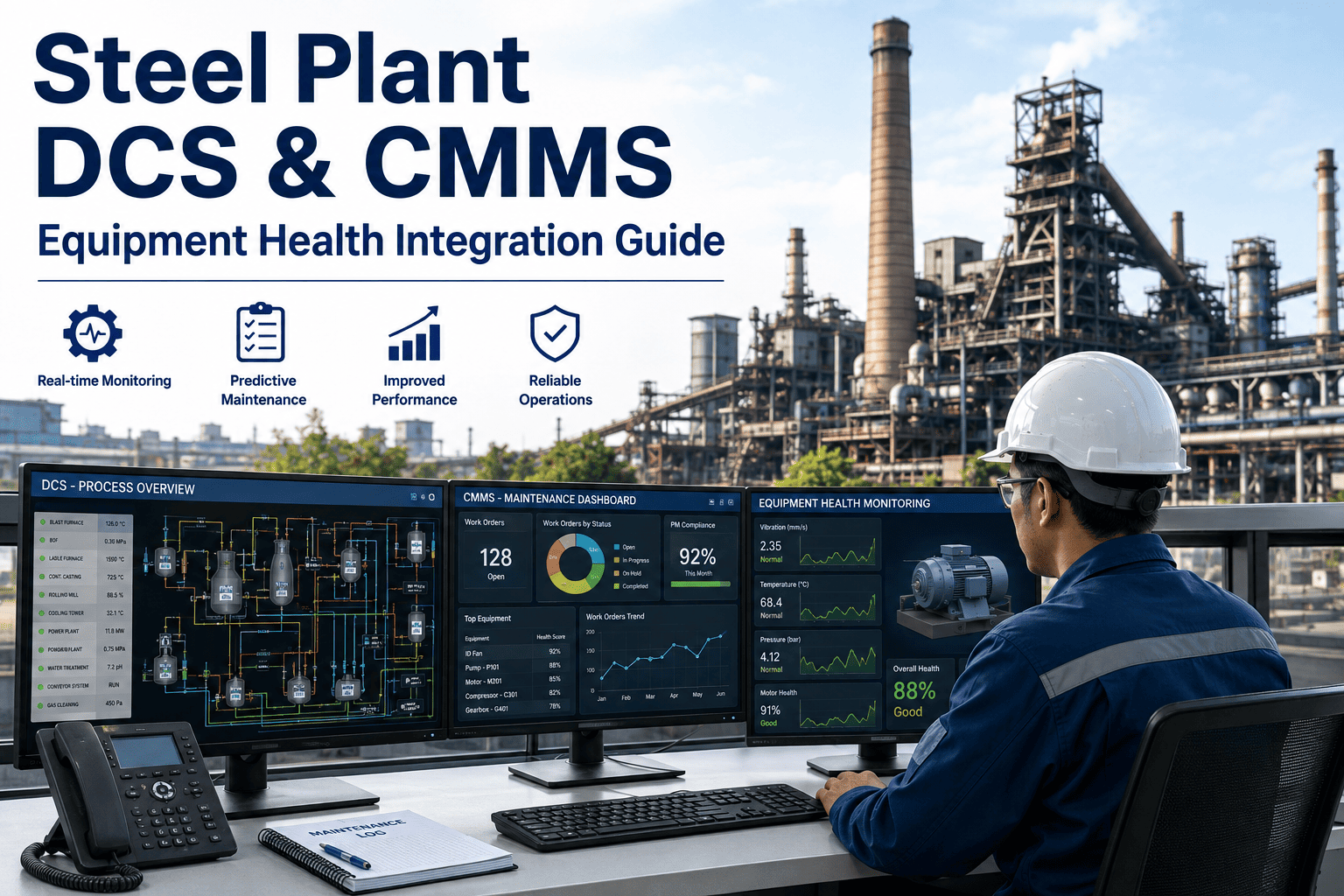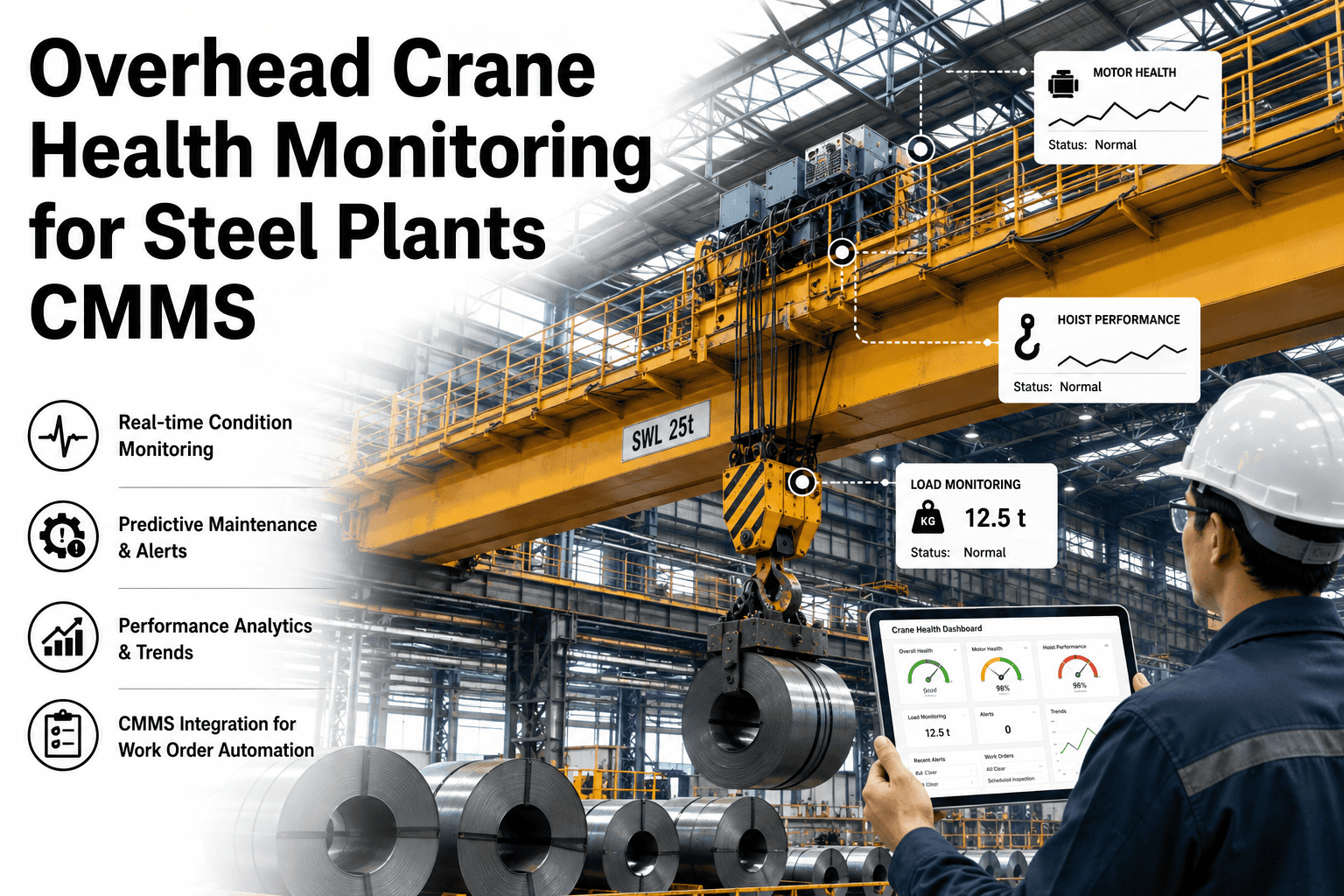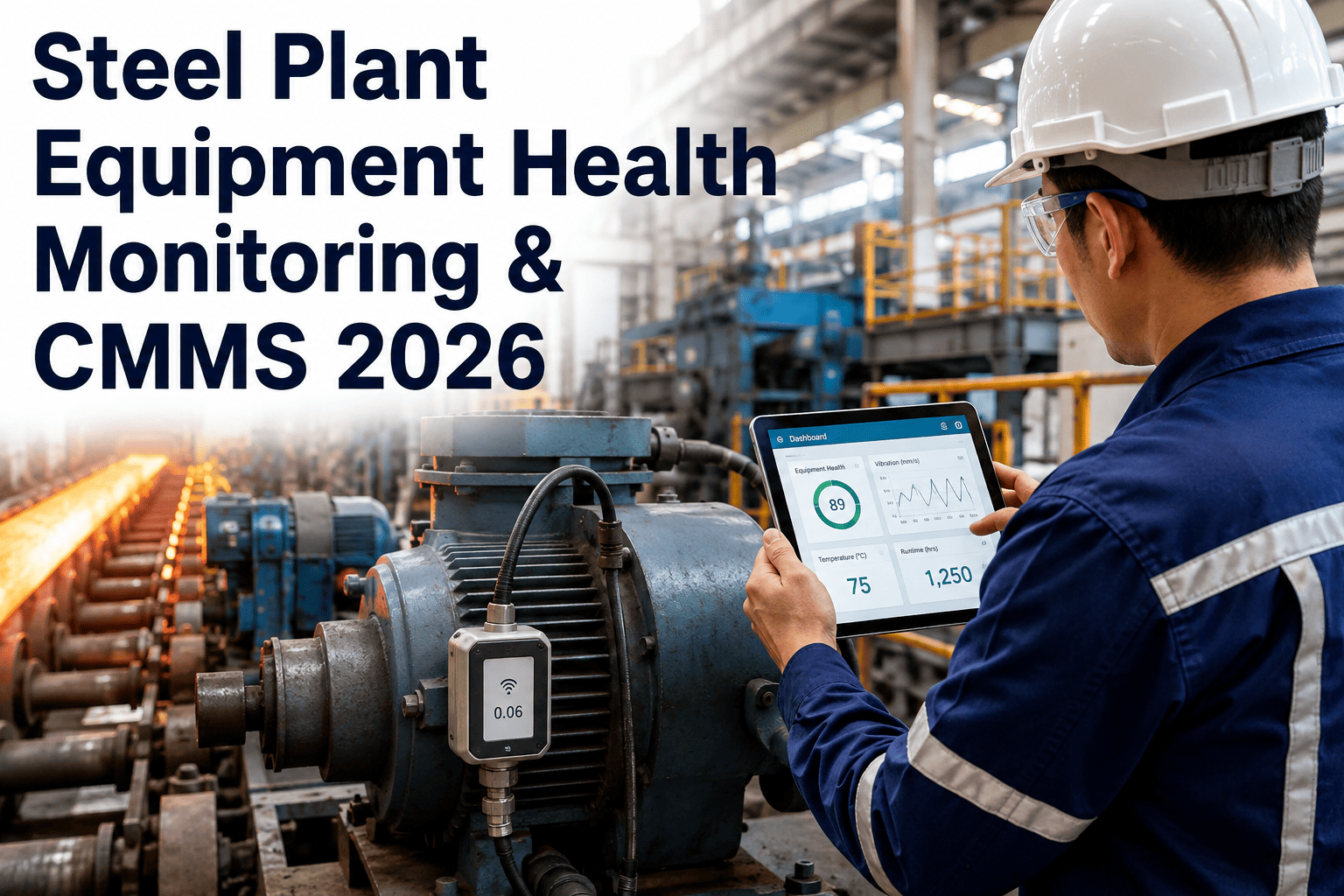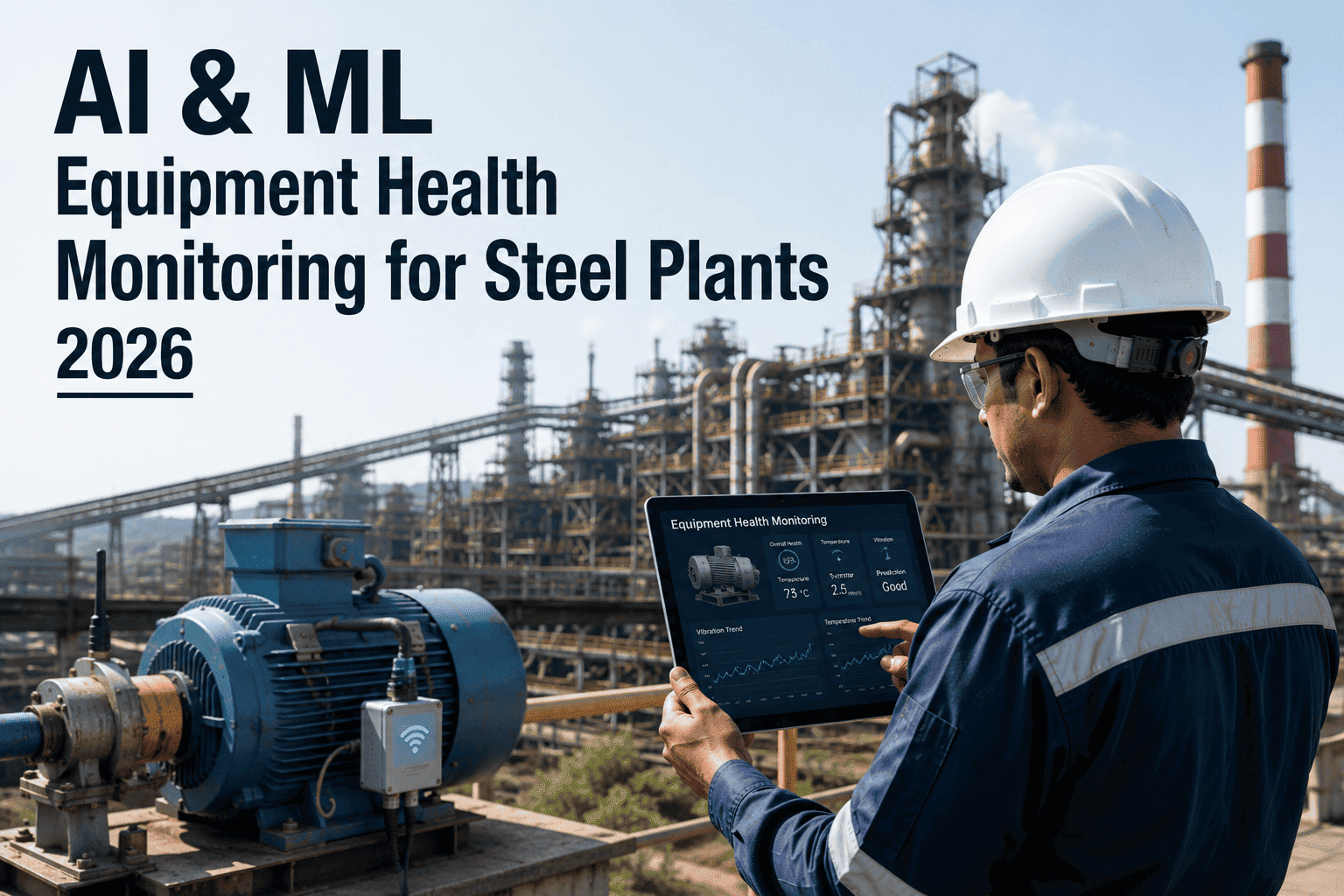
AI equipment health monitoring for steel plants has moved from pilot projects to production-grade deployments, with machine learning models now detecting anomalies in furnace temperature, pressure and rolling-mill vibration data hours or days before failures occur. In 2026, steel producers leveraging ML-driven health monitoring report 25–40% reductions in unplanned downtime and 15–20% lower maintenance spend across critical assets. OxMaint brings these predictive capabilities into an integrated CMMS and EAM platform — work orders, asset tracking, spare-parts inventory and AI health scoring in one system. Ready to see it on your plant? Start Free Trial or read on for the full breakdown.
Steel AI Monitoring 2026
What if your blast furnace warned you 72 hours before a refractory failure?
AI and machine learning equipment health monitoring is transforming steel plants — turning reactive firefighting into predictive precision. OxMaint's AI health CMMS for steel correlates sensor data, work-order history and asset profiles to flag developing failures before they cost you a cast or a coil.
The Cost of Reactive Maintenance
Why Steel Plants Are Moving to AI Health Monitoring in 2026
A single unplanned caster outage can cost a steel plant $250K–$900K per incident in lost production, scrap and emergency repairs. Yet most mills still run on time-based PMs and breakdown-driven work orders — blind to the early warning signs buried in their sensor data.
AI anomaly detection in steel plants solves this scale problem. Machine learning models trained on vibration, temperature, pressure, current and oil-quality data can identify patterns of degradation that no technician watching a SCADA screen would catch — not because they lack skill, but because the signal-to-noise ratio across thousands of channels is beyond human capacity. The result: a shift from "find and fix" to "predict and prevent," with work orders triggered automatically by AI health scores rather than calendar dates alone.
Machine Learning in Action
Where ML Delivers the Biggest Wins in Steel Plant Monitoring
Machine learning steel maintenance isn't one model — it's a portfolio of techniques applied to different asset classes. Here are the four highest-impact application areas for steel producers in 2026.
Furnace Anomaly Detection
ML models monitor furnace temperature gradients, gas flow ratios and refractory wear indicators to detect hot spots, flame instability and lining degradation — flagging developing issues 24–96 hours before traditional threshold alarms fire.
Avg. detection lead time: 54 hours
Rolling Mill Predictive Scores
Vibration spectrum analysis and motor-current signature analysis generate rolling health scores for stands, gearboxes and bearings. The model detects bearing race defects, gear pitting and misalignment before they affect product quality or cause a catastrophic failure.
Bearing failure prediction accuracy: 89%
Caster & Pump Health
Continuous-caster mold oscillation, coolant flow and hydraulic-pressure data feed models that detect strand-stick risk, roll-stack degradation and cooling-system fouling — three of the most common causes of caster breakouts and unplanned stoppages.
Breakout risk events reduced: 60%
Spare-Parts Demand Forecasting
ML doesn't just predict failure — it predicts what you'll need to fix it. OxMaint's models forecast parts demand based on AI health scores and historical consumption, keeping critical spares available without overstocking slow-moving inventory.
Inventory carrying cost cut: 18%
Worked Example
Steel Plant AI Health Monitoring: A Real-World Scenario
Consider a mid-size integrated steel plant with 1,800 tracked assets — two blast furnaces, a BOF shop, a continuous caster and a hot strip mill. Their annual maintenance budget is $14M, and unplanned downtime costs average $420K per major event.
- 28% of maintenance hours spent on reactive repairs
- Average 11 unplanned outages per year on critical assets
- $4.6M annual downtime cost
- Spares inventory valued at $8.2M with frequent stockouts
- Work orders triggered by calendar PMs and operator call-outs
- 9% of maintenance hours spent on reactive repairs
- Average 4 unplanned outages per year on critical assets
- $1.5M annual downtime cost
- Spares inventory optimized to $6.7M with 95% fill rate
- AI health scores auto-trigger work orders before failure
The shift isn't just about fewer breakdowns. It's about converting maintenance from a cost center into a reliability advantage. When AI health scores feed directly into your CMMS work-order engine, every inspection, parts order and crew dispatch is timed for maximum impact at minimum cost. That's what ML steel plant monitoring delivers when it's integrated into the maintenance workflow — not siloed in a data-science dashboard nobody acts on.
How OxMaint Helps
AI-Powered CMMS Built for Steel Plant Maintenance Teams
OxMaint isn't a bolt-on analytics layer — it's a full CMMS and EAM platform with AI health monitoring built into the core maintenance workflow. Here's how steel plants use it to cut downtime, reduce costs and stay audit-ready.
AI Health Scores on Every Asset
Each asset gets a continuously updated health score (0–100) based on sensor data, work-order history and operating conditions. When a score drops below your configured threshold, OxMaint auto-generates a work order with the likely failure mode, recommended parts and priority level — no manual triage required.
Outcome: Cut unplanned downtime 30–50% and eliminate the "run-to-failure" mentality.
Auto-Generated Predictive Work Orders
When ML models detect an anomaly — a bearing vibration trend, a furnace temperature deviation, a hydraulic pressure drift — OxMaint creates a work order automatically, assigns it to the right technician, reserves the needed spare parts and routes it through your approval workflow. The days of a data scientist emailing a PDF report that nobody actions are over.
Outcome: Reduce mean time to repair (MTTR) by 25–40% with pre-staged parts and clear failure-mode context.
Spare-Parts Inventory Optimized by AI
OxMaint links AI health predictions directly to your parts catalog. When a model predicts a bearing failure in the next 30 days, the system checks stock levels, flags shortages and can auto-create purchase requisitions for critical spares. You hold what you need — not a warehouse full of "just-in-case" inventory tying up capital.
Outcome: Cut inventory carrying costs 15–20% while improving spare-parts fill rate to 95%+.
Maintenance Analytics & Audit Readiness
Every work order, inspection, parts issue and AI prediction is logged with full traceability — meeting ISO 55000 asset-management requirements and internal audit standards. Dashboards show OEE, MTBF, MTTR, PM compliance and cost-per-ton-maintained in real time, with drill-downs to the asset and work-order level.
Outcome: Pass audits with one-click report exports and prove ROI on every maintenance dollar.
See OxMaint's AI Health Monitoring on Your Steel Plant Assets
Book a 30-minute demo and we'll show you exactly how ML anomaly detection, predictive work orders and AI-driven spares optimization would work on your furnaces, casters and rolling mills.
FAQ
AI Equipment Health Monitoring for Steel Plants — Frequently Asked Questions
How does AI anomaly detection work in a steel plant?
AI anomaly detection in steel plants works by training machine learning models on historical sensor data — temperature, vibration, pressure, current, flow rates — from your furnaces, casters, mills and pumps. The models learn the normal operating signature of each asset under different production loads and conditions. When live data deviates from that learned baseline, the system flags an anomaly and generates a health score. In OxMaint, that anomaly automatically triggers a work order with failure-mode context so your team can act before a breakdown occurs. Start Free Trial to connect your first assets in under an hour.
What equipment in a steel plant benefits most from ML health monitoring?
The highest-impact assets are blast furnaces and EAFs (refractory wear and temperature anomalies), continuous casters (mold oscillation, roll-stack degradation, cooling-system fouling), rolling mills (bearing and gearbox vibration analysis), hydraulic systems (pressure drift and contamination), and large motors and pumps (current signature analysis). Any asset with sensor data and a critical production role is a candidate. OxMaint's asset-tracking module lets you prioritize by criticality, failure frequency and downtime cost.
How much does AI health CMMS software cost for a steel plant?
Pricing scales with the number of tracked assets and AI-monitored sensor channels. Most mid-size steel plants (500–2,000 assets) invest $2K–$8K per month for OxMaint's full CMMS + AI health suite. With typical downtime savings of $1M–$4M annually, payback is usually achieved in 3–6 months. Book a Demo and we'll build a custom ROI model based on your plant's asset count and current downtime costs.
Can OxMaint integrate with our existing SCADA, PLC and historian systems?
Yes. OxMaint connects to major SCADA platforms, PLCs and process historians (including PI System, GE Proficy, Aspen InfoPlus and others) via standard industrial protocols and APIs. Sensor data flows into OxMaint's ML models continuously, and the resulting health scores and work orders stay inside your CMMS — so your technicians don't need to learn a separate analytics tool. Integration typically takes 2–4 weeks depending on the number of data sources.
How long does it take to deploy ML steel plant monitoring?
A typical deployment takes 6–10 weeks from data connection to actionable predictions. Weeks 1–4 cover integration with your sensor and historian systems and historical data ingestion. Weeks 5–8 involve model training, baseline establishment and validation against your maintenance team's domain knowledge. By weeks 8–10, auto-generated predictive work orders are live. OxMaint's onboarding team handles the heavy lifting — your reliability engineers provide asset context and validate model output.
Stop Reacting. Start Predicting.
Join the steel plants using OxMaint's AI health monitoring to cut unplanned downtime 30–50%, reduce maintenance spend and turn reliability into a competitive advantage. Book a demo or start your free trial today.
Free 14-day trial · No credit card