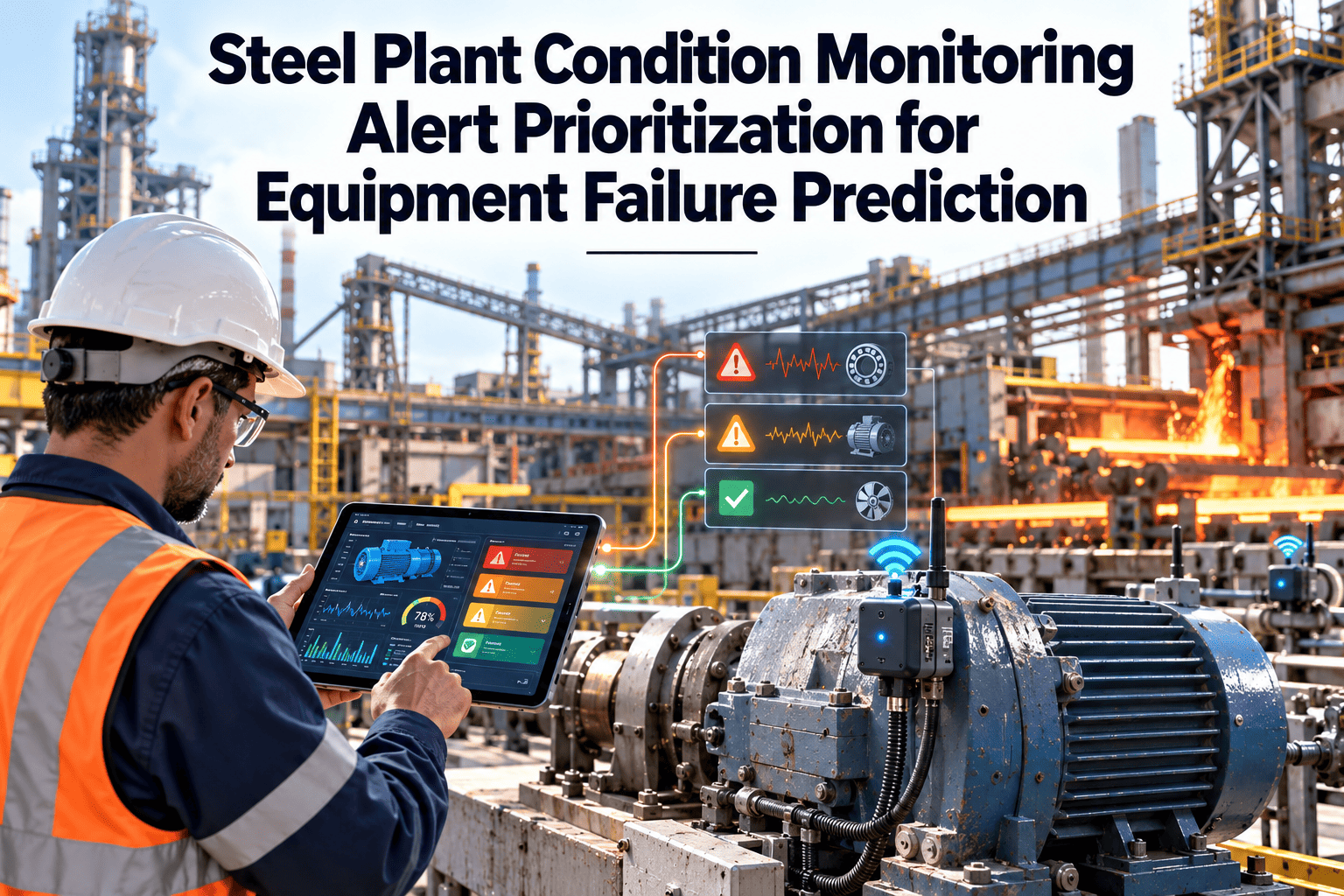
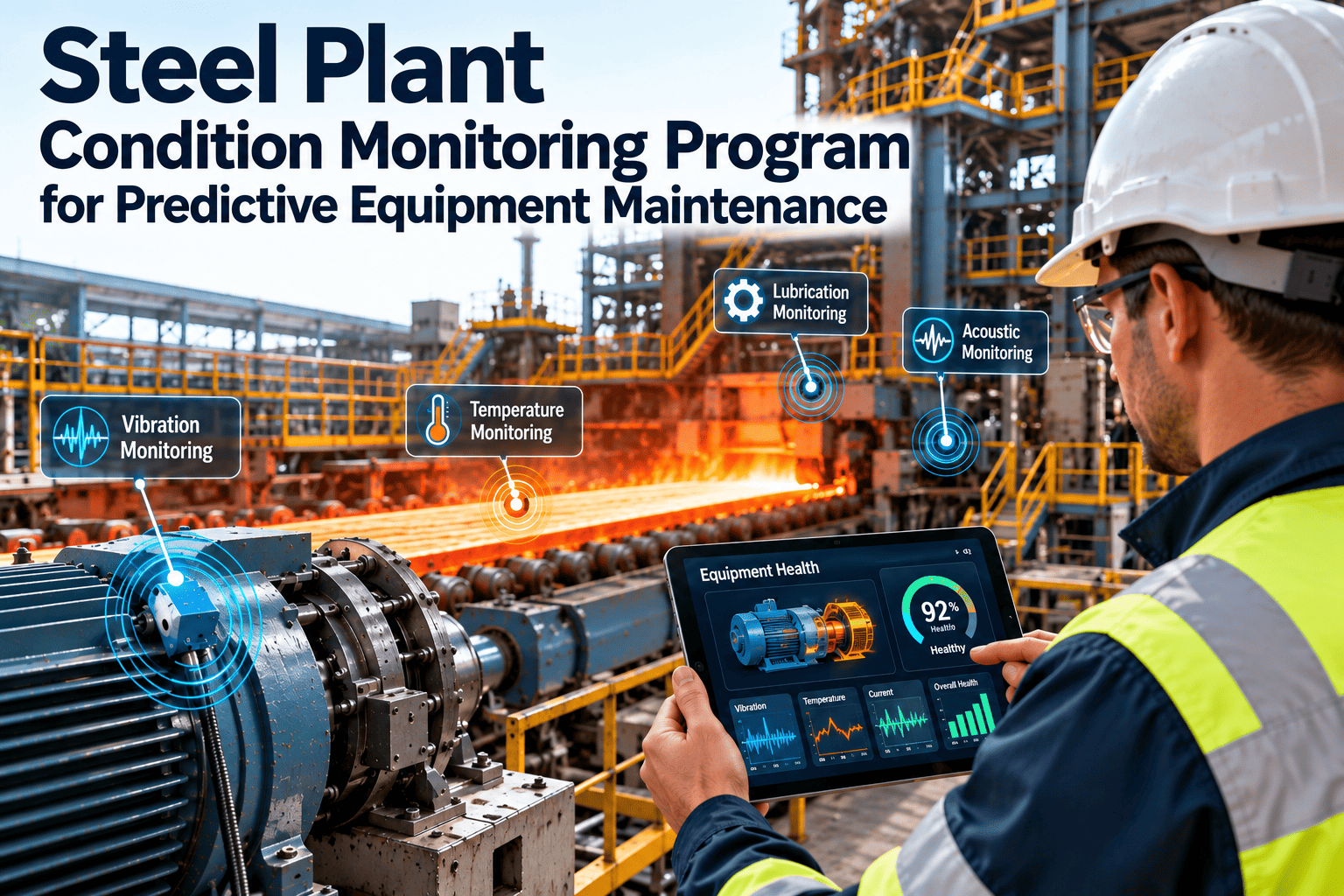
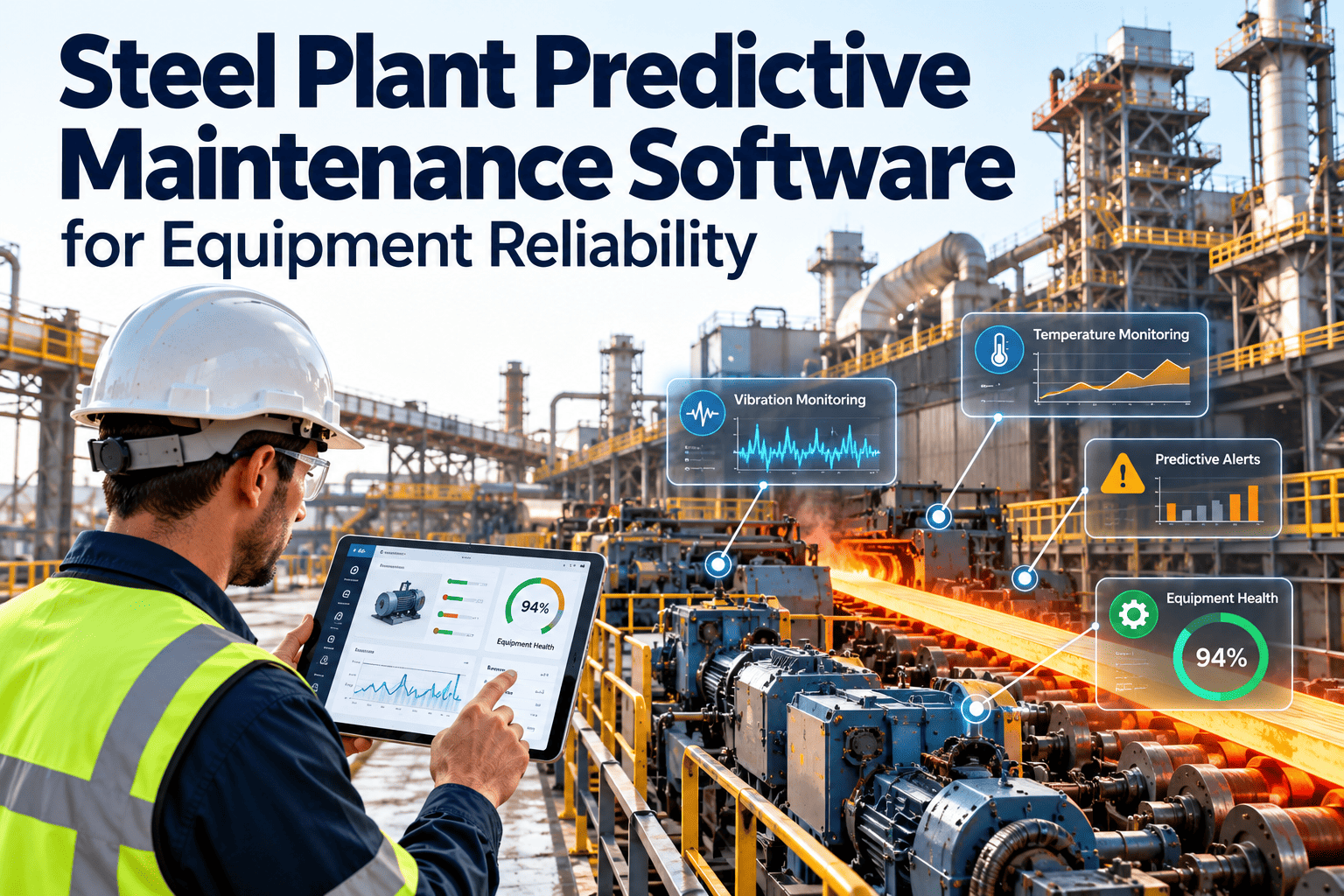
Steel plants lose an estimated $180,000–$620,000 per unplanned equipment failure on critical assets — blast furnace tuyères, continuous caster rolls, hot strip mill drives — and the overwhelming majority of those failures were preceded by detectable anomalies in sensor data that nobody was watching in real time. Traditional maintenance programmes rely on fixed PM intervals that ignore actual equipment condition: a motor running at 40% load on a temperate shift gets the same grease interval as the same motor at 95% load in peak summer heat, even though their degradation curves are completely different. OxMaint's AI predictive maintenance module monitors live sensor streams, detects statistical anomalies before they become faults, and converts those signals into prioritised, context-rich work orders that reach maintenance teams while there is still time to act — replacing calendar-driven maintenance assumptions with condition-driven maintenance decisions.
AI Predictive Maintenance for Steel Plants
Anomaly detection, condition monitoring, and predictive alerts that convert sensor data into maintenance actions — before equipment fails, not after.
Why Calendar-Based PM Fails in Steel Plant Conditions
Fixed-interval preventive maintenance was designed for equipment that ages predictably at a constant rate. Steel plant assets don't operate at constant rates — they cycle through heat campaigns, variable throughput, seasonal ambient extremes, and production surges that compress months of wear into weeks. A PM interval calibrated for average conditions is wrong for every condition that isn't average.
How OxMaint AI Predictive Maintenance Works in a Steel Plant
OxMaint's predictive maintenance engine operates across four layers — data ingestion from plant sensors and SCADA/historian systems, statistical baseline modelling per asset, anomaly detection against that baseline, and automated work order generation with maintenance context. Each layer is configurable by the reliability engineering team without custom software development.
The Anomaly That Will Fail Your Blast Furnace Is Already in the Data. OxMaint Finds It First.
Connect your steel plant sensors to OxMaint's AI engine and start receiving predictive alerts 3–14 days before equipment failure — with work orders, parts lists, and historian context already prepared.
Steel Plant Asset Classes — Condition Monitoring Requirements and Failure Modes
Different steel plant asset classes generate different failure signatures and require different sensor inputs. OxMaint ships with pre-configured monitoring templates for the major asset classes found across blast furnace, BOF, continuous casting, and rolling mill operations.
Predictive Maintenance KPIs for Steel Plant Reliability Teams
OxMaint tracks the metrics that matter for predictive programme performance — not just system availability, but the operational outcomes that justify the investment in condition monitoring infrastructure.
Predictive Alert Lead Time
Percentage of predictive alerts that fire more than 72 hours before the predicted failure window. Below 50% suggests sensor polling frequency or model sensitivity needs adjustment.
False Positive Rate
Percentage of predictive alerts that result in no actionable maintenance finding. Above 25% erodes technician trust in the system — the most common cause of predictive programme failure in steel plants.
Alert-to-WO Conversion Rate
Percentage of predictive alerts converted into accepted and completed work orders. Below 60% indicates alert prioritisation or craft assignment problems that reduce programme effectiveness.
Reactive Work % (Post-Deployment)
Share of total maintenance hours consumed by unplanned emergency work. Steel plants with mature predictive programmes consistently operate below 20% reactive — down from typical baselines of 45–65%.
MTBF Improvement — Instrumented Assets
Mean Time Between Failures for assets under active AI monitoring, vs. pre-programme baseline. Top-performing steel plants achieve 3–6× MTBF improvement within 18 months across instrumented critical assets.
Average Predictive WO Lead Time
Average days between predictive work order creation and the predicted failure window. Longer lead time enables better scheduling integration, parts procurement, and permit preparation — reducing emergency response rates.
Financial Case: AI Predictive Maintenance ROI in Steel
The ROI of predictive maintenance in steel closes faster than in most industries because the consequence of a single avoided failure often exceeds the annual cost of the monitoring programme that prevented it.
The steel industry is one of the best environments for AI predictive maintenance to deliver real returns — not because the technology is exceptional here, but because the consequence of failure is so extreme. A stave burnout on a blast furnace or a spindle fracture on a hot strip mill costs more in one event than a full year of condition monitoring infrastructure. The critical success factor is not sensor density or model sophistication — it is false positive management. I have seen predictive programmes fail in world-class steel plants because the maintenance team stopped trusting the alerts after three consecutive false positives sent them to check perfectly healthy equipment during a campaign. OxMaint's baseline modelling approach, which stratifies the normal operating range by production load rather than using a flat threshold, is the most effective false-positive management technique I have encountered in 19 years in this industry. A caster roll that runs warmer under high throughput should not generate alerts every time output increases — and with load-stratified baselines, it doesn't.
Frequently Asked Questions
How long does it take for OxMaint AI models to establish reliable baselines for steel plant assets?
For assets with existing historian data, OxMaint can backfill 30–90 days of sensor history to establish an initial baseline before go-live — meaning predictive alerts can begin firing from day one rather than waiting for a live learning period. For assets with no prior sensor history, a 30-day live data collection period is required before anomaly detection becomes reliable. During the learning period, OxMaint operates in observation-only mode, logging sensor data without generating alerts. Most steel plants have sufficient historian data for their critical assets to enable immediate baseline modelling. Sign in to start your asset baseline configuration.
Which sensors are required to start AI predictive maintenance on steel plant assets?
OxMaint works with whatever sensor data you already have — there is no minimum sensor requirement to start. A continuous caster with only motor current and bearing temperature sensors gets a meaningful anomaly model on those two parameters. Adding vibration probes improves model sensitivity but is not a prerequisite. The programme typically starts with existing process sensors already connected to the IOT/historian and expands to dedicated IoT sensors on the highest-criticality assets as the programme matures. Book a demo to see which of your existing sensors can feed OxMaint's AI engine from day one.
How does OxMaint handle false positives from normal process variation in steel plant operations?
Steel plant false positives typically originate from three sources: planned production surges, seasonal ambient temperature variation, and post-maintenance break-in periods. OxMaint addresses each with load-stratified baselines (separate normal ranges for different throughput levels), planned event suppression (alerts suspended during known production surges or maintenance windows), and post-maintenance settling periods (14-day exclusion window after a work order is completed on an asset). The combined effect is a false positive rate below 12% for well-configured assets in our steel plant deployments — below the 15% threshold where technician trust erodes. Sign in to configure your false positive suppression rules.
Can OxMaint predictive maintenance work alongside an existing SAP PM or IBM Maximo system?
Yes — OxMaint integrates with SAP PM and Maximo via REST API in two modes: as a standalone predictive layer that manages AI-generated work orders independently, or as a work order creation service that pushes predictive WOs into SAP PM or Maximo as the system of record. In hybrid mode, OxMaint handles anomaly detection, alert management, and sensor data enrichment while your existing CMMS retains cost coding, history, and reporting. Most steel plants with existing enterprise CMMS installations use the hybrid approach to avoid a full system replacement. Book a demo to see the SAP PM integration architecture.
What is a realistic implementation timeline for AI predictive maintenance in a steel plant?
A phased deployment covering 20–40 critical assets runs over 10–16 weeks: Weeks 1–3 cover sensor connectivity and historian backfill for baseline modelling; Weeks 4–6 cover asset model configuration and alert rule definition with the reliability team; Weeks 7–10 cover parallel-run validation against known failure history; Weeks 11–16 cover live predictive alerts with supervised acceptance and false-positive tuning. Full programme maturity — where the model is reliably predicting 80%+ of detectable failures with a false positive rate below 15% — typically takes 6–9 months from go-live. Start your free trial and begin the asset configuration process today.
Every Failure That Was Preceded by a Detectable Anomaly Was a Preventable Failure.
OxMaint's AI predictive maintenance module monitors your steel plant assets continuously — detecting anomalies 3–14 days before failure, converting them into scheduled maintenance actions, and building the reliability data that reduces unplanned downtime year over year. Stop discovering failures at shift start. Start preventing them a week before.