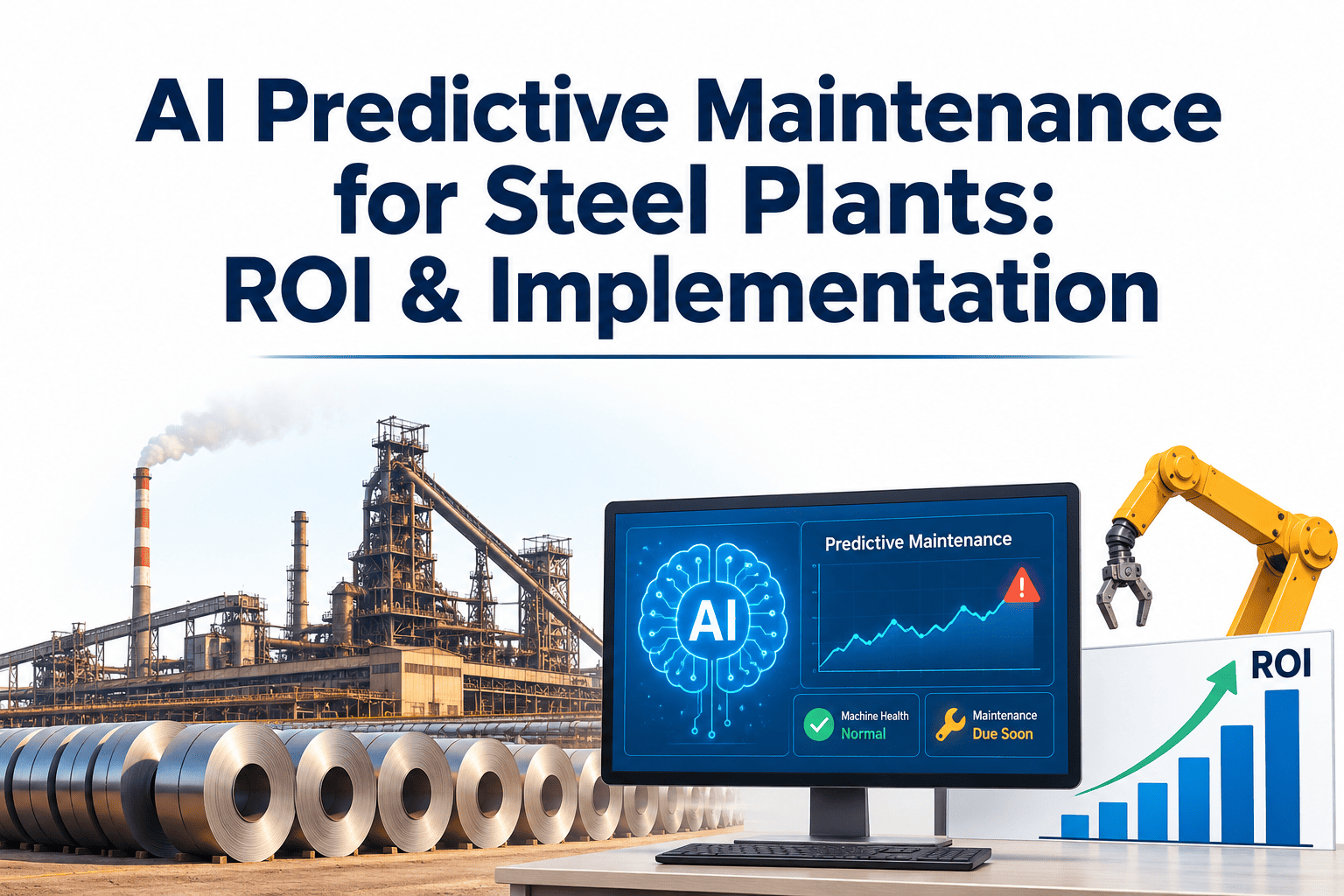
AI predictive maintenance for steel plants now delivers measurable ROI by combining sensor data, machine learning models, and CMMS work-order automation to forecast equipment failures days or weeks before they occur. In an industry where a single unplanned blast furnace shutdown can cost $500K–$2M per day, steel plant AI maintenance shifts teams from reactive firefighting to data-driven reliability—improving OEE, extending asset life, and slashing spare-parts spend. OxMaint brings predictive analytics, work-order management, and asset tracking into one AI-powered CMMS platform purpose-built for heavy industrial operations, so your reliability engineers can act on predictions the moment they surface. Ready to see it on your assets? Start Free Trial or read on for the full ROI breakdown and implementation roadmap.
Every Unplanned Furnace Shutdown Costs $500K–$2M/Day. AI Cuts That Risk by Up to 50%.
Steel plants deploying AI predictive maintenance report 25–50% fewer unplanned outages, 20–40% lower maintenance spend, and 10–20% longer asset life. OxMaint turns sensor streams and historical work-order data into failure predictions your team can act on—before a bearing seizes or a refractory lining fails.
How AI Predictive Maintenance Pays for Itself in Steel Plants
A typical integrated steel mill runs 1,200–4,000 maintainable assets across the blast furnace, BOF/EAF, continuous caster, hot strip mill, and utilities. When a critical asset fails unexpectedly, the cascading cost includes lost production, scrap, emergency labor premiums, and expedited spare parts. AI predictive maintenance for steel plants attacks each of these cost centers.
Example: A 1,800-asset steel plant avoiding 2 blast-furnace outages/year ($1.4M each), cutting mill downtime 30% ($600K), and reducing spares inventory 18% ($220K) generates ~$3.62M in annual savings against an OxMaint investment of ~$95K/yr—a 38× return.
AI refractory wear models predict lining failure 5–14 days in advance, enabling planned gunning or relining instead of emergency shutdowns at peak production.
Vibration + temperature ML models detect rolling-mill bearing degradation 200+ operating hours before seizure, converting unplanned outages into 4-hour planned stops.
Predictive demand forecasting trims safety stock 15–25% while guaranteeing critical spares are available precisely when the model flags a developing fault.
Technicians arrive with the right parts, tools, and diagnostic context—eliminating 2–3 hours of wasted diagnostic time per work order and reducing overtime premiums.
Where AI Predicts Failures in a Steel Plant — Asset by Asset
Not every asset benefits equally from predictive AI. The highest-ROI targets are the bottleneck assets where an unplanned failure halts the entire production chain. Below are the five asset classes where steel plant machine learning delivers the fastest, largest payback.
| Asset Class | Failure Mode Predicted | Data Sources | Prediction Lead Time | Avg. Value per Catch |
|---|---|---|---|---|
| Blast Furnace | Refractory lining wear & hearth breakthrough | Thermocouple grid, cooling-water delta-T, gas chemistry, tuyere camera | 5–14 days | $1.2M–$2.0M |
| Rolling Mill Stand | Bearing seizure, roll surface degradation | Vibration (acceleration, velocity), oil debris, temperature, motor current | 200+ operating hrs | $250K–$600K |
| Continuous Caster | Mold oscillation drift, strand break-out | Mold temperature gradient, mold level, oscillation frequency, lubrication flow | 8–48 hours | $400K–$900K |
| BOF / EAF Transformer | Winding insulation degradation, tap-changer failure | DGA oil analysis, partial discharge, thermal imaging, load profile | 3–30 days | $300K–$800K |
| Hot Charge Furnace | Skid pipe cracking, burner efficiency drift | Skin thermocouples, flue-gas O₂, burner flame intensity, fuel/air ratio | 10–21 days | $150K–$450K |
Prediction lead times are typical ranges observed in deployed steel plant AI maintenance systems; actual performance depends on sensor density, data quality, and model maturity. ISO 17359 and ISO 13374-4 alignment recommended.
How to Implement AI Predictive Maintenance in a Steel Plant: A 6-Month Timeline
Steel plants that succeed with predictive AI follow a phased rollout: connect data first, validate models on a single critical asset, then scale. Trying to predict everything at once is the #1 reason AI maintenance pilots stall. Here's the proven 6-month path to production.
Asset Criticality & Data Audit
Rank assets by production impact (RPN). Audit existing sensors, PLC tags, historian coverage, and CMMS work-order history. Identify the top 5–10 bottleneck assets with sufficient data depth (18+ months of records) to fuel initial models.
Data Pipeline & Sensor Integration
Connect OxMaint to your historian (OSIsoft PI, GE Proficy, AspenTech), DCS/SCADA tags, and existing CMMS. Ingest vibration, temperature, pressure, oil analysis, and work-order history. Fill sensor gaps with wireless vibration + temperature sensors on priority assets.
Pilot Model on One Critical Asset
Train and validate ML failure-prediction models on a single high-value asset—typically a rolling mill stand or blast furnace. Baseline failure prediction accuracy, false-positive rate, and lead time. Target: 80%+ recall on actual failures with <15% false alarms.
Work-Order Automation Activation
When the AI model flags a developing fault, OxMaint auto-generates a predictive work order with diagnostic context, recommended parts, and safety procedures—routed to the right technician. This closes the loop between prediction and action, the step most pilots miss.
Scale to 20–50 Assets
Replicate validated model templates across similar assets. Expand to caster, furnace, and utility systems. Tune thresholds using feedback from maintenance technicians and actual inspection findings. Begin monthly ROI tracking against baseline KPIs.
Full Production & Continuous Learning
Models now retrain monthly on new failure and survival data. OxMaint dashboard shows live health scores, predicted failure dates, and confidence intervals for all monitored assets. Reliability team shifts from PM-based to condition + prediction-based maintenance strategy.
How OxMaint Delivers AI Predictive Maintenance ROI for Steel Plants
OxMaint is an AI-powered CMMS and EAM platform built for the realities of steel production—high-temperature environments, 24/7 continuous operation, complex asset hierarchies, and thin margins where every hour of unplanned downtime is measured in six figures. Here's how OxMaint turns predictive AI into measurable outcomes.
AI Failure Prediction Engine
Machine-learning models trained on your sensor and work-order data predict bearing failures, refractory wear, and motor degradation 8–200+ hours in advance. Auto-generates work orders the moment a threshold is crossed.
Digital Work Orders & PM Scheduling
Replace paper routes and whiteboards with mobile work orders that carry diagnostic context, OEM manuals, parts lists, and safety lockout procedures. Auto-escalate overdue PMs and prioritize by asset criticality.
Smart Spare-Parts Inventory
Predictive demand forecasting links failure probability to BOMs and min/max levels—so the right bearing, valve, or refractory brick is in stock exactly when the model predicts it will be needed, without overstocking.
Maintenance Analytics & OEE Dashboards
Live dashboards track OEE, MTBF, MTTR, PM compliance, and prediction accuracy by asset, shift, and area. Drill from a KPI tile to the individual work order in two clicks. Export audit-ready reports for ISO 55000 compliance.
A 1,800-Asset Steel Plant: AI Predictive Maintenance ROI in Year One
Consider a mid-size integrated steel plant producing 2.5M tons/year, running 1,800 maintainable assets, and spending $4.2M annually on maintenance (labor + parts + contractors). Their reliability team manages 12,000 work orders/year across two shifts, still using a legacy CMMS with no predictive capability and spreadsheets for vibration tracking.
Annual maintenance spend · 14 unplanned critical outages · 68% OEE · 71% PM compliance · 12,000 work orders/yr
$1.3M spend reduction · 6 unplanned outages (−57%) · 76% OEE (+8 pts) · 94% PM compliance · 9,400 work orders/yr (−22%)
| ROI Category | Annual Savings | How It's Achieved |
|---|---|---|
| Avoided blast furnace outages (2 fewer) | $2.8M | Refractory wear model predicts lining failure 10 days in advance → planned relining during scheduled outage instead of emergency shutdown |
| Rolling mill uptime recovery | $600K | Vibration ML model flags bearing degradation 200 hrs pre-failure → planned 4-hr stop vs. 36-hr unplanned outage |
| Reduced spares inventory carrying cost | $220K | Predictive demand forecasting trims safety stock 18% while guaranteeing critical-spares availability |
| Labor efficiency & overtime reduction | $180K | Technicians arrive with parts + diagnostics → 30% faster MTTR, 40% less emergency overtime |
| Extended asset life (deferred capex) | $150K | Condition-based PM extends bearing + motor life 15–20%, deferring one major rebuild cycle |
| Total Annual Savings | $3.95M | Against OxMaint platform + implementation cost of ~$95K/yr → 38× ROI, 2.9-month payback |
See OxMaint Predict Failures on Your Steel Plant Assets — Live
Book a 30-minute demo and we'll connect OxMaint to a sample of your sensor data, build a pilot failure-prediction model, and show you exactly how much unplanned downtime you can eliminate in Year One.
AI Predictive Maintenance for Steel Plants — Frequently Asked Questions
How much does AI predictive maintenance cost for a steel plant?
A steel plant deploying AI predictive maintenance typically invests $60K–$150K/year for platform licensing, sensor augmentation, and integration, depending on asset count and data sources. Against an average avoided-outage value of $1.2M–$2.0M per blast furnace event, most plants achieve full payback in 3–9 months. OxMaint pricing scales with monitored assets—book a demo for a tailored quote.
How accurate is AI failure prediction in steel plants?
Production-grade ML models on well-instrumented steel assets typically achieve 80–92% recall (true positive rate) with a false-positive rate under 15%. Accuracy improves over the first 3–6 months as models retrain on your plant's specific failure history and operating modes. Rolling mill bearing models and blast furnace refractory models tend to reach high accuracy fastest due to rich vibration and thermal data.
What sensors are needed for predictive maintenance in a steel plant?
The minimum viable sensor set includes vibration (acceleration/velocity) on rotating equipment, surface and internal thermocouples on furnaces and casters, oil debris sensors on large gearboxes, motor current/power signatures on mill drives, and process tags (pressure, flow, gas chemistry) from your existing DCS/historian. Most steel plants already have 60–70% of the required instrumentation—OxMaint audits gaps and recommends wireless sensors only where needed.
Can AI predictive maintenance integrate with our existing CMMS and historian?
Yes. OxMaint connects to standard steel-industry historians (OSIsoft PI, GE Proficy, AspenTech IP21), DCS/SCADA systems, and existing CMMS platforms via REST APIs and OPC-UA. If you're migrating from a legacy CMMS, OxMaint imports your asset hierarchy, work-order history, and BOMs—so your team starts with context, not a blank system. Start a free trial to test integration with your data.
How long does it take to implement AI predictive maintenance in a steel plant?
A phased rollout reaches production in 4–6 months: Month 1 for asset criticality and data audit, Month 2 for pipeline integration, Month 3 for pilot model validation on one critical asset, and Months 4–6 for work-order automation activation and scaling to 20–50 assets. Plants with mature sensor infrastructure and 18+ months of clean historian data can compress this to 12–16 weeks.
Stop Reacting to Failures. Start Predicting Them.
Join the steel plants cutting unplanned downtime 25–50% and recovering millions in avoided outages with OxMaint's AI-powered CMMS. Your first predictive model can be live in 90 days.
Free 14-day trial · No credit card