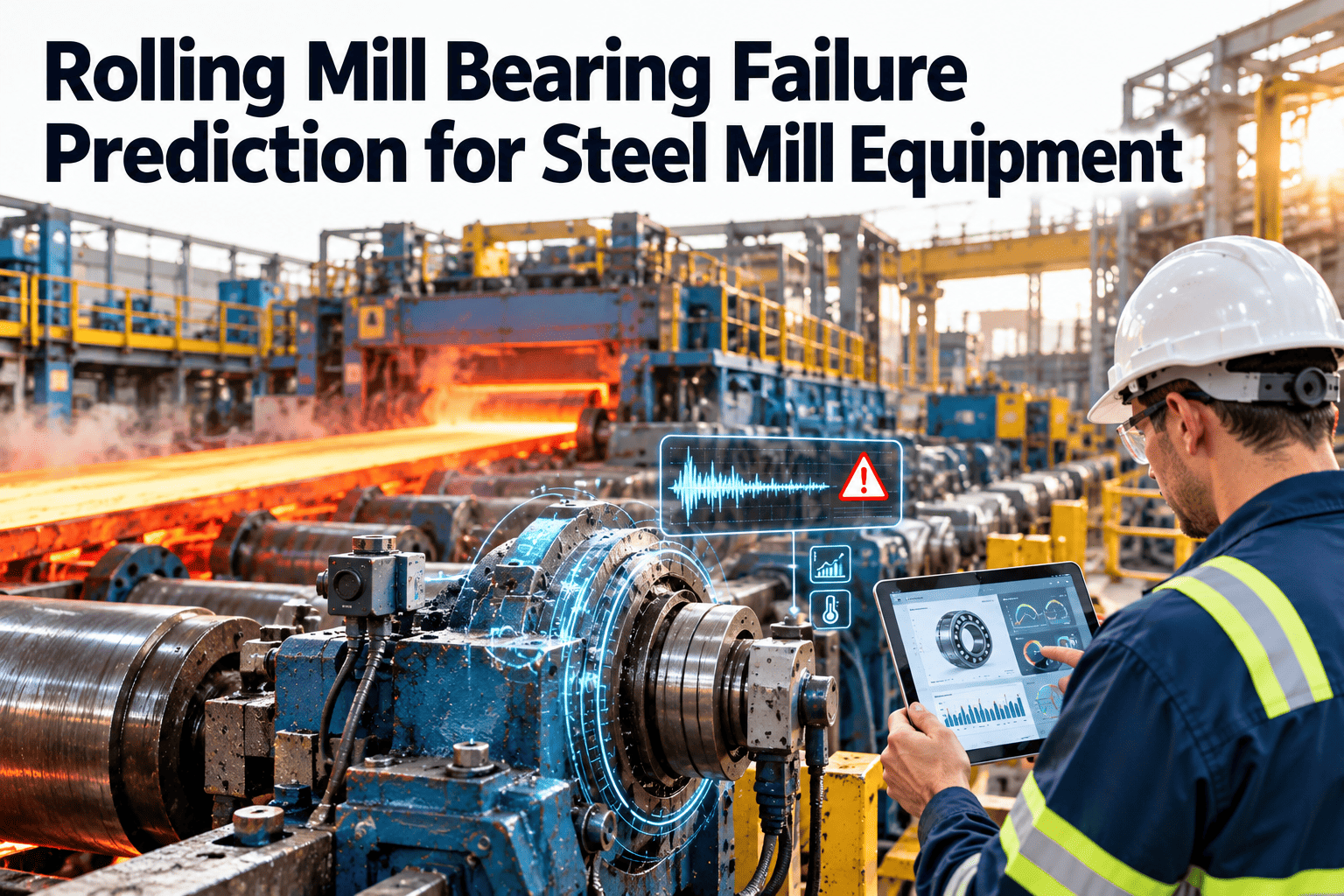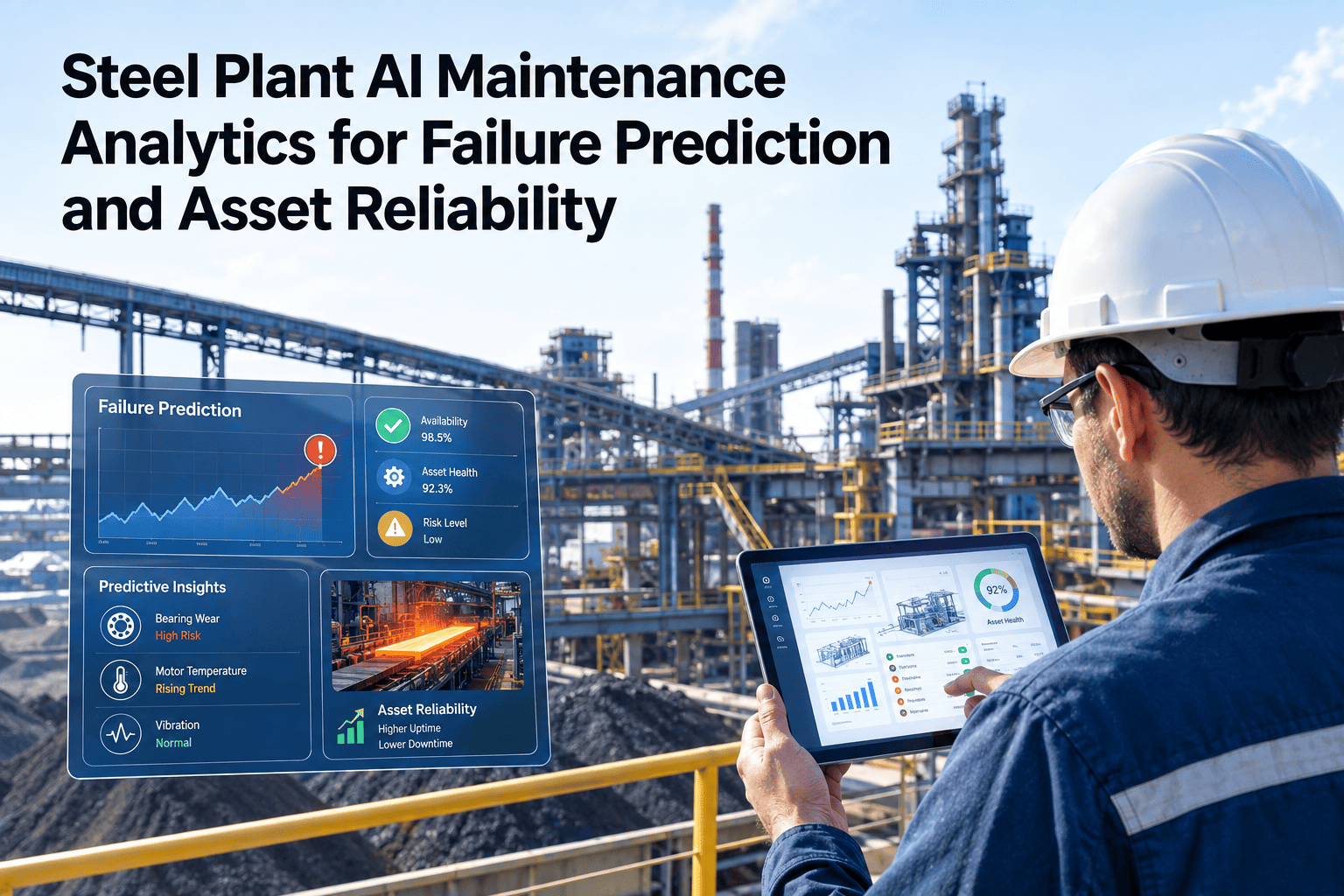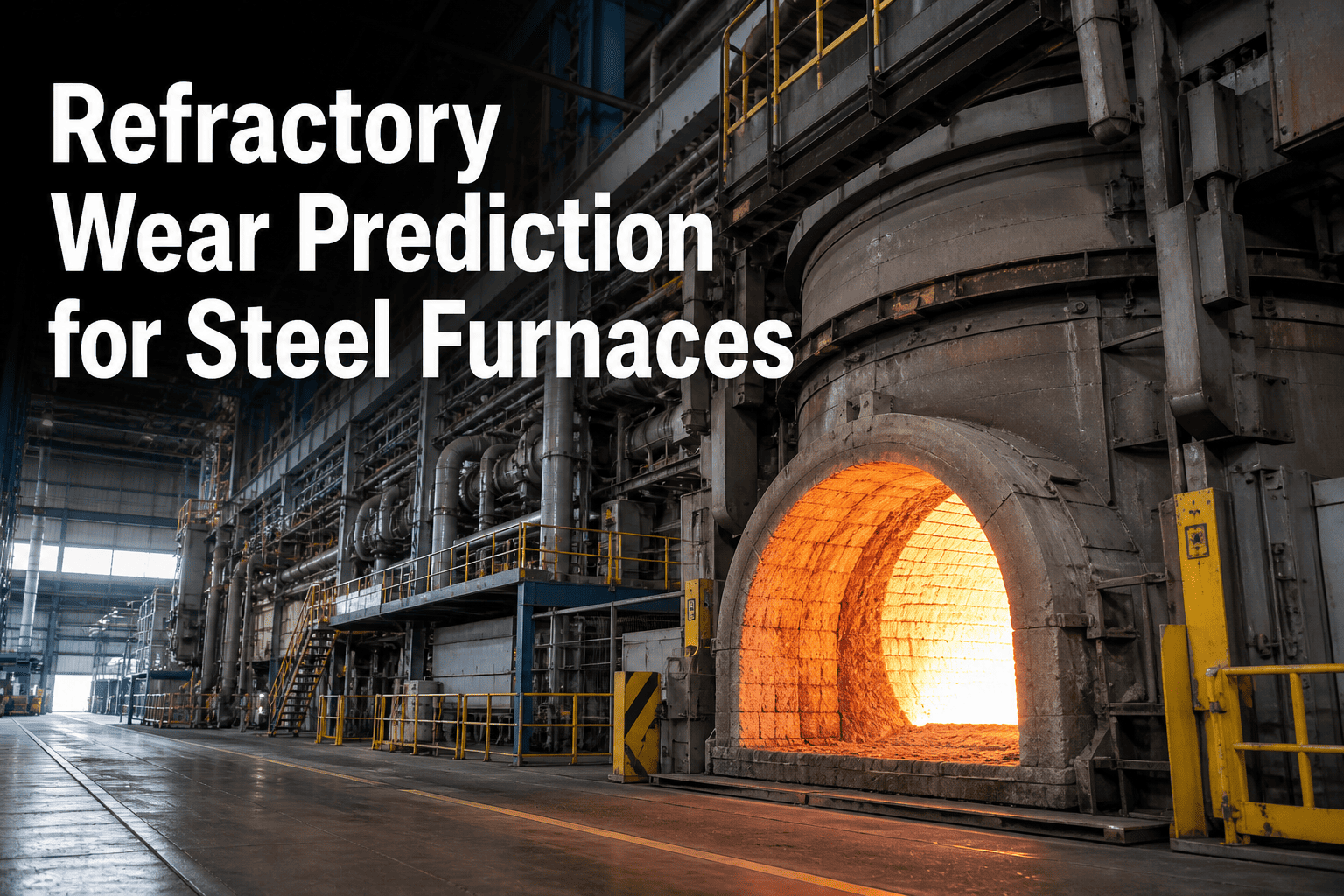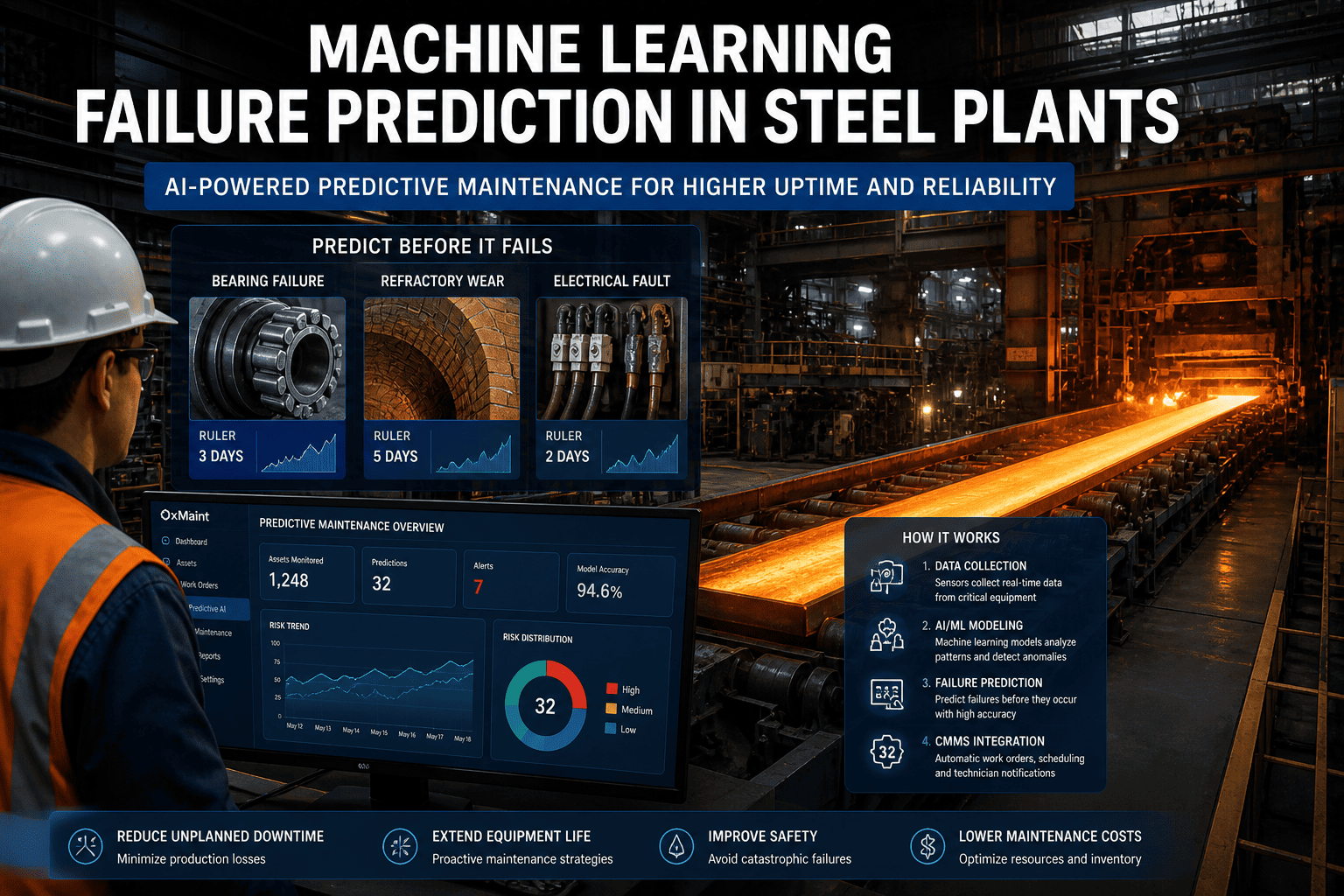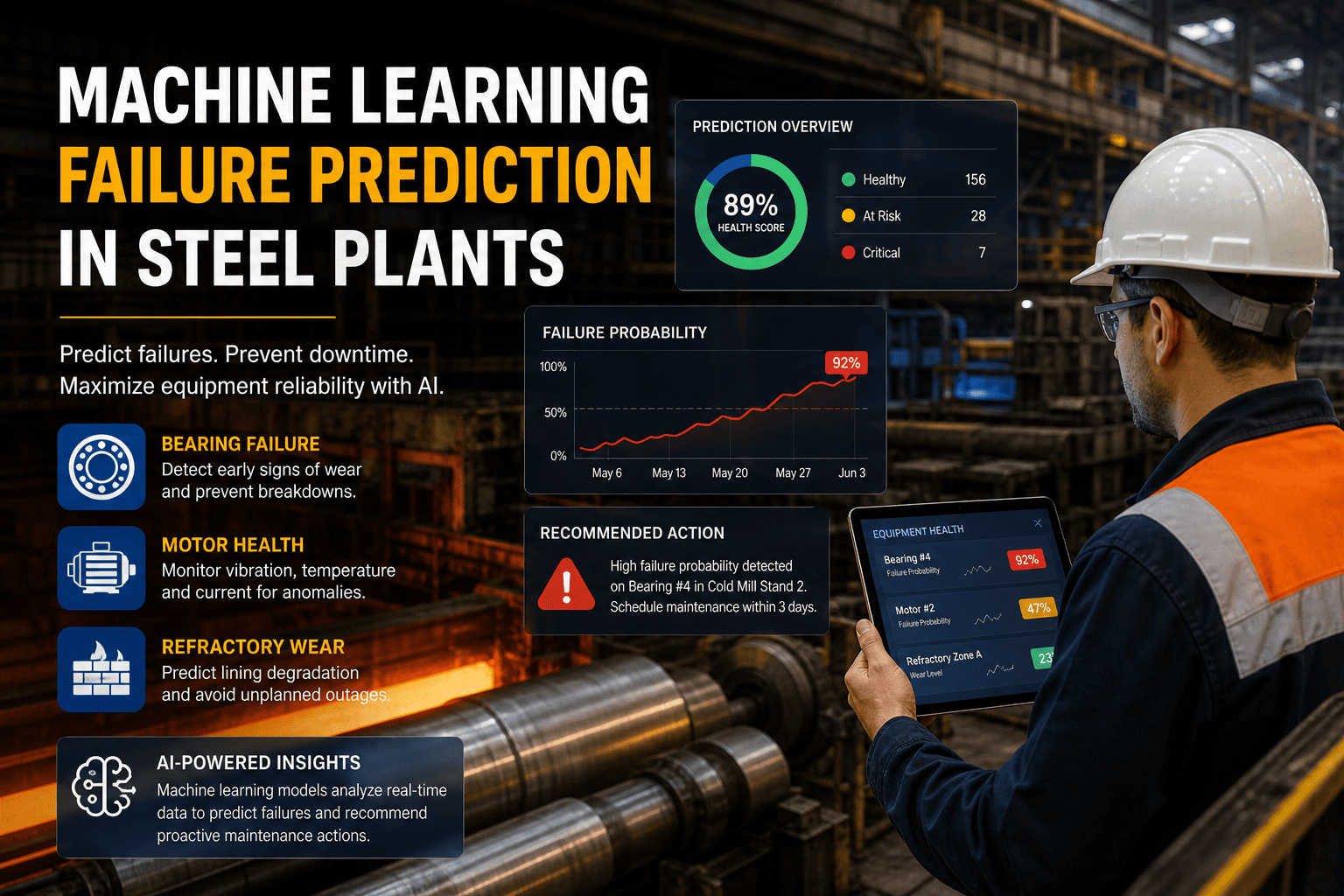
When a blast furnace tuyere fails without warning, the unplanned casthouse stoppage costs more in a single shift than a year of predictive maintenance investment. Machine learning failure prediction in steel plants is no longer a research project — it is a production-operational tool that processes work order history, sensor readings, and maintenance records to generate specific, time-bounded failure predictions for bearings, motors, refractory systems, and drive components. The shift from calendar-based to prediction-based maintenance is the single highest-leverage reliability improvement available to a steel plant maintenance programme today.
Industry 4.0 · Predictive Maintenance AI
Machine Learning Failure Prediction in Steel Plants
Bearings · Motors · Refractory Systems — CMMS-Integrated Prediction That Creates Work Orders, Not Just Alerts
$1.4M
Cost per hour of unplanned stoppage
87%
ML bearing detection accuracy
14 days
Average prediction lead time
35%
Unplanned downtime reduction
8–14 mo
Typical ROI payback period
Three Failure Modes ML Predicts Most Reliably in Steel
01
Bearing and Rotating Equipment Failure
Rolling mill drives · Ladle cranes · Caster pinch rolls · Fan assemblies
87% accuracy · 10–21 day lead
Vibration spectral analysis detects bearing defect frequencies — BPFO, BPFI, and BSF signatures — before any audible noise or temperature rise is detectable. ML models trained on your plant's bearing failure history learn which frequency progressions at which amplitudes lead to emergency replacement versus controlled intervention. OxMaint receives these alert signals and automatically generates a work order with estimated time-to-failure window, recommended inspection steps, and parts list.
BPFO / BPFI
Primary defect frequencies tracked
10–21 days
Average advance warning window
$180K–$420K
Cost avoidance per emergency avoided
02
Refractory Wear and Thermal Degradation
Blast furnace linings · Torpedo ladles · BOF vessels · Tundish
94% accuracy · 30–60 day lead
Thermal camera data and campaign-length records train regression models that predict remaining refractory life within ±3% accuracy. The most expensive single maintenance event in a steel plant — emergency blast furnace relining — is almost entirely preventable with ML refractory prediction. Plants using this approach schedule relining at optimum lining thickness, extending campaign length without breakthrough risk and eliminating the 18–24 hour emergency campaign preparation cost.
±3%
Remaining life prediction accuracy
30–60 days
Advance relining warning window
$800K–$2.1M
Emergency relining cost avoided
03
Motor and Electrical System Fault Detection
Drive systems · EAF transformers · Motor windings · Switchgear
91% accuracy · 21–35 day lead
Motor current signature analysis (MCSA) identifies stator winding faults, rotor bar defects, and insulation degradation from current waveform anomalies. ML classifiers distinguish normal operational current variations from fault signatures with 91% precision — critical in steel where a single drive failure on a continuous caster triggers an immediate casting stop with full tundish management cost. Early detection allows scheduled motor change-out rather than emergency replacement under production pressure.
MCSA
Motor current signature analysis method
91%
Classification precision
$350K–$900K
Transformer failure cost avoided
ML Predictions Only Deliver ROI When They Create Work Orders — Not Just Dashboard Alerts
Every OxMaint ML prediction above threshold auto-generates a work order, assigns a technician, flags required parts, and tracks resolution to closure — the full loop from prediction to proof of action.
What Your CMMS Data Already Contains — and How ML Activates It
Data Already in Your Work Order History
Failure timestamps per asset — exact date and time of each unplanned event
Failure mode / fault code — bearing failure, electrical fault, refractory wear
Time since last PM at point of failure — reveals PM interval adequacy
Repair duration and parts consumed — feeds MTTR and cost models
Technician observations — early warning narrative data often ignored
Repeat failure patterns — same asset, same failure mode, different dates
3+ years of structured work order history is sufficient to begin initial ML model training in OxMaint. No sensors required to start.
What ML Adds on Top
Pattern recognition across 1,000s of historical work orders simultaneously
Time-to-failure prediction window — "this asset class fails 14 days after this signature"
Cross-fleet learning — failures on similar assets inform predictions on untested units
Continuous model retraining from every new confirmed or missed failure event
Anomaly scoring — real-time deviation from historical normal operating parameters
Sensor data fusion when available — vibration + temperature + current combined into one score
Models reach production accuracy within 60–90 days of data onboarding. False positive rates fall below 8% by month 12.
ML Prediction Performance by Steel Asset Class
| Asset | Failure Type Predicted | Lead Time | Accuracy | Data Requirement | Cost Avoidance / Event |
|---|---|---|---|---|---|
| Rolling Mill Stand F2/F3 | Bearing + spindle coupling | 14–21 days | 89% | 3 yr WO history + vibration | $180K–$420K |
| Blast Furnace Shell | Refractory wear / breakthrough | 30–60 days | 94% | Campaign data + thermal | $800K–$2.1M |
| Continuous Caster Segment | Roller misalignment + bearing | 7–10 days | 81% | 2 yr WO history + temperature | $240K–$600K |
| EAF Transformer | Insulation / winding degradation | 21–35 days | 91% | Oil DGA data + load history | $350K–$900K |
| Ladle Crane Main Hoist | Wire rope fatigue + bearing | 5–8 days | 78% | Inspection records + load cycles | $90K–$200K |
| Hydraulic Descaler Pump | Seal failure + impeller wear | 10–18 days | 85% | 2 yr WO + pressure trend | $40K–$110K |
"
We deployed ML failure prediction on our F2 and F3 finishing stands first — eight years of closed work orders in OxMaint gave the model exceptional training data. Within six months, four bearing failures were predicted with an average 16-day lead time. All four were scheduled and repaired during planned downtime windows. Two of those failure modes had historically caused emergency stops. The critical factor people underestimate is what happens after the prediction fires. If the prediction creates a notification that someone acknowledges and then waits for a weekly planning meeting to act on, you have lost the lead time advantage. In OxMaint, the prediction fires and the work order is already assigned, the parts are already flagged, and the planning conversation is about which window to use — not whether to act. That closed loop is what converts the investment into actual downtime reduction on your KPI dashboard.
Dr. Suresh Venkataraman, B.Tech (Metallurgy), M.Tech (Industrial Engineering), PhD (Reliability Systems)
Senior Reliability Engineer — JSW Steel (Vijayanagar Works) · 18 Years Steel Manufacturing Maintenance and Reliability · Specialist in CMMS-integrated predictive analytics, ML-driven maintenance programme design, and reliability engineering for blast furnace and rolling mill operations
Frequently Asked Questions
How much work order history is needed before ML predictions become reliable?
The practical minimum is 24–36 months of structured work order history with consistent failure codes, asset identifiers, and timestamps for both failure occurrence and repair completion. This provides enough failure events per asset class for initial model training — typically 15–30 confirmed failure events per asset type is sufficient for a first-generation model. OxMaint begins generating exploratory predictions at 24 months and reaches production-grade accuracy (false positive rate below 12%) at 36 months for most steel plant asset classes. Plants with older CMMS data that can be imported or digitised from paper records can accelerate this timeline significantly. Start your free trial to see what predictions OxMaint can generate from your existing work order history.
What is the difference between a threshold alert and an ML prediction, and why does it matter?
A threshold alert fires when a measured parameter exceeds a fixed limit — vibration above 7 mm/s, temperature above 80°C. This is useful but reactive: the threshold is crossed only after significant degradation has already occurred. An ML prediction fires when the pattern of parameter evolution matches historical pre-failure trajectories — predicting that the threshold will be crossed, and when. A bearing that is trending toward failure generates an ML alert 14 days before the vibration threshold is breached. That 14-day window is the scheduled maintenance opportunity. Threshold alerts alone give you hours or days; ML predictions give you weeks. Book a demo to see OxMaint's ML prediction versus threshold alert comparison on real asset data.
How does OxMaint handle false positive predictions without eroding maintenance team trust?
Every ML-generated work order in OxMaint includes a confidence score and the specific indicators that triggered the prediction — not just an alert label. Technicians who investigate a prediction and find no defect close the work order with a "no fault found" code, which feeds directly back into model retraining. This confirmation loop reduces false positive rates from a typical 20–30% at model launch to below 8% by month 12. The transparency of showing why the prediction fired — which vibration frequencies, which trend pattern — allows experienced technicians to validate or challenge the model, which accelerates both trust-building and model improvement. Explore OxMaint's confidence scoring and false positive feedback loop in your free trial.
Can ML failure prediction work alongside existing SAP PM or other ERP systems?
Yes. OxMaint integrates with SAP PM, Oracle, and other ERP systems via standard API connections — ML predictions generated in OxMaint can trigger work orders that flow into SAP PM for planning and execution, or SAP PM work order history can be imported into OxMaint to serve as the ML training dataset. Plants already invested in SAP PM infrastructure benefit from OxMaint's ML layer as an intelligence layer that generates predictions from existing data, with work orders created in whichever execution system the maintenance team uses daily. The integration architecture is configured during OxMaint implementation based on your existing system landscape. Book a demo to discuss OxMaint's integration options with your existing maintenance systems.
OxMaint · Predictive Maintenance AI
Every Closed Work Order in Your CMMS Is Training Data for Your Next Predicted Failure. OxMaint Activates It.
Work order history. Sensor readings. Failure codes. OxMaint's ML engine converts every data point into time-bounded predictions — and every prediction into an assigned, tracked work order before the failure happens.