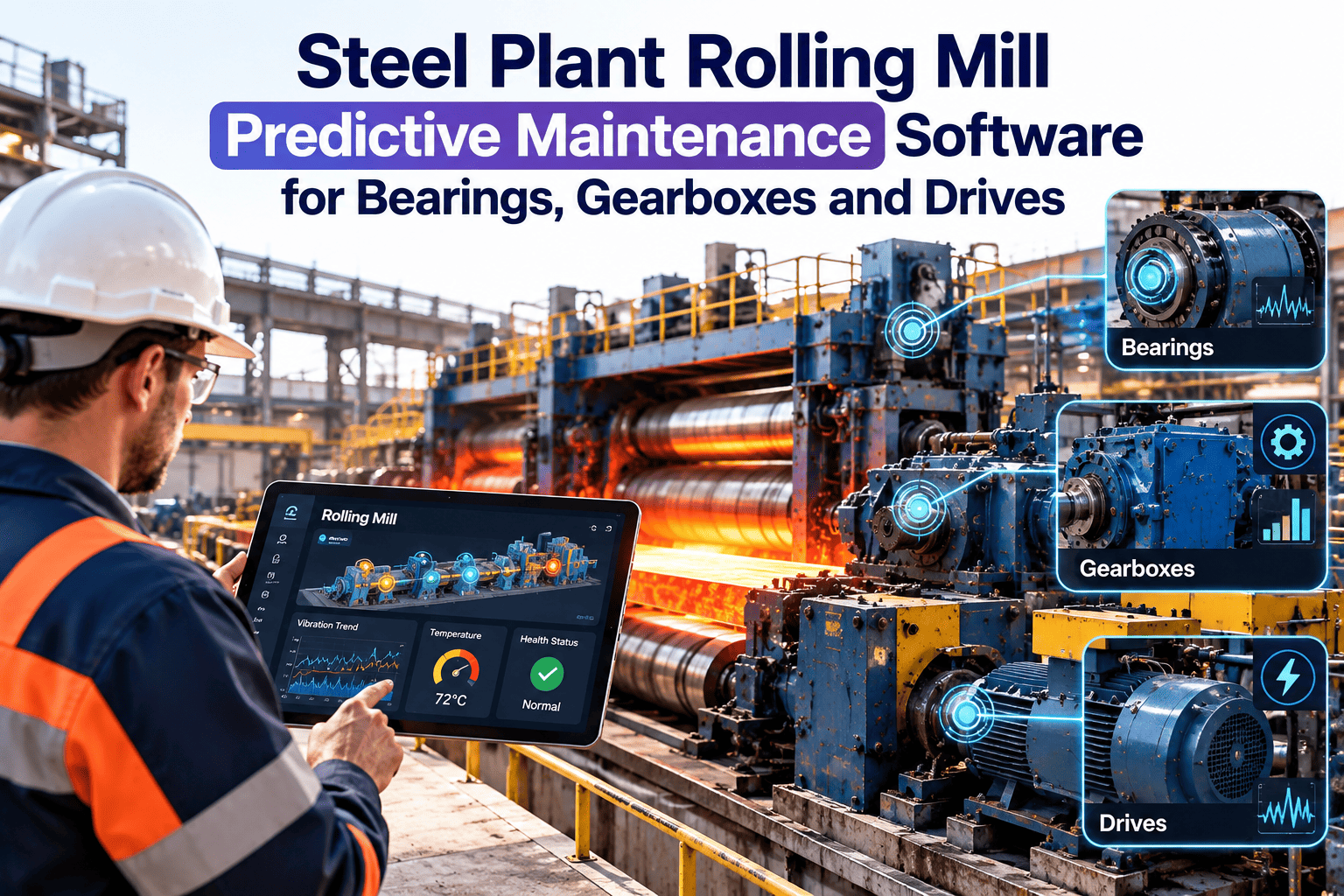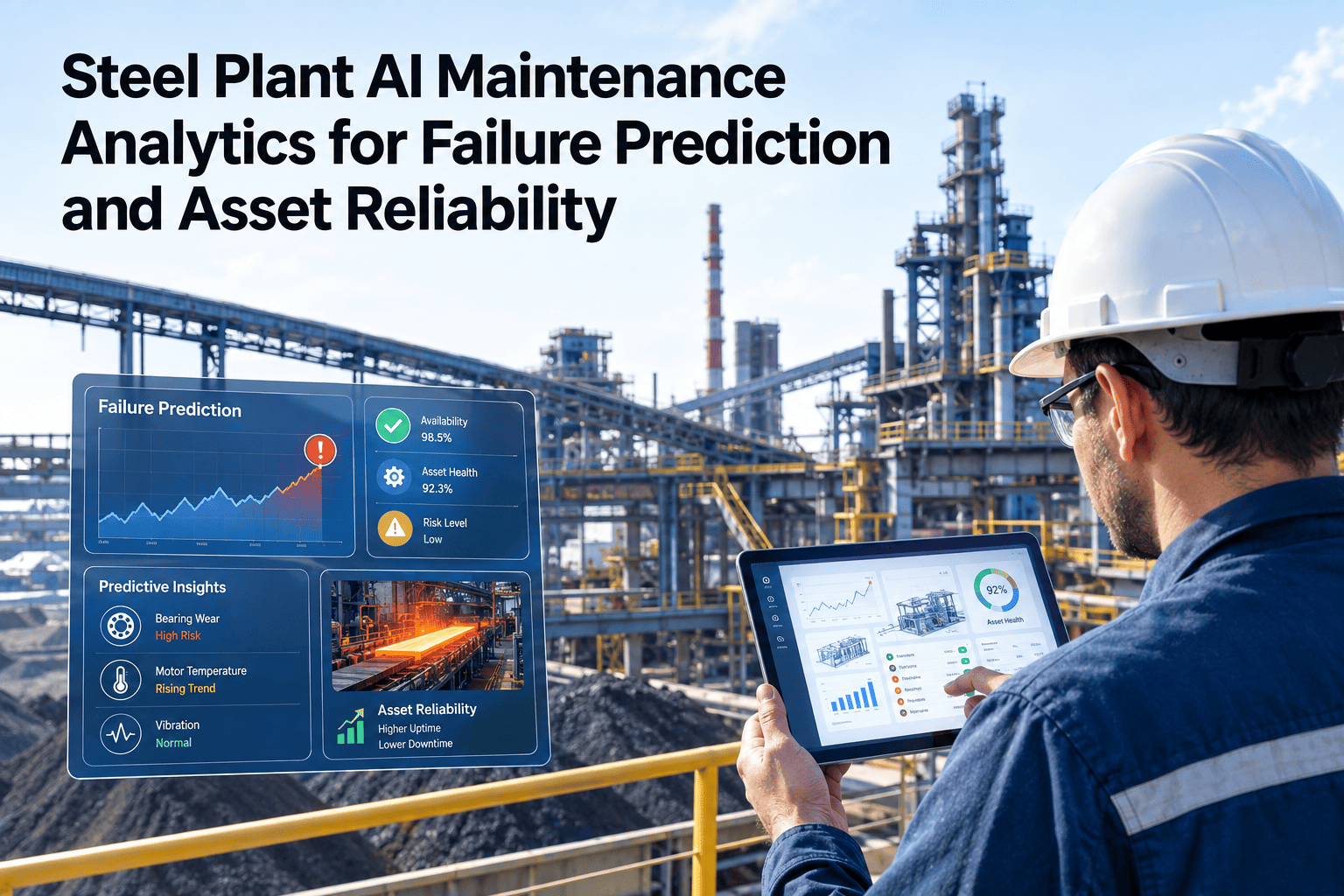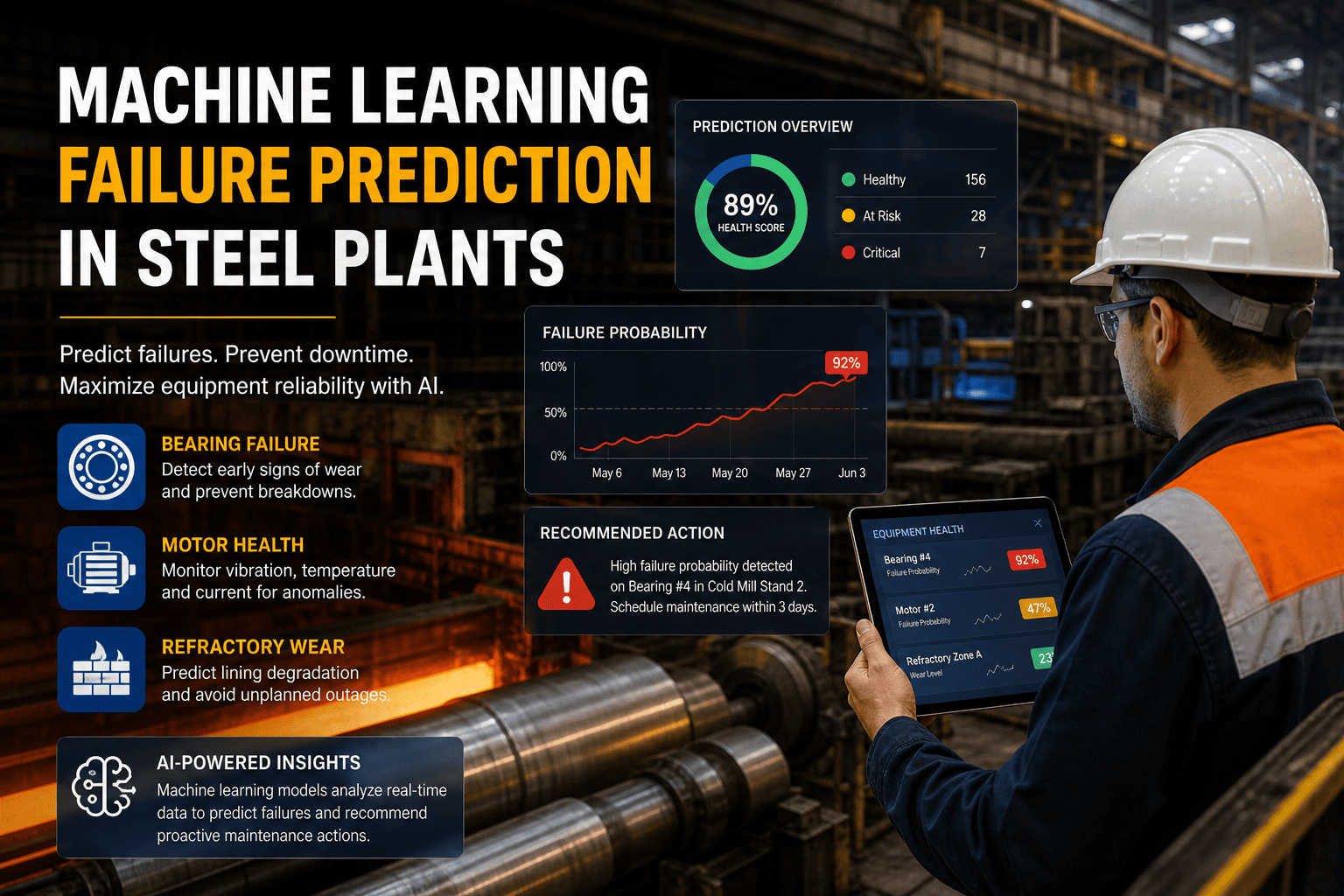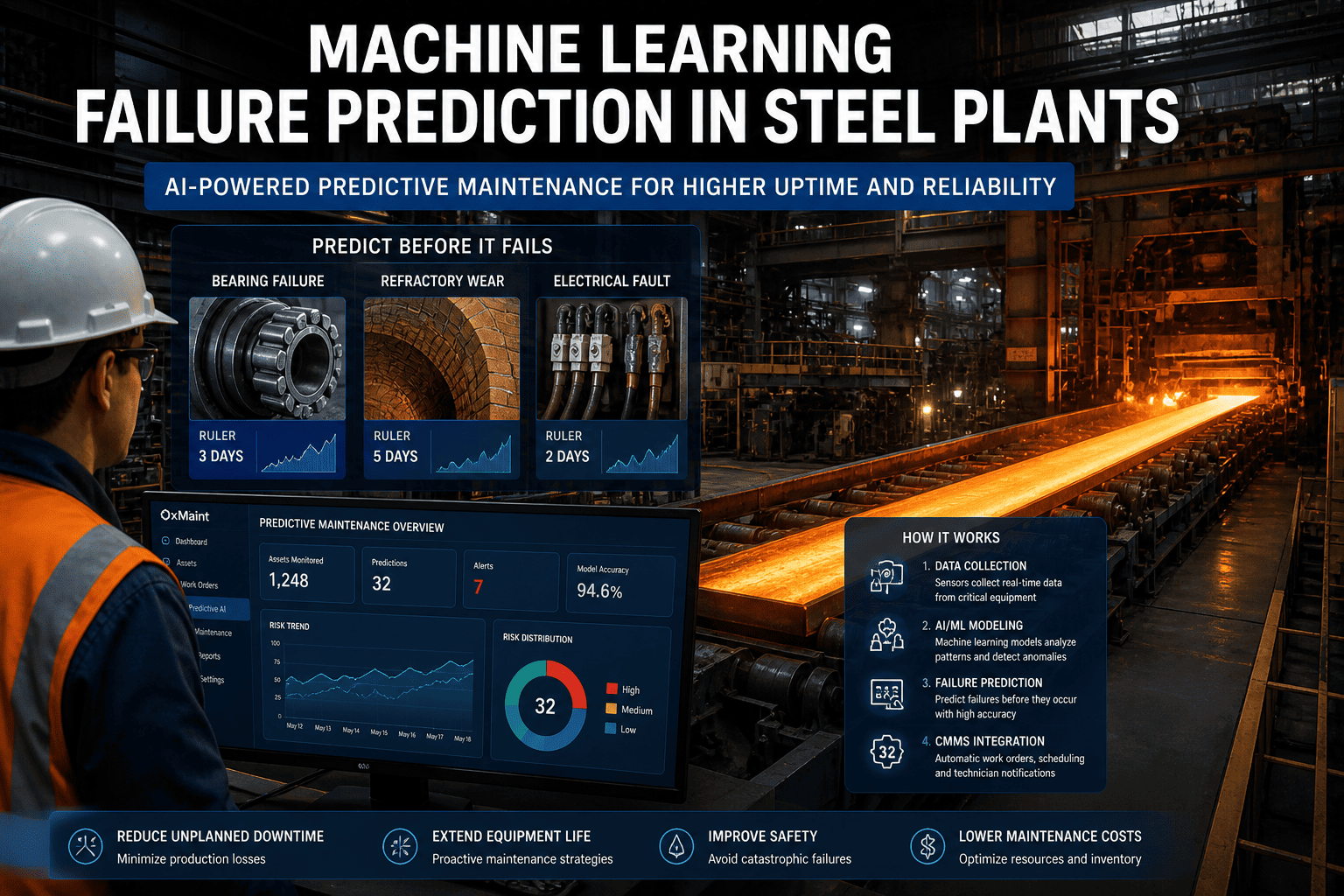
Steel plants lose an average of $1.4 million per hour of unplanned downtime. Traditional time-based maintenance schedules miss 42% of failures because they ignore real operating conditions. Machine learning failure prediction changes this by learning from your plant's own failure history — bearing degradation patterns, refractory wear curves, and electrical fault signatures — and alerting maintenance teams days before breakdown, not seconds after.
Industry 4.0 · Predictive Maintenance AI
Machine Learning Failure Prediction in Steel Plants
Predict Bearing Failures · Refractory Wear · Electrical Faults — Before They Stop Production
87%
Bearing failure detection accuracy
14 days
Average advance warning window
35%
Reduction in unplanned stoppages
$2.8M
Avg. annual savings per plant
Why Traditional Maintenance Fails at Scale
Reactive / Time-Based
Fixed PM intervals ignore actual wear rates
Failures discovered during production, not before
Same schedule for lightly loaded and overloaded equipment
No pattern recognition across similar assets
MTBF calculated monthly — too late to act
ML Failure Prediction
Models adapt to actual operating conditions
Alerts generated 7–21 days before predicted failure
Asset-specific degradation curves per equipment class
Cross-fleet learning from every failure event
Live anomaly scores updated every work order cycle
The 3 Failure Types ML Predicts Most Reliably in Steel
01
Bearing Degradation
Rolling mill drives · Ladle cranes · Caster pinch rolls
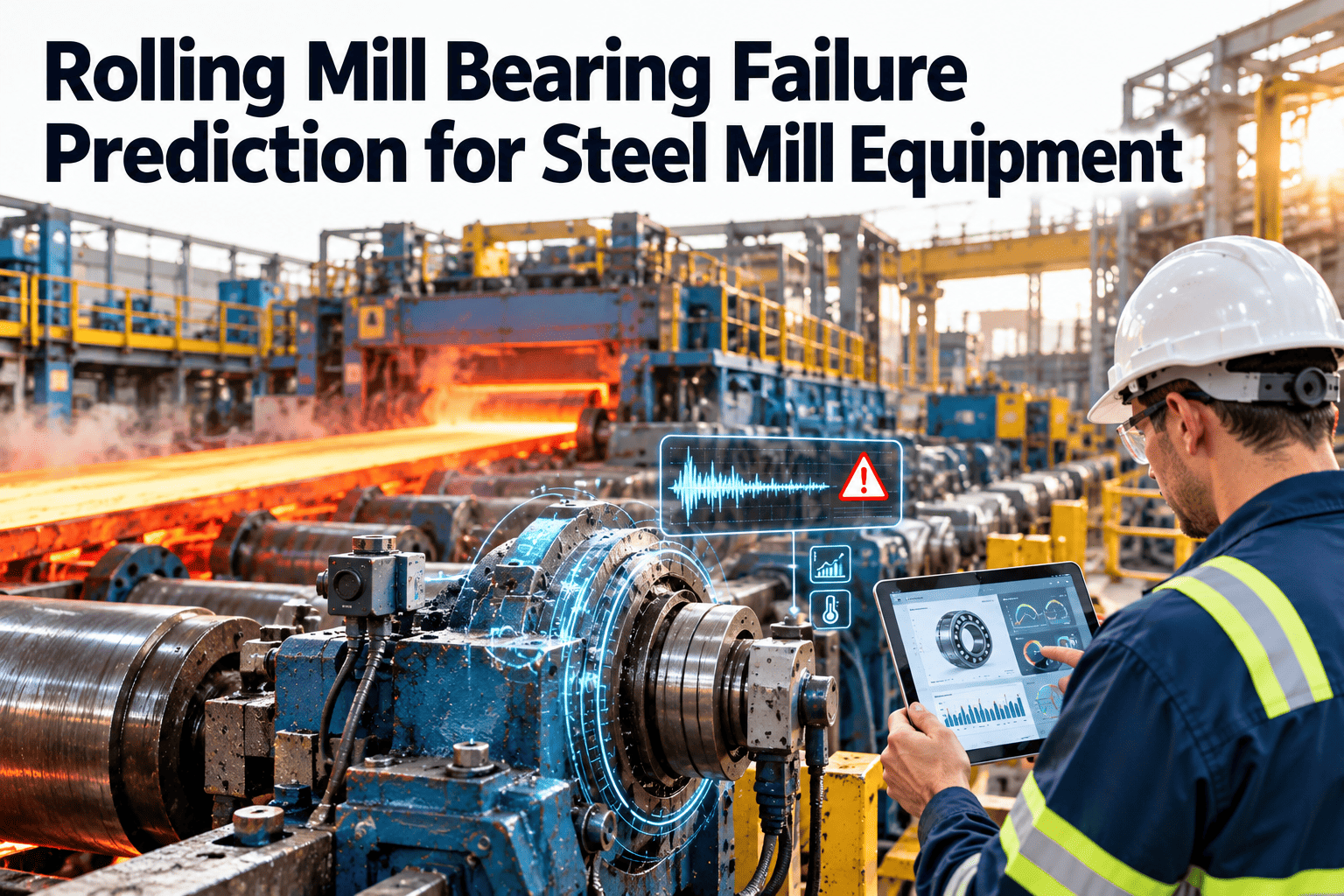
Vibration spectral analysis detects bearing defect frequencies 10–21 days before failure. ML models trained on your plant's bearing history identify which frequency signatures historically led to emergency replacements vs. planned interventions. OxMaint integrates these alerts directly into work order generation — no sensor data stays siloed in a separate system.
10–21 days
average advance warning
02
Refractory Wear
Blast furnace linings · Torpedo ladles · Tundish
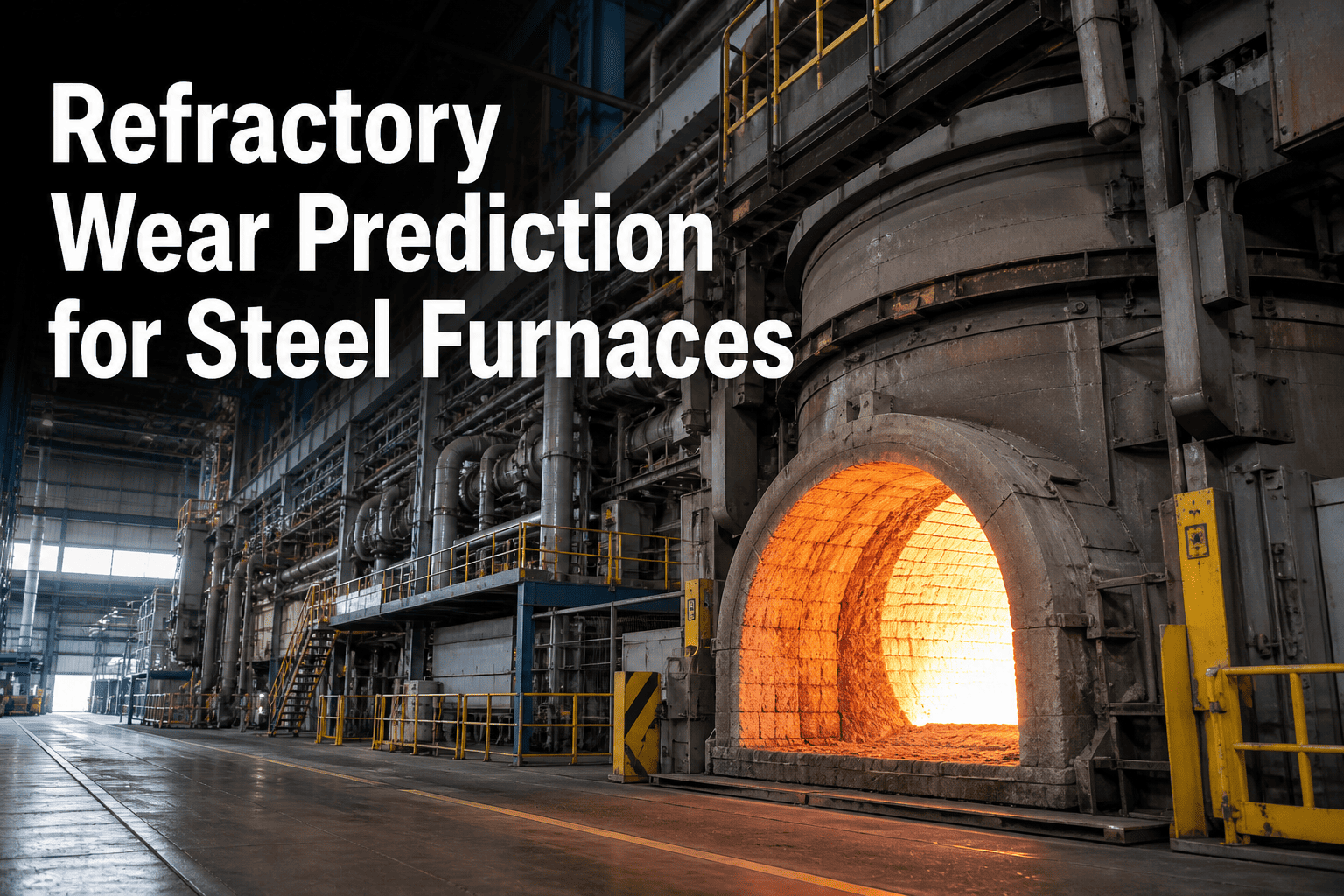
Thermal imaging and campaign-length data train regression models that predict remaining refractory life within ±3% accuracy. Steel plants using ML refractory prediction eliminate emergency relining campaigns — the most expensive single maintenance event — by scheduling interventions at optimum lining thickness, not after failure or at fixed campaign lengths.
±3%
remaining life prediction accuracy
03
Electrical Fault Detection
Drive systems · Transformer banks · Motor windings
Current signature analysis and power quality monitoring identify stator winding faults, rotor bar defects, and insulation degradation before they trip production. ML classifiers distinguish normal operational variations from fault signatures with 91% precision — critical in steel where a single drive failure on a continuous caster stops the entire line.
91%
electrical fault classification precision
See How OxMaint's ML Predictions Connect to Real Work Orders
Every prediction generates a work order, assigns a technician, and tracks resolution — automatically. No data stays in a dashboard that nobody acts on.
How ML Models Are Built from Your CMMS Data
1
Historical Work Order Ingestion
3–5 years of closed work orders provide failure timestamps, failure modes, asset identifiers, and repair durations. OxMaint structures this data into training-ready feature sets — no data science team required.
→
2
Feature Engineering per Asset Class
Operating hours since last PM, failure frequency trend, ambient temperature correlation, and production load variables are computed per asset — blast furnace, caster, and rolling mill models trained separately.
→
3
Model Training and Validation
Gradient boosting and LSTM models are validated against held-out historical failures. Precision and recall metrics are reviewed with your reliability team before deployment — no black-box alerting.
→
4
Live Alert to Work Order
When a prediction crosses the alert threshold, OxMaint automatically generates a work order, categorises it by urgency, and assigns it to the relevant technician — the entire prediction-to-action loop is closed within the CMMS.
Real Performance Data — Steel Plant ML Deployment Results
| Asset Class | Failure Type | Prediction Lead Time | Detection Accuracy | Cost Avoidance / Event |
|---|---|---|---|---|
| Rolling Mill Drives | Bearing degradation | 14–21 days | 89% | $180,000–$420,000 |
| Blast Furnace Lining | Refractory wear | 30–60 days | 94% | $800,000–$2,100,000 |
| Continuous Caster | Roller misalignment | 7–10 days | 81% | $240,000–$600,000 |
| EAF Transformer | Insulation degradation | 21–35 days | 91% | $350,000–$900,000 |
| Ladle Crane | Wire rope fatigue | 5–8 days | 78% | $90,000–$200,000 |
"
We deployed ML failure prediction on our F2 and F3 finishing stands first because they had the richest work order history — eight years of closed WOs in OxMaint. Within the first six months, the model predicted four bearing failures with an average 16-day lead time. Every single one was scheduled and repaired during planned downtime windows. Prior to ML, two of those failure modes had historically caused emergency stops. The critical step people miss is that the prediction is worthless unless it immediately creates a work order that gets acted on. That closed loop between the model output and the maintenance team's daily task list is what actually delivers the ROI.
Dr. Priya Anantharaman, B.Tech (Metallurgy), M.Tech (Industrial Engineering), PhD (Reliability Systems)
Senior Reliability Engineer — JSW Steel (Vijayanagar) · 16 Years Steel Manufacturing Maintenance · Specialist in CMMS-integrated predictive analytics and ML-driven maintenance programme design
Frequently Asked Questions
Do we need IoT sensors installed before ML failure prediction can start?
No. OxMaint's ML models begin with work order history data — failure timestamps, failure codes, asset identifiers, and repair durations that your team already captures. Sensor integration adds real-time signal data on top of this foundation but is not required to generate initial failure predictions. Most steel plants see their first actionable predictions within 60–90 days of CMMS data onboarding, with model accuracy improving as more failure events are logged. Start your free trial to see which assets have enough history to begin prediction today.
How does the ML model stay accurate as equipment conditions change over time?
OxMaint's models are retrained on a rolling 90-day window of confirmed failure events — every time a predicted failure is confirmed or a missed failure is logged, the model updates its weighting. This continuous retraining means the models adapt to production volume changes, equipment age progression, and process chemistry changes without manual recalibration. Your reliability engineers receive a monthly model performance report showing precision and recall trends, so accuracy is always visible and never a black box. Book a demo to see how model retraining is configured for steel plant asset classes.
What happens when the ML model generates a prediction — who sees it and what action is taken?
Every prediction above the configured confidence threshold automatically generates a work order in OxMaint, classified by urgency level and assigned to the relevant asset's responsible technician or reliability engineer. The work order includes the predicted failure type, estimated time to failure window, and recommended inspection steps derived from previous similar failure resolutions. The maintenance manager dashboard shows all active predictions alongside their confidence scores and scheduled resolution status — so no prediction is ever acknowledged and forgotten. Explore how prediction-to-work-order automation works in OxMaint.
How long does it take to see ROI from ML failure prediction in a steel plant?
Plants with 3 or more years of structured CMMS history typically see their first confirmed prediction-avoidance within 90–120 days of model deployment. Full ROI — measured as cost of avoided failures versus total system cost including implementation — is typically achieved within 8–14 months. The fastest returns come from high-cost, high-frequency failures: rolling mill bearing replacements and refractory relining campaigns, where a single avoided emergency event often exceeds the annual platform cost. Book a demo to see an ROI projection built from your plant's asset profile.
OxMaint · Predictive Maintenance AI
Your Work Order History Is Already a Failure Prediction Dataset. OxMaint Activates It.
Every closed work order in OxMaint trains the ML model that predicts your next bearing failure, refractory wear event, or electrical fault — automatically, without a data science team.