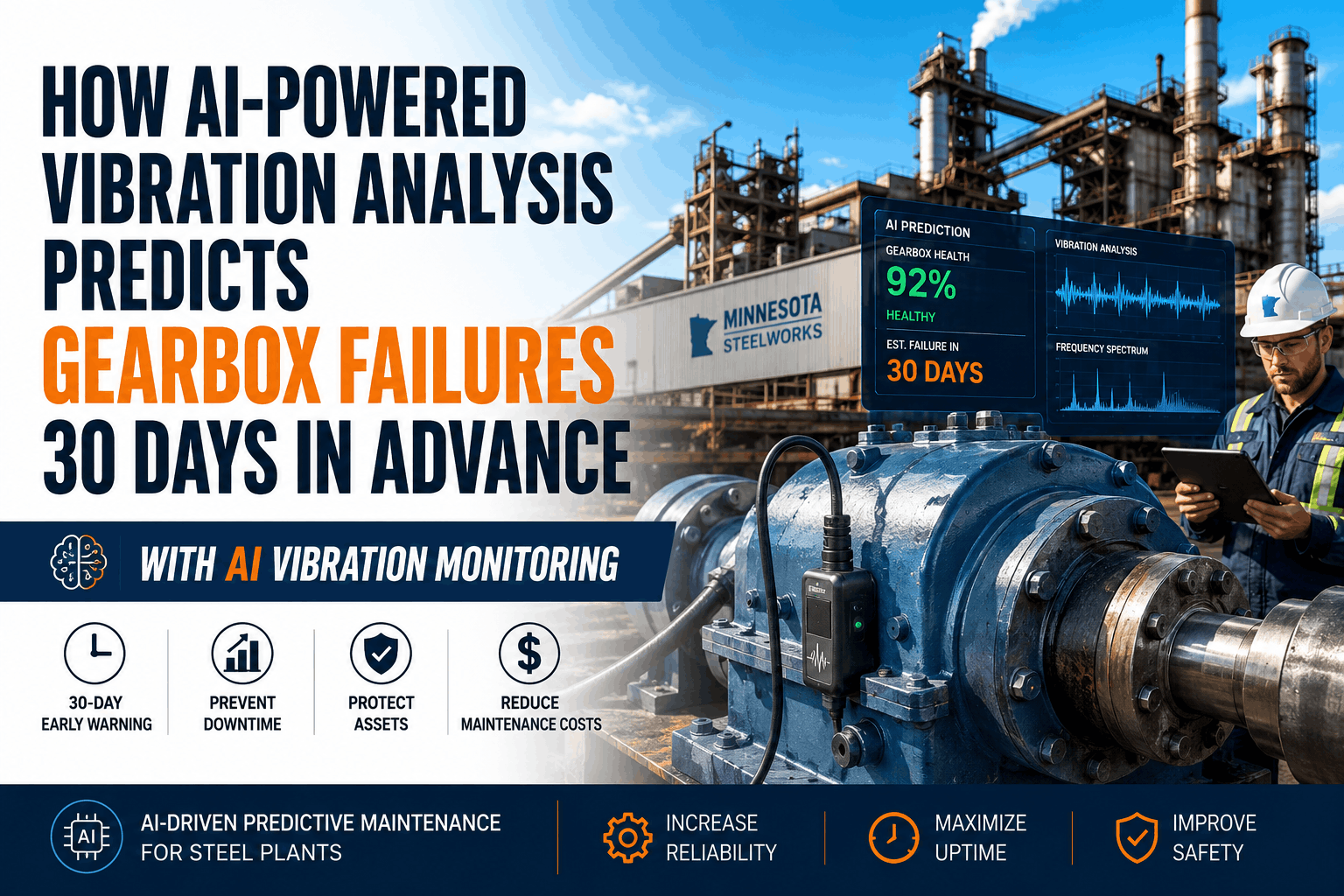
How AI-Powered Vibration Analysis Predicts Gearbox Failures 30 Days in Advance
By Alex Jordan on June 26, 2026
A cracked bearing race, a fractured gear tooth, or a shaft running progressively out of alignment — each generates a distinct vibration signature that appears in sensor data 30–90 days before the equipment fails catastrophically. AI-powered vibration analysis interprets these signals with machine learning trained on thousands of failure patterns, translating raw mechanical noise into predictive intelligence that enables maintenance planners to schedule corrective work during planned maintenance windows rather than responding to unplanned shutdowns costing $260,000 per hour or more. At major U.S. steel mills, vibration monitoring integrated with CMMS workflows has reduced bearing failure incidents by 70% while extending equipment life 25–40%, delivering ROI ratios of 10:1–25:1 within the first 24 months of deployment.
PREDICTIVE MAINTENANCE · TECHNICAL GUIDE · 2026
How AI-Powered Vibration Analysis Predicts Gearbox Failures 30 Days in Advance
Detect bearing defects, gear misalignment, and lubrication failures before failure occurs — automatically convert vibration alerts into scheduled CMMS work orders 30–90 days before catastrophic breakdown, eliminating emergency repair costs and unplanned downtime.
Every rotating machine — motor, pump, gearbox, turbine — generates vibration as a byproduct of normal operation. When components are healthy, vibration patterns are stable and predictable. Machine learning trained on failure databases recognizes these patterns and forecasts remaining useful life — the point-of-no-return when the component must be replaced to prevent failure.
How It Works
The Vibration-to-Action Pipeline
1
Sensor Data
Capture 6–12× daily
→
2
AI Analysis
ML detects deviation
→
3
Classification
Identify fault type
→
4
RUL Forecast
30–90 day prediction
→
5
Work Order
Auto in CMMS
Six Critical Fault Types Detected
Bearing Outer Race
High-frequency spikes
Detection 45–90 days before failure
Gear Tooth Crack
Impulses at mesh freq
Detection 30–60 days before fracture
Shaft Misalignment
1× & 2× speed peaks
Detection 60–120 days advance
Lubrication Breakdown
Broadband noise increase
Detection 30–45 days before seizure
Rotor Imbalance
1× running speed dominant
Detection 75–120 days advance
Foundation Looseness
Speed & sub-harmonics
Detection 45–90 days advance
AI vs. Traditional Monitoring
Capability
Threshold-Based
AI-Powered
Baseline Learning
Fixed thresholds regardless of age
Individual baseline established first 4–8 weeks
Early Detection
2–3 week delay after degradation starts
30–90 day advance warning from baseline deviation
False Alarms
Alert fatigue from process variations
Learns context; <2% false alarm rate
Fault Classification
Generic "vibration high" alert
Auto identifies fault type & action
RUL Forecast
No prediction capability
80%+ accuracy within 60 days
CMMS Integration
Manual work order creation
Auto work orders 60 days before failure
Deployment Architecture
Sensor Placement
Strategic Points
Install on bearing housings & gearbox casings
Optimal placement captures maximum signal energy from fault monitoring.
Baseline Learning
4–8 Weeks
ML develops signature of healthy equipment
By week 6, 95%+ confidence in detecting anomalies.
Anomaly Detection
Real-Time
Each data point scored against baseline
Forecasts when component reaches failure threshold.
CMMS Integration
Automated
RUL triggers work order creation
Work orders appear 60 days before predicted failure.
"
We deployed vibration monitoring on our hot mill bearing housings in Q3 2024. Within 8 weeks, the system detected a spalling condition with 67 days before predicted failure. That one early detection paid for the entire monitoring system investment — the alternative would have been a $1.4M unplanned downtime event.
Maintenance Director — Hot Strip Mill, Pennsylvania, USA
ROI Analysis
When Does It Pay for Itself?
$250K–$400K
Annual investment for 20–30 assets
$2M–$8M
Annual cost avoidance
10–30×
ROI ratio by Year 1
One avoided failure ($500K–$2M) justifies the entire annual investment