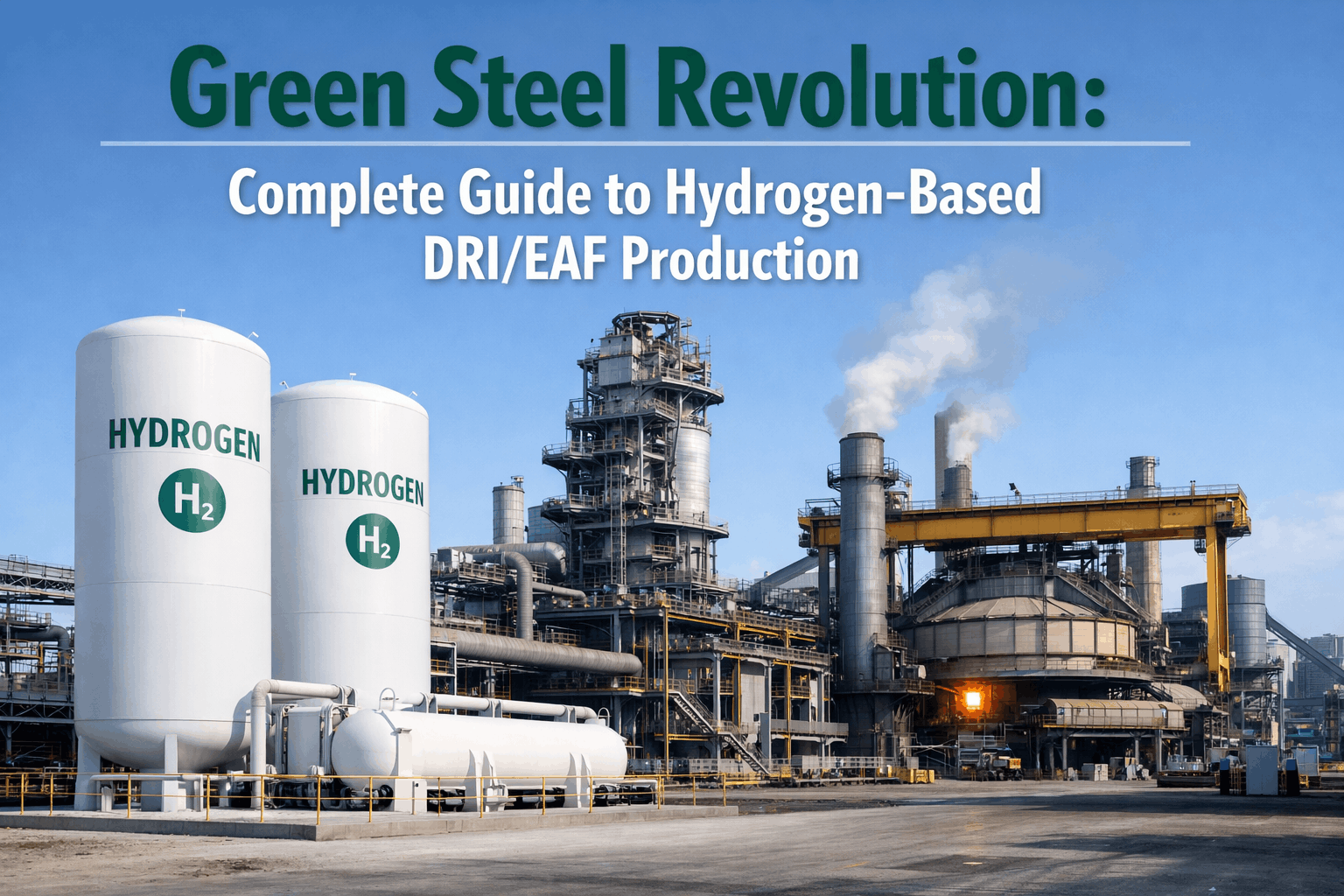
Green Hydrogen Steel Plants: Maintenance and Safety Challenges
By James Smith on April 27, 2026
The transition to hydrogen-based steelmaking — replacing coking coal with green hydrogen in direct reduction ironmaking — is the most significant change in steelmaking process technology in 70 years. It is also the most significant change in steel plant maintenance engineering in the same period. Hydrogen is not simply a different fuel or reductant: it is a substance with physical properties that create failure modes, safety hazards, and maintenance requirements that conventional steel plant maintenance programmes are not designed to address. Hydrogen embrittlement degrades high-strength structural steel over time in ways that are invisible to visual inspection. Hydrogen leaks are colourless, odourless, and ignite at 4% concentration — lower than methane, and with a flame that is invisible in daylight. Managing a hydrogen steel plant without a compliance tracking system designed around these specific hazards is not just an operational risk — it is a safety and regulatory exposure that grows with every operating hour. Book a demo to see how OxMaint's Compliance Tracking manages hydrogen leak monitoring schedules, embrittlement inspection programmes, and safety documentation for hydrogen-based steelmaking facilities.
Next Generation SteelmakingCompliance Tracking
Green Hydrogen Steel Plants: Maintenance & Safety Challenges
Hydrogen embrittlement inspection, leak detection maintenance, ATEX compliance, DRI reactor monitoring, and safety management systems for H2-based direct reduction and electric arc furnace steelmaking facilities.
Permeation rate4× faster than methane through materials
Embrittlement riskHigh-strength steels (>690 MPa) in H₂ environments
01 — H₂ Embrittlement
02 — Leak Detection
03 — DRI Reactor PM
04 — ATEX Compliance
05 — Safety Management
Section 01
Hydrogen Embrittlement: The Slow Failure Mode That Visual Inspection Cannot Detect
Hydrogen embrittlement (HE) is the degradation of mechanical properties — particularly fracture toughness and fatigue crack growth resistance — in high-strength steels exposed to hydrogen over time. In a hydrogen steel plant, structural elements, pressure vessels, piping, and fasteners operating in high-pressure hydrogen environments are subject to hydrogen absorption that progressively reduces the material's ability to tolerate stress concentration. The characteristic failure mode is sudden brittle fracture at loads well below the material's rated tensile strength — with no preceding plastic deformation, and no visual indication that the material has been compromised.
Most Susceptible Materials
High-strength steels >690 MPa yield strength
Quenched and tempered structural steels
High-strength fasteners (Grade 10.9, 12.9)
Martensitic and precipitation hardened stainless
Weld heat-affected zones in high-strength materials
Acoustic emission monitoring — detects active crack growth
Hardness testing — identifies heat-affected zones at elevated risk
Inspection Programme Structure
Baseline inspection before H₂ service — full PAUT of all susceptible welds and components
Annual PAUT re-inspection of all H₂-wetted high-strength structural elements
Fastener replacement programme — all Grade 10.9+ fasteners in H₂ zones on defined cycle
Weld quality documentation — all new welds in H₂ service require pre-heat and post-weld heat treatment records
OxMaint: Inspection records per component with NDT report attachment and next inspection date tracking
Section 02
Hydrogen Leak Detection: Maintenance of the Invisible Hazard Management System
A hydrogen leak detection system that is not functioning is not a passive condition — it is an active hazard. Because hydrogen is colourless and odourless, the leak detection system is the only mechanism by which a developing hydrogen release in a confined or semi-confined area will be identified before it reaches a flammable or explosive concentration. The maintenance programme for H₂ detection equipment must be treated with the same criticality as a fire suppression system: if it fails, the consequence of the next process event is unmitigated.
Detection Technology
Application in H₂ Steel Plant
PM Interval
Calibration Requirement
OxMaint Compliance Trigger
Catalytic bead (pellistor) sensors
General area monitoring — process buildings, compressor rooms, DRI reactor area
Monthly bump test; 6-month full calibration
Certified H₂ calibration gas; record calibration factor and response time per sensor
Monthly work order per sensor; failure to complete flags zone as unmonitored
Thermal conductivity sensors
High-concentration H₂ environments where catalytic sensors are saturated — DRI reactor off-gas, H₂ storage areas
Quarterly calibration; annual sensor replacement
Two-point calibration with N₂ and certified H₂ blend; cross-sensitivity check
Quarterly PM work order; annual replacement triggered by sensor age counter
Electrochemical sensors
Low-concentration precision monitoring — confined space entry points, control room perimeter
3-month calibration; sensor replacement on sensitivity loss >20%
Factory-calibrated; field bump test monthly; replacement at sensitivity threshold
Sensitivity trend monitoring; replacement work order at 20% sensitivity loss
Open-path laser (TDLAS)
Outdoor H₂ storage farms, pipeline corridors, areas impractical for fixed point sensors
Monthly mirror clean and alignment check; 6-month full system test
Quarterly instrument calibration; weekly route survey in pressurised zones
Reference leak source calibration; microphone sensitivity test
Weekly route work order; any detected indication triggers immediate isolation work order
Compliance gap risk: Any H₂ detection sensor that is overdue for calibration or bump testing creates a documented zone of unmonitored H₂ hazard. Under IEC 60079-29-2 and EN 50271, detection system maintenance records are subject to regulatory inspection. OxMaint generates a compliance dashboard showing the calibration status of every detection sensor in the plant — zones with overdue sensors are flagged immediately, not discovered at annual inspection.
The direct reduction reactor operating on 100% hydrogen (or H₂/N₂ blends during transition operations) presents maintenance challenges specific to the hydrogen environment — different from natural gas DRI reactors in material compatibility, pressure containment requirements, and the failure modes that must be monitored. The following covers the maintenance requirements specific to H₂-based DRI reactor operation beyond the standard DRI PM programme.
Reactor Pressure Vessel
H₂ service material compatibilityAll vessel materials must be verified against Nelson curves (API 941) for H₂ partial pressure and operating temperature — standard DRI vessel materials may require upgrading for 100% H₂ operation at elevated pressure
Weld inspection intervalAnnual PAUT of all pressure-retaining welds in H₂ service — more frequent than natural gas DRI due to hydrogen embrittlement risk in weld HAZ; all inspection records maintained in OxMaint per weld joint
Flange and gasket managementH₂ service flanges require metal spiral-wound or ring-type joint gaskets — PTFE and soft-face gaskets have higher permeation rates; all gasket replacements documented with material grade and torque records
H₂ Recirculation Compressors
Seal system PMDry gas seals on H₂ compressors require quarterly seal gas flow verification, annual seal cartridge inspection, and buffer gas system function test — seal failure allows H₂ release at compressor casing
Valve and check valve conditionNon-return valves on H₂ compressor discharge must be inspected semi-annually — NRV failure causes reverse flow and potential H₂ migration into non-rated equipment
Vibration monitoringH₂ recirculation compressors monitored continuously with OxMaint condition monitoring integration — bearing fault detection at 3–6 weeks lead time prevents unplanned H₂ system shutdown
Piping System Integrity
Pipe-to-soil corrosion (buried lines)Cathodic protection system annual testing for all buried H₂ piping — hydrogen can cause cathodic corrosion products to generate nascent hydrogen at pipe surface, accelerating embrittlement
Expansion joint and bellowsAll expansion joints in H₂ service inspected quarterly for corrosion, fatigue cracking, and liner condition — bellows failure is a significant H₂ release source in DRI reactor connections
Pipe support and hangersAnnual inspection of all spring hangers and constant-load supports on H₂ piping — load variation from pipe weight changes (insulation loss, pipe scale) increases stress concentration at elbows and tees
H₂ detection calibration compliance, embrittlement inspection schedules, and DRI reactor PM — all in one compliance tracking platform that documents every safety-critical maintenance event.
ATEX Compliance and Electrical System Maintenance in H₂ Zones
Hydrogen has a wider flammability range (4–75%) than any common industrial gas, and its low minimum ignition energy (0.017 mJ versus 0.28 mJ for methane) makes it ignitable by electrostatic discharge sources that would not ignite natural gas. All electrical equipment in zones where H₂ may be present must be rated for Zone 1 or Zone 2 ATEX classification (or NEC Class I Division 1/2 equivalents), and that equipment requires a maintenance programme that verifies the ATEX certification remains valid and the equipment condition has not compromised its explosion protection.
01
Equipment Register Maintenance
Every electrical or instrumentation device installed in a classified H₂ zone must be registered with its ATEX/IECEx certificate number, protection concept (Ex d, Ex e, Ex ia, etc.), temperature class, and installation date. OxMaint maintains this register per asset with certificate expiry alerts — ATEX certificates must be current, and equipment installed before the H₂ zone classification was established must be verified as suitable for H₂ (Group IIC) service, not just gas group IIA or IIB.
02
Zone Classification Review After Plant Modifications
Any modification to H₂ piping, equipment layout, or ventilation that changes the size or shape of an H₂ hazardous zone requires a zone classification review under IEC 60079-10-1 before the modification is commissioned. Equipment previously outside a classified zone that falls inside the revised zone boundary must be replaced with ATEX-rated equivalents before H₂ service resumes. OxMaint's change management workflow ensures zone reclassification review is triggered by any relevant maintenance work order scope before work commences.
03
Ex Equipment Periodic Inspection
IEC 60079-17 requires periodic inspection of all installed Ex equipment on a risk-based schedule — typically annual detailed inspection plus visual checks at shorter intervals for Zone 1 equipment. Each inspection must be performed by a CompEx-qualified (or equivalent) inspector and documented with the equipment serial number, inspection category (visual, close, detailed), and any deficiencies found. OxMaint schedules Ex equipment inspection work orders per asset with CompEx qualification requirement on the work order and inspection report attachment at closure.
04
Earthing and Bonding Continuity
Electrostatic discharge is a significant H₂ ignition source given its 0.017 mJ minimum ignition energy. All conductive items in H₂ zones — equipment casings, pipework, flanges, flexible hoses — must be bonded and earthed, with continuity verified at least annually. Resistance measurement records per bonding point are maintained in OxMaint and provide the audit trail required under EN 60079-32-1 electrostatic hazards standard for H₂ environments.
Section 05
Safety Management System: Compliance Documentation for H₂ Steel Plants
Hydrogen steel plants operating under the EU Seveso III Directive, UK COMAH regulations, or equivalent major hazard facility regulations are subject to a Safety Management System (SMS) requirement that goes beyond conventional industrial plant safety management. The SMS must demonstrate that all hazards — including hydrogen release, fire, explosion, and embrittlement — are identified, assessed, and controlled through documented procedures with evidence of execution. Maintenance records are a central SMS evidence source: they demonstrate that the control measures identified in the hazard analysis are being implemented at the frequency and to the standard specified.
01
Process Hazard Analysis (PHA) Integration
Every H₂ system maintenance task must trace back to a control measure identified in the PHA (HAZOP or LOPA) for the relevant process node. OxMaint maintenance tasks are linked to PHA references — when a maintenance task is deferred, the system generates a risk assessment requirement to confirm the PHA-identified control measure is still effective during the deferral period.
02
Permit-to-Work for H₂ Environments
All maintenance work in H₂ zones requires a hot work or cold work permit with H₂-specific safety measures: atmospheric test before entry, continuous monitoring during work, ATEX tool requirement confirmation, and defined H₂ emergency response procedure. OxMaint's permit-to-work integration manages H₂ zone permit issuance and closure, preventing permit-free entry and ensuring every H₂ zone maintenance event has complete permit documentation.
03
Competency Records for H₂ Work
Technicians performing maintenance in H₂ zones must hold current H₂ hazard awareness training, confined space entry certification where applicable, and CompEx qualification for Ex equipment work. OxMaint tracks qualification status per technician and prevents assignment to H₂ zone work orders where a required qualification has expired — the work order cannot be accepted by an unqualified technician.
04
Incident and Near-Miss Recording
SMS regulations require documented near-miss and incident recording with investigation and corrective action for all H₂-related events. A H₂ detector activation, an unexpected H₂ concentration reading during maintenance, or a seal leak at a compressor are all near-miss events that must generate investigations traceable to corrective actions. OxMaint's corrective action module manages H₂ near-miss investigations from initial report through root cause to verified corrective action closure.
"
The maintenance challenge that hydrogen steel plant operators consistently underestimate at the planning stage is not the process technology — the DRI reactors and EAF technology are well-understood. It is the systemic change to maintenance culture and documentation that hydrogen hazard management requires. A natural gas leak in a steel plant is visible, smellable, and immediately actionable. A hydrogen leak is none of those things. The detection system is not a backup to sensory awareness — it is the only early warning. When I say every H₂ sensor calibration record in OxMaint is a safety-critical document, I mean it in exactly the same sense as a fire suppression inspection certificate. The plants that will have safety incidents are the ones that treat H₂ detection maintenance as routine instrumentation work rather than as the primary line of defence it is.
Olusegun Adeyemi, MSc, CEng MIChemE
Process Safety & Reliability Engineering, ArcelorMittal · 17 Years Process Safety Management in Steel & Chemical Industries · Specialist: Hydrogen safety management systems, ATEX compliance in steelmaking, and DRI process hazard analysis for H₂-based direct reduction facilities
Frequently Asked Questions
What is the key difference between maintaining a natural gas DRI plant and a hydrogen DRI plant?
Three primary differences: First, material compatibility — all components must be verified against Nelson curves and hydrogen embrittlement criteria, which are stricter than natural gas service requirements for high-strength steels. Second, leak detection — hydrogen's colourless, odourless nature makes sensor maintenance a safety-critical activity rather than a compliance formality; sensors must be bump-tested and calibrated on shorter intervals than CH₄ systems. Third, ATEX classification — hydrogen (Gas Group IIC) requires more stringent Ex equipment specifications than methane or propane (Group IIA), and all installed Ex equipment must be verified as IIC-rated, not just ATEX-marked. OxMaint's compliance module manages all three requirements in one platform.
How does OxMaint support ATEX Ex equipment maintenance compliance for hydrogen zones?
OxMaint maintains an Ex equipment register per zone with each device's certificate number, protection concept, temperature class, and Group IIC verification. IEC 60079-17 periodic inspection work orders are scheduled per asset with inspection category (visual / close / detailed) and CompEx qualification requirement. Inspection reports attach to the asset record at closure. Any Ex equipment with an overdue inspection is flagged in the compliance dashboard — providing the audit trail required during Seveso, COMAH, or equivalent major hazard facility regulatory inspections. Book a demo to see OxMaint's ATEX compliance module.
Which fasteners and structural components need special attention in hydrogen service?
All fasteners with yield strength above 690 MPa (Grade 10.9 and 12.9 bolts) are susceptible to hydrogen embrittlement in H₂ service and should be placed on a defined replacement cycle rather than inspected-to-life management. Weld HAZ areas in high-strength structural steels require PAUT inspection annually. Expansion joints, bellows, and flexible connections have higher permeation rates and require quarterly visual and ultrasonic inspection. OxMaint tracks component age and inspection history per fastener batch and structural element, with replacement work orders firing at the defined cycle interval regardless of visual condition.