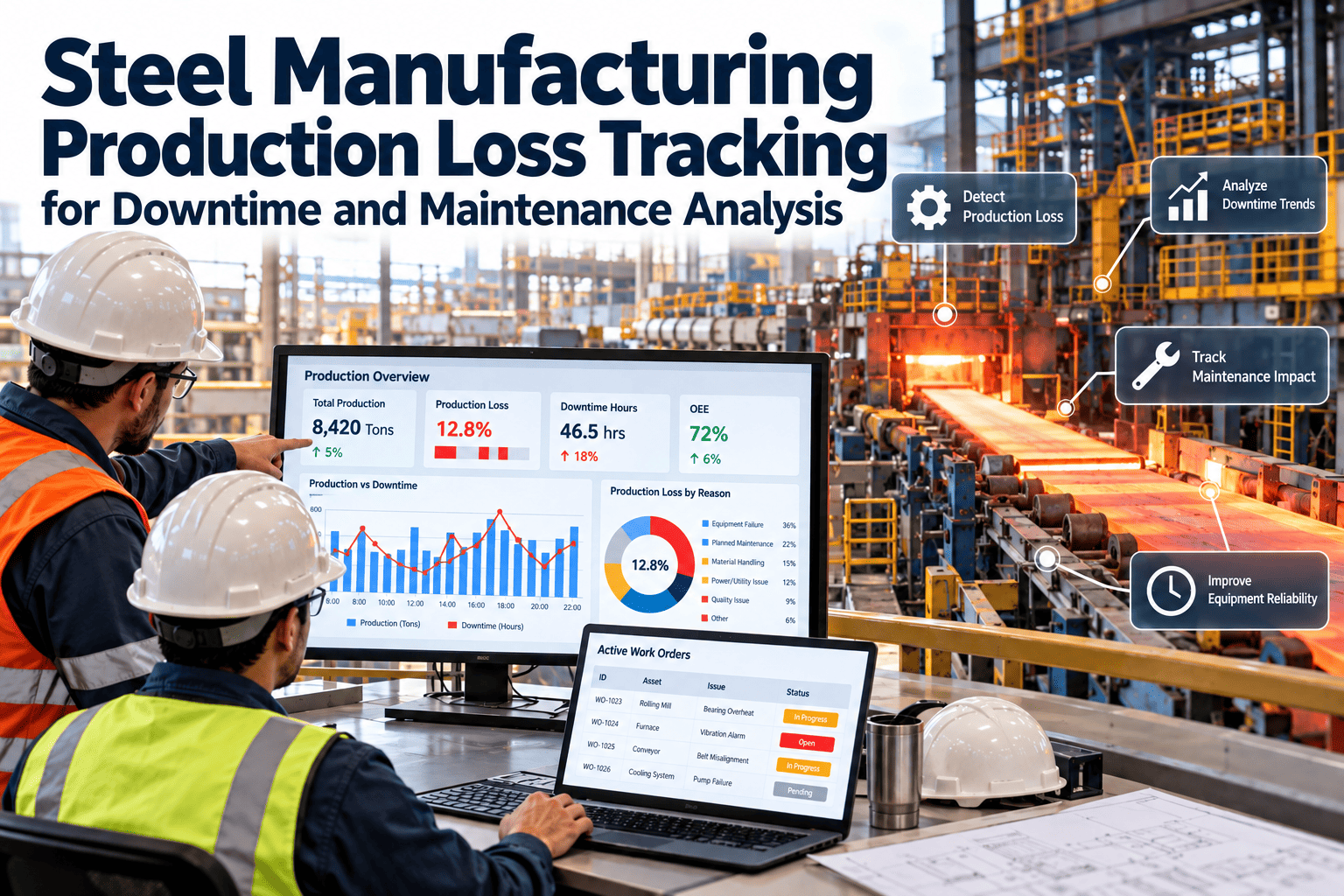
Every OEE percentage point lost in a steel plant has a name, a cause, and a work order that should have been triggered — but wasn't. When a blast furnace cooling pump degrades over two shifts and no anomaly is flagged until production slows, the OEE loss is already logged as an availability event with no corrective action record to show for it. OxMaint's Analytics and Reporting platform changes this by converting OEE loss events — availability losses, performance losses, and quality losses — into prioritised maintenance work orders automatically, closing the gap between what the production dashboard shows and what the maintenance team actually acts on.
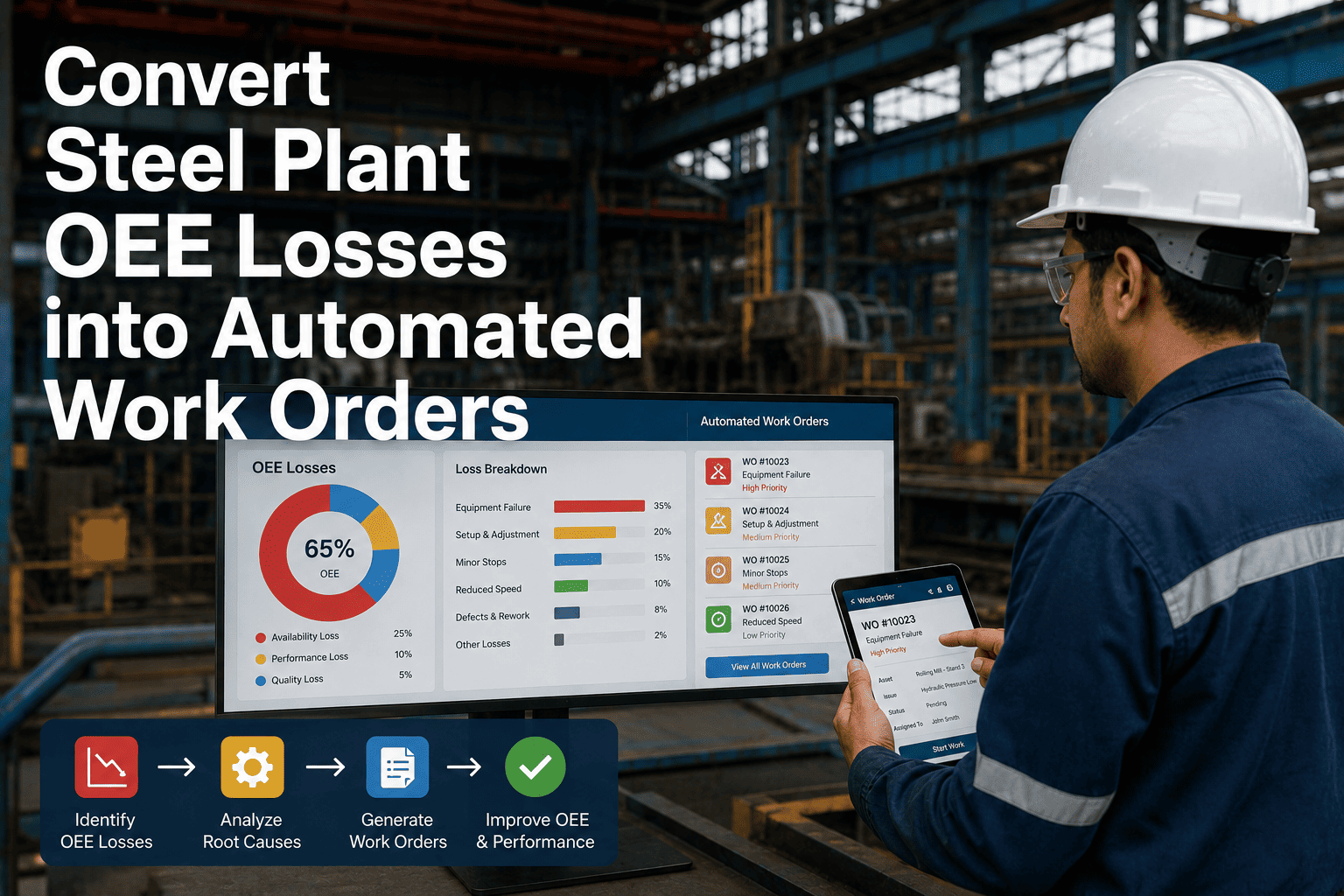
Convert Steel Plant OEE Losses into Automated Work Orders
How a 1.8 MTPA integrated steel plant reduced OEE losses by 31% by connecting its production loss tree directly to OxMaint work order automation — with zero new sensors required.
The Problem — OEE Data Sitting Unused in a Production Dashboard
The steel plant in this case study had a functioning MES system producing daily OEE reports. Rolling mill, blast furnace, and continuous caster losses were categorised, timestamped, and visible to production management. The problem was the gap between the production dashboard and the maintenance team: OEE losses were reviewed in weekly meetings, discussed, and then forgotten — because no work order was ever automatically created from a loss event.
When Rolling Mill Stand 2 showed a 12% performance loss over three shifts, the MES logged it as a speed loss event. No maintenance work order was created. The root cause — worn roll neck bearing — was discovered two weeks later during a physical inspection after a breakdown.
All OEE losses were treated as equal — a 0.3% quality loss on the finishing stand received the same (zero) maintenance response as a 4.1% availability loss on the hot strip mill. Without priority scoring, maintenance resources addressed whatever was visibly broken, not whatever was costing the most.
From the moment an OEE loss event was logged to the moment a maintenance work order was created — if one was created at all — the average lag was 38 hours. This lag meant repeat losses accumulated before any corrective action addressed the root cause.
OEE loss events in the MES had no connection to the asset's maintenance history. A maintenance technician attending a speed loss on the continuous caster had no visibility of the previous two maintenance events, last PM date, or spare parts history — each intervention started from zero context.
Steel Plant OEE Loss Tree — The Three Loss Categories and Their Maintenance Triggers
OEE is a product of three loss categories: Availability, Performance, and Quality. Each category maps to a distinct maintenance root cause profile in a steel plant. OxMaint's analytics engine classifies incoming OEE loss events by category and routes them to the correct maintenance response template automatically.
| OEE Loss Category | Steel Plant Cause Examples | Production Impact | OxMaint Trigger |
|---|---|---|---|
| Availability Loss | Blast furnace tuyere failure, rolling mill coupling breakdown, hydraulic system fault, continuous caster nozzle blockage | Scheduled production hours lost — highest $/hour impact. Typical: $40K–$220K per event | Immediate Priority 1 corrective work order — escalated to maintenance supervisor in under 2 min |
| Performance Loss | Roll neck bearing degradation (speed reduction), reheating furnace temperature uniformity drift, drive motor partial fault, cooling water flow restriction | Reduced throughput — plant running below rated speed or capacity. Typical: $8K–$60K per shift | Priority 2 work order generated — assigned to next available technician with asset history attached |
| Quality Loss | Roll pass misalignment (surface defects), mould level oscillation irregularity, descaling nozzle blockage (scale defects), sensor calibration drift | Off-spec product — downgraded or scrapped. Typical: $15K–$80K per downgrading event | Priority 2 quality-linked work order — sent to quality and maintenance team simultaneously |
OxMaint's Analytics platform connects your existing MES or production historian to its work order engine — no new sensors, no DCS replacement. Book a demo to see the OEE loss-to-work-order workflow live, or start a free trial to connect your production data today.
Before and After — How OEE Loss Management Changed
OEE Improvement Visualised — 12-Month Performance
How OxMaint Converts OEE Losses to Work Orders — 4 Steps
The OEE-to-work-order automation pipeline operates continuously across all connected assets. Each step requires no manual intervention — the maintenance team receives prioritised, context-rich work orders rather than raw alert notifications.
OxMaint connects to the existing MES, historian, or production system via OPC-UA or direct API. Every OEE loss event — availability dip, speed loss, or quality deviation — is captured in real time and classified by category and production impact value.
Each loss event is scored by combining production impact ($/hour), asset criticality rating, and current maintenance backlog. A 4.1% availability loss on the hot strip mill scores higher than a 0.3% quality loss on a secondary processing line — ensuring the maintenance team always acts on what matters most.
A structured work order is created in OxMaint with the asset ID, loss category, priority level, last PM date, open maintenance backlog, and spare parts availability pre-populated. The technician receives a mobile notification with a fully contextualised task — not a blank work order requiring re-investigation.
When the work order is closed, OxMaint compares the asset's post-intervention OEE performance against the pre-event baseline. If OEE recovers to expected levels, the event is closed. If OEE remains degraded, a follow-up work order is auto-generated — ensuring losses are not left unresolved after a single intervention.
Measured Results — 12-Month Summary
| Metric | Baseline (Pre-OxMaint) | Post-OxMaint (12 months) | Improvement |
|---|---|---|---|
| Overall Equipment Effectiveness | 67.4% | 87.8% | +20.4 pts |
| Mean Time to Work Order | 38 hrs | 4.2 hrs | −89% |
| Unplanned Downtime (hrs/quarter) | 58 hrs | 14 hrs | −76% |
| PM Compliance Rate | 43% | 94% | +51 pts |
| Quality Loss Events (off-spec batches/month) | 18 | 4 | −78% |
| Maintenance Cost per tonne | $7.90 | $4.80 | −39% |
| Rolling Mill Bearing MTBF | 980 hrs | 1,840 hrs | +88% |
Your OEE Dashboard Is Already Showing You What to Fix — OxMaint Turns It Into Action
Connect your steel plant's production data to OxMaint's work order automation in days, not months. No new sensors, no DCS replacement. The first automated work order generated from an OEE loss event typically pays for the entire implementation.
Expert Review
The OEE-to-work-order gap is one of the most expensive invisible problems in steel plant operations. Every plant I have worked in has an MES or production system producing daily OEE data — and in every plant, that data is reviewed in a weekly meeting and then filed. The root cause is structural: production and maintenance are managed as separate systems, so a production loss event never automatically creates a maintenance action. The only sustainable way to close that gap is automation — and what OxMaint does by converting OEE loss events directly into prioritised work orders is exactly the integration the industry needs. The 38-hour time-to-work-order figure in this case study is not unusual — I have seen plants where that lag exceeds 72 hours for performance losses that aren't visibly catastrophic. At $8,000–$60,000 per shift of performance loss, that lag is the single most expensive maintenance process failure a steel plant can have.
Frequently Asked Questions
Every OEE Point Your Plant Is Losing Today Has a Work Order That Should Have Been Created
OxMaint connects your production loss data to your maintenance team's daily work schedule — automatically, in real time, with priority scoring that ensures the right asset gets attended first. Start with a free account to connect your first production data source, or book a 30-minute walkthrough to see the OEE-to-work-order pipeline live on a steel plant configuration identical to yours.