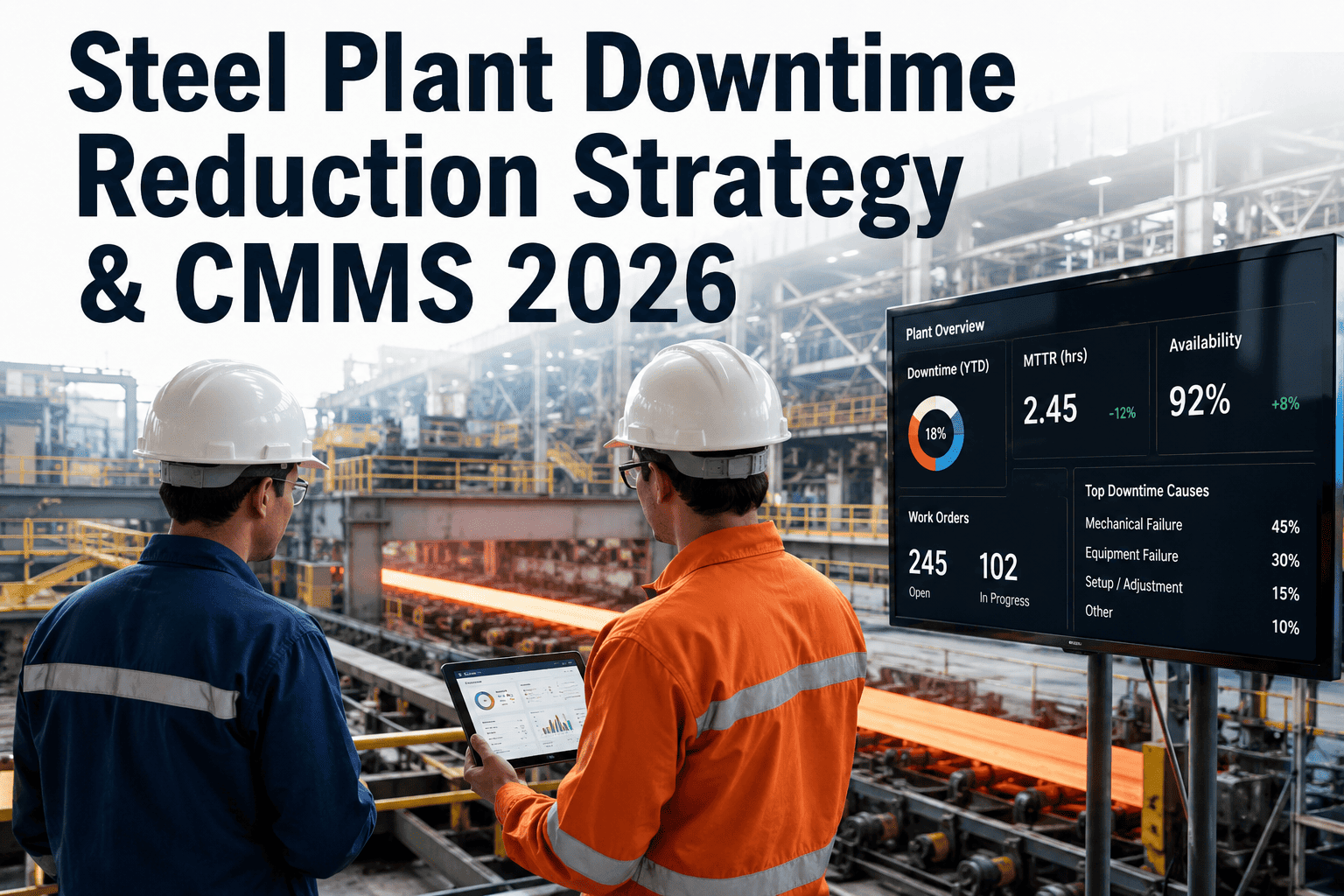
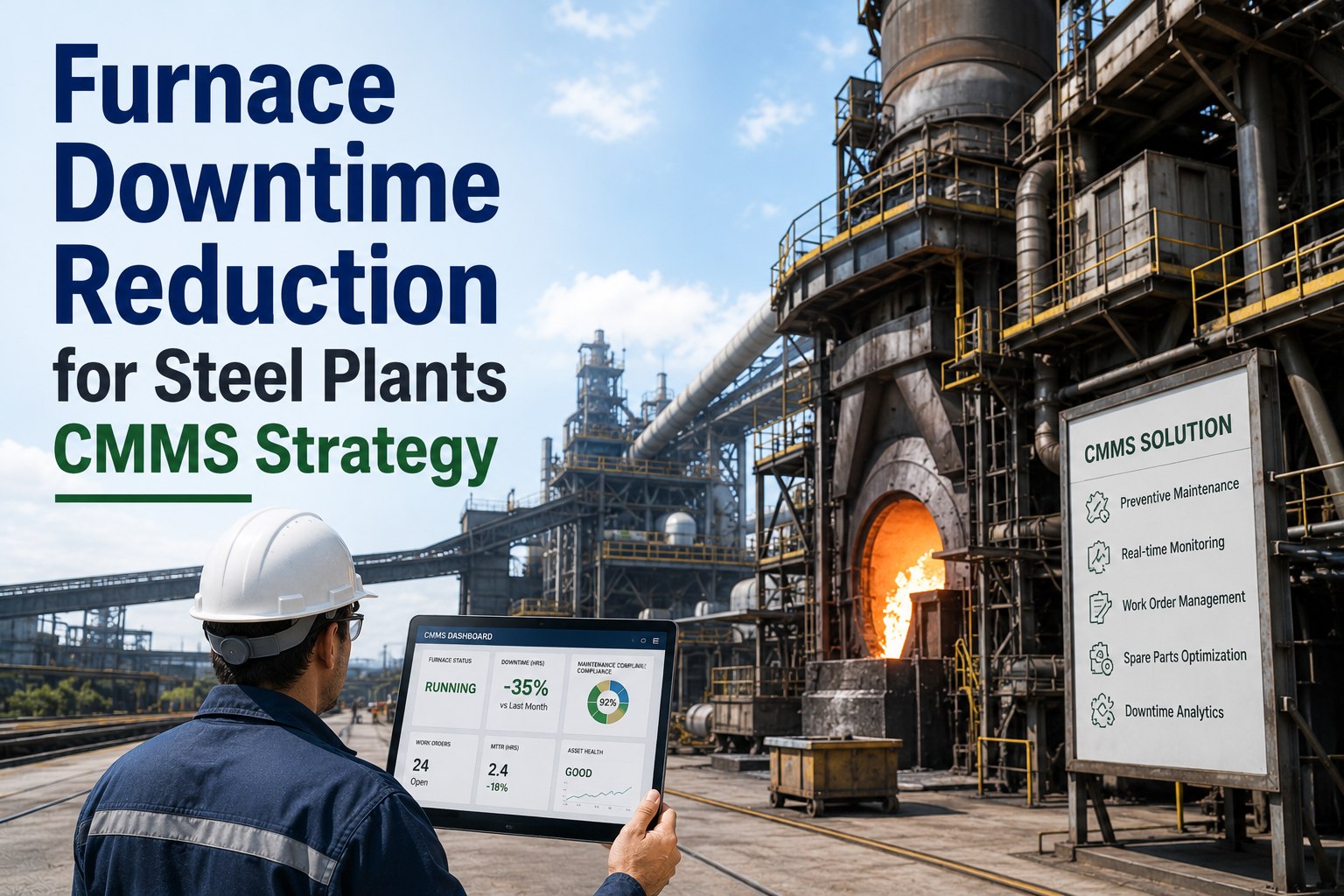
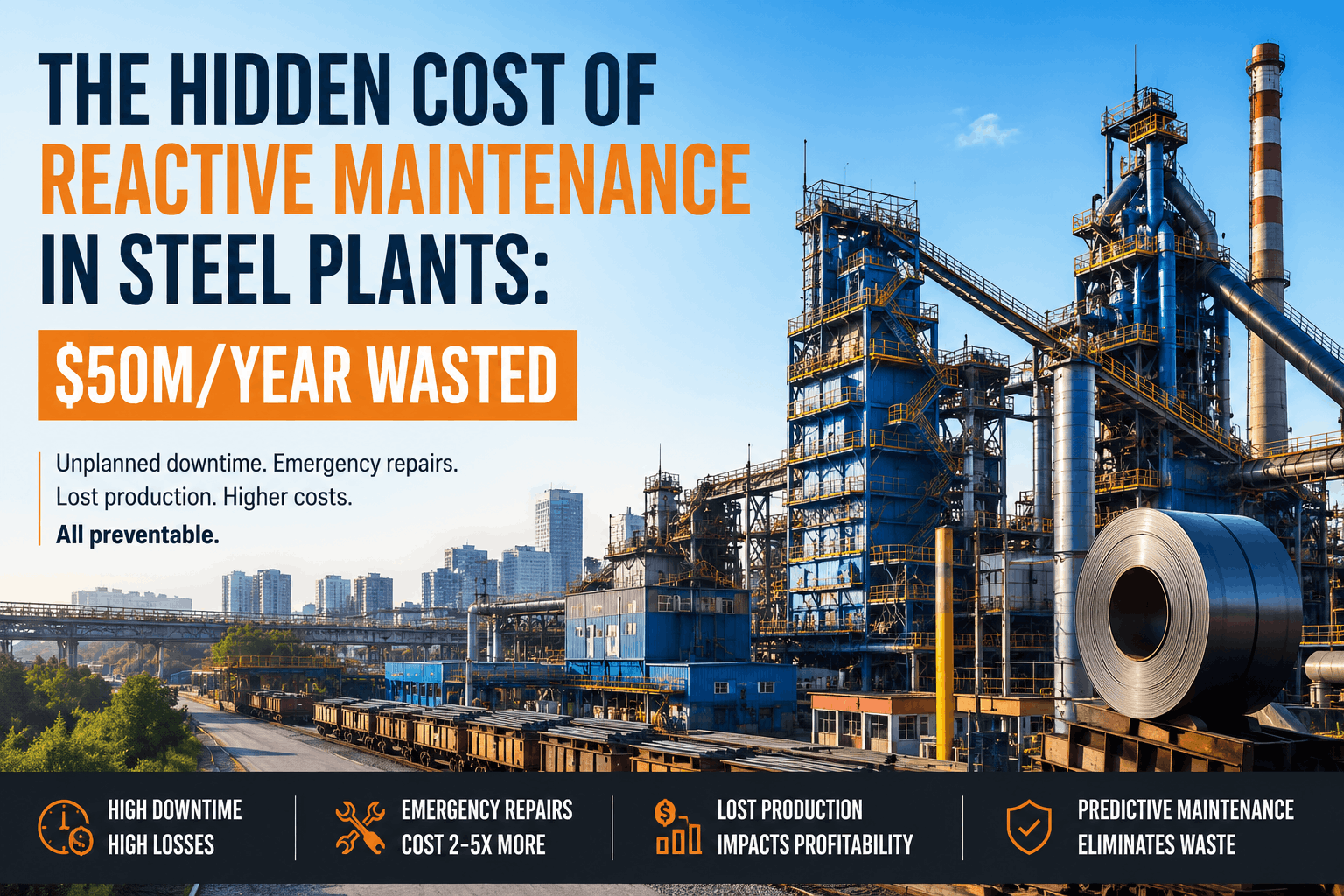
Steel plants that rely on calendar-based preventive maintenance replace components with 30–60% useful life still remaining, waste labor on healthy equipment, and still fail to prevent 40% of unplanned breakdowns. The industry lost $4.2 billion to unplanned downtime in 2024 — and most of that was avoidable. Whether your plant runs a blast furnace, rolling mill, or EAF, choosing the right maintenance strategy for each asset class is one of the highest-leverage decisions in operations. Start a free trial on Oxmaint or book a 30-minute demo to see how leading steel plants are combining both strategies to cut downtime by up to 45%.
Comparison · Steel Plant Maintenance Strategy
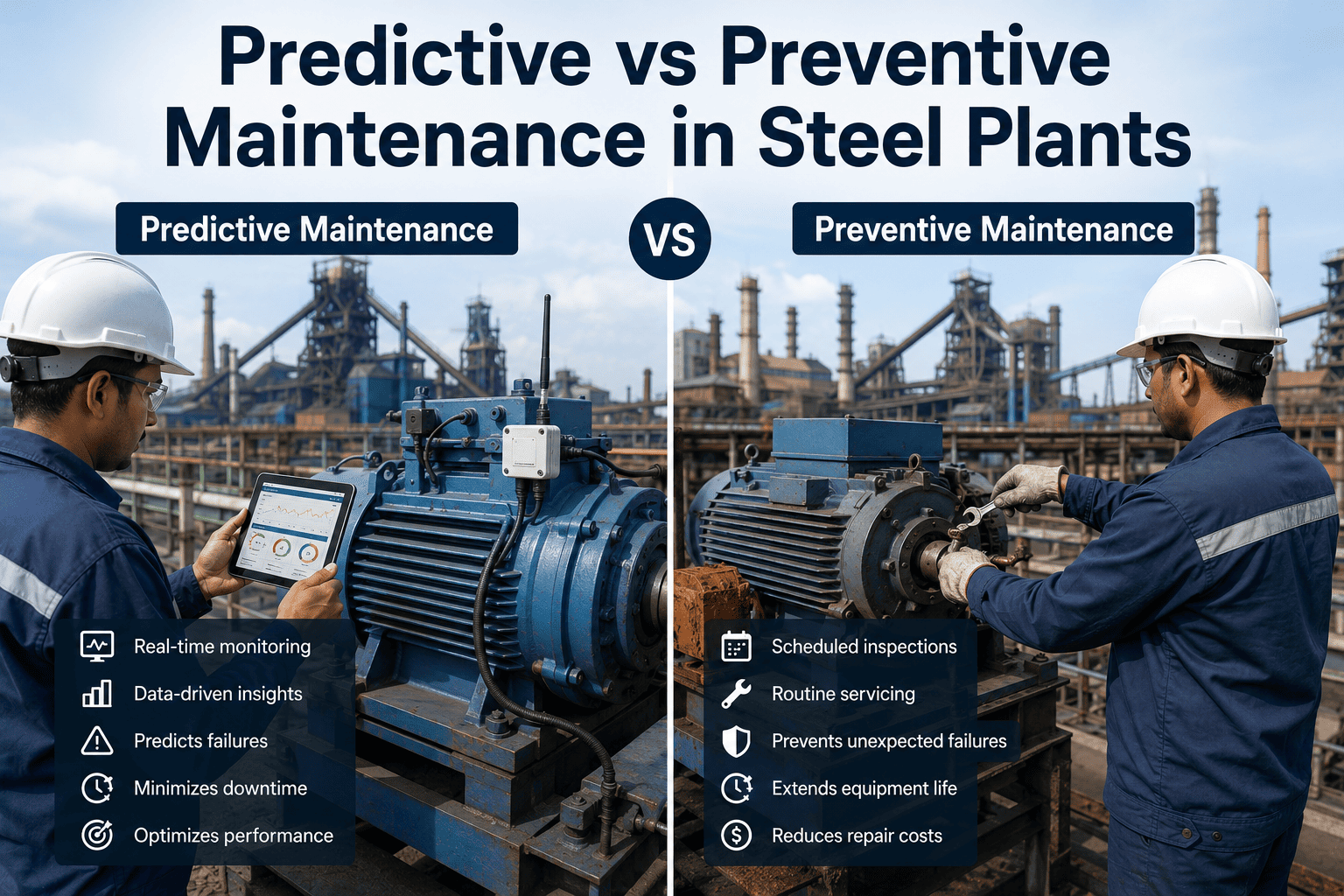
Predictive vs Preventive Maintenance in Steel Plants
A data-backed comparison of both strategies — which assets belong to each approach, what the cost difference looks like, and how to build the hybrid model that maximizes uptime per maintenance dollar.
$4.2B
Steel industry unplanned downtime cost in 2024
40%
Of breakdowns PM alone cannot prevent
25–30%
Maintenance cost reduction with predictive strategy
$150K
Maximum cost per hour of critical equipment failure
The Core Difference — What Each Strategy Actually Does
Both approaches aim to prevent unplanned failures. The critical difference is what triggers the maintenance action — a calendar or actual equipment condition data.
Preventive Maintenance
Scheduled · Time-Based · Calendar-Driven
TriggerFixed intervals — hours, days, or production cycles
Data neededOEM manual + historical failure intervals
Setup costLow — CMMS + PM templates
WeaknessReplaces 30–60% of life remaining in components
Best forLow-cost assets, safety-critical tasks, fluid changes
Predictive Maintenance
Condition-Based · Sensor-Driven · AI-Triggered
TriggerSensor threshold — vibration, temp, current anomaly
Data neededContinuous sensor feed + AI degradation model
Setup costHigher — sensors, IIoT, analytics platform
WeaknessRequires training data and sensor infrastructure
Best forCritical rotating equipment, high-consequence failures
Cost Impact — Where the Real Money Difference Shows Up
The cost gap between strategies becomes visible only when you count what each approach wastes, not just what it spends. A preventive program on the wrong assets burns parts budget on components with life remaining. Predictive on the wrong assets burns sensor and analytics budget chasing marginal gains.
Unplanned Downtime Rate
Preventive (PM)
Moderate — 12–15 hrs/month
Hybrid PM + PdM
Optimized — 2–3 hrs/month
Annual Maintenance Cost (per $10M budget)
Reactive Only
$10M baseline + $3–5M emergency
Preventive Only
~$9.2M (waste on healthy parts)
Predictive Only
~$8.4M (high sensor overhead)
Hybrid Optimized
~$7.0–7.5M · 25–30% savings
Which Strategy for Which Steel Plant Asset?
The right answer is never all-PM or all-PdM. Match the strategy to asset criticality, failure mode detectability, and consequence of failure. This is the decision matrix used by maintenance engineers at integrated steel plants.
| Steel Plant Asset |
Failure Consequence |
Right Strategy |
Oxmaint Trigger Type |
| Blast Furnace Blowers |
Production stop — $100K+/hr |
Predictive (vibration + temp) |
Sensor threshold auto-WO |
| Rolling Mill Drive Motors |
Line shutdown — $50–150K/hr |
Predictive (current signature) |
AI anomaly → work order |
| Continuous Caster Rolls |
Quality defect + downtime |
Preventive + condition check |
Runtime hours + inspection |
| Cooling Tower Pumps |
Moderate — manageable backup |
Preventive (monthly PM) |
Calendar-triggered PM |
| EAF Electrode Arms |
Heat loss + electrode damage |
Predictive (thermal imaging) |
IR threshold → alert |
| Hydraulic Power Units |
Production slowdown |
Preventive (fluid change + PM) |
Calendar + fluid analysis |
| Conveyor Drive Gearboxes |
Moderate — transfer possible |
Hybrid (PM + oil analysis) |
Interval + oil sample trigger |
| Auxiliary Cranes |
Safety-critical |
Preventive (compliance-driven) |
Regulatory calendar PM |
Head-to-Head: PM vs PdM — Key Performance Metrics
Based on industry data from steel plants that have implemented both strategies. Numbers reflect outcomes after 12 months of structured implementation.
| Performance Metric |
Preventive Only |
Predictive Only |
Hybrid (PM + PdM) |
| Unplanned downtime reduction |
20–35% |
40–55% |
45–60% |
| Maintenance cost vs baseline |
-8 to -12% |
-18 to -22% |
-25 to -30% |
| Component life extension |
Minimal |
30–40% |
40–60% |
| Emergency repair frequency |
Reduced |
Significantly reduced |
Lowest — 70%+ reduction |
| Implementation time to value |
30–60 days |
90–180 days |
30–90 days (phased) |
| Uptime improvement |
+8 to +12% |
+18 to +22% |
+20% average |
The Hybrid Transition — How Steel Plants Move from PM to PdM
Most plants land at 30–50% PdM, 40–50% PM, and 10–20% run-to-failure. The transition is phased, not a cutover. Starting with 20–40 critical assets for PdM while maintaining PM everywhere else delivers 80% of predictive value at a fraction of full deployment cost.
01
Months 1–3 · PM Foundation
Digitize all PM schedules in CMMS. Establish PM compliance baseline. Identify top 20–40 critical assets by failure consequence and production impact. Begin accumulating asset history and failure data.
Result: PM compliance lifts from 51% to 85%+
02
Months 4–6 · Sensor Deployment on Critical Assets
Deploy vibration, temperature, and current sensors on the 20–40 highest-consequence assets. Connect sensor feeds to CMMS for threshold-based work order creation. PM continues on all remaining assets.
Result: First condition-triggered WOs replace calendar PMs on critical assets
03
Months 7–12 · AI Validation and PM Interval Optimization
AI models validate prediction accuracy on each asset class. Confirmed assets shift to PdM. Oil analysis and condition checks extend PM intervals on healthy assets by 25–50%. Maintenance cost reduction becomes measurable.
Result: 25–30% cost reduction, 45% downtime reduction achieved
"The steel plants that get predictive maintenance wrong treat it as an either/or against preventive. The ones that get it right treat it as a portfolio decision — predictive on the 20% of assets that cause 80% of downtime cost, preventive on the 60% that benefit from structured intervals, and run-to-failure on the 20% where replacement is cheaper than any program. A CMMS that manages both strategies from the same work order queue, with sensor-triggered and calendar-triggered maintenance both visible on the same dashboard, is the only way to execute a hybrid model without creating the visibility gaps that cause it to collapse. The goal is not the strategy. The goal is uptime per maintenance dollar — and that requires matching the right approach to every asset, not one approach to all assets."
Rajiv Menon, CMRP, CRL
Certified Maintenance and Reliability Professional · Certified Reliability Leader · 22 years steel plant maintenance strategy consulting · Former Head of Asset Integrity, integrated steel operations · SMRP fellow
Frequently Asked Questions
Can a steel plant run both predictive and preventive maintenance simultaneously?
Yes — and most high-performing steel plants do. The hybrid model is the industry standard: predictive on critical rotating equipment where failure is costly and degradation is sensor-detectable, preventive on lower-criticality or safety-mandatory assets where interval-based maintenance is required by regulation. Oxmaint manages both from the same work order queue so your team has full visibility regardless of what triggered the job.
Start a free trial to configure your hybrid PM/PdM program.
How long does it take to see ROI from predictive maintenance in a steel plant?
Most steel plants see measurable ROI within 6–12 months of deploying predictive maintenance on critical assets. The first 90 days typically yield PM compliance improvement and reduced emergency callouts. Full cost reduction of 25–30% and uptime improvement of 20%+ typically materializes in months 9–18 as prediction accuracy improves on each asset class. Phased deployment on 20–40 assets first accelerates time-to-value significantly.
Book a demo to model ROI against your plant's asset register.
Which steel plant assets are best suited for predictive maintenance first?
Prioritize assets with three characteristics: high failure consequence (downtime cost above $50K per event), detectable degradation via vibration, temperature, or current signature, and a failure frequency that gives the AI model enough data. In steel plants this typically means blast furnace blowers, rolling mill drive motors, continuous caster drives, and EAF transformers — typically 20–40 assets that generate 80% of total unplanned downtime cost.
How does Oxmaint support both PM and predictive maintenance in one system?
Oxmaint handles calendar-triggered PM work orders and sensor/IoT-triggered predictive work orders from the same platform. Both feed into the same asset history, compliance record, and technician dispatch queue. When a sensor threshold fires on a rolling mill motor, the work order is created, prioritized, and dispatched identically to a scheduled PM — giving your team one dashboard for the entire maintenance portfolio.
Start your free trial today.
Build the Hybrid Maintenance Model That Reduces Steel Plant Downtime by 45%
Oxmaint runs PM and predictive maintenance from one platform — same work order queue, same asset history, same compliance trail. Most steel plant teams go live within 14 days.