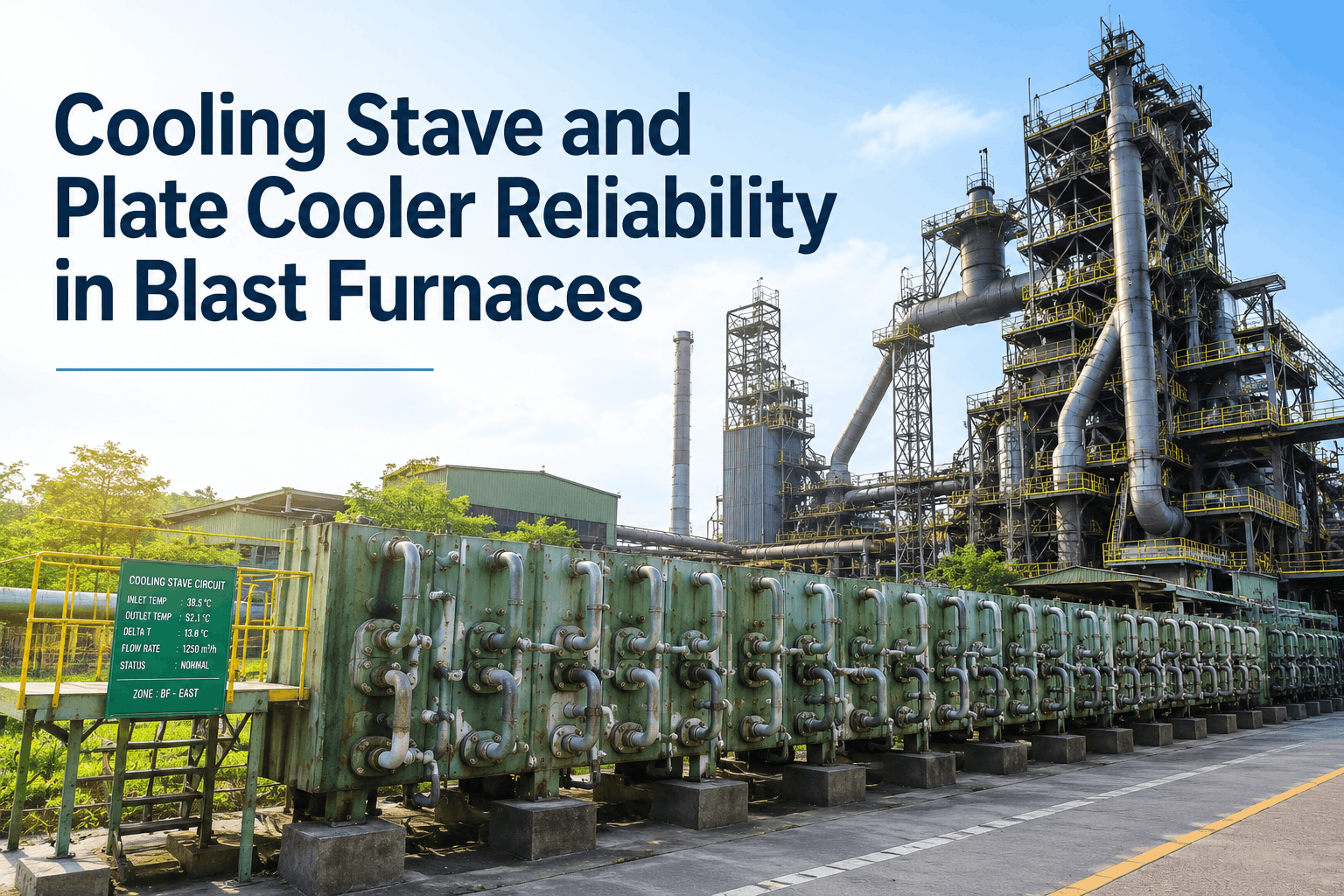
Blast furnace cooling staves are the unheralded guardians of iron production. These copper and steel components dissipate the extreme thermal and chemical stress of a 1,500°C active zone, preventing catastrophic shell damage that would force complete furnace relining—a $30M–$50M catastrophe requiring 60–90 day shutdown. Yet 62% of blast furnace operators still rely on periodic visual inspection and manual temperature recording to assess stave condition, missing critical failure signals until hot spots appear on the shell exterior or cooling water suddenly escalates. Start Free Trial with Oxmaint's blast furnace stave monitoring module to track thermocouple data continuously, detect leak acceleration early, and predict stave end-of-life with precision weeks in advance. Schedule a Demo to see how leading ironmakers cut stave-related shutdowns by 80–95% through automated thermal trending, water leak detection, and predictive replacement schedules. This guide gives blast furnace operators and reliability engineers the framework to standardize stave condition tracking, embed predictive thresholds, and eliminate the silent failures that compromise furnace campaign life.
Blast Furnace Cooling Staves: Why Campaign Life Depends on Undetected Failures
A blast furnace campaign—the period between major relinigns—directly determines ironmaking economics. Modern campaigns target 10–15 years (120,000–180,000 operating days) because furnace construction and management have improved, but cooling stave reliability controls this outcome. Each stave must dissipate 500–1,200 MW of heat while resisting corrosion and thermal cycling stress. When stave condition is monitored with precision—thermocouple temperature trending, cooling water flow and leak detection, and copper face erosion tracking—campaigns achieve design life and stave replacement becomes a planned, scheduled event within the capital budget. When stave condition is unknown or monitored only visually, failures develop in isolation: a single stave leaks silently for weeks, neighboring staves absorb excess heat and fail prematurely, shell temperature rises unnoticed, and suddenly the furnace develops a hot spot that forces emergency ramp-down or refractory repair at $5M–$15M unplanned cost. Start Free Trial to build centralized stave monitoring that captures every thermocouple reading, water flow anomaly, and leak event in a searchable database enabling root cause analysis and predictive trending. Mills implementing structured stave tracking reduce emergency stave-related shutdowns by 80–95%, extend campaign life by 2–4 years on average, and cut stave replacement costs by 25–40% through optimized supplier contracts and planned procurement.
Critical Blast Furnace Stave Failure Signatures and Early Detection
Stave failures follow observable patterns. Thermocouple temperature drifts, cooling water temperature or flow anomalies emerge, leak rates accelerate, and shell hotspots develop weeks before catastrophic failure forces emergency action. Schedule a Demo to see how Oxmaint consolidates real-time stave data and flags approaching critical thresholds days or weeks before shell damage occurs.
Stave copper face temperature rises steadily week-over-week, indicating reduced cooling effectiveness. Without trending, gradual drift goes unnoticed until temperature approaches unsafe limits (typically >180–200°C).
Water leak rate on individual staves climbs from <1 L/h baseline to 5–10 L/h range over weeks. Manual weekly inspections miss acceleration; automated leak detection captures trend and flags anomalies within days.
Repeated thermal expansion and contraction from furnace cycling (ramp-down for maintenance, then ramp-up) causes micro-cracking in stave copper. Invisible until crack intersects cooling passage and leak accelerates.
Hot face copper erodes due to slag corrosion and mechanical wear. Erosion reduces heat dissipation and allows hot spots to form. Post-campaign ultrasonic inspection detects, but trend analysis could predict.
When underlying stave fails, shell temperature in that zone rises 20–50°C above normal. If undetected, hot spot cascades: refractory deteriorates, slag penetrates, and emergency ramp-down becomes necessary within days.
Leaking staves can accumulate to reduce circuit pressure, reducing flow to all staves in that zone. Undetected pressure drift compromises cooling on multiple staves simultaneously.
Blast Furnace Stave Condition Management: Standards, Metrics, and Outcomes
Blast furnace operators implementing structured stave condition programs standardize thermocouple data collection, establish predictive temperature thresholds, and embed stave health monitoring into daily operator discipline and capital planning workflows.
| Stave Monitoring Element | Failure Mode Detected | Structured Monitoring Practice | Assessment Frequency | Campaign Life and Cost Impact |
|---|---|---|---|---|
| Thermocouple Temperature Trending | Stave copper face overheating, reduced cooling | Continuous data logging from all active stave thermocouples with weekly trend analysis and alert if temperature rise exceeds 1°C/week threshold | Continuous logging; weekly trending | 2–4 year campaign extension; 80–95% reduction in emergency stave-related shutdowns |
| Cooling Water Flow Monitoring | Leak acceleration in individual staves or circuit blockage | Automated flow sensor per cooling circuit with logging and alert if circuit flow drops >5% from baseline or individual stave leak exceeds 10 L/h | Continuous; alert on deviation | Early intervention prevents cascade failure; zero undetected major leaks |
| Shell Temperature Hotspot Detection | Stave failure beneath shell manifests as localized thermal anomaly | Infrared camera survey with zone mapping and alert if any shell zone temperature exceeds adjacent zones by >20°C | Monthly or continuous via IR array | Pinpoints failing staves within 1–2 days; enables targeted stave replacement |
| Stave Leak Rate Baseline and Tracking | Water loss acceleration indicating copper face crack or brazed joint failure | Individual stave leak measurement at startup and monthly thereafter; flag if leak rate increases >50% month-over-month | Monthly measurement; baseline at campaign start | Predicts stave end-of-life 4–12 weeks in advance; enables planned replacement |
| Copper Face Erosion Trending | Erosion reduces cooling heat transfer and allows hotspots | Post-campaign ultrasonic thickness mapping linked to CMMS stave history for erosion-rate trending and refractory grade optimization | Per campaign end; quarterly trend update | Identifies high-erosion stave zones; enables refractory or stave material optimization |
| Water System Pressure Trending | Accumulating stave leaks reduce circuit pressure and compromise cooling on all staves | Automated pressure sensor per circuit with trending and alert if pressure drops >2 bar below nominal | Continuous; alert on pressure drop | Detects system-wide leak accumulation; triggers multi-stave replacement planning |
| Campaign Life Forecasting | No planning for stave replacement within capital budget window | Trending combined thermocouple drift, leak rate, and copper erosion to forecast stave end-of-life with 4–8 week accuracy | Monthly forecast update | 100% planned stave replacements; zero emergency ramp-downs; optimized capital allocation |
Building Blast Furnace Stave Intelligence with Integrated CMMS
Leading ironmakers standardize stave condition data collection, embed predictive thresholds into daily operations, and link stave monitoring directly to capital planning and campaign management. Schedule a Demo to see how Oxmaint consolidates thermocouple, flow, and leak data into unified stave health monitoring and predictive replacement forecasting.
- Audit all existing thermocouples and ensure coverage of all active stave zones with at least one sensor per major stave block
- Connect all thermocouple signals to data logger with continuous archiving and ≥1-hour resolution time-series database
- Configure automated dashboard showing each stave temperature, trend line, and alert threshold; enable operator visibility to detect anomalies in shift
- Install flow meters on primary and secondary cooling circuits with continuous monitoring and alert if circuit flow drops >5% from baseline
- Conduct baseline stave leak measurement (visual inspection and collection method) and log individual stave leak rate in CMMS asset record
- Schedule monthly leak rate re-measurement and flag any stave where leak rate increases >50% month-over-month as requiring investigation
- Deploy infrared camera array or regular thermal imaging survey to map shell temperature across furnace height and width
- Establish baseline shell temperature profile and configure automated alert if any zone exceeds adjacent zones by >20°C
- Link shell hotspot alerts to underlying stave zones for rapid pinpointing and work order generation for targeted stave inspection or replacement
- Build stave replacement forecast by trending thermocouple drift, leak acceleration, and pressure loss; establish predictive model for end-of-life within 4–8 week accuracy
- Generate monthly forecast report showing which stave zones are approaching replacement threshold and timing to enable capital planning
- Link forecast directly to procurement and schedule planned stave replacements during optimal maintenance windows, avoiding emergency ramp-downs
Blast Furnace Stave Management Best Practices and Quick Wins
Blast Furnace Stave KPIs and Monitoring Targets
Ironmakers tracking stave condition KPIs directly link monitoring investment to campaign life extension and operational cost reduction. Start Free Trial with Oxmaint's blast furnace analytics to monitor stave health in real time and forecast campaign life extension.
Total operating time between major furnace relining operations. Mills with structured stave monitoring achieve 12–15 years; reactive mills average 8–10 years. Each year of extension = $5M–$10M in deferred capital.
Count of furnace ramp-downs or shutdowns forced by stave failure. Best-in-class mills achieve <0.2. Each unplanned shutdown costs $2M–$8M in lost production and emergency repair.
Average rate of stave copper face temperature change across all zones. Stable or decreasing indicates healthy cooling. Drift >1°C/week signals developing failures.
Percentage variation in cooling circuit flow rate. Stable flow indicates no major leaks or blockages. Flow drop >5% indicates emerging stave leak or system blockage requiring investigation.
Count of staves where monthly leak measurement increases >50% from prior month. Any increase >50% signals copper face crack or brazed joint failure requiring replacement planning.
Count of shell zones exceeding normal temperature by >20°C. Early detection enables stave replacement; rising hotspot count predicts cascade failures and furnace damage risk.
Blast Furnace Operator Success: Real Stave Monitoring Outcomes
"Our blast furnace averaged 9.5-year campaigns with 1–2 stave-related emergency shutdowns every 2 years. After implementing Oxmaint's thermocouple trending and leak detection system, we identified staves approaching failure 8–12 weeks in advance and scheduled replacements during our quarterly maintenance window. Last campaign extended to 14.2 years—47% longer than historical average. We eliminated stave-related emergency shutdowns entirely. Stave replacement costs dropped 32% through planned procurement instead of emergency ordering. The system has already paid for itself multiple times over in avoided ramp-downs and procurement savings."