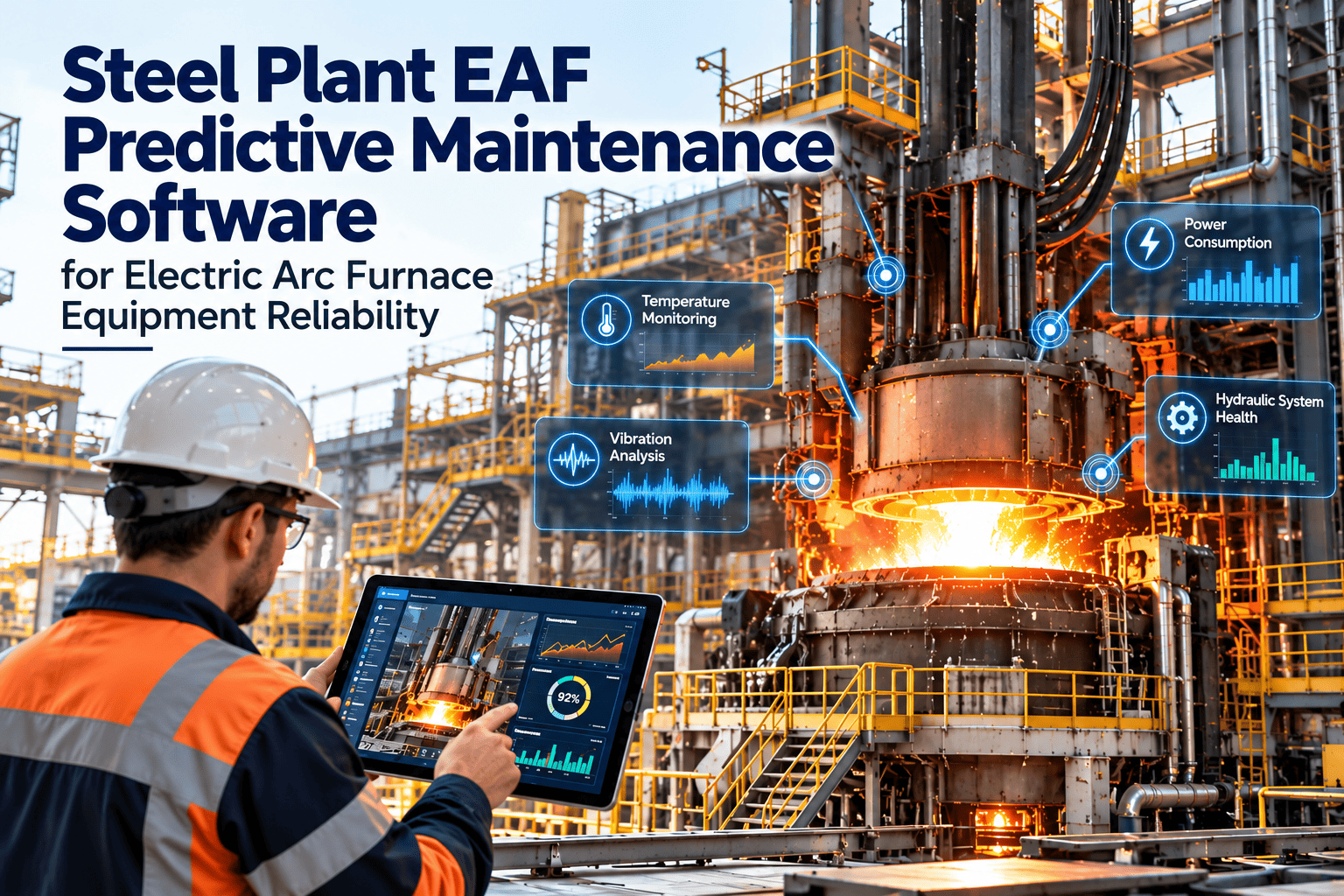
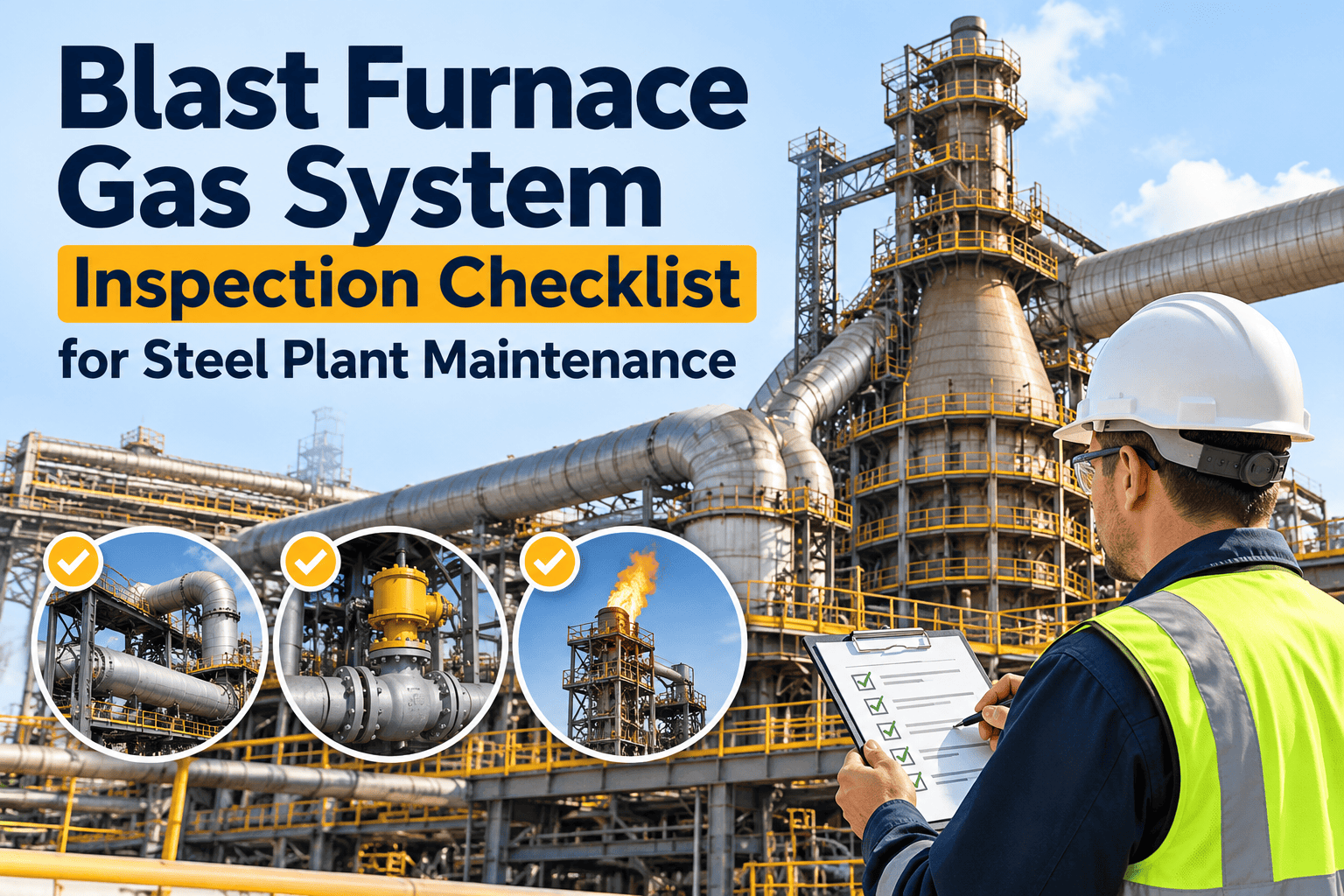
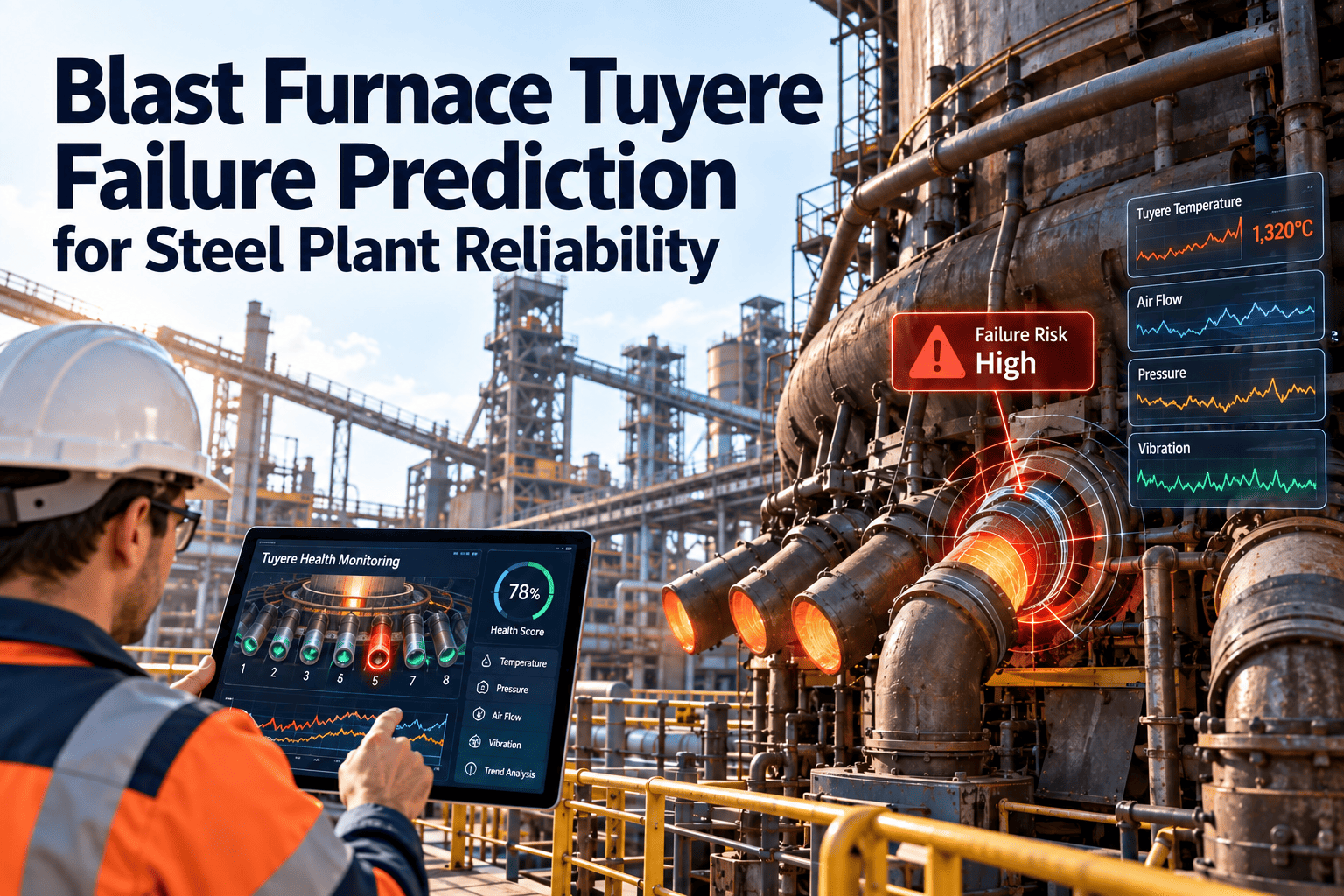
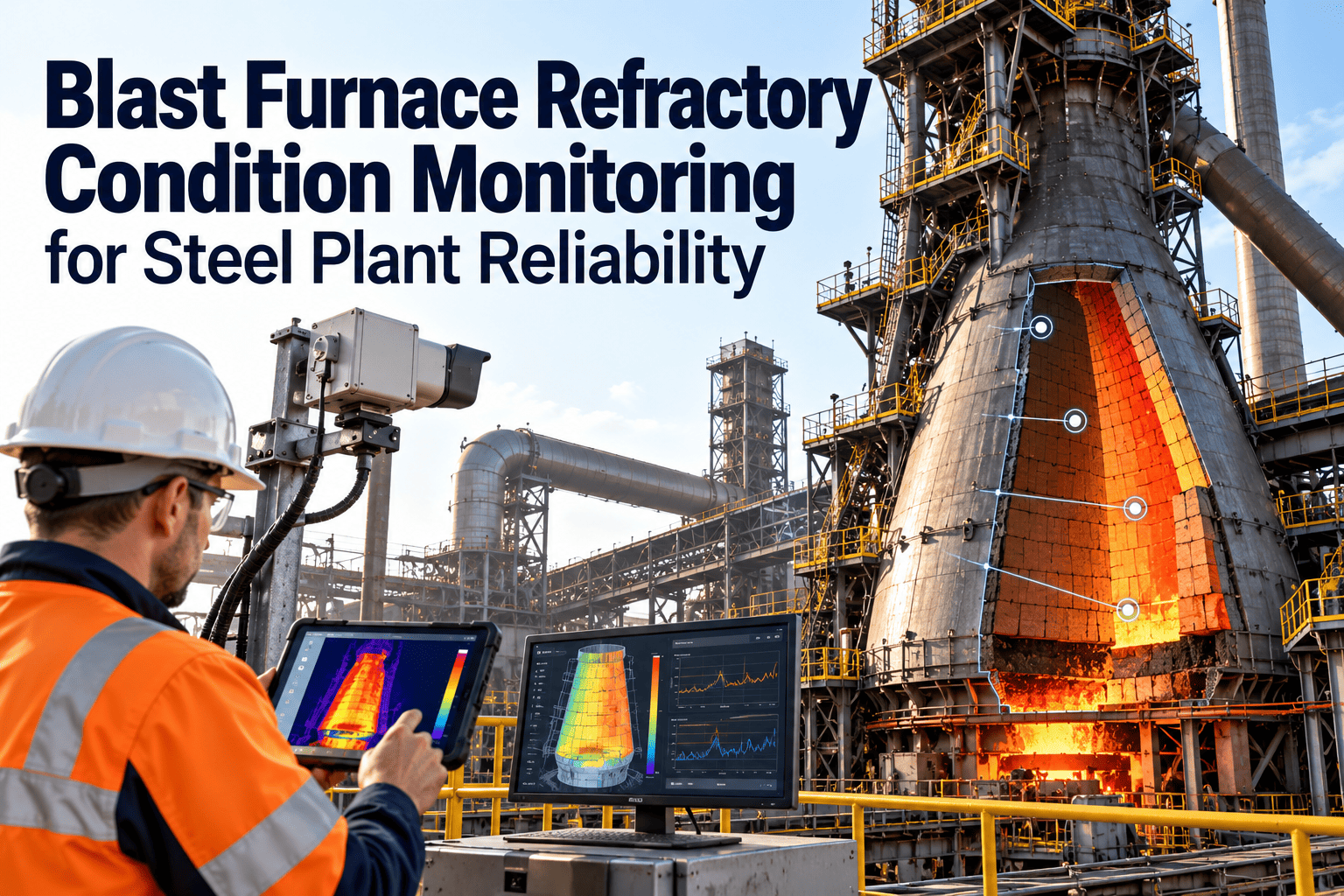
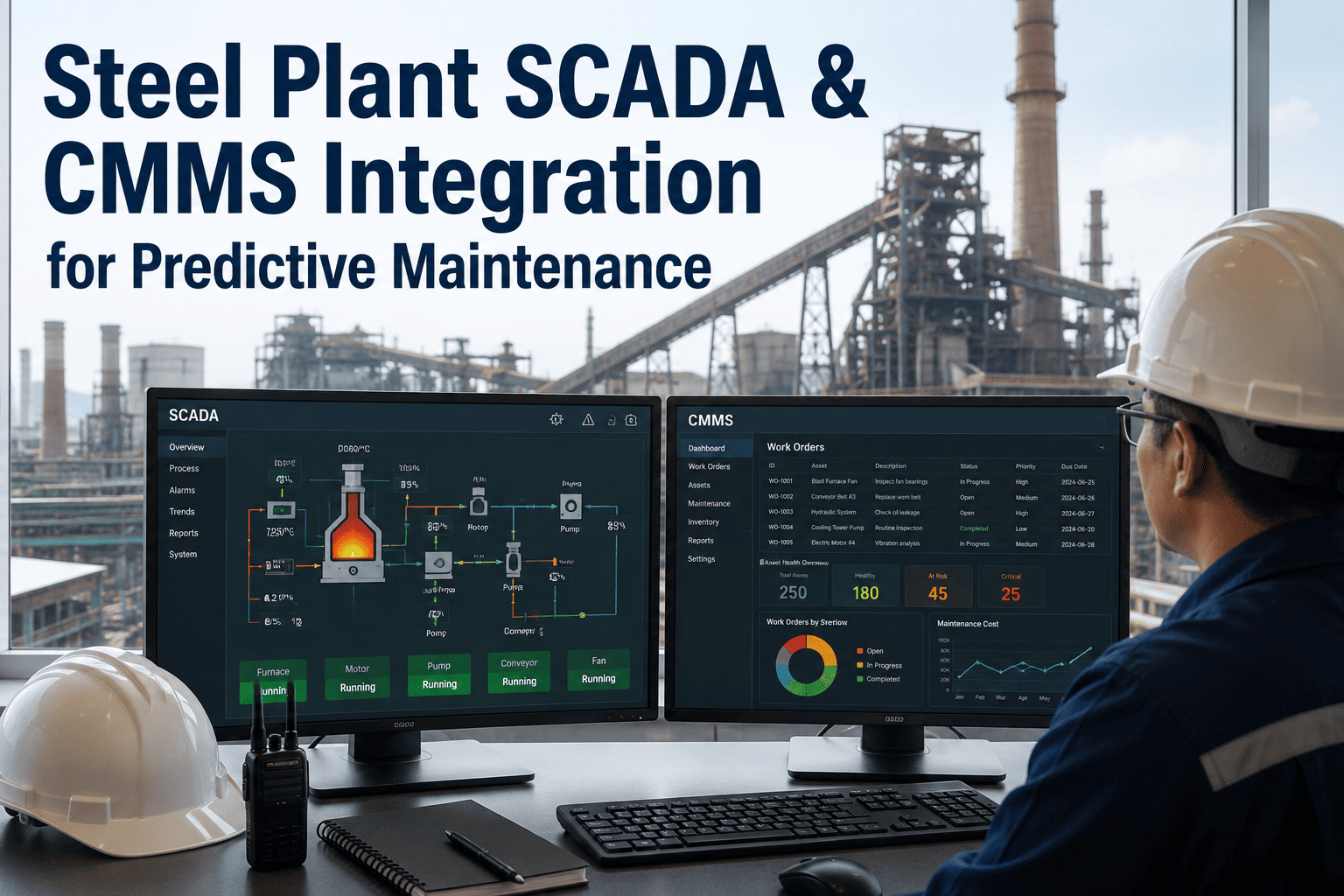
Steel plants lose $50,000–$150,000 per hour when a blast furnace fails without warning. The steel industry spent $4.2 billion on unplanned downtime in 2024 — yet most plants still rely on fixed threshold alarms that miss the early signals. AI-powered early warning systems change this equation by detecting anomalies 2–8 weeks before catastrophic failure. See how OxMaint's predictive AI works for your blast furnace or book a 30-min demo with a steel reliability expert.
Case Study — Steel Plant Reliability
Blast Furnace Failure Early Warning AI
How an integrated steel plant converted a $4.8M emergency into a $340K planned intervention — using AI anomaly detection connected to OxMaint work orders.
92%
Failure prediction accuracy
2–8 wks
Early warning lead time
$4.46M
Savings per intervention
The Problem: Alarms That Fire Too Late
A blast furnace generates data every second — thermocouples, cooling water differentials, gas pressure, tap hole wear. Yet most plants monitor each signal independently against a fixed threshold. By the time a DCS alarm fires, the damage is already in motion.
01
Threshold-only alarms
Fixed limits on individual sensors miss spatial drift patterns that signal lining erosion weeks before failure.
02
No SCADA–CMMS link
Alarms don't auto-generate work orders. Technicians act on memory and verbal handoffs — hours are lost.
03
Reactive repair premium
Emergency furnace repairs cost 10–14x more than planned interventions and halt production for days.
How AI Early Warning Works
OxMaint's AI monitors 200+ parameters per furnace simultaneously. Instead of fixed thresholds, spatial models calculate what each sensor should read based on its neighbours — a deviation invisible to DCS becomes a clear anomaly to AI.
1
SCADA signal ingestion
Thermocouple arrays, cooling water deltas, gas composition, pressure readings — all streamed in real time via OPC-UA or Modbus.
↓
2
Spatial anomaly detection
AI compares each sensor against its geometric neighbourhood. An 18°C spatial deviation at 847°C — below any fixed alarm — triggers an early alert.
↓
3
Risk score & work order
OxMaint auto-generates a prioritised work order with failure mode, recommended action, parts list, and optimal scheduling window.
↓
4
Planned intervention
Team acts during scheduled downtime. Cost: $340K. Alternative emergency scenario cost: $4.8M+.
Real Plant Data: Before vs. After AI Deployment
| Metric |
Before AI |
After AI (12 months) |
Improvement |
| Unplanned furnace downtime (hrs/year) |
186 hrs |
62 hrs |
67% reduction |
| Average warning lead time |
2–4 hrs (DCS alarm) |
14–42 days (AI) |
10× earlier |
| Emergency repair cost per event |
$4.8M avg |
$340K avg (planned) |
93% lower |
| Work order auto-generation time |
4–8 hrs (manual) |
<5 minutes (AI) |
99% faster |
| Planned maintenance % |
41% |
78% |
+37 points |
Is your blast furnace data working for you? OxMaint connects SCADA signals to predictive alerts and auto-generated work orders — so your team acts in days, not after the alarm.
Key AI Signals That Predict Blast Furnace Failure
◈
Stave cooler temperature drift
Spatial deviation across TC arrays indicates localised refractory erosion. Detectable 4–6 weeks early.
◈
Cooling water ΔT anomaly
Rising differential temperature in panel circuits signals heat load increase from lining loss.
◈
Gas pressure fluctuation
Irregular burden descent patterns linked to scaffold formation — detectable weeks before tapping disruption.
◈
Tap hole wear trend
Erosion velocity models predict tap hole failure 2–3 heats in advance using flow rate and temperature history.
"
We already had 94 thermocouples connected to the DCS. What OxMaint's spatial model gave us was the ability to see what each TC should read based on its eight neighbours and the physical furnace geometry. An 18°C spatial deviation at 847°C — far below any DCS alarm — was clearly anomalous in the model. That single detection saved us a $4.8M emergency and six weeks of lost production.
— Head of Reliability Engineering, 4 MTPA Integrated Steel Plant
OxMaint Early Warning AI deployment, 2024
OxMaint vs. Standalone SCADA Alarms
| Capability |
DCS/SCADA Only |
OxMaint AI |
| Multi-sensor correlation |
Single threshold per sensor |
200+ parameters correlated |
| Warning lead time |
2–4 hours |
14–42 days |
| Auto work order creation |
Manual, 4–8 hrs |
Under 5 minutes |
| Spatial anomaly detection |
Not available |
Geometric neighbourhood model |
| Prediction accuracy |
Reactive only |
92% |
Frequently Asked Questions
How does OxMaint connect to our existing SCADA and DCS systems?
OxMaint integrates via OPC-UA, Modbus, or direct Ethernet/IP as a Layer 3–4 analytics overlay. It reads data from your existing Level 1 and Level 2 systems without modifying them. Around 80% of blast furnace deployments use existing instrumentation with no new sensor installation needed.
Sign up to explore integration options for your plant's specific setup.
How long does it take to get the first AI anomaly alerts?
OxMaint establishes AI baselines within 2–4 weeks of normal operating data. Most steel plants receive their first anomaly alerts within 30 days of connection. The spatial models begin detecting deviation patterns well before any DCS threshold would fire, giving your team actionable lead time of 14–42 days on average.
Book a demo to discuss your deployment timeline.
What failure modes can AI detect on a blast furnace?
OxMaint's AI detects refractory lining erosion via thermocouple spatial drift, cooling system degradation through water ΔT anomalies, burden descent irregularities from gas pressure patterns, and tap hole wear via flow and temperature trend models. These cover over 85% of unplanned blast furnace failure modes. The system also flags anomalies on tuyeres, blowpipes, and hot blast stoves — extending protection across the full furnace system.
What is the typical ROI timeline for AI early warning on a blast furnace?
Plants deploying OxMaint report payback periods of 5–8 months. A single prevented emergency repair — typically $4–12M — exceeds annual platform costs. Ongoing savings from 45% unplanned downtime reduction and 30% lower maintenance cost per tonne compound year over year.
Get a tailored ROI estimate for your furnace capacity and campaign stage.
Prevent Your Next Furnace Emergency
OxMaint detects blast furnace anomalies 2–8 weeks early, auto-generates work orders, and connects every SCADA signal to a maintenance action. Your first AI alert can appear within 30 days of go-live.