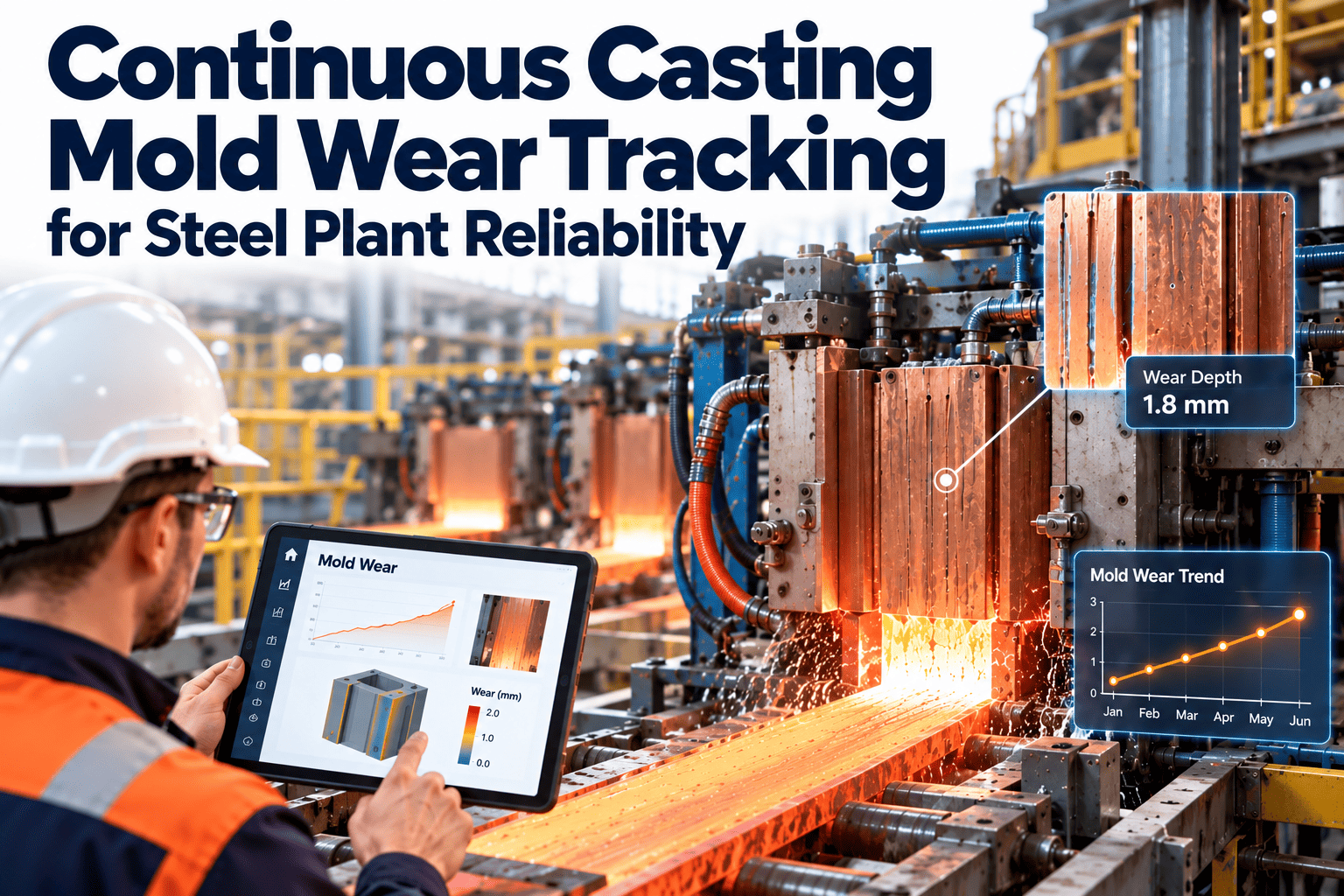
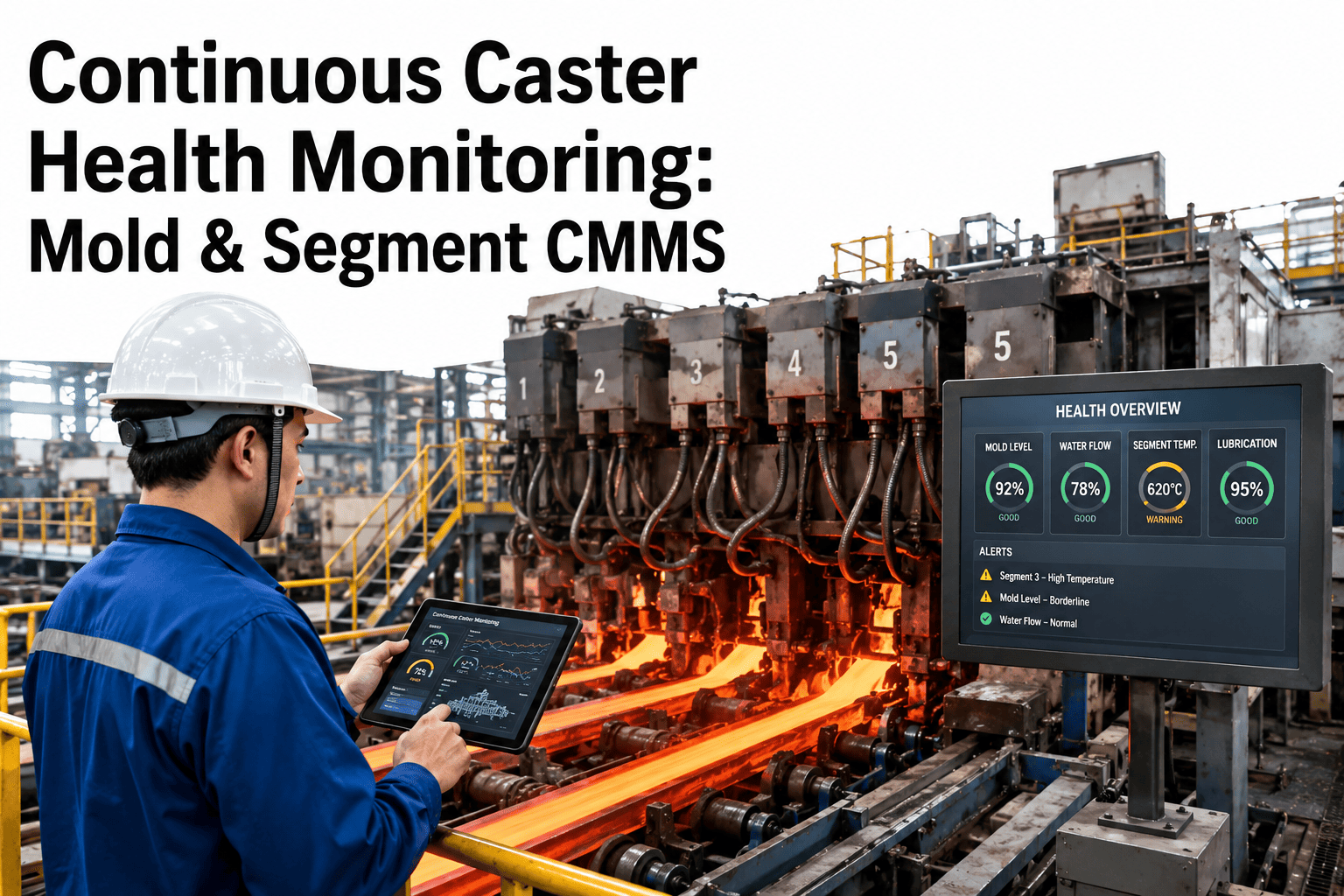
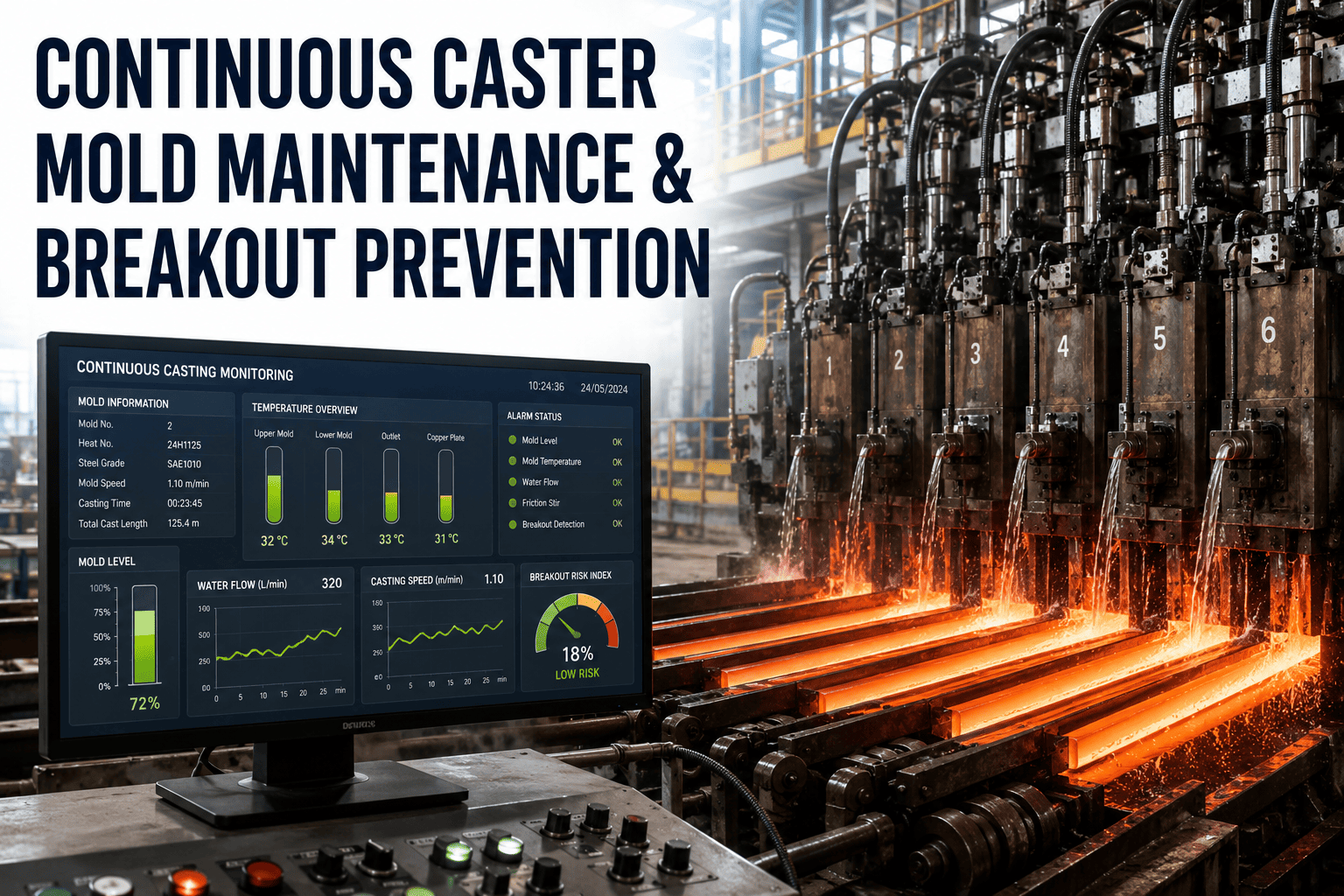
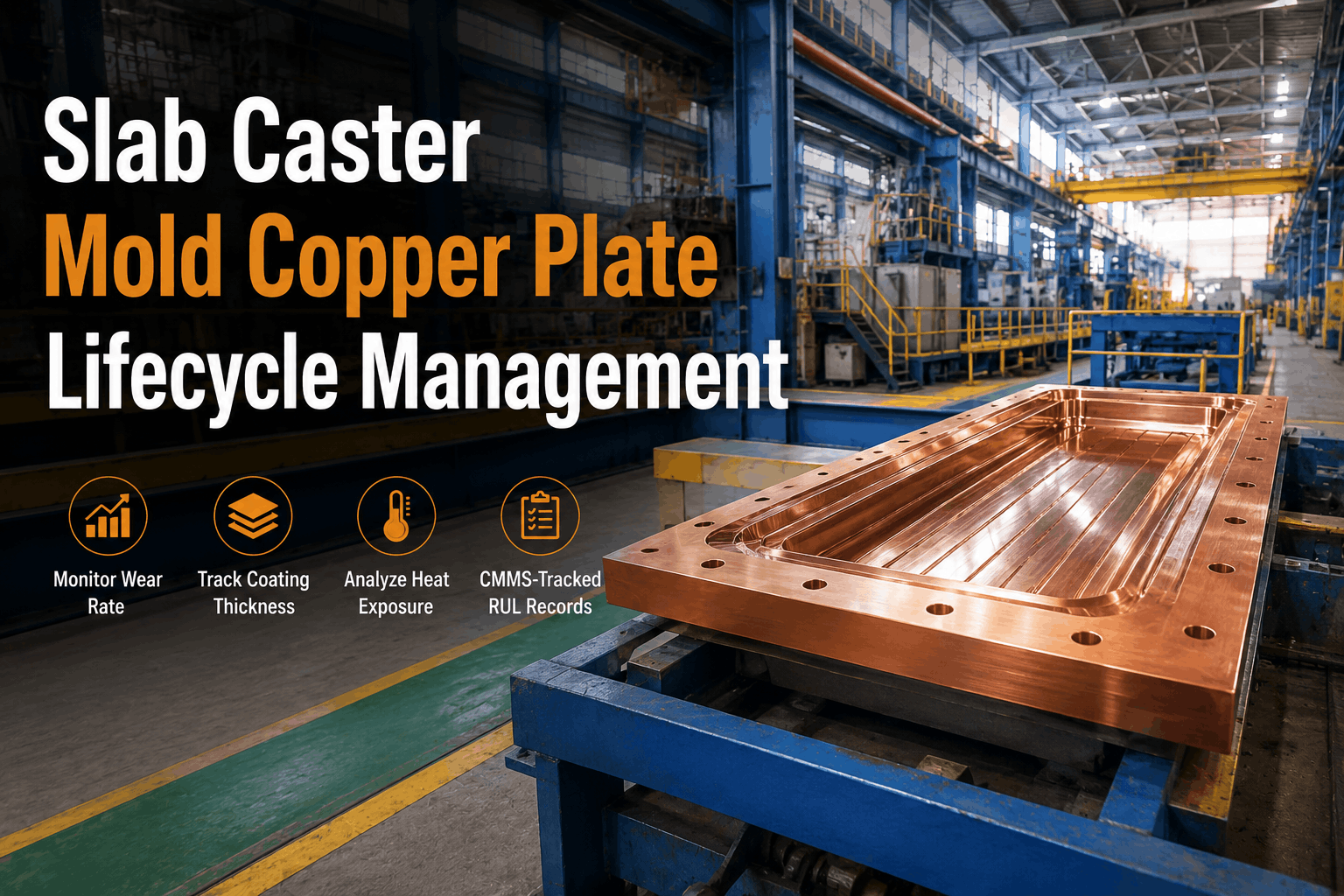
The continuous casting mold is the heart of every caster — the single point where molten steel at 1,600°C first solidifies against water-cooled copper plates. Mold copper plate condition directly controls slab quality, casting speed, and breakout risk. A single set of copper plates for a slab caster can cost tens of thousands of dollars, and advanced coating technologies have pushed campaign life from 100-150 heats (traditional Cr plating) to 500-627 heats (Ni-Co and advanced coatings). Several North American casters now routinely achieve 500,000+ tons per campaign on thick slab casters with premium coatings (SMS Group). But achieving maximum copper plate life requires tracking every plate through multiple campaigns, refurbishments, coating cycles, and dimensional measurements — data that gets lost on paper turnover cards.
A mold copper plate doesn't simply wear out and get replaced — it goes through multiple refurbishment cycles where it's stripped, measured, remachined, recoated, and returned to service. Each cycle removes copper from the base plate, and each plate has a finite number of lives. Without systematic tracking, plants overuse plates past safe limits, underuse plates that still have life, lose coating history, and suffer preventable breakouts. Oxmaint CMMS tracks every copper plate through its entire lifecycle — tonnage cast, wear measurements, coating type and thickness, refurbishment history, and remaining plate thickness — ensuring maximum value extraction from every plate while preventing catastrophic failures.
Four Failures Mode: Why Copper Plates Are Removed from Service
Copper plate life is determined by whichever failure mode reaches its limit first. The CMMS must track all four simultaneously:
Edge Wear
Friction between the solidifying shell and copper surface, amplified by mold oscillation and strand withdrawal. Worst at the lower portion where the shell is thickest. Wear exceeds 1mm at lower mouth = end of campaign. Narrow faces wear faster than broad faces.
Thermal Cracking
Meniscus area subject to extreme heat flux — temperature gradients of hundreds of °C across the plate. Repeated thermal cycling causes fatigue cracks that propagate intergranularly. Hardness can drop up to 50% at recrystallization temperatures. Zinc diffusion ("brassing") from scrap-based steel accelerates cracking.
Plate Deformation
Wide-face plates develop fan-shaped bulging from thermal expansion. Narrow faces shrink in width direction. Both create gaps between wide and narrow faces that affect shell formation. Excessive taper deviation causes quality defects or breakouts.
Coating Degradation
Nickel/Ni-Co coating peels at lower mouth from friction. Meniscus area develops thermal fatigue cracks in coating. Corrosion from cooling water chemistry and mold flux chemicals. Exposed copper contaminates the strand — star cracks and surface defects.
Track Every Plate, Every Measurement, Every Campaign
Oxmaint records dimensional measurements, coating status, tonnage cast, and refurbishment history for every copper plate — with automated alerts when plates approach wear limits.
Coating Technologies: Life Multipliers the System Must Track
The coating on a copper plate determines its campaign life — and different coatings have dramatically different lifespans. The CMMS must record which coating is on each plate and its remaining thickness:
The Refurbishment Cycle: Maximizing Total Plate Value
A copper plate isn't a consumable — it's a reusable asset that goes through multiple refurbishment cycles. Each cycle follows a precise sequence, and the CMMS must track each step:
Remove from Caster
Campaign completed or wear limit reached. Record: total tonnage cast, total heats, reason for removal.
Inspection & Measurement
3D profile scan, crack mapping, coating thickness measurement, taper verification. Record: residual copper thickness, crack locations, deformation measurements.
Strip & Machine
Old coating removed. Cracks machined out. Surface remilled to specification. Record: copper removed (mm), remaining thickness, machining date.
Recoat
New coating applied — type and configuration per caster requirements. Copper edge plating on narrow faces if needed. Record: coating type, thickness, hardness, vendor, date.
Quality Verification
Final dimensional check: taper, profile, cavity dimensions, water seam uniformity. Thermocouple testing for breakout prediction system. Record: pass/fail, dimensions, QA sign-off.
Return to Service
Plate reinstalled in mold assembly. Campaign counter reset. All data linked to plate serial number. Cycle repeats 5-8 times before plate reaches minimum thickness and is scrapped.
What the CMMS Must Track Per Copper Plate
Every copper plate in inventory needs a complete digital record linking across multiple campaigns and refurbishments:
Breakout Prevention: The Maintenance-Safety Connection
A mold breakout — where the thin solidifying shell ruptures and molten steel pours out below the mold — is the most dangerous event in continuous casting. Proper plate tracking directly prevents breakouts through:
Maximize Copper Plate Life — Minimize Breakout Risk
Oxmaint tracks every copper plate from manufacture to scrap — tonnage cast, refurbishment cycles, coating history, dimensional measurements, and remaining life calculation. Extend campaigns, reduce copper spend, and prevent breakouts.
Frequently Asked Questions
How long does a continuous casting mold copper plate last?
Campaign life depends on coating technology: Cr plating: 100-150 heats, Ni plating: ~300 heats, Ni-Co: 500-800 heats. Record campaign lives include 544 heats (Steel Dynamics/Butler thin slab) and 627 heats (Nucor Crawfordsville) with advanced Ni-Co coatings (Evertz). For thick slab casters with UniGuard® coatings, 500,000+ tons per campaign is routinely achieved at several North American casters (SMS Group). Billet casters using deoxidized copper typically achieve only 3,000-5,000 tons total. Each plate undergoes 5-8 refurbishment cycles before reaching minimum copper thickness and being scrapped.
What causes copper plate wear and failure?
Four primary mechanisms: Edge wear — friction between solidifying shell and copper, worst at lower portion where shell is thick, campaign ends when wear exceeds ~1mm at lower mouth; Thermal fatigue cracking — meniscus area subject to extreme thermal cycling with temperature gradients of hundreds of °C, hardness drops up to 50%, zinc diffusion ("brassing") from scrap steel accelerates cracking; Plate deformation — wide faces bulge fan-shaped, narrow faces shrink, creating gaps; Coating degradation — peeling, corrosion from water chemistry and mold flux, exposing copper to the strand.
What copper alloys are used for mold plates?
Three main alloys: Deoxidized copper — lowest cost, used in billet casters, limited to 3,000-5,000 tons; CuAg (silver copper) — 0.08-0.12% silver significantly increases softening temperature, hardness, and creep strength with minimal thermal conductivity loss; CuCrZr (chromium zirconium copper) — highest strength and thermal fatigue resistance, standard for high-speed slab casters. Dispersion-strengthened copper is emerging for extreme high-speed thin slab applications. All alloys are manufactured to ISO 9001 standards with rigorous metallurgical property specifications.
What is a mold copper plate refurbishment?
Refurbishment is the process of reconditioning a used plate for reuse: strip the old coating, inspect for cracks (dye penetrant/visual), machine the hot face to remove cracks and restore surface profile (this removes copper — typically 0.5-2mm per cycle), recoat with new nickel or specialty coating, and verify dimensions and taper. For narrow faces, copper edge plating can restore width dimensions and extend life. The "everlasting mold" concept (Evertz) uses copper-to-copper electroplating to fully compensate thickness loss from machining, making plates potentially reusable indefinitely. Each standard plate supports 5-8 refurbishment cycles before reaching minimum thickness.
How does CMMS tracking improve mold copper plate management?
A CMMS creates a complete lifecycle digital record for every plate: serial number, alloy type, original/remaining thickness, cumulative tonnage, campaign history with heats and grades cast, every refurbishment cycle with copper removed and coating applied, dimensional measurements (taper, profile, water seam), thermocouple health status, and cost tracking. This enables data-driven decisions: when to end a campaign (based on wear data, not arbitrary schedules), which coating to use (based on campaign performance history), when to scrap a plate (based on actual remaining thickness), and how to balance plate rotation across strands for even utilization. Without this tracking, plants either over-conservatively scrap plates with remaining life, or dangerously run plates past safe limits.