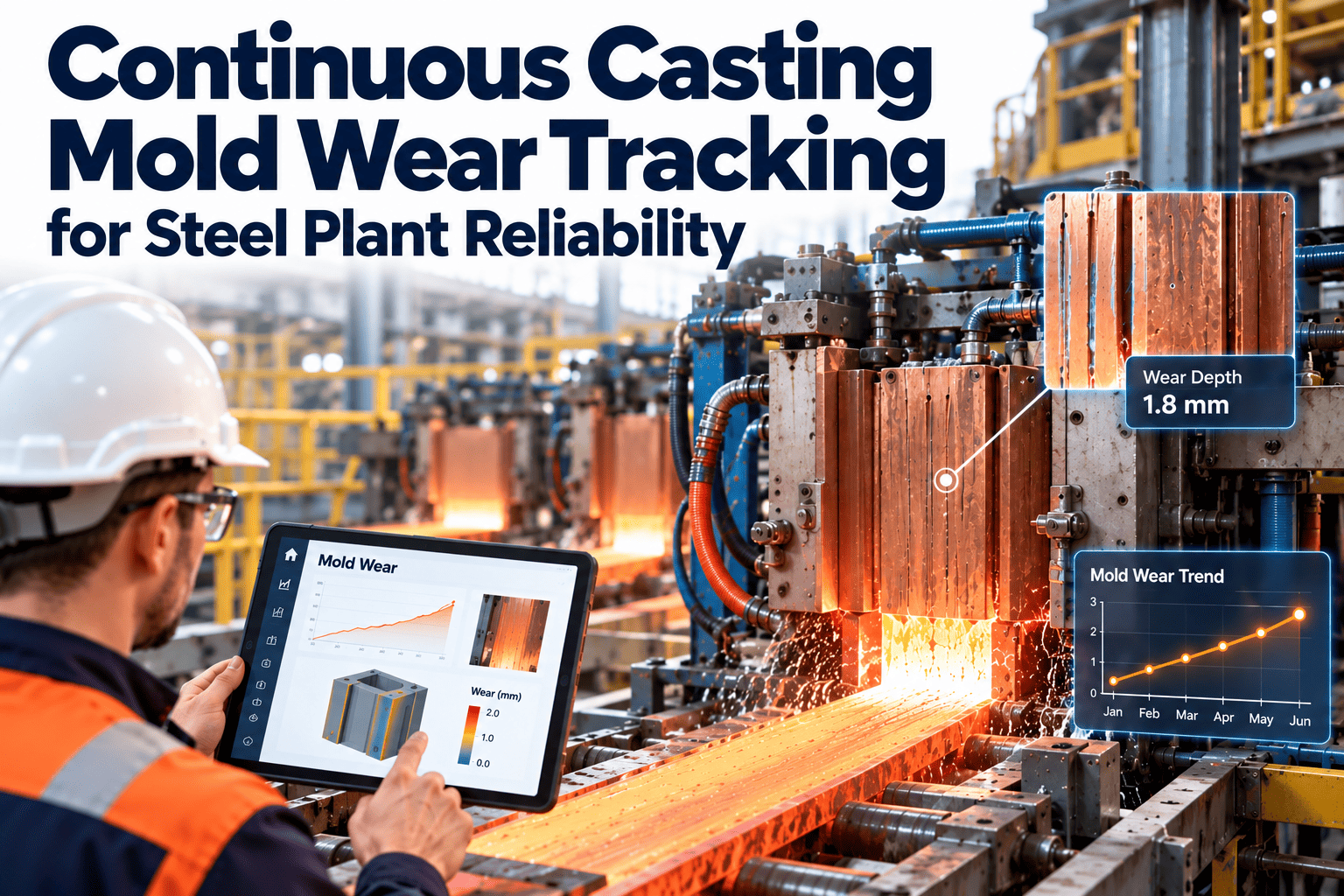
Continuous casting mold wear tracking gives a caster team something most plants still lack: a clear answer to how much life is left in each copper mold. Copper faces wear, distort and lose coating during every campaign, and the changes affect heat transfer, shell friction and strand surface quality long before a breakout alarm sounds. Plants that rely on memory, spreadsheets or fixed heat counts end up pulling good molds early or running worn molds too long. This guide explains what to measure, how to decide between remachining and retirement, and how Oxmaint CMMS software can keep the full mold history in one place.
Continuous Casting Mold Wear Tracking for Steel Plant Reliability
Track mold contour, copper wear, campaign heats and maintenance history so replacement timing is based on evidence. Reduce casting instability, avoid unplanned mold changes and protect strand quality.
What changes inside a mold during a campaign
A mold works at the hardest point of the process. Liquid steel meets cooled copper, a thin shell forms, and the shell must slide down the mold without sticking or tearing.
Why it matters
- Worn copper changes the gap between shell and mold, which changes heat transfer.
- Distortion alters taper, so friction rises on narrow or wide faces.
- Coating loss exposes softer copper that wears faster.
- Cracks and scale in water slots reduce cooling and create hot spots.
The cost of tracking molds from memory
Many plants log mold campaigns in a spreadsheet or on a whiteboard. The weakness is not the tool itself. It is that nothing warns anyone when a mold is approaching a limit.
Manual tracking
- Heat counts entered by hand after the shift
- Measurement sheets stored in different folders
- No alert when a mold reaches review level
- Remachining history known only to a few people
- Mold changes decided by habit
Tracked as an asset
- Heats and tonnage logged against the mold serial number
- Measurements and photos attached to each inspection
- Review level creates a planned work order
- Full repair history visible to planner and shop
- Mold changes based on wear and process data
The mold passport: what to record for every mold
Treat each mold as a serialized asset with its own passport. The fields below are a practical starting set that you can adjust for slab, bloom or billet casters.
Signals that point to a worn mold
Measurements are the anchor, but process and quality signals tell you when to measure sooner.
| Signal | Where it appears | Possible meaning | Follow-up |
|---|---|---|---|
| Uneven heat flux between faces | Mold thermocouples and cooling data | Local wear, gap change or fouled water slots | Compare faces, inspect at next change |
| Rising hot spot alarms | Mold temperature monitoring | Shell thinning or contact change | Review sticker and breakout history |
| Longitudinal or corner cracks | Slab or bloom surface | Taper or heat transfer problem | Check taper and corner wear |
| Thermocouple drift | Calibration checks | Sensor aging or deposits | Recalibrate or replace sensors |
| Frequent powder or level issues | Casting records | Process instability that may worsen wear | Review level control and oscillation |
| Dimensional deviation at exit | Strand measurement | Distortion or width setting problem | Measure mold and verify settings |
Give every mold a record your whole caster team can trust
Log heats, measurements and repairs against each mold serial number in Oxmaint, and plan the next change before it becomes urgent.
Deciding what happens at the end of a campaign
After removal, each mold needs a clear decision. Define the rule in advance, so the shop and the caster team make the same call.
Return to service
Measurements and surface are within limits, and process signals were stable.
Remachine
Wear or distortion can be removed while leaving enough copper for the required thickness.
Recoat or repair
Base copper is sound but the coating is worn, damaged or inconsistent.
Retire
Remaining copper is below the minimum, cracks are severe or repair repeats.
Remachining removes copper each time, so the number of remachining cycles is part of the mold life record. Use your copper supplier and mold shop limits for minimum thickness.
Why coatings and copper grade belong in the record
Mold performance depends on the copper alloy and the surface layer as much as on casting practice. Without a record, you cannot compare one supplier or coating with another.
- Plating layers of nickel, cobalt or related alloys protect copper from wear, but thick layers can reduce heat transfer.
- Different copper alloys resist softening and distortion differently under repeated heating.
- Coating thickness, supplier and process route should be logged, so campaign life can be compared fairly.
- Repeat failures at the same location may point to a coating defect rather than a casting problem.
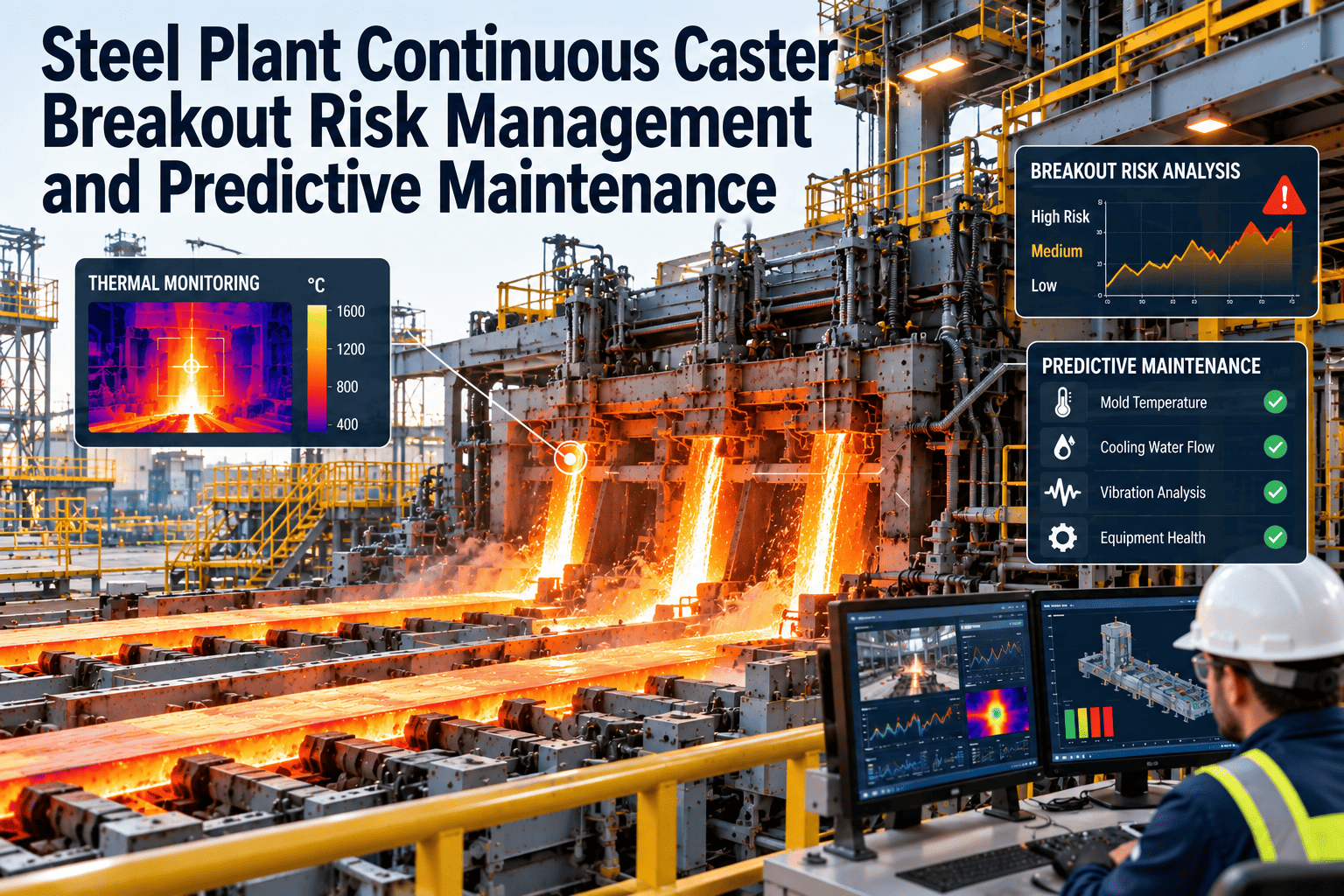
Linking mold wear to breakout and quality risk
A worn mold does not always cause a breakout, but it widens the conditions in which one can happen. The link is easiest to see when casting events and mold records live together.
After any breakout or sticker, pull the mold passport and ask what the last measurement, heat count and thermocouple trend showed.
Mold wear inspection checklist
Use the same checklist for every mold so results can be compared across heats, strands and casters.
At mold removal
- Record heats and tons since last change
- Photograph hot face and corners
- Note scoring, discoloration and cracks
- Check water slots for scale
In the mold shop
- Measure contour at defined points
- Check taper and flatness
- Verify coating thickness
- Record remachining amount
Before installation
- Confirm serial number and settings
- Verify thermocouple connections
- Pressure test water circuits
- Log installation date and strand
KPIs for mold life management
These measures show whether tracking is changing results, not only creating records.
How Oxmaint supports mold wear tracking
Oxmaint organizes the mold as an asset with its maintenance history, inspection results and linked work.
- Register each mold. Create mold assets by serial number with caster, strand and copper details.
- Capture campaign data. Record heats and tonnage with meter based readings, so usage accumulates automatically against the asset.
- Digitize inspections. Use mobile checklists for removal, shop measurement and pre-installation checks, with photos.
- Trigger planned work. Create work orders when heats or condition reach your review levels.
- Manage spares and parts. Track spare molds, thermocouples and coating work in inventory.
- Analyze results. Use reports to compare campaign life by supplier, grade and caster.
Mold wear tracking FAQs
Why track mold heats if we already measure wear?
Heats give context for each measurement. Together they let you predict when a mold will reach its limit.
Where does wear usually concentrate in a copper mold?
It varies by design, but wear is often greater in the lower mold. Always record measurement points. Set up records by location.
How do we decide between remachining and retirement?
Compare remaining copper thickness, crack severity and repair history with your supplier limits, then record the decision rule.
Can a CMMS replace mold monitoring systems?
No. Mold monitoring detects process events, while the CMMS holds history and plans work. A demo shows how they fit.
What should we capture after a breakout?
Mold serial number, heats since change, last measurements, thermocouple trend and casting conditions, linked to the work order.
Replace mold changes by habit with mold changes by evidence
Start a mold register your planners, caster crew and mold shop can all use, and see which molds need attention next.