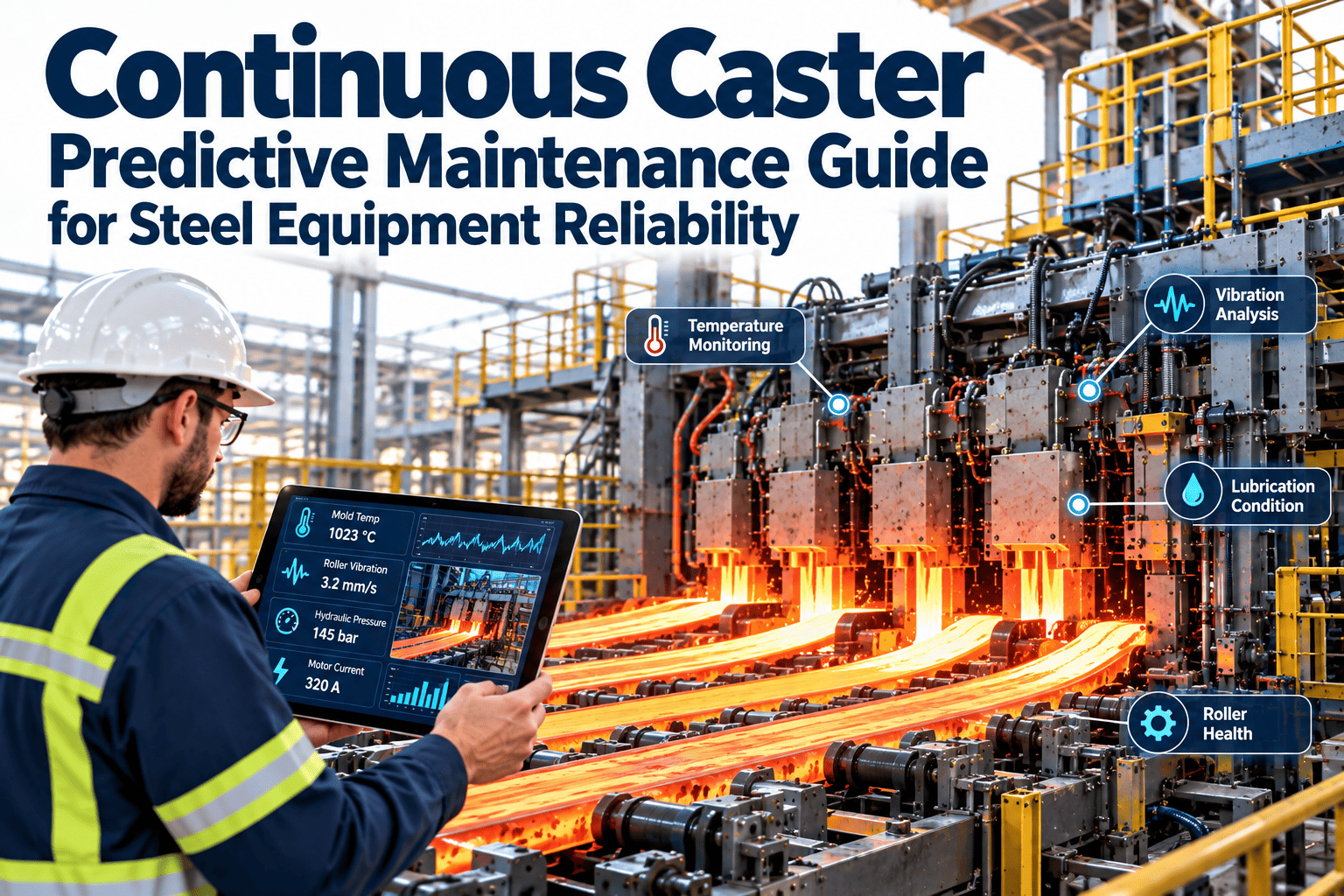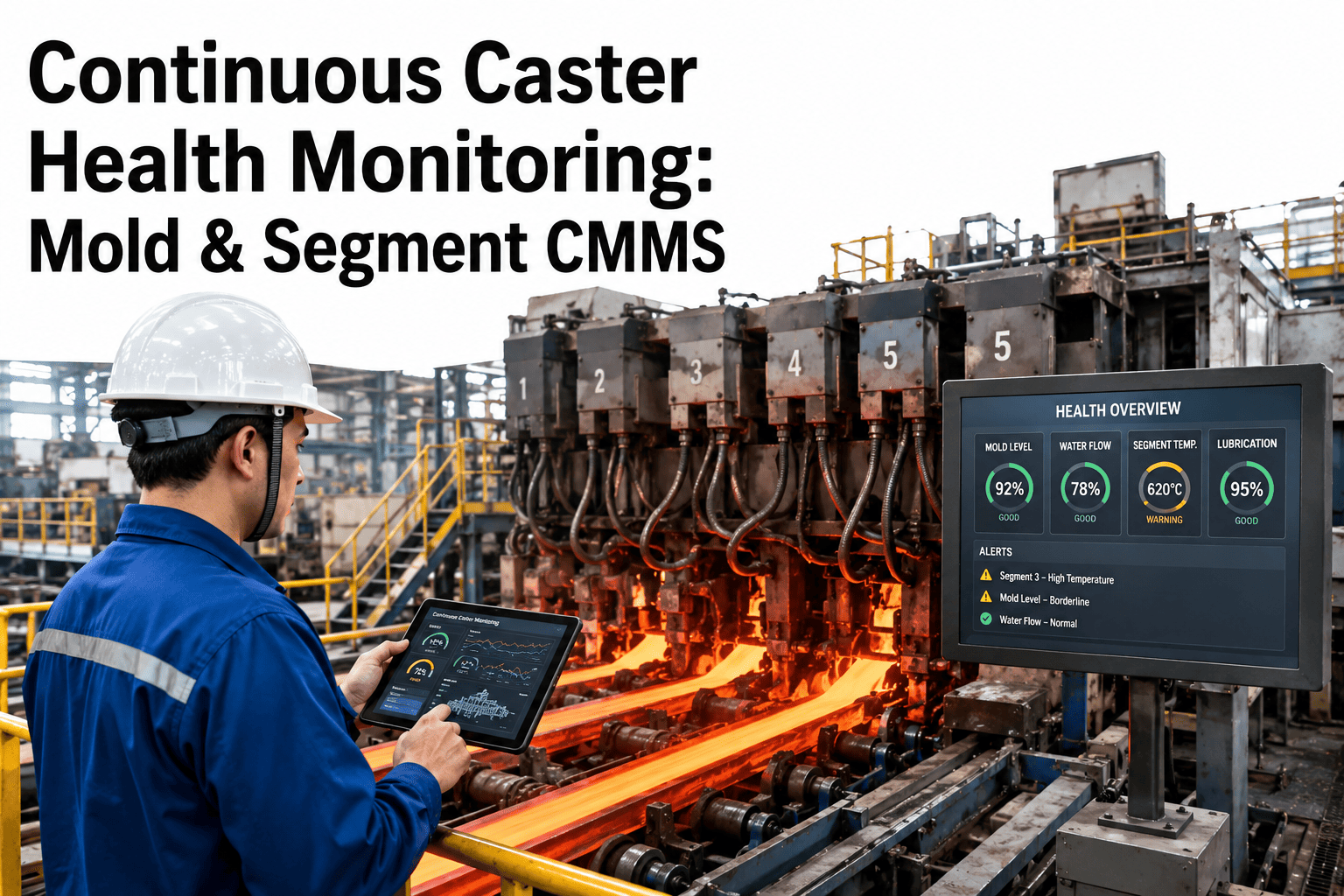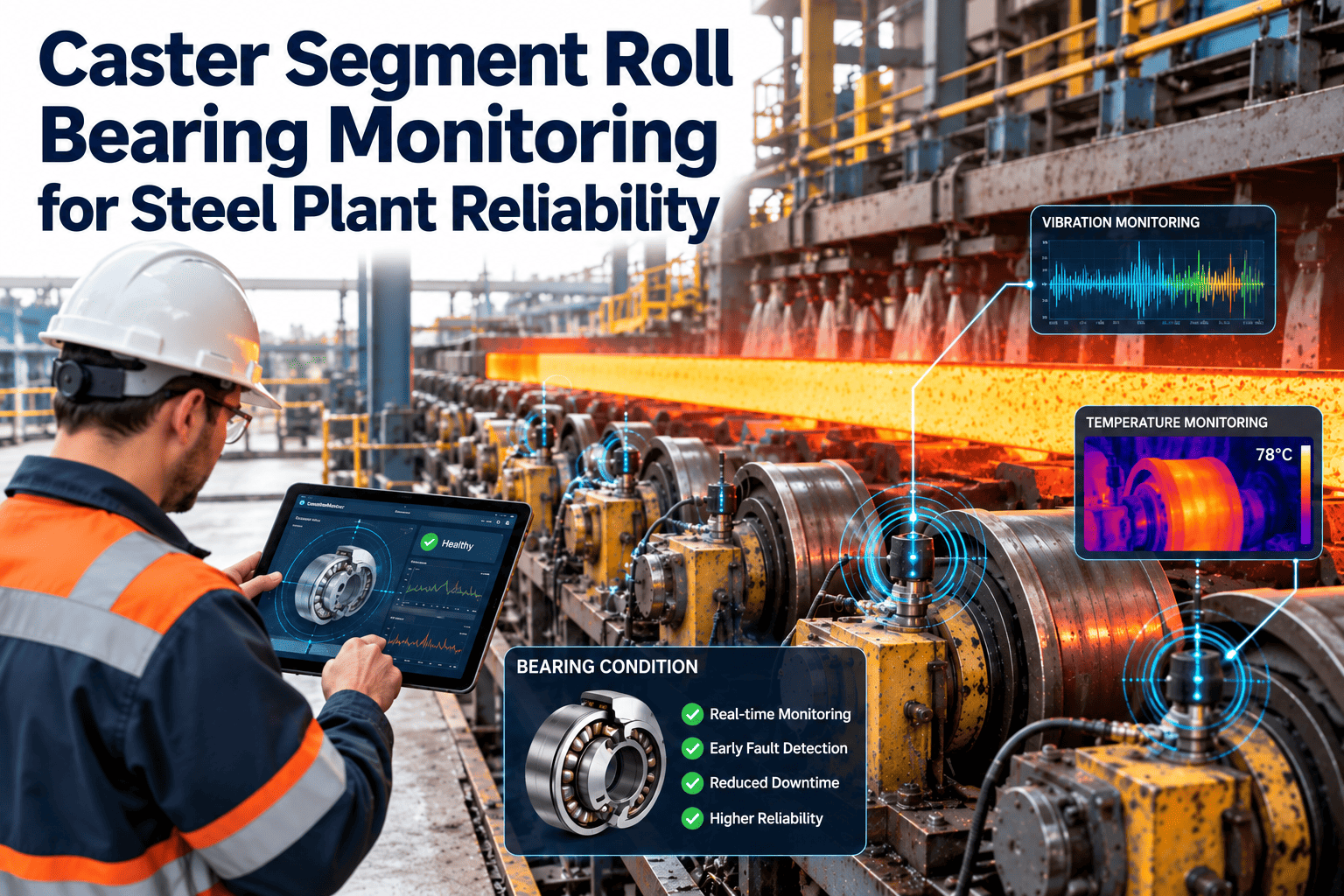
A caster segment roll bearing rarely announces itself. The roll turns slowly under heavy strand load, cooling water, steam and scale, so early damage hides behind normal-looking operation until the bearing locks and the roll starts dragging the shell. Trending vibration, housing temperature and inspection findings for every roll position turns that hidden decline into a ranked maintenance queue. This guide explains what to measure, how to set alert tiers, and how to connect each finding to a work order in Oxmaint maintenance management software.
Caster Segment Roll Bearing Monitoring for Steel Plant Reliability
Catch bearing degradation on slab and billet casters through vibration, temperature and inspection trends. Schedule the segment change on your terms instead of after a seized roll scores the strand surface or forces an emergency stop.
Segment roll bearings work in one of the harshest bearing environments in the plant
Bearings supporting strand rolls carry heavy loads at low speed while exposed to heat, cooling water, steam and scale. Each condition is manageable alone. Together they leave very little margin for a seal, grease film or alignment problem.
| Stressor | Where it comes from | What it does to the bearing |
|---|---|---|
| Heavy radial load | Strand weight, ferrostatic pressure and soft reduction forces | Raises contact stress and shortens fatigue life when lubrication is marginal |
| Low rotational speed | Casting speed set by the process, not the bearing | Thins the lubricant film and makes vibration signals weak and hard to read |
| Cooling water and steam | Secondary cooling sprays close to every segment | Washes grease out, promotes corrosion and degrades seals |
| Scale and debris | Strand surface and spray water carryover | Abrades seals and raceways once it passes the first line of defense |
| Thermal cycling | Radiant heat, start-up, stops and sequence casting | Distorts housings, shifts fits and ages lubricant |
Five stages between a healthy bearing and a seized roll
Treating failure as a path rather than an event changes what maintenance can do. Each stage has a measurable signal and a proportionate response.
Healthy and baselined
A new or rebuilt bearing is measured under normal casting conditions. Those readings become the reference for that exact roll position.
Early drift
Vibration amplitude or a specific frequency band moves away from baseline. Response: confirm the reading, check neighboring rolls and shorten the inspection interval.
Thermal separation
Housing temperature rises relative to adjacent rolls under the same cooling conditions. Response: raise a work order, verify lubrication and plan the segment change.
Functional symptoms
Rough rotation, noise, slip against strand speed or visible roll wear appear. Response: treat as urgent and coordinate with casting operations for the earliest safe window.
Lock-up or seizure
The roll stops turning and drags the strand shell. Response is an emergency stop, damage assessment and an expensive unplanned segment change.
Combine signals instead of trusting any single reading
Vibration, temperature and inspection data fail in different ways. Used together they give a defensible picture of bearing health and fewer false alarms.
| Signal | What it reveals | Practical limit | How to record it |
|---|---|---|---|
| Housing vibration | Raceway damage, looseness, misalignment | Weak at very low speed; needs a consistent measuring point | Reading logged against the roll position with a trend |
| Housing temperature | Friction from lubrication loss or advanced damage | Influenced by spray conditions and radiant heat | Compare against neighboring rolls, not an absolute number |
| Rotation check | Binding, slip or a roll that has stopped turning | Often manual and shift dependent | Inspection checklist item with pass or fail |
| Lubrication condition | Grease flow, water contamination, starvation | Visible only at certain points in the system | Lubrication task with outcome note |
| Teardown findings | Actual wear mode and seal condition | Available only at segment change | Failure code and photos on the work order |
Three alert tiers keep slow-speed vibration data actionable
A single alarm limit is either too noisy or too late. Tiers let the team respond in proportion to the evidence.
Trend moving, no symptom
Reading departs from the position baseline. Action: add to the next round, compare neighbors and confirm the sensor location.
Two signals agree
Vibration and temperature or rotation both deviate. Action: create a work order and book the segment into the next planned window.
Functional failure signs
Binding, slip or rapid temperature rise. Action: escalate to casting operations and arrange the earliest safe change.
Rules for trending slow rotating bearings
- Measure at the same point, in the same direction and under similar casting conditions every time.
- Trend per roll position, because the same bearing part number behaves differently on inner and outer radius.
- Judge change against baseline and neighbors instead of copying generic limits from faster machines.
- Record casting speed and cooling state with each reading so conditions can be separated from damage.
- Close the loop: every alert needs a documented outcome, even when the bearing turns out to be healthy.
Monitoring only works when every roll position has an identity
Readings are useless if nobody can say which roll produced them. Build the hierarchy once and every later record inherits it.
- Give each roll position a permanent ID that survives segment rebuilds, so history stays with the location.
- Track the physical segment and bearing serial numbers separately, because segments rotate between positions.
- Store bearing type, seal arrangement, lubrication method and last replacement date on the asset record.
- Link spares and rebuilt units so teardown findings feed the next installation decision.
Capture bearing evidence every time a segment leaves the machine
The planned segment change is the best source of failure data you will get. Use a repeatable checklist so findings are comparable across strands.
At removal
- Record roll position and segment ID
- Rotate each roll by hand and note binding
- Photograph housings, seals and grease points
- Note water or scale in the housing area
- Log last alert history for the position
At bench teardown
- Assign a failure mode code per bearing
- Measure journal and housing fits
- Inspect seals and lubrication passages
- Decide reuse, repair or scrap
- Update the position history before reinstall
What changes when bearing health is tracked by roll position
Seizure-driven maintenance
- Replacement intervals based only on the calendar
- Readings on paper or in personal spreadsheets
- Alerts without owners or deadlines
- Failure cause guessed after the stop
- Emergency stops decided by the failure
Trend-driven maintenance
- Intervals adjusted by measured condition
- Readings stored against each roll position
- Alerts convert into assigned work orders
- Teardown findings coded and reused
- Segment changes planned with operations
Why the same roll position keeps failing
Replacing a bearing fixes the symptom. Repeat failures at one position usually point to a cause that sits outside the bearing itself, and only coded teardown records reveal the pattern.
| Likely root cause | What the record usually shows | Corrective direction |
|---|---|---|
| Water ingress past seals | Corrosion, emulsified grease, rust staining in the housing | Review seal type, spray pattern and cleaning routine for that position |
| Grease starvation | Dry or discolored grease, blocked passages, early temperature rise | Check distribution lines, metering and lubrication task completion |
| Segment misalignment | Uneven wear on one side, roll gap deviation, edge loading marks | Verify alignment at each segment change and correct frames |
| Roll surface or shell damage | Roll runout, localized scoring, uneven rotation | Inspect roll body together with the bearing before reinstalling |
| Incorrect fit or installation | Fretting, creep on the ring, premature spalling | Standardize mounting steps and measure fits on every rebuild |
Why coded failure data beats memory
- Experienced technicians recognize patterns, but their knowledge leaves the plant when they do.
- Free-text notes cannot be filtered, so recurring causes stay invisible across strands and years.
- Failure codes let reliability engineers rank causes and justify a seal, lubricant or alignment change.
- Photos attached to the work order settle disagreements between operations, maintenance and suppliers.
Bearing alerts only help when casting operations can act on them
A segment change needs a window, a spare segment and a crew. Agree on how condition findings reach the people who plan casting so that a warning in week one does not become an emergency in week three.
What maintenance should hand over
- The roll position and strand affected
- Which signals deviate and by how much
- Latest safe date for the segment change
- Spare segment and parts availability
What operations should share back
- Upcoming sequence and planned stops
- Casting speed and grade changes that affect load
- Operator observations such as noise or strand surface marks
- Confirmed change windows and crew availability
Use planned stops deliberately
- Match alerts to the next sequence break or scheduled outage and compare against the latest safe date.
- Bundle other findings on the same segment, such as spray nozzle or roll gap issues, into one job.
- Keep a prioritized list of segments awaiting change so the order is clear when a window opens.
- Review the list at the daily maintenance and production meeting rather than in separate conversations.
Documentation that stands up after a breakout investigation
After a serious stop, the first questions are what was known and when. Clear records protect the team and speed the investigation.
Time-stamped readings
Every inspection value keeps its date, shift, technician and casting condition.
Decision trail
Each alert shows who reviewed it, what was decided and why a change was deferred.
Complete history
Bearing installs, rebuilds and scrap decisions remain attached to the roll position.
- Review deferred alerts weekly so an accepted risk is always a conscious, recorded decision.
- Keep teardown photos and measurements with the work order rather than on a personal phone.
- Use reports to show which positions consume the most bearings and labor over time.
Give every roll position a history before the next bearing locks
Set up your caster asset hierarchy, inspection checklists and alert-driven work orders in one maintenance system built for steel plant teams.
From a drifting reading to a closed work order
Oxmaint connects the pieces that usually live in different places: asset records, inspection rounds, work orders, parts and reports.
Asset records
Register strands, segments, roll positions and bearings with type, seal and lubrication details.
Inspection rounds
Technicians log vibration, temperature and rotation checks from mobile devices at each position.
Alert to work order
Readings beyond your thresholds create corrective work orders with priority and owner.
Planning and parts
Link spare segments and bearings to the job so the outage window is not wasted waiting for stock.
Preventive schedules
Lubrication, cleaning and inspection tasks recur by calendar or running time.
Reporting
Dashboards show repeat failures by position and how long alerts stay open.
Six indicators that show whether monitoring is working
Pick targets that match your caster and product mix. The definitions matter more than any benchmark copied from another plant.
| Indicator | Definition | What it tells you |
|---|---|---|
| Bearing-related unplanned stops | Casting stops traced to roll bearing or housing failure | Whether seizures are actually declining |
| Detection lead time | Time from first alert to segment change | How much warning the team really gets |
| Planned versus unplanned changes | Share of segment changes scheduled in advance | Maturity of the planning process |
| Repeat failures per position | Bearing failures at the same roll location | Root causes that remain unsolved |
| Alert closure time | Hours from alert to documented outcome | Discipline of the response loop |
| Inspection completion | Rounds finished versus scheduled | Reliability of the underlying data |
A phased start that does not disturb casting
Register
Build the hierarchy and load bearing data for the strand with the worst history.
Baseline
Take consistent readings during stable casting and record conditions.
Alert
Set watch, alert and act thresholds and tie them to work order rules.
Learn
Review teardown findings, tune limits and extend to remaining strands.
Common mistakes in caster bearing monitoring
- Applying absolute vibration limits written for fast, lightly loaded machines to slow rolls.
- Moving sensors or measuring points between rounds, which destroys the trend.
- Ignoring neighboring rolls when one position looks abnormal.
- Recording alerts without recording what the teardown eventually found.
- Treating lubrication as a separate program from bearing condition.
- Letting spare segments return to service without a documented bearing history.
Caster roll bearing monitoring questions
Can vibration monitoring work on slow caster rolls?
Yes, with trending against a position baseline and a consistent measuring point. Combine it with temperature and rotation checks for confidence.
Is temperature alone enough to detect failing bearings?
Rarely. Temperature usually rises late and varies with spray conditions, so compare against neighbors and pair it with vibration.
How should alerts become maintenance work?
Define thresholds per tier and let each tier create a prioritized work order. You can book a demo to see the setup.
What should be recorded at segment change?
Roll position, failure mode, seal and lubrication condition, photos and the decision to reuse or scrap each bearing.
Where do we start with limited sensors?
Start with inspection rounds on your highest-risk strand, then add instrumentation where history justifies it. Create your account to log the first round.
Plan the next segment change instead of reacting to it
Bring roll bearing readings, inspections, spares and work orders into one workflow your casting and maintenance teams can both trust.