A hot strip mill in Odisha lost an entire night shift to a single coiler jam. The strip head failed to grip the mandrel, the tail whipped back into the pinch rolls, and the resulting cobble took four hours to clear before rolling could resume. The post-mortem found a wrapper arm that had been landing 4mm off position for weeks — invisible during normal running, catastrophic the moment tension timing slipped. Coilers do not fail gradually the way a gearbox does; they fail in the half-second window between strip release and mandrel capture, which is why coiler and tension reel maintenance needs its own discipline, separate from the rest of the mill.
Steel Plant CMMS Guide 2026
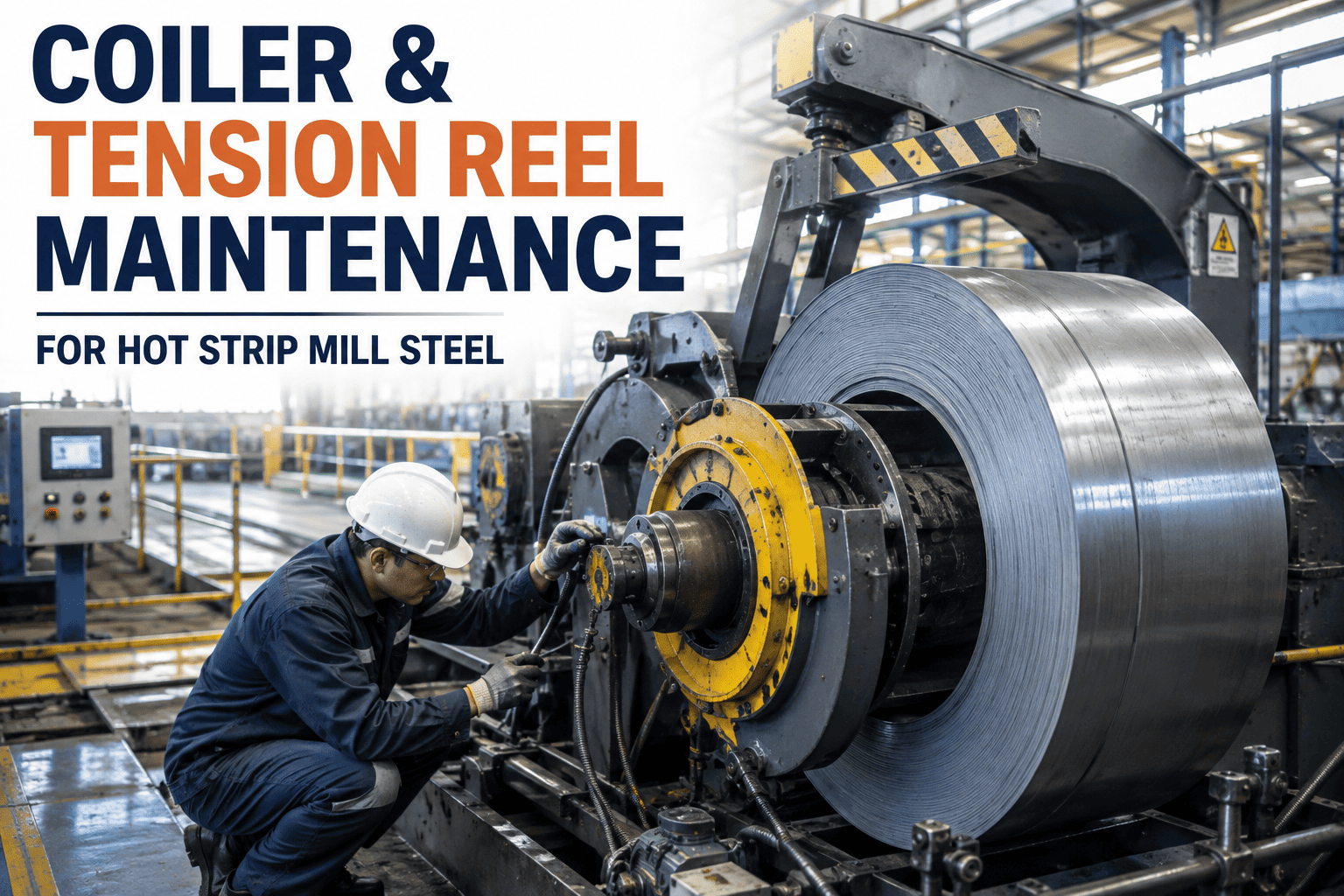
Coiler & Tension Reel Maintenance for Hot Strip Mills
Mandrel wear, wrapper roll condition, and pinch roll discipline — protecting the highest-tension, highest-speed asset at the back end of the mill.
Wrapper Roll Bearing Alert Threshold
Strip Entry Speed At The Coiler
Peak Coiling Tension On The Mandrel
#1
Cause Of Campaign Interruption In Hot Rolling
Why Coilers Fail Differently From Everything Else in the Mill
Every other asset on a hot strip mill wears down steadily. The coiler does something else — it repeats a violent three-stage cycle thousands of times a month, and any small misalignment shows up only at the exact instant tension transfers from mill to mandrel. That is why coiler failures are rarely slow; they are sudden, physical, and expensive.
3x
Higher bearing replacement frequency at the coiler than anywhere else in the mill — a direct result of cyclic loading as coil weight grows on the mandrel with every wrap.
Do not wait for the next telescoped coil to find the problem. Book a demo and see coiler component wear tracked automatically, coil after coil.
Inside the Coiling Cycle: Where Maintenance Actually Matters
A coiler moves through three distinct mechanical states for every single coil. Each state stresses a different set of components — understanding the cycle is the first step to maintaining it correctly.
1
Preparation State
Pinch rolls lower and wrapper rolls close around the mandrel, setting gaps to match strip thickness. Guide plates align the strip head toward the mandrel throat.
Watch: Pinch roll gap symmetry, guide plate alignment
→
2
Normal Coiling
After 3-5 wraps, tension stabilises, pinch rolls release, and wrapper rolls open. The mandrel and mill accelerate together to full coiling speed under sustained cyclic load.
Watch: Mandrel expansion pressure, wrapper roll bearing temperature
→
3
Finishing State
Mill and coiler decelerate together, wrapper rolls close to clamp outer wraps, and pinch rolls establish tail tension before the coil is stripped from the mandrel.
Watch: Wrapper arm position, mandrel segment retraction
Track Every Coiler Component on a Coil-Count Basis
Oxmaint logs mandrel wear, wrapper roll condition, and pinch roll pressure per coil — so replacement work orders generate before the next jam, not after it.
Where Coiler Reliability Actually Breaks
These are common patterns behind coiler failures — and how coil-by-coil monitoring catches each one before it becomes a stopped mill.
Initial Situation
Telescoped coils were increasing on one coiler, blamed each time on strip steering upstream. Yield loss from downgraded coils was mounting.
Discovery Path
1
What did the telescoping pattern show?
Defects clustered on one coiler only, not across the mill's full coiler set
2
What did pinch roll gap logs reveal?
Drive-side and operator-side gap readings had drifted apart by over 0.5mm
3
Why had the asymmetry gone unnoticed?
Gap was checked as a single average reading, not separately per side
4
What effect did this have on the coil?
Asymmetric gap steered the strip into the coiler, producing an offset inner wrap
5
What was the root cause?
FINDING: Pinch roll gap was never measured independently on each side, letting asymmetry build up unnoticed
Actions Taken
Immediate: Pinch roll gap re-set and verified independently on drive and operator side
CMMS Enhancement: Dual-side gap logging added per shift with automatic asymmetry alerts
Systemic Fix: Telescoping rate linked to gap symmetry history for faster root-causing
Outcome
Telescoped coil rate on the affected coiler dropped sharply within two weeks of the gap correction.
Initial Situation
Wrapper roll bearings were failing every few weeks on one coiler, each time treated as a random, unpredictable event requiring emergency repair.
Discovery Path
1
What did the failure history show?
Every failed bearing belonged to the same wrapper roll position across multiple replacements
2
What did temperature readings from the last shifts before failure show?
A steady upward trend was visible for days, but nobody was logging it consistently
3
What did the roll gap mechanism inspection find?
A misaligned gap adjustment mechanism was applying uneven side load to that bearing
4
Why did the misalignment go unaddressed?
Roll gap mechanism function was checked visually, not against a measured tolerance
5
What was the root cause?
FINDING: No temperature trend logging on wrapper roll bearings, so a mechanically-driven failure repeated at the same position each time
Actions Taken
Immediate: Gap adjustment mechanism repaired and realigned to specification
CMMS Enhancement: Bearing temperature logged and trended per wrapper roll, per coil
Systemic Fix: Automatic alert set for any upward temperature trend across 10 consecutive coils
Outcome
Repeat bearing failures at that position stopped, replacing emergency repairs with a single planned replacement.
Initial Situation
Coils were arriving at the customer with loose, collapsed inner wraps. Transport damage was suspected first, since the coils left the mill looking fine.
Discovery Path
1
What did wrapper arm position data show?
Position at strip head engagement varied by more than 3mm between coils of the same gauge
2
What did that variation suggest?
Inconsistent wrap tension at coil start, a known cause of loose inner wraps
3
What did a mandrel cylinder bypass test find?
The expansion piston seal was drifting under sustained pressure — invisible during normal running
4
Why was this never caught earlier?
The mandrel oval diameter is only visible once the coil is stripped, well after the defect forms
5
What was the root cause?
FINDING: No scheduled cylinder bypass testing, so a slowly bypassing piston seal partially collapsed the mandrel under coil weight
Actions Taken
Immediate: Mandrel expansion cylinder seals replaced at the next offline window
CMMS Enhancement: Quarterly cylinder bypass testing added to the coiler PM schedule
Systemic Fix: Wrapper arm position variance tracked against customer coil complaints for early linkage
Outcome
Loose inner wrap complaints on that coiler stopped after seal replacement and testing was scheduled.
Coiler PM Checklist by Component
Coiler maintenance runs on coil count and shift-level checks, not calendar time alone:
Mandrel
Expansion & Segment Wear
- Segment wear vs. 2mm limit
- Expansion cylinder bypass test
- Taper key wear tracking
Wrapper Rolls
Surface & Bearing Condition
- Bearing temperature trend
- Surface crack inspection
- Gap mechanism function check
Pinch Rolls
Gap & Pressure Control
- Drive vs. operator side gap
- Pressure cylinder drift test
- Surface scale build-up check
Coiler Drive
Gearbox & Motor Health
- Gearbox oil particle analysis
- Motor current signature
- Drive alignment check
Frequently Asked Questions
How is mandrel segment wear measured?
Segment gap is measured at fully expanded position against design specification. Most mills replace segments once wear on the seating surface exceeds around 2mm.
Book a demo to see segment wear tracked per coil count.
Why do coiler bearings fail more often than other mill bearings?
The coiler experiences continuous cyclic loading as coil weight grows on the mandrel with every wrap, at the highest speed point in the mill, making it the highest bearing replacement frequency zone.
Can coiler component tracking integrate with Level 2 automation?
Yes, Oxmaint connects coiler wear data with Level 1 and Level 2 automation feeds for real-time condition tracking.
Sign in to see supported integrations.
What causes telescoped coils most often?
Pinch roll gap asymmetry between the drive and operator side is a leading cause, steering the strip unevenly into the coiler during wrap formation.
When should coiler PM align with roll change schedules?
Whenever possible — coiler component replacement is typically aligned with the work roll change window to avoid adding a separate mill stoppage.
Give Your Coiler the Discipline It Demands
Oxmaint tracks mandrel, wrapper roll, and pinch roll condition on a coil-count basis, so replacement work orders fire before the next jam.


.png)